WorkLife Fund 1 is a venture capital fund founded by Brianne Kimmel in 2019, specifically targeting the 'future of work' and the consumerization of enterprise software. The deck successfully raised $10M by emphasizing Kimmel's unique position as the 'GTM Angel' and her proprietary deal-flow engine, SaaS School. Rather than focusing on traditional fund metrics, the presentation leans heavily on social proof, including a list of high-profile LPs like Marc Andreessen and Chris Dixon, and a track record of getting into competitive rounds alongside top-tier firms like Sequoia and Accel. The strate…
Key takeaways
- The fund targeted a $3M raise with a $5M cap, though catalogue facts indicate it ultimately closed at $10M (Slide 17).
- Proprietary deal flow is a central pillar, with SaaS School providing exposure to 200+ companies per year and contributing roughly 40% of investments (Slide 13, 17).
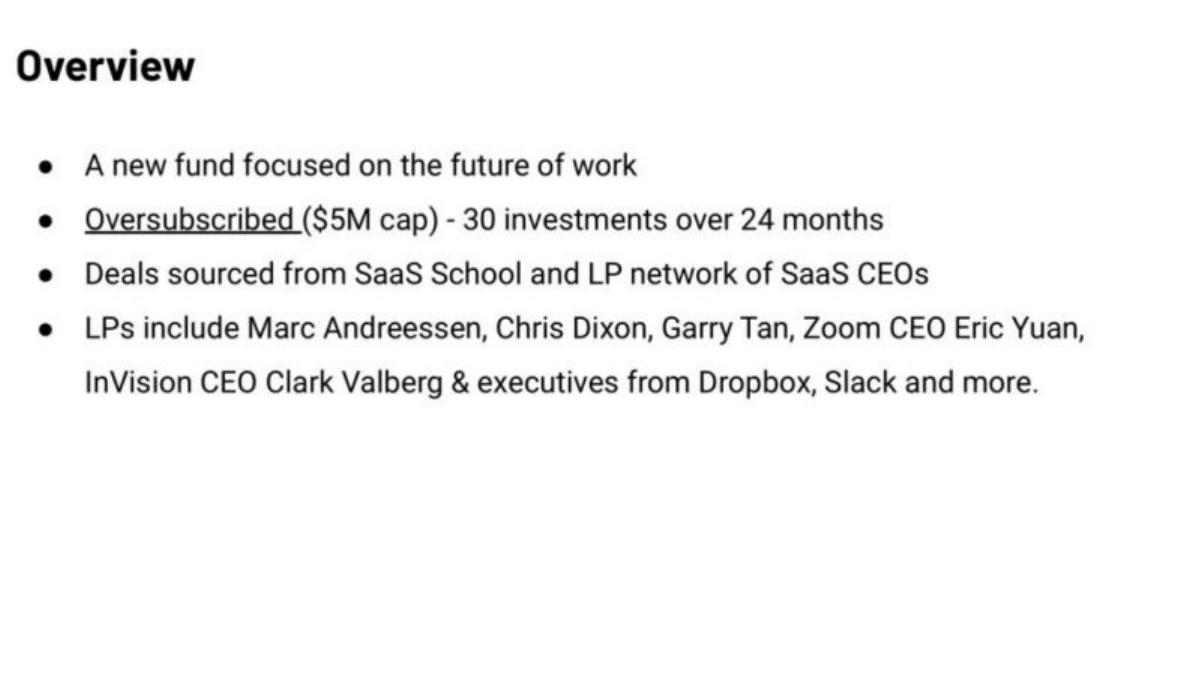
- The GP leverages a high-signal LP base including Marc Andreessen, Chris Dixon, and Zoom CEO Eric Yuan to demonstrate institutional credibility (Slide 2).
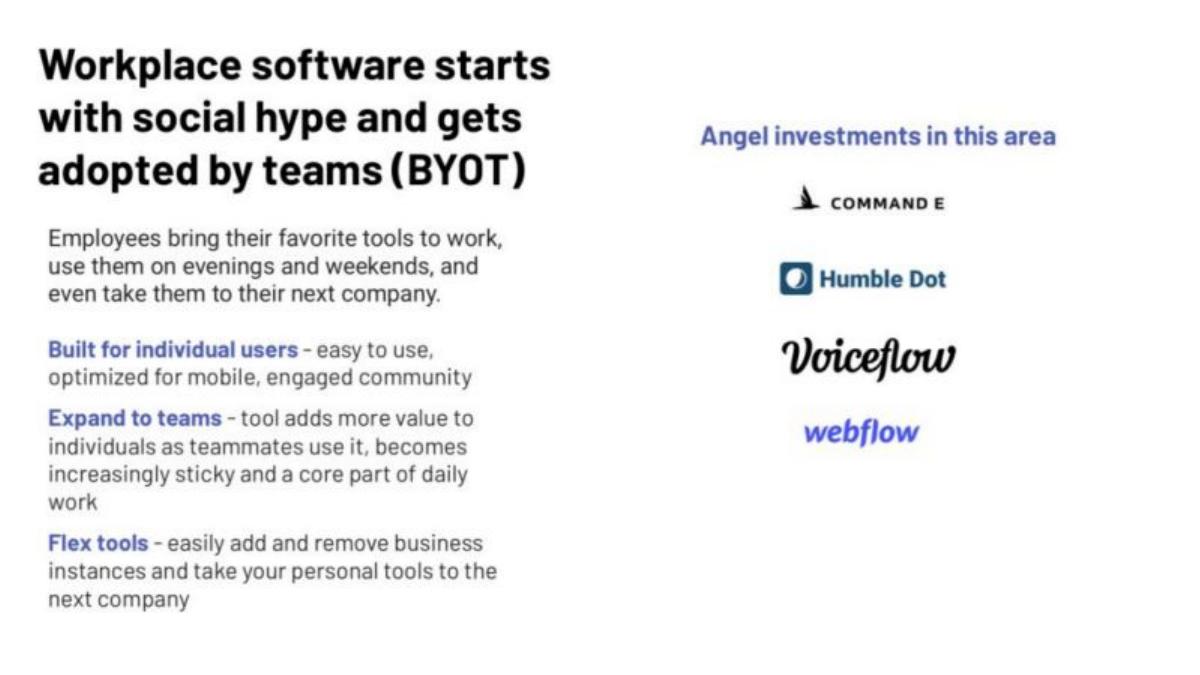
- The investment thesis focuses on 'BYOT' (Bring Your Own Tools), where employees drive software adoption within the enterprise (Slide 5).
- Kimmel's angel track record includes early entries into high-growth companies like Webflow, Voiceflow, and Work OS (Slide 10).
- The fund operates on a standard 2% management fee and 20% carry structure with an 18-24 month investment period (Slide 17).
- Social proof is heavily utilized through screenshots of tweets, podcast features, and testimonials from YC alumni (Slides 11, 12, 14).
- The 'Strike Zone' for the fund is defined as workplace collaboration tools that are post-product with some users, often coming out of Y Combinator (Slide 18).
The Solo GP Playbook: Selling a Thesis and a Network
The WorkLife Fund 1 pitch deck is a masterclass in how a solo General Partner (GP) can raise a debut fund by productizing their personal brand and network. Brianne Kimmel does not rely on decades of institutional fund management; instead, she sells a specific, timely thesis: the consumerization of the enterprise. The deck is less about spreadsheets and more about the cultural shift in how software is bought and used.
Slide 1: Title Slide
The deck opens with a minimalist blue slide. It identifies the fund as 'Work Life' and provides the subtitle 'A future of work focused fund.' It includes Brianne Kimmel's name and a Gmail address, signaling the early, personal nature of the fundraise.
Slide 2: Overview
This slide acts as an executive summary. It establishes the fund's focus and immediately leads with social proof. It notes the fund is 'Oversubscribed' with a '$5M cap' and plans for 30 investments over 24 months. Crucially, it lists LPs including Marc Andreessen, Chris Dixon, Garry Tan, and Zoom CEO Eric Yuan. This list instantly validates Kimmel as a peer to the industry's elite.
Slide 3: About the General Partner
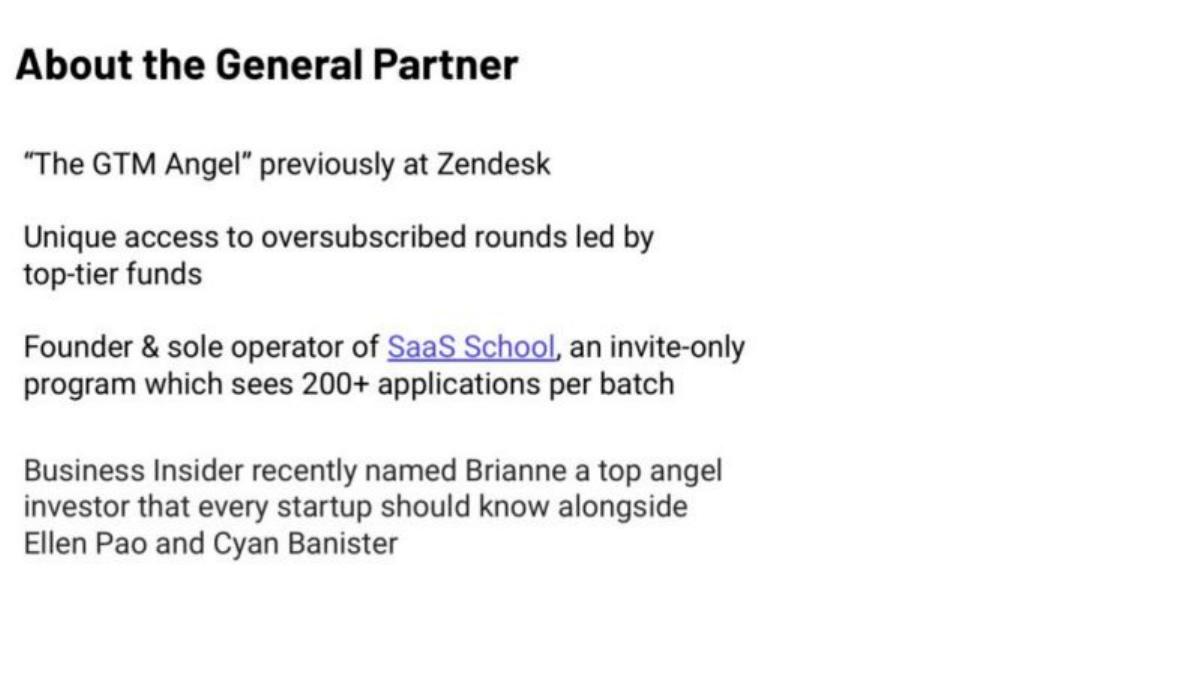
Kimmel positions herself as 'The GTM Angel,' highlighting her background at Zendesk. She claims 'Unique access to oversubscribed rounds led by top-tier funds.' It also introduces SaaS School, her proprietary program, and mentions a Business Insider ranking to solidify her status as a top angel investor.
Slide 4: The Consumerization of the Enterprise
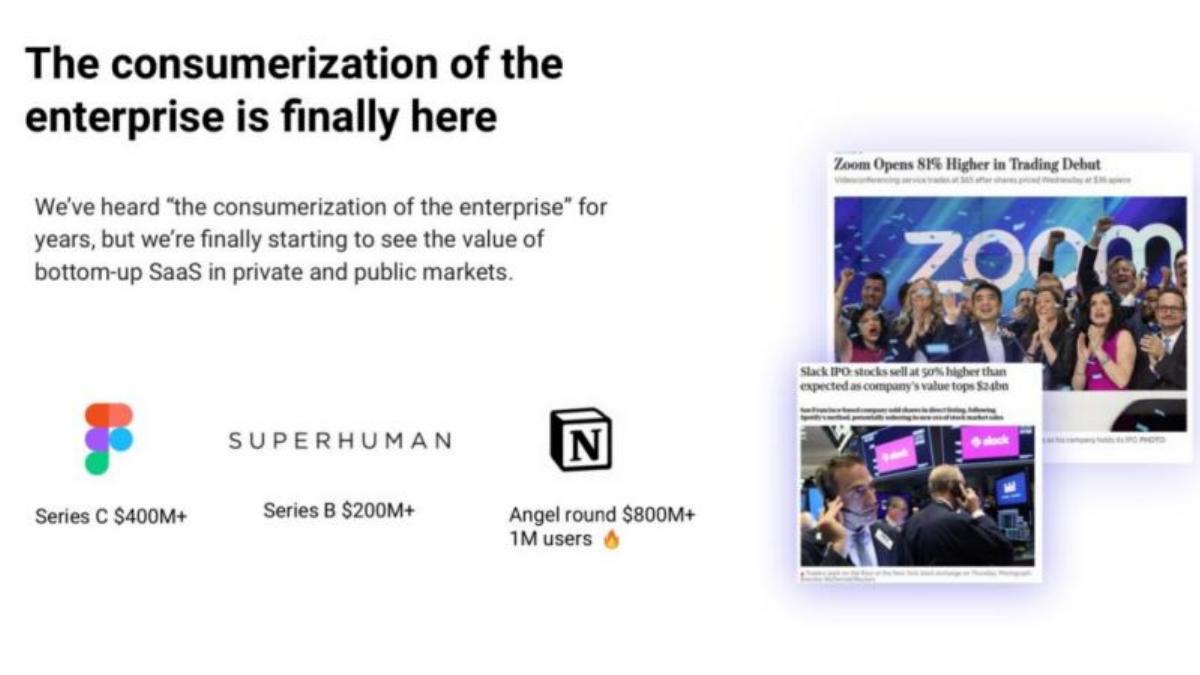
This slide defines the market opportunity. It argues that 'bottom-up SaaS' is finally showing its value in public and private markets. It uses logos of Figma (Series C $400M+), Superhuman (Series B $200M+), and Notion (Angel round $800M+, 1M users) as evidence. Screenshots of Zoom and Slack IPO news reinforce the massive scale of this trend.
Slide 5: Workplace Software and Social Hype
Kimmel introduces the 'BYOT' (Bring Your Own Tools) concept. She explains that employees now bring favorite tools to work, which then expand to teams. The slide lists her angel investments in this area: Command E, Humble Dot, Voiceflow, and Webflow.
Slide 6: Reimagining Work Opportunities
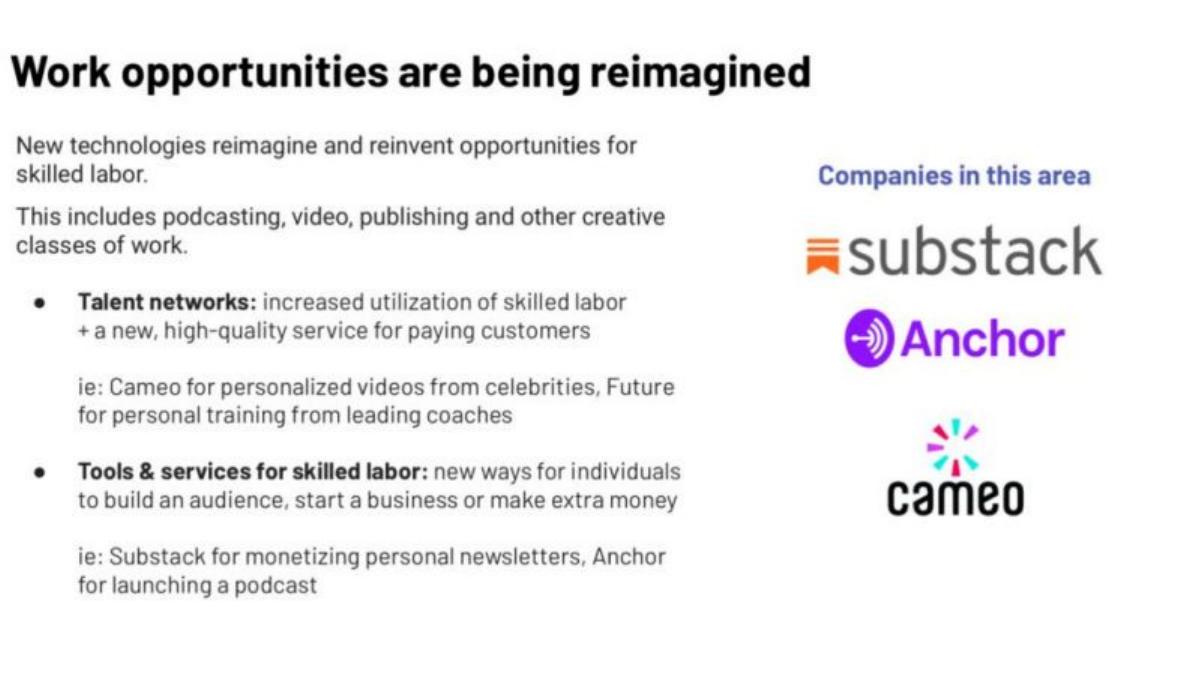
This slide expands the thesis to 'skilled labor' and the creator economy. It mentions talent networks and tools for creators to build audiences. Logos for Substack, Anchor, and Cameo are displayed as representative companies in this space.
Slide 7: Brand and Social Signals
Here, the deck argues that software decisions are now impacted by brand and community. It notes that individuals pay out of pocket for early access and wear branded apparel. Visuals include a 'Superhuman' diamond-encrusted envelope and a 'Figma' tote bag, illustrating how software has become a lifestyle choice.
Slide 8: Work Life as Identity
Citing the 2019 Edelman Trust Barometer, this slide claims the employer is the 'most trusted institution.' It suggests the modern workplace is a community and a discovery platform. Photos show Instagrammable offices and employees bringing dogs to work, emphasizing the 'Life' aspect of the fund's name.
Slide 9: Building a Maniacally Focused Fund
Kimmel outlines the fund's competitive advantages: curated deal flow, strategic positioning as a 'next-gen micro-fund,' and a community that accelerates partner integrations. Screenshots of tweets from David Sacks and Aaron Levie support her 'Startup Software' thesis.
Slide 10: Angel Track Record
This is a critical 'proof of work' slide. It lists 10 companies Kimmel invested in as an angel, including Webflow, Work OS, and Girlboss. Most importantly, it lists co-investors like Accel, Lightspeed, NEA, and A16z, proving she can win allocations in rounds led by the world's best firms.
Slide 11: Personal Brand Strategy
Kimmel details how she built her brand through the 'Venture Stories' podcast, keynote speaking at SaaStr, and writing for firms like Openview. A photo shows her judging a Loom hackathon with Figma CEO Dylan Field, placing her at the center of the ecosystem.
Slide 12: Top of Mind Awareness
This slide is a collage of media coverage, podcast appearances, and social media interactions. It visually demonstrates that she is a recognized thought leader in the SaaS and product-led growth space.
Slide 13: SaaS School
Kimmel explains her proprietary deal-flow engine. SaaS School is an invite-only program where founders learn from executives at companies like Airtable and Dropbox. It provides exposure to 200+ companies per year, giving her a significant 'first look' advantage.
Slide 14: Testimonial
A single quote from Moataz Soliman, co-founder of Instabug (YC W16), calls SaaS School 'the best experience I've had since YC.' This provides third-party validation of the value she provides to founders.
Slide 15: Multi-Prong Strategy
This slide summarizes her deal flow sources: SaaS School, her Angel Network (including Front CEO Mathilde Collin), founder referrals, and social media (20k Twitter followers). It emphasizes that her flow comes from 'high signal sources.'
Slide 16: Reputation Validation
Kimmel shares screenshots of emails from Peter Lauten (A16z) and Cadran Cowansage (Elpha/YC). These emails praise her as a 'super helpful angel investor' and invite her into rounds, proving her reputation among both investors and founders.
Slide 17: Fund I Strategy
The 'Ask' slide. It targets a $3M fund with a $5M cap. It specifies $50k-$150k checks, an 18-24 month period, 20% carry, and a 2% management fee. It also notes that 40% of deals will come from SaaS School.
Slide 18: The Strike Zone
The final content slide defines her ideal investment: workplace collaboration, post-product, with some users. It uses 'Tandem' (a YC company that raised from A16z) as the perfect example of a 'strike zone' deal.
Slide 19: BestPitchDeck.com Promo
A standard closing slide from the hosting platform, not part of the original fund presentation.
What Works in This Deck
Unassailable Social Proof: For a first-time fund, the most important thing is proving you belong. By listing LPs like Andreessen and Dixon on slide 2 and showing co-investments with Accel and Sequoia on slide 10, Kimmel removes the 'risk' of her being an outsider.
Proprietary Deal Flow: Most VCs claim to have 'great networks.' Kimmel goes further by showing a specific product (SaaS School) that generates deal flow. This makes her sourcing advantage tangible and repeatable rather than just a collection of coffee meetings.
Clear, Timely Thesis: The 'consumerization of the enterprise' was a powerful tailwind in 2019. The deck does a great job of connecting cultural trends (Instagrammable offices, branded swag) to investment opportunities.
What is Missing
Portfolio Construction Details: While the deck mentions 30 investments, it lacks a detailed breakdown of how the $3M-$5M will be allocated across initial checks versus reserves for follow-ons.
Exit Potential Analysis: The deck focuses heavily on the 'hotness' of the rounds and the brands, but it doesn't explicitly discuss the exit landscape or the multiples required to return a micro-fund of this size.
Team/Support Structure: As a solo GP, the deck is entirely focused on Kimmel. There is no mention of back-office support, venture partners, or how she manages the administrative burden of a 30-company portfolio alongside running SaaS School.
What a Founder Should Copy
The 'Proof of Work' Collage: Slide 12 is an excellent way to show 'top of mind awareness.' Instead of just saying you are an expert, show the podcasts, articles, and tweets that prove it.
The 'Strike Zone' Slide: Every founder (and fund manager) should have a slide like number 18. It tells the investor exactly what a 'win' looks like for you, which helps them understand your focus and filter.
Leading with the 'Who': If you have high-profile backers or early adopters, don't hide them at the end. Kimmel puts her most famous LPs on slide 2, which ensures the reader pays attention to everything that follows.
Frequently asked questions
- What is the primary investment thesis of WorkLife Fund 1?
- The fund invests in the 'future of work,' specifically focusing on the consumerization of the enterprise. This thesis suggests that modern workplace software is adopted bottom-up by individual users who bring their own tools (BYOT) to work, driven by brand, community, and social signals rather than just IT department mandates.
- How does Brianne Kimmel source deals for the fund?
- Kimmel uses a 'multi-prong strategy' for deal flow. This includes SaaS School (an invite-only program for founders), her personal angel network of CEOs and GPs, referrals from top-tier venture firms, and a strong social media presence with over 20k Twitter followers and 3M monthly impressions at the time of the deck.
- Who are the notable Limited Partners (LPs) in the fund?
- The deck lists an impressive roster of LPs, including venture capitalists Marc Andreessen, Chris Dixon, and Garry Tan, as well as tech executives like Zoom CEO Eric Yuan, InVision CEO Clark Valberg, and various executives from Dropbox and Slack.
- What are the specific fund terms outlined in the deck?
- According to slide 17, the fund targeted $3M with a $5M cap. It planned to invest $50k-$150k per deal over an 18-24 month period. The economic structure is a standard VC model with a 2% management fee and 20% carry on profits.
- What stage of companies does WorkLife Fund 1 target?
- The fund focuses on competitive Seed and Series A stage companies. Specifically, it looks for 'strike zone' opportunities in workplace collaboration that are post-product and have an initial user base, often targeting companies coming out of Y Combinator.