Wonder is a mobile advertising platform targeting the shift toward mobile lifestyles, specifically aiming to help businesses reach consumers on the move. The deck outlines a two-sided problem: consumers are overwhelmed by irrelevant ads, while businesses struggle to adapt traditional advertising to mobile environments. Wonder’s solution involves a web-based dashboard for businesses to deploy geo-located advertisements to nearby shoppers. The deck is notable for its extremely aggressive 90-day product development timeline, which includes building a founding team and launching a full-stack plat…
Key takeaways
- The company identifies a $4 billion Total Addressable Market (TAM) for U.S. mobile ad spending by 2015 (Slide 5).
- Wonder targets a Serviceable Obtainable Market (SOM) of $100 million by 2013 (Slide 5).
- The product development roadmap is structured into three 30-day periods, culminating in a launch on Day 90 (Slide 6).
- A key use case involves national chains sending geo-located advertisements to individuals near a store's specific location (Slide 4).
- The solution for businesses is a web-based dashboard described as 'simple and easy to use' (Slide 3).
- The deck identifies a consumer pain point where users are subject to numerous advertisements that are 'not beneficial' (Slide 2).
- The founding team is not yet fully established, as 'Develop strong founding team' is listed as a task for the second 10-day period (Slide 6).
- The platform intends to support both a web-based business dashboard and a native iPhone application (Slide 6).
Wonder Pitch Deck Analysis
The Wonder pitch deck is a product-centric presentation that focuses on the transition of the advertising industry from traditional media to mobile platforms. The deck is structured to highlight the friction between current advertising methods and the 'mobile lifestyle' of modern consumers. It positions Wonder as the bridge that allows businesses to communicate with customers based on their physical location.
Slide 1: Title Slide
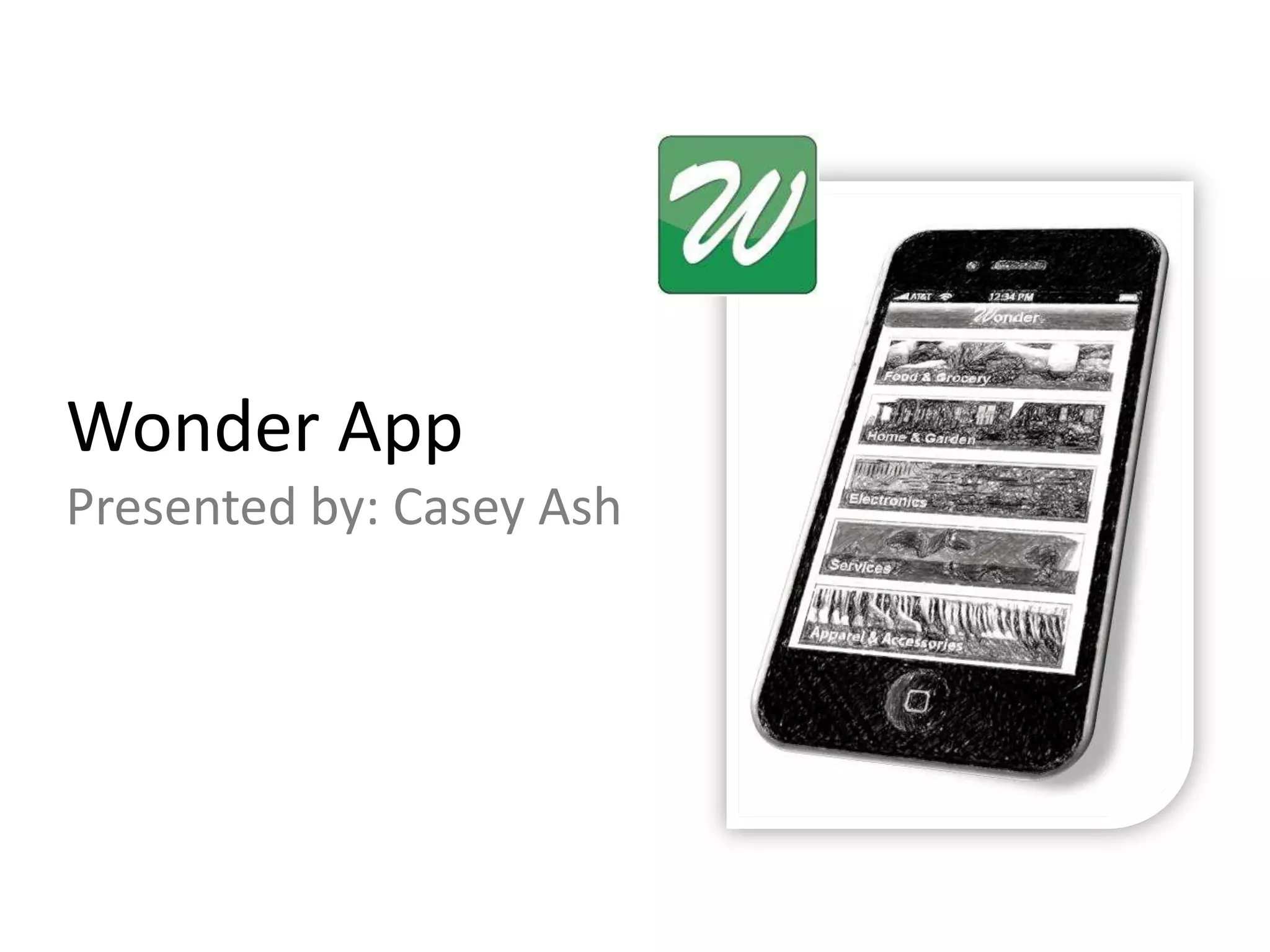
The title slide introduces the 'Wonder App' and notes that it is presented by Casey Ash. The visual includes a green square logo with a white 'W' and a mockup of an iPhone 4-era device. The mockup shows a list-based interface with categories such as 'Food & Grocery,' 'Home & Garden,' 'Electronics,' 'Services,' and 'Apparel & Accessories.' This suggests a directory or marketplace-style application where users can browse local offerings.
Slide 2: The Problem
The problem is framed from two perspectives: the consumer and the business. For consumers, the deck states they are 'subject to numerous advertisements that are not beneficial.' This implies a lack of relevance in current ad tech. For businesses, the problem is that 'consumers are shifting to a mobile lifestyle that inhibits traditional advertising methods.' This slide establishes the need for a more targeted, mobile-first approach to marketing.
Slide 3: The Solution
The solution slide focuses exclusively on the business side of the platform. It describes a 'web-based dashboard that is simple and easy to use' for businesses that want to reach consumers 'on the move.' By focusing on the dashboard, the deck emphasizes the ease of campaign management for the merchant, though it does not explicitly detail the consumer-facing solution on this slide.
Slide 4: Use Case Two: National Chains
This slide provides a specific application of the technology. It suggests that national chains struggle to maintain a 'local' feel. The proposed solution is for these chains to send 'geo-located advertisements to those individuals near the store’s location.' This indicates that Wonder’s technology relies on geofencing or proximity triggers to deliver notifications to users' devices when they are within a certain radius of a retail outlet.
Slide 5: Market Size – U.S. Mobile Ad Spending
Wonder uses a standard TAM/SAM/SOM breakdown to illustrate the financial opportunity. The charts indicate a significant growth period in mobile advertising. The Total Addressable Market (TAM) is projected to reach $4,000,000,000 by 2015, up from less than $1,000,000,000 in 2010. The Serviceable Addressable Market (SAM) is shown at approximately $2,800,000,000 for 2015. On a separate chart, the company sets its Serviceable Obtainable Market (SOM) at $100,000,000 for the year 2013. These figures place the deck’s creation likely around 2011 or 2012.
Slide 6: Product Development Roadmap
The final slide in this set outlines a 90-day roadmap divided into three 30-day blocks. First 30 days (Preliminary): Focuses on general administration, developing a 'strong founding team,' and finalizing designs for the website, dashboard, and iPhone app. Second 30 days (Beta): Covers front-end and back-end development, ending with gathering user feedback. Third 30 days (Launch): Involves increasing marketing efforts and finalizing all technical components, leading to a 'Day 90 - Launch.' This is an exceptionally ambitious timeline for a startup that, according to the roadmap, has not yet fully formed its founding team.
What Wonder Does Well
The deck identifies a very clear and timely trend: the shift from desktop and traditional media to mobile. By highlighting the 'mobile lifestyle,' the founders successfully tap into a major market transition. The use of a specific 'National Chain' use case is also effective, as it moves the conversation from abstract 'advertising' to a concrete business scenario—driving foot traffic to physical stores using location data.
The market size slide is also well-constructed. It uses clear bar charts to show not just the current market size, but the projected growth, which is essential for convincing investors of the venture's scalability. The distinction between TAM, SAM, and SOM shows a level of professional market analysis often missing in early-stage decks.
What Is Missing from the Deck
The most glaring omission is the lack of a 'Team' slide. While the roadmap mentions developing a founding team in the first 10 days, investors typically invest in people first. Without bios, past successes, or technical credentials, the deck relies entirely on the idea and the market projections. Furthermore, there is no mention of the 'Ask.' A pitch deck should clearly state how much capital is being raised and what that capital will achieve.
Additionally, the business model is not explained. It is unclear if Wonder intended to charge a subscription fee for the dashboard, take a commission on sales, or charge per ad impression/click. The competitive landscape is also ignored; by the early 2010s, several players were already exploring geo-located mobile ads and check-in services (such as Foursquare or Groupon), and failing to address them is a significant oversight.
Founder's Takeaway: The 90-Day Trap
Founders should be cautious about including hyper-compressed roadmaps like the one on Slide 6. Claiming that a company will go from 'developing a founding team' to 'launch' in 90 days often signals a lack of experience to seasoned investors. Building a robust back-end, a user-friendly front-end, and a native iOS application while simultaneously recruiting a team and executing a marketing plan is a monumental task that rarely fits into a three-month window. A more realistic roadmap that accounts for testing, iteration, and recruitment lead times is generally more persuasive.
However, the way Wonder segmented the 'Problem' slide (Slide 2) into 'For Consumers' and 'For Businesses' is a best practice. Every two-sided marketplace or B2B2C platform must solve a problem for both parties to be successful. Clearly articulating the pain points for both the advertiser and the end-user is a strong way to frame the necessity of the product.
Frequently asked questions
- What is Wonder's core value proposition?
- Wonder aims to solve the irrelevance of traditional advertising by providing businesses with a tool to send geo-located, beneficial advertisements to mobile consumers. For businesses, it offers a web-based dashboard to manage these campaigns, while consumers receive targeted offers based on their physical proximity to a store, theoretically increasing the utility of the ads they see.
- How does Wonder define its market opportunity?
- The deck cites U.S. Mobile Ad Spending as its primary market. It shows a growth trajectory from 2010 to 2015, where the TAM reaches $4,000,000,000 and the SAM reaches approximately $2,800,000,000. The company specifically targets a $100,000,000 Serviceable Obtainable Market (SOM) for the year 2013, suggesting an early-2010s origin for the deck.
- What is the timeline for Wonder to reach the market?
- The deck proposes a highly compressed 90-day 'Product Development' schedule. This includes a 30-day preliminary phase for team building and design, a 30-day beta phase for front-end and back-end development, and a final 30-day launch phase focused on marketing and finalization. The deck claims the product will launch exactly on Day 90.
- Who is the intended user for the Wonder platform?
- The deck identifies two primary business segments: local businesses wanting to reach consumers on the move and large national chains. For national chains, the focus is on 'local level' advertising, allowing them to treat mobile users like regular customers by triggering notifications when they are near a specific retail location.
- What critical startup information is missing from this deck?
- The deck omits several standard components, including a detailed team slide (beyond mentioning the need to build one), a clear business model or revenue strategy, a competitive analysis, and a specific financial 'ask' or use of funds. It also lacks technical details on how the geo-location technology functions or how it maintains user privacy.