WiZE MobileTv (operating under WiZE Mobile Sdn Bhd) proposes a mobile television platform aimed at the Malaysian market, branded as 'Mobyle TV'. The deck addresses the technical challenge of device fragmentation, arguing that their platform can deploy services to both mid-range and high-end handsets to capture a larger user base. Financially, the company projects a ramp-up from $750,000 in FY2010 sales to $1,500,000 in FY2012, though it anticipates significant net losses throughout this period, reaching a peak loss of $797,500 in FY2011. The strategy relies heavily on diverse content streams…
Key takeaways
- The company aims to solve mobile industry fragmentation by deploying services across both mid-range and high-end devices (Slide 3).
- Financial projections show a steady increase in sales from $750,000 in FY2010 to $1,500,000 in FY2012 (Slide 7).
- Despite rising revenue, the company forecasts consistent net losses, including a $726,558 loss in FY2010 and a $715,000 loss in FY2012 (Slide 7).
- The business model includes diverse revenue streams such as M-Downloads, M-Health, M-Learning, and M-Banking (Slide 5).
- The platform features a 'copy-test' mechanism for advertisers to iterate on ads based on real-time user reactions (Slide 4).
- Management is led by Pasha Zahari, who serves as CEO/CTO and has a background as an IT System Integrator at Ericsson Malaysia (Slide 6).
- The balance sheet indicates a significant 'Paid-in Capital' of $5,200,000 across all projected years (Slide 8).
- The cash flow projection shows a consistent monthly 'Sales of Long-term' asset inflow of $250,000 (Slide 9).
WiZE MobileTv Malaysia Pitch Deck Analysis
The WiZE MobileTv Malaysia Business Plan & Investment Proposal is a detailed, albeit dated, look at the mobile content and streaming landscape. The deck, branded with the 'Mobyle TV' logo, focuses on the technical and financial hurdles of launching a multi-faceted mobile service in a fragmented market. While the document provides extensive financial tables, it reflects a specific era of mobile technology where 'mid-range' handsets were a primary target for data growth.
Slide 1: Title and Contact Information
The cover slide introduces WiZE Mobile Sdn Bhd and the 'Malaysia Business Plan & Investment Proposal'. It includes a physical address in Shah Alam, Selangor, and a contact email (maha@mobiletv.my). The 'Mobyle TV' logo appears in the bottom right corner, establishing the consumer-facing brand. The watermark 'XCHG TECHNOLOGY' appears across this and subsequent slides, likely referring to the parent or partner technology provider.
Slide 2: Strategic Roadmap
This slide outlines a five-step process for service deployment:
Explore the opportunity: Understanding market needs and segmentation. · Develop and deploy: Implementing the network and charging mechanisms. · Excite subscribers: Launching the service and managing device provisioning. · Operate the service: Providing care services and managing Service Level Agreements (SLAs). · Manage the service lifetime: Monitoring performance and network capacity.
This is a high-level operational framework rather than a specific timeline of milestones.
Slide 3: Market Problem and Fragmentation
The deck identifies a core industry problem: slow uptake of non-SMS data services due to high-end devices being a small percentage of the market. Slide 3 states that analysts lower expectations because 'industry fragmentation renders application development nightmarish and extremely costly.' WiZE Mobile's solution is a platform that allows for development across both mid-range and high-end devices. The slide explicitly asks, 'why don't we adopt fragmentation?' suggesting their technology thrives on device diversity rather than trying to bypass it.
Slide 4: Value Network and Advertising
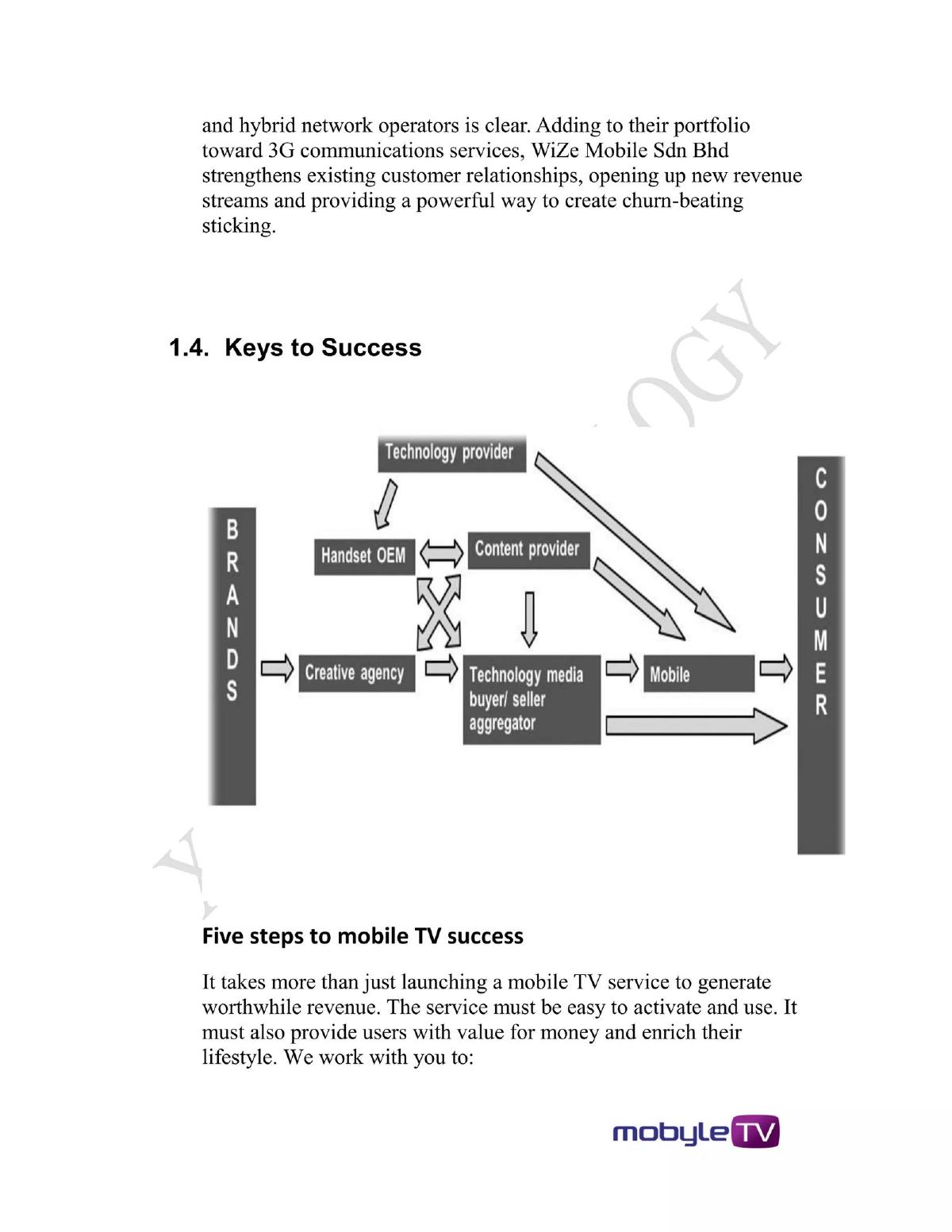
This slide introduces the 'Generic Mobile Digital TV service value network,' a complex flowchart divided into three phases: Service Development, Service Delivery, and Service Consumption. It maps out the relationships between content developers, network infrastructure, and mobile device retailers. A key value proposition mentioned in the text is the ability for advertisers to 'copy-test' ads in real-time, allowing for continuous improvement based on user reactions.
Slide 5: Revenue Streams and Sales Forecast
The company lists several content categories under 'Activity,' including Live Streaming, M-Award Shows, M-Music Shows, and M-Fashion. It also lists 'Other Revenue Streams' such as M-Downloads, M-Health, M-Learning, and M-Banking. The sales forecast philosophy is summarized as 'anytime, anywhere and anything,' emphasizing that mobile TV content should be shorter in duration than traditional TV to accommodate mobile usage patterns.
Slide 6: Milestones and Management
The top half of the slide features a Gantt-style milestone chart labeled 'StartUp fund' through 'R10,' covering a period from February to June. The bottom half introduces Pasha Zahari as CEO/CTO. His biography notes he was a Managing Director and worked as an IT System Integrator for Ericsson Malaysia from 1999 to 2002. His educational background includes an SPM (1996) and a Professional Certificate in Computer Science/IT from BMC Institute.
Slide 7: Projected Profit and Loss
FY 2010: Sales of $750,000, Gross Margin of 45.00% ($337,500), and a Net Loss of ($726,558). · FY 2011: Sales of $1,050,000, Gross Margin of 45.00% ($472,500), and a Net Loss of ($797,500). · FY 2012: Sales of $1,500,000, Gross Margin of 45.00% ($675,000), and a Net Loss of ($715,000).
The largest expense is Payroll, which grows from $912,000 in FY2010 to $1,370,000 in FY2012. Notably, Marketing/Promotion is listed at $0 for all three years, which is highly unusual for a consumer-facing mobile service.
Slide 8: Projected Balance Sheet
The balance sheet shows a consistent 'Paid-in Capital' of $5,200,000. Total Assets are projected to grow from $4,922,690 in FY2010 to $6,098,367 in FY2012. The 'Cash' position is remarkably high, starting at $4,722,690 in FY2010 and ending at $5,898,367 in FY2012. This suggests the company is projecting to raise or hold a significant amount of capital upfront to sustain the multi-year losses shown on the P&L slide.
Slide 9: Projected Cash Flow
The final slide provided is a monthly Pro Forma Cash Flow table. It shows 'Cash Sales' of $62,500 per month. A significant line item is 'Sales of Long-term,' which contributes $250,000 to the cash position every month. There is also a 'New Current Borrowing' of $41,667 per month. This granular view reinforces the company's reliance on external financing or asset sales to maintain operations during the initial years.
What Works / What is Missing
What Works: The deck does a good job of identifying a technical bottleneck—device fragmentation—and positioning it as a competitive advantage rather than a barrier. The financial projections are granular, providing P&L, Balance Sheet, and Cash Flow views, which is more than many early-stage decks offer. The focus on 'shorter time sessions' for mobile content shows an early understanding of mobile consumption habits.
What is Missing: The most glaring omission is the 'Ask.' While it is titled an 'Investment Proposal,' there is no slide stating how much capital is being raised or what the terms are. Additionally, the Marketing/Promotion expense is listed as $0 in the P&L (Slide 7), which is unrealistic for a service aiming to 'Excite subscribers' (Slide 2). There is also no detailed breakdown of the 'One Billion Phones' mentioned in the header of Slide 3 to show how many of those are actually in the target Malaysian market. Finally, the unit economics—such as the cost to acquire a subscriber versus their lifetime value—are not addressed.
Founder Takeaways
Address fragmentation head-on: If your technology solves a messy industry problem (like cross-platform compatibility), make that a central pillar of your pitch, as WiZE did on Slide 3. Be realistic about marketing: Listing zero dollars for marketing in a consumer service launch is a red flag for investors. Founders should ensure that their financial projections reflect the operational reality of acquiring users. Connect milestones to funding: The milestone chart on Slide 6 is disconnected from the financial slides. A better approach is to show how specific tranches of investment will trigger specific development or launch milestones.
Frequently asked questions
- What is the core problem WiZE MobileTv is trying to solve?
- According to Slide 3, the company is addressing the 'nightmarish' cost of application development caused by mobile industry fragmentation. Instead of focusing only on high-end smartphones, which represent a small percentage of the market, their platform is designed to deploy services to both mid-range and high-end devices to maximize reach.
- Who is leading the company and what is their experience?
- Slide 6 identifies Pasha Zahari as the CEO/CTO and Managing Director. His professional background includes serving as an IT System Integrator for Ericsson Malaysia from 1999 to 2002 and working with companies like Pintar Technology and Jaring Malaysia. He holds a Professional Certificate in Computer Science/IT from BMC Institute.
- What are the projected financials for the first three years?
- Slide 7 outlines a Pro Forma Profit and Loss statement. Sales are projected at $750,000 (FY2010), $1,050,000 (FY2011), and $1,500,000 (FY2012). However, the company expects to remain unprofitable, with net losses of $726,558, $797,500, and $715,000 respectively over those three years.
- What content and services does the platform plan to offer?
- Slide 5 lists various activities including Live Streaming, M-Award Shows, M-Music Shows, and M-Fashion. Additionally, it mentions 'Other Revenue Streams' such as M-Downloads, M-Health, M-Learning, and M-Banking, suggesting a broad utility play beyond just entertainment.
- How does the company plan to handle advertising?
- Slide 4 describes a 'dynamic, real-time' environment that allows advertisers to 'copy-test' their advertisements. This means advertisers can select what works best based on initial user reactions, treating advertising as an ongoing service that improves continuously rather than a static final product.