Tia’s pitch deck is a masterclass in narrative-driven fundraising for complex, brick-and-mortar-plus-digital businesses. The deck avoids the trap of being 'just another app' by positioning Tia as a 'full-stack care delivery platform.' It leverages a thesis-driven approach, arguing that the future of healthcare is virtual-first and relationship-based rather than transactional. The presentation highlights a significant cost advantage—40% lower cost per service than a typical PCP—and a massive market opportunity, noting that women control $2.8 trillion in U.S. healthcare spend. By focusing on th…
Key takeaways
- The deck positions the company as a 'Modern Medical Home for Women' on the title slide, immediately establishing a broad scope beyond niche reproductive health.
- Slide 2 presents a clear 'Thesis' that contrasts their model (Virtual-first, Whole people, Relationship-based) against traditional failures (Virtual-only, Specific conditions, Transaction-based).
- The 'secret sauce' is defined on Slide 4 as a fusion of Brand, Care, and Tech, visualized through a Venn diagram to explain defensibility.
- Slide 6 emphasizes a lifelong care model from 'puberty to menopause,' explicitly linking this to increased 'customer lifetime value.'
- Operational efficiency is quantified on Slide 8, claiming >60% virtual care delivery and a 40% lower cost per service compared to typical Primary Care Physicians.
- The market size slide (Slide 9) uses a $2.8 trillion figure to show that women control >80% of total U.S. healthcare dollars, framing the business as a 'front door' to the entire system.
- The team slide (Slide 10) highlights a 'consumer tech' pedigree, featuring backgrounds from Google Creative Lab, Bridgewater, and Owler to justify their brand-led approach.
- User-generated content (UGC) is used on Slide 5 as a proxy for organic growth and brand loyalty, showing social media testimonials from patients.
The Narrative of the Full-Stack Medical Home
The Tia pitch deck is a compelling example of how to pitch a 'bricks-and-clicks' business model to venture capitalists. In a sector often crowded with point solutions—apps for fertility, apps for period tracking, or apps for menopause—Tia uses this deck to argue for a unified, physical, and digital presence. The $100M raise was predicated on the idea that healthcare is not a transaction, but a lifelong relationship. By framing themselves as a 'Medical Home,' they move the conversation from 'cost per acquisition' to 'lifetime value.'
Slide 1: The Vision Statement
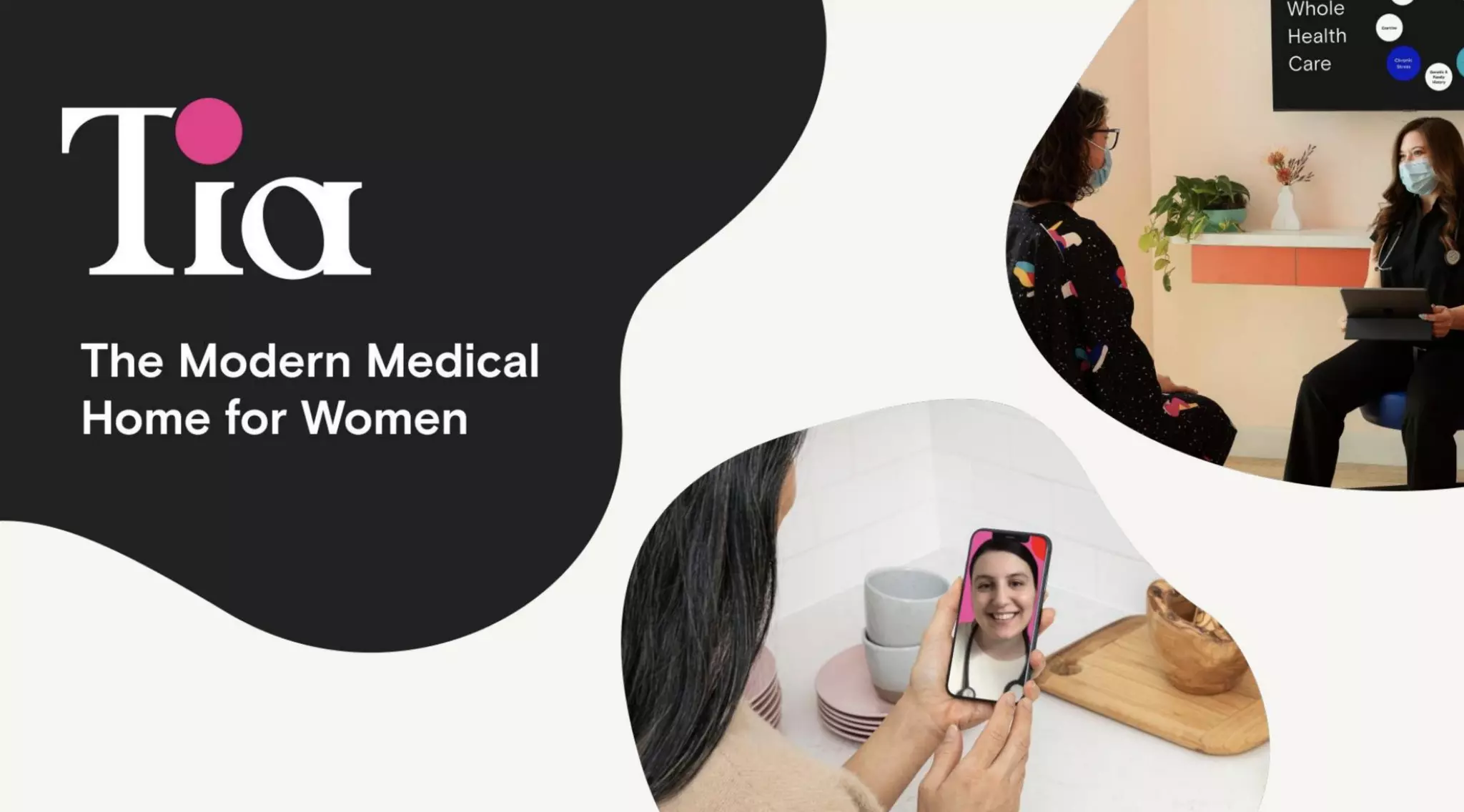
The title slide sets a high bar. It uses the phrase "The Modern Medical Home for Women." This is a strategic choice of words. In clinical terms, a 'medical home' is a model of care that is patient-centered, comprehensive, and coordinated. By adding 'Modern' and 'Women,' Tia stakes a claim on a specific demographic while promising a technological upgrade to a traditional clinical concept. The imagery—showing both a physical clinic and a mobile telehealth interface—immediately communicates the hybrid nature of the business.
Slide 2: The Thesis-Driven Approach
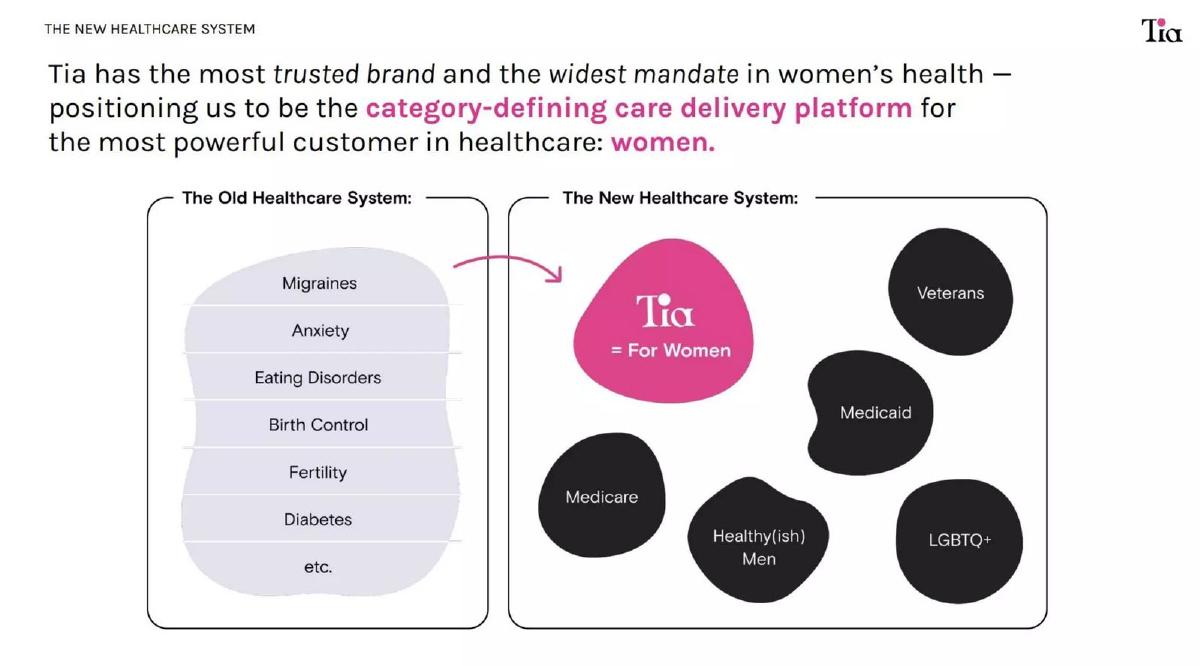
Slide 2, titled "Our Thesis," is perhaps the most important slide for setting the stage. It uses a 'Check vs. X' format to define what the future of healthcare looks like. By stating that the system will be "Virtual-first" but "NOT virtual-only," they defend the high capital expenditure of physical clinics. By choosing "For whole people" over "specific conditions," they distance themselves from 'niche' startups. This slide tells the investor exactly how to think about the rest of the deck.
Slides 3-4: Defining the 'Secret Sauce'
Slide 3 introduces the "Tia Care Continuum," a visual flow showing a patient moving from a mobile app to a physical front desk to a telehealth session. This reinforces the 'full-stack' nature of the platform. Slide 4 follows up with a Venn diagram of Brand, Tech, and Care. While Venn diagrams are common in decks, Tia uses this to claim their 'magic' happens at the intersection. They explicitly call this a "winning playbook we’ve proven is both scalable & defensible," which is a direct answer to common VC concerns about the low defensibility of pure service businesses.
Slide 5: Social Proof and Brand Love
Slide 5 focuses on "Brand Experience." It features screenshots of user-generated content (UGC) from Instagram, Facebook, and Twitter. One testimonial states, "I cried for the rest of the day because they listened to me." In the cold world of healthcare metrics, this slide aims to prove that Tia has achieved 'mindshare' and 'viral UGC.' This is used to justify their 'acquisition and engagement flywheels,' suggesting that their brand strength reduces their reliance on paid marketing.
Slide 6: The Lifetime Value Argument
Slide 6 addresses the 'Care Model.' It contrasts Tia against companies that cater to 'narrow chapters' of life. By supporting women from "puberty to menopause," Tia is making a financial argument: their Customer Lifetime Value (LTV) is significantly higher than a company that only helps a woman during a 12-month pregnancy window. The visual timeline of 'Avoiding Pregnancy,' 'Fertility,' 'Pregnancy,' and 'Menopause' makes this expansion clear and logical.
Slides 7-8: Tech-Enabled Efficiency
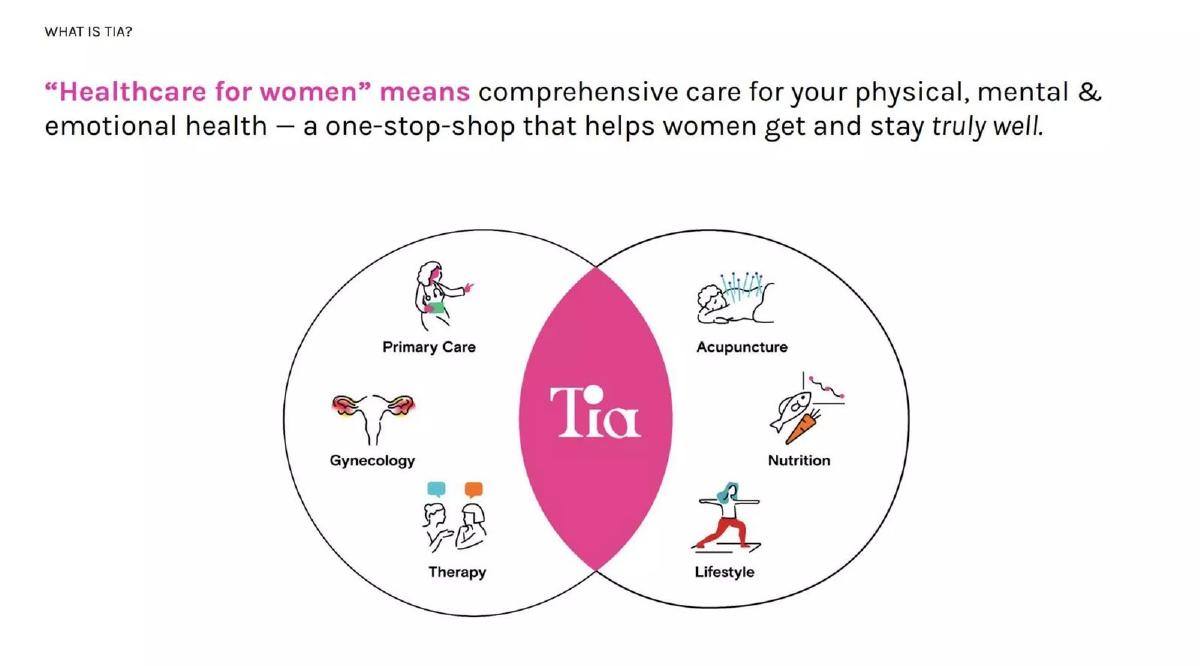
Slide 7 introduces the "three screens" of Tia: My screen (patient), Your screen (provider), and Our screen (shared record). This is a product-focused slide that promises 'transparency' and 'collaboration.' Slide 8 provides the 'Key Statistics' that VCs crave. It claims ">60% of care is delivered virtually" and "40% lower cost per service compared to a typical PCP." The graphic shows a patient at the center of a 'Care Team' including Acupuncturists, OB/GYNs, and Therapists. This suggests that Tia uses a 'top-of-license' staffing model, where lower-cost providers handle routine tasks, preserving the MD's time for complex issues—a key driver of their 40% cost reduction.
Slide 9: The $2.8 Trillion Opportunity
Slide 9 is the 'Market Size' slide, but it is framed through the lens of influence. It argues that because women make healthcare decisions for their families, they control ">80% of the total U.S. healthcare dollars." The pie chart shows a "$2.8 trillion" slice for women vs. $700 billion for men. This reframes Tia from a 'women's health startup' to a 'gateway to the entire healthcare economy.' It is a classic 'Total Addressable Market' (TAM) expansion tactic.
Slide 10: The Team
The final slide in this sample focuses on the founders, Felicity Yost (CPOO) and Carolyn Witte (CEO). The bios emphasize their 'consumer tech' backgrounds—Google Creative Lab, Bridgewater, and Owler. This is a deliberate choice to signal that they are building a modern, data-driven brand rather than a traditional medical practice. The description of Witte as a 'storyteller' and Yost as an 'analytics & data junkie' presents a balanced leadership duo capable of handling both the 'soft' brand side and the 'hard' operational side of the business.
What Works in the Tia Deck
The strength of this deck lies in its narrative consistency. Every slide reinforces the idea that the current healthcare system is fragmented and transactional, and that Tia is the holistic, relationship-based solution. The use of high-quality photography and a distinct visual style (pink accents, clean typography) mirrors the 'Brand' pillar they claim as their secret sauce. They successfully bridge the gap between 'tech' and 'clinical' by showing how their proprietary software (the three screens) leads to better clinical outcomes and lower costs.
What Is Omitted
As this is a 10-slide sample of a 29-slide deck, several critical components are missing. There is no financial roadmap showing when the company expects to reach profitability, which is a major concern for high-CapEx clinic models. There is no geographic expansion plan —investors would want to know if the 'playbook' works outside of their initial markets (like New York or Los Angeles). Additionally, there is no competitive analysis slide. While they mention 'other women's healthcare players,' they don't name them or show a feature-by-feature comparison. Finally, the specific 'Ask' (how the $100M will be spent) is not present in this selection.
What Founders Should Copy
The Thesis Slide: Don't just say what you do; say what you believe about the future of your industry. Contrasting your 'Yes' against the industry's 'No' (Slide 2) is a powerful way to build alignment with an investor. · LTV Framing: If your business serves a customer over a long period, visualize that timeline (Slide 6). It turns a single-service business into a platform play. · The 'Front Door' Argument: If you are targeting a specific demographic, explain how that demographic controls a larger share of the market than is immediately obvious (Slide 9). · Quantified Efficiency: Don't just say you are 'efficient.' Use a specific benchmark, like Tia's '40% lower cost per service compared to a typical PCP' (Slide 8). · Social Proof as Growth: Using real social media posts (Slide 5) is often more convincing than a generic 'User Growth' chart, as it proves brand resonance and organic reach.
Frequently asked questions
- What is the primary value proposition of Tia according to the deck?
- Tia positions itself as a 'full-stack care delivery platform' that serves as the 'modern medical home for women.' Unlike competitors that focus on specific life stages like fertility or pregnancy, Tia emphasizes a 'Care Continuum' that spans from puberty to menopause. This approach aims to build long-term relationships and higher lifetime value by being the first place women turn for all health needs, whether online or in person.
- How does Tia justify its unit economics and scalability?
- On Slide 8, Tia provides two key statistics: over 60% of care is delivered virtually, and they achieve a 40% lower cost per service compared to a typical Primary Care Physician (PCP). They attribute this to a 'collaborative Care Team' model where patients are supported by medical assistants, therapists, and nurse practitioners rather than relying solely on expensive MD time for every interaction.
- What role does technology play in their pitch?
- Tia describes their technology as 'homegrown' and focuses on the 'three screens' of Tia (Slide 7). This includes a patient-facing app ('My screen'), a provider-facing interface ('Your screen'), and a shared health record ('Our screen'). The goal is to facilitate transparency and collaboration, moving away from the black-box nature of traditional medical records to improve the doctor-patient relationship.
- How does the deck address market size and opportunity?
- Slide 9 frames the opportunity not just as 'women's health,' but as control over the entire U.S. healthcare spend. It claims women make the bulk of healthcare decisions for partners, children, and parents, controlling $2.8 trillion (over 80%) of annual spend. By capturing the woman as a patient, Tia positions itself as the 'front door' to the broader healthcare economy.
- What is missing from this 10-slide sample of the deck?
- This sample lacks a specific 'Ask' slide detailing the terms of the $100M raise, a detailed financial projection or P&L, a competitive landscape map, and a roadmap for geographic expansion. While it mentions being 'scalable,' it does not show the specific unit economics of a single clinic or the 'playbook' for launching new markets, which would be critical for a $100M round.