Partner-Funded Expansion in a Pitch Deck: Who Pays to Open
How to show investors that a partner pays for your new locations: state who funds what, what the partner gets back, and how it changes your margin.
When a Partner Pays to Open Your Locations: How to Show It in a Pitch Deck
Opening physical locations is expensive, so a founder whose partner will pay for the build-out has a strong point to make: more sites for less of the investors' money. But "no capex for us" leaves an investor with questions. Who pays for exactly what? What does the partner get in return, and for how long? Who runs the site and keeps the revenue? And how much of the profit is left for the company? Three real decks show three versions of the arrangement. Chamberlain Coffee says a joint-venture partner will fully fund its first five cafés. Tia says health systems give it financial support to open clinics, alongside insurance contracts, referrals and management fees. Taster licenses its restaurant brands to partners for a royalty. This guide shows how to present each one so an investor can see the trade-off.
TL;DR
To show partner-funded expansion, name the partner type, list which costs the partner pays (build-out, equipment, opening losses) and which you pay, and state what the partner receives in return: equity in a joint venture, a revenue or profit share, a fee, or a contract. Then show the effect on your numbers: capital you no longer need to raise, the share of each site's revenue or profit you keep, and who controls the site. A one-line "no capex" claim without the partner's return reads as incomplete.
Three real ways to present partner-funded expansion
Each slide below was read from the original deck. Two show company-run sites with partner funding; the third, a franchise royalty model, is the contrast case.
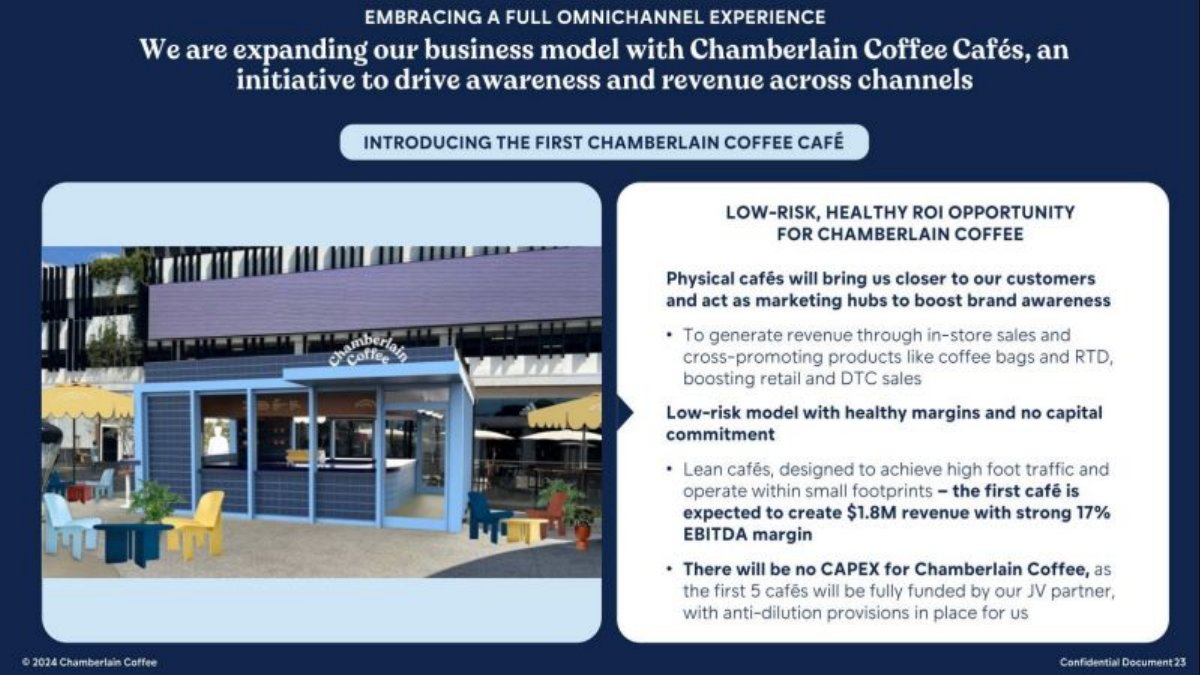
Chamberlain Coffee business model slide — slide 11
US coffee brand sold online and in retail; page 11, "Introducing the first Chamberlain Coffee café".
Chamberlain Coffee deck, slide 11. Exact stored slide matched to this analysis.
Our analysis: A clear statement of who pays and for how many sites. Its gap is the partner's return: without it, an investor can't tell what share of the forecast EBITDA belongs to Chamberlain.
Evidence and limitation: Our reading: the number of funded sites (5) and the funder (a joint-venture partner) are stated; the cost per café, the partner's ownership or profit share and the agreement's status are not. The $1.8M revenue and 17% EBITDA margin are a forecast ("expected") for one café; by our arithmetic that is about $306,000 of EBITDA, before any partner share. The slide also says the cafés are meant to promote the brand's retail and online sales.
What a founder can adapt: "First 5 cafés: build-out $[x] each, 100% funded by JV partner; partner owns [y]% of the JV / receives [z]% of café EBITDA. Our share of first-café forecast EBITDA: $[a]."
Supporting analysis
What the deck claims: "Low-risk, healthy ROI opportunity for Chamberlain Coffee"; "Low-risk model with healthy margins and no capital commitment"; "Lean cafés, designed to achieve high foot traffic and operate within small footprints – the first café is expected to create $1.8M revenue with strong 17% EBITDA margin"; "There will be no CAPEX for Chamberlain Coffee, as the first 5 cafés will be fully funded by our JV partner, with anti-dilution provisions in place for us".
Presentation choice: It shows the funding side of partner-funded expansion stated plainly, and what's missing on the return side.
When it does not fit: Don't show site EBITDA as if it were all yours when a partner shares in it.
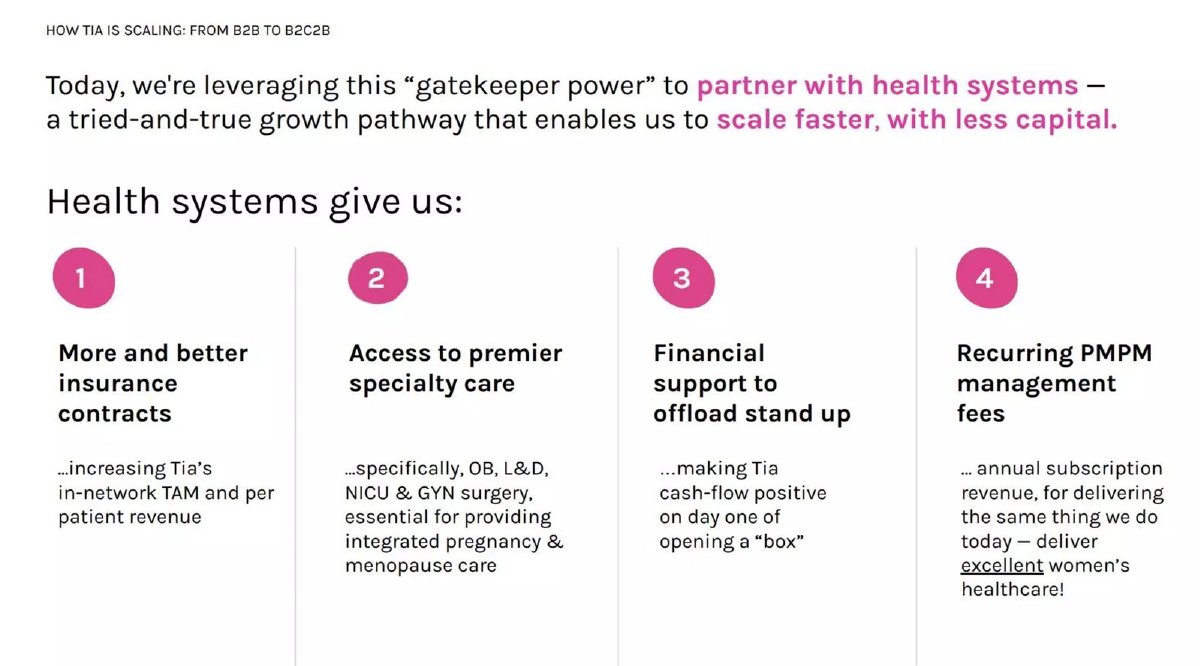
US women's health clinic and virtual care company; page 26, "How Tia is scaling: from B2B to B2C2B".
Tia deck, slide 26. Exact stored slide matched to this analysis.
Our analysis: It shows partner funding as one part of a wider partnership, with the partner's motive explained on the page before. It is a qualitative claim: an investor would need the number of partnered clinics and the terms.
Evidence and limitation: Our reading: the slide lists four things the partner provides, one of which is funding for opening a clinic. It states the result ("cash-flow positive on day one") but not the amount of support, the number of clinics or what the health system receives. The previous page (25) explains the partner's motive: women make most healthcare decisions for their families, so a clinic is a "front door" to the health system's spending. No figures are given.
What a founder can adapt: "[n] clinics opened with [partner type]; partner funds $[x] of stand-up per clinic; we receive $[y] PMPM management fees; partner gains referrals to its specialists."
Supporting analysis
What the deck claims: "Today, we're leveraging this 'gatekeeper power' to partner with health systems – a tried-and-true growth pathway that enables us to scale faster, with less capital." "Health systems give us: 1 More and better insurance contracts …increasing Tia's in-network TAM and per patient revenue; 2 Access to premier specialty care …specifically, OB, L&D, NICU & GYN surgery…; 3 Financial support to offload stand up …making Tia cash-flow positive on day one of opening a 'box'; 4 Recurring PMPM management fees …annual subscription revenue…".
Presentation choice: It shows how to explain why a partner would fund your sites: what the partner gains from your customers.
When it does not fit: Don't claim day-one cash-flow positive sites without showing how many have opened that way.
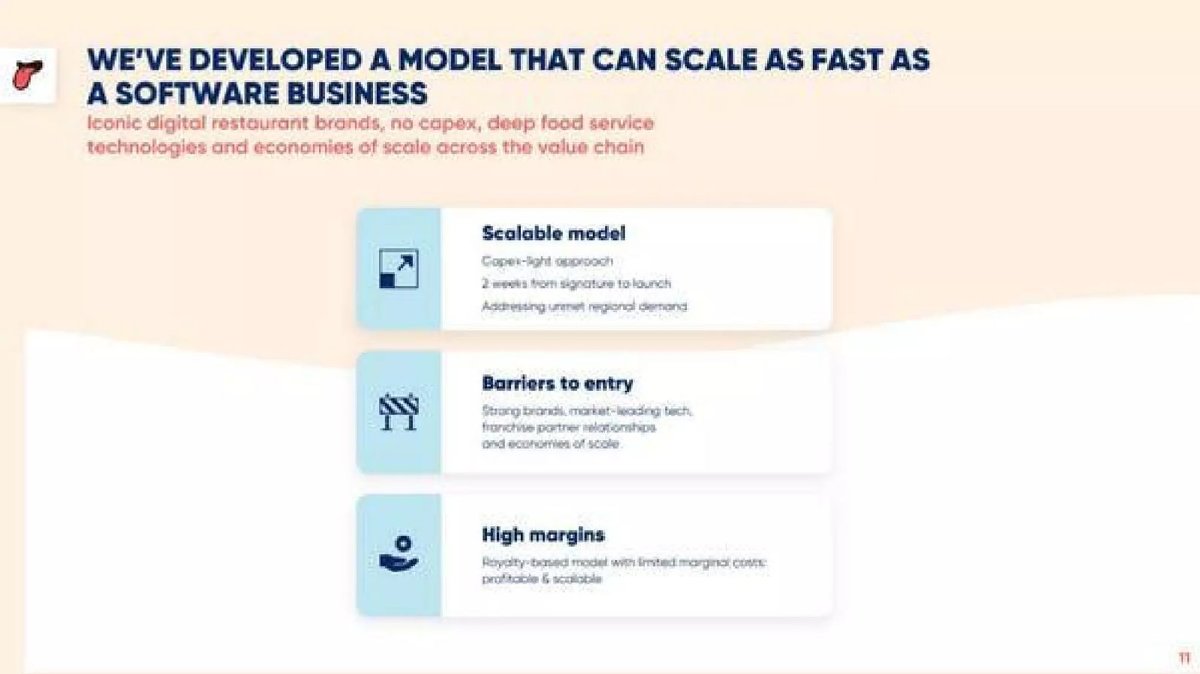
European delivery-only restaurant brand company; page 11, "We've developed a model that can scale as fast as a software business".
Taster deck, slide 11. Exact stored slide matched to this analysis.
Our analysis: The contrast case: the partner funds and runs the site, so the company's capital need is lowest, but its revenue is a royalty rather than site sales. Investors will value that differently from a company that operates partner-funded sites.
Evidence and limitation: Our reading: the partner here is a franchise partner who operates the kitchen; Taster earns a royalty. The slide gives a launch time (2 weeks from signature) but no royalty rate, partner count or revenue per site.
What a founder can adapt: "Royalty [x]% of partner kitchen sales; [n] partner kitchens; average sales $[y] per kitchen; 2 weeks signature to launch."
Supporting analysis
What the deck claims: "Iconic digital restaurant brands, no capex, deep food service technologies and economies of scale across the value chain". "Scalable model: Capex-light approach; 2 weeks from signature to launch; Addressing unmet regional demand". "Barriers to entry: Strong brands, market-leading tech, franchise partner relationships and economies of scale". "High margins: Royalty-based model with limited marginal costs: profitable & scalable".
Presentation choice: It shows the other end of the range, where the partner both funds and operates.
When it does not fit: Don't present royalty revenue alongside full site sales without saying which you report.
Funder, costs covered, partner return and effect on the company's numbers.
Slide
Who funds
Costs covered
Partner's return
Who operates
Effect shown
Chamberlain Coffee p11
Joint-venture partner
"Fully funded", first 5 cafés
Not stated (anti-dilution for company)
Company
Forecast $1.8M revenue, 17% EBITDA (one café)
Tia p26
Health systems
"Stand up" support
Implied: patients for its specialists
Company
"Cash-flow positive on day one" (no figures)
Taster p11
Franchise partners
Not specified ("no capex")
Pays royalty
Partner
2 weeks to launch; royalty margins
Key Takeaways
Say who pays for which cost: build-out, equipment, opening losses.
State what the partner gets back and for how long.
Show the share of site revenue or profit you keep.
Say who runs the site and who controls decisions.
Cut the capex from your use of funds, and show the raise both ways.
Label site results as forecast until a funded site has opened.
Build your partner-funded expansion slide
Answer each prompt with a number or a named term.
Partner. What type of partner funds your sites, and is the agreement signed, a letter of intent or in negotiation?
Costs covered. Which costs does the partner pay: build-out, equipment, opening losses? What does one site cost in total?
Partner's return. What does the partner get back: ownership share, revenue or profit share, fee, exclusivity? For how long?
Your share. What share of each site's revenue or profit is left for you after the partner's return?
Control. Who runs the site and who decides on prices, staff and closures?
Raise. How much would you need to raise without the partner, and how much with?
Copyable framework: [n] sites funded by [partner type] ([signed/LOI]); partner pays $[a] per site for [costs], receives [return] for [term]. We run the sites and keep [x]% of site [EBITDA/revenue], $[b] per mature site ([forecast/actual]). Capital needed: $[c] with the partner, $[d] without.
Illustrative example 1 — written by us
Before: There will be no CAPEX for Chamberlain Coffee, as the first 5 cafés will be fully funded by our JV partner, with anti-dilution provisions in place for us.
After: First 5 cafés: $[x] build-out each, fully funded by JV partner (signed [date]); partner owns [y]% of the JV. Our share of forecast first-café EBITDA: $[a] of about $306K.
What improved: Built from Chamberlain Coffee's page 11. Costs, ownership share and dates are placeholders the slide does not give; $306K is our arithmetic from its forecast.
Illustrative example 2 — written by us
Before: Financial support to offload stand up …making Tia cash-flow positive on day one of opening a 'box'.
After: [n] clinics opened with health-system partners, each receiving $[x] of stand-up funding; [n] of [n] cash-flow positive in month one.
What improved: Built from Tia's page 26. Counts and amounts are placeholders.
Why the arrangement needs its own slide content
Partner funding changes the company an investor is buying. If a partner pays for build-out, the company needs less capital per site and can open faster. In return it usually gives something up: a share of the site's profit, part ownership of the sites, a fee, or exclusivity. A slide that shows only the benefit invites the investor to assume the cost is large.
The arrangement also differs from franchising, which our franchise guide covers. In a franchise the partner (the franchisee) usually funds, owns and runs the location and pays the brand a royalty. In the arrangements here, the partner pays for some or all of the build-out, while the company keeps operating the site or the service. Taster is included as the contrast case.
This guide is about presenting your own arrangement clearly. It is not legal, tax, accounting or investment advice, and the structure of any partnership agreement is a question for your advisers.
Say who pays for what
Split the cost of opening one site into its parts and say who pays each: construction and fit-out, equipment, permits, pre-opening staff and marketing, and the operating losses before the site breaks even. "Fully funded" can mean all of these or only the build-out.
Chamberlain Coffee's page 11 says the first five cafés "will be fully funded by our JV partner." That is clear on the number of sites and the funder. It doesn't say whether "fully funded" includes opening losses, or what each café costs. Tia's page 26 says health systems provide "financial support to offload stand up", which tells the reader the partner helps with opening costs but not how much.
A useful habit is to show the cost per site and the partner's share as numbers: "Build-out $[x] per site, 100% partner-funded; pre-opening losses $[y], funded by us."
Show what the partner gets back
Every funding partner expects a return. Common forms are part ownership of the sites through a joint venture, a share of revenue or profit, a fixed fee, a minimum purchase commitment, or exclusivity in an area. A joint venture is a specific legal and accounting arrangement: under IFRS 11, joint control exists only when decisions about the relevant activities require the unanimous consent of the parties sharing control. If you use the term, say who owns what share.
Chamberlain's slide mentions "anti-dilution provisions in place for us", which suggests protection of the company's ownership in the joint venture, but it doesn't give the split of ownership or profit. Tia's partner return is implied rather than stated: health systems gain a front door for patients who then use their specialists and hospitals, and in turn give Tia better insurance contracts, referrals and "recurring PMPM management fees" (per member per month). Taster's slide names its return directly: a "royalty-based model."
State the partner's return in the same unit as your own: "Partner receives [x]% of site EBITDA for [n] years" or "Partner owns [x]% of the joint venture." (IFRS Foundation)
Show what it does to your numbers
Partner funding should show up in three places in the deck. First, use of funds: if a partner pays for build-out, the raise shouldn't include it. Showing the raise with and without the partner helps an investor see the value of the arrangement and the risk if the partner withdraws. Second, unit economics: the share of each site's revenue or profit you keep after the partner's return. Third, payback: payback on your own capital per site becomes much shorter, but payback on the site's total cost doesn't change, so say which you show.
Chamberlain's slide gives a forecast for the first café, "$1.8M revenue with strong 17% EBITDA margin", which by our arithmetic is about $306,000 of EBITDA a year. The slide doesn't say what share of that EBITDA belongs to Chamberlain after the partner's share, so an investor can't yet tell what the company earns from each café. The figure is a forecast for a café not yet open, and the slide labels it "expected."
Taster's slide makes the trade-off explicit in another way: "Capex-light approach", "2 weeks from signature to launch" and "Royalty-based model with limited marginal costs." A royalty model keeps the company's costs low but also means its revenue per site is a royalty, not the site's full sales.
A worked example (hypothetical)
Take an invented fitness studio company. Each studio costs $600,000 to build and equip, plus about $150,000 of losses before break-even. A property partner agrees to fund build-out and equipment for ten studios in exchange for 40% of each studio's EBITDA for ten years. The company funds opening losses and runs the studios.
Without the partner, ten studios need $7.5M. With the partner, they need $1.5M of the company's money. A mature studio is planned at $1.2M revenue and a 20% EBITDA margin, $240,000 a year; the company keeps 60%, $144,000. Payback on the company's own $150,000 per studio is about one year of mature EBITDA; payback on the studio's full $750,000 is about 3.1 years at the full $240,000.
On the slide: "10 studios, build-out and equipment ($600K each) funded by [partner type] for 40% of studio EBITDA over 10 years. Our capital per studio: $150K of opening losses. Raise needed: $1.5M, against $7.5M without the partner." All figures in this example are invented for illustration.
Show the risks the arrangement carries
Partner funding moves risk around rather than removing it, and investors will ask about it. The first risk is dependence: if one partner funds all planned sites, the expansion plan rests on that partner staying willing and solvent. Say how many partners you have and whether the agreement commits them to a number of sites or only to the first few.
The second is the end of the term. If the partner's share or fee lasts ten years, or the partner owns part of the sites, say what happens at the end: does the share stop, can you buy the partner out, and at what price? An investor modelling the company's value will want to know whether your share of site profit rises later.
The third is control. A partner who funds a site may want a say in where it opens, what it sells and when it closes. If decisions need the partner's agreement, say so on the slide or in the appendix. Tia's partnership shows the opposite benefit as well: a partner with its own reasons to want your sites to succeed, here referrals to its specialists, is less likely to walk away. Naming that motive helps an investor judge how durable the arrangement is.
Make the rest of the deck agree
Once the arrangement is on a slide, the forecast should show revenue and profit after the partner's share, the use-of-funds slide should leave out the partner-funded capex, and any site count should match the number of sites the partner has agreed to fund. If the agreement is signed, say so and give the term; if it is a letter of intent or under negotiation, say that instead. An investor will ask for the agreement in due diligence.
Common mistakes
"No capex" alone. Say which costs the partner pays and which you pay.
Partner's return missing. State the share, fee or ownership the partner receives.
Full site profit shown as yours. Show your share after the partner's return.
Capex still in use of funds. Remove partner-funded costs from the raise.
Unclear agreement status. Say signed, letter of intent or in negotiation.
Mixing models. Don't call a franchise royalty a partner-funded site.
Diagnostic checklist
The partner type and agreement status are stated.
Costs covered by the partner are listed with a per-site amount.
The partner's return and its term are stated.
Your share of site revenue or profit is shown.
Who operates and controls the site is clear.
Use of funds excludes partner-funded costs; raise shown with and without.
Forecast site results are labelled as forecasts.
Frequently asked questions
Is partner-funded expansion the same as franchising?
Not usually. In a franchise the franchisee funds, owns and runs the site and pays you a royalty. In a partner-funded expansion the partner pays some or all of the opening cost while you usually keep running the site, in exchange for a share, fee or ownership.
Should I still show site-level profit if a partner shares it?
Yes, show the site's full profit and then your share after the partner's return, so an investor can see both the site's quality and what the company earns.
Does partner funding reduce how much I need to raise?
It can. Show the raise with and without the partner so an investor sees the value of the arrangement and the extra capital needed if it falls through.
Where should this go in the deck?
Usually on the business model or go-to-market slide, with the effect carried into the use-of-funds and financial slides.
How we chose these examples
Discovery (2026-10-04, runs 99–101): Tia page 26 was found while reading unused decks end to end. A corpus search for capital-light, no-capex and partner-funded wording returned 15 pages; Chamberlain Coffee 11 and Taster 11 were read at full size. Sonder's SPAC deck page 27 was set aside because SPAC and listed-company decks are excluded. Closest content read: the unpublished location-economics draft, the franchise model, the live payback and use-of-funds guides. None teaches how to present a partner-funded, company-run expansion.
Rendered and read at full size from the original deck files: Chamberlain Coffee 11, Tia 26 (with 25 for context) and Taster 11. All three are published teardowns and none is excluded. The three images were prepared at 1200px wide and uploaded through the standing slide-image workflow.
Ratios are our arithmetic from printed values. Company figures are reported as printed and not verified. This guide explains presentation, not legal, tax, accounting or investment advice. Slide readings and analysis are an AI editorial model review, not human-checked.