Wondercraft's Seed deck is a masterclass in brevity and social proof. Raising $3M in early 2024, the company focused on a 'show, don't tell' approach, utilizing high-fidelity product UI mockups and a dense traction slide to overcome the skepticism often facing AI startups. The deck highlights a significant early milestone: 30,000 beta users since May 2023 and a viral case study with the Hacker News Recap podcast. By positioning themselves as a multi-purpose studio rather than a single-feature tool, they successfully mapped their technology to a $250 billion creator economy. While the deck lac…
Key takeaways
- The deck reports 30,000 users in beta since May 2023, providing significant early-stage validation (Slide 8).
- Wondercraft positions itself as a horizontal platform serving nine distinct personas, from marketers to book publishers (Slide 7).
- The team leverages high-profile past employers including Spotify, Palantir, and Acast to establish industry authority (Slide 9).
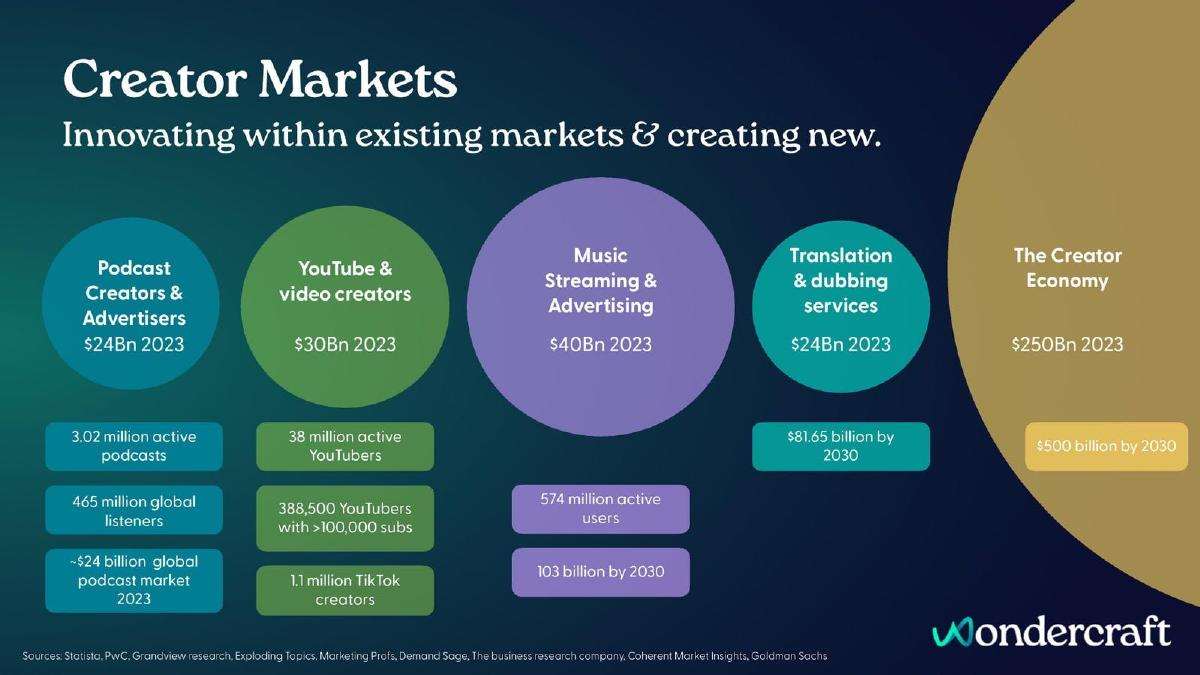
- Market sizing targets a $250 billion Creator Economy, broken down into specific segments like podcasting and dubbing (Slide 6).
- The product is framed as a solution to three distinct pain points: professional barriers for creators, scaling issues for enterprises, and language barriers for publishers (Slide 3).
- Social proof is emphasized through a 'Product of the Month' award on Product Hunt and mentions in Forbes and Wired (Slide 8).
- The deck omits a specific funding ask, valuation, or use of funds breakdown.
- Product capabilities are summarized as 'studio-quality audio... simply by typing,' emphasizing the low barrier to entry (Slide 2).
The 9-Slide Strategy for AI Audio Dominance
Wondercraft's 2024 Seed deck is a lean, visually-driven presentation that relies heavily on the 'YC effect' and immediate product utility. In an era where AI startups are often criticized for being 'wrappers' on existing models, Wondercraft uses its 9 slides to argue for a comprehensive workflow solution. By focusing on the 'Audio Studio' concept, they move the conversation away from raw technology and toward creative output.
Slide 1: Title and Vision
The deck opens with a clean, dark-themed title slide featuring the Wondercraft logo and the tagline: "Voicing Ideas. Empowering Originality." It establishes the brand identity immediately and dates the presentation to 2023, though the round closed in early 2024. There is no clutter here; it is a standard, professional entry point.
Slide 2: The Value Proposition
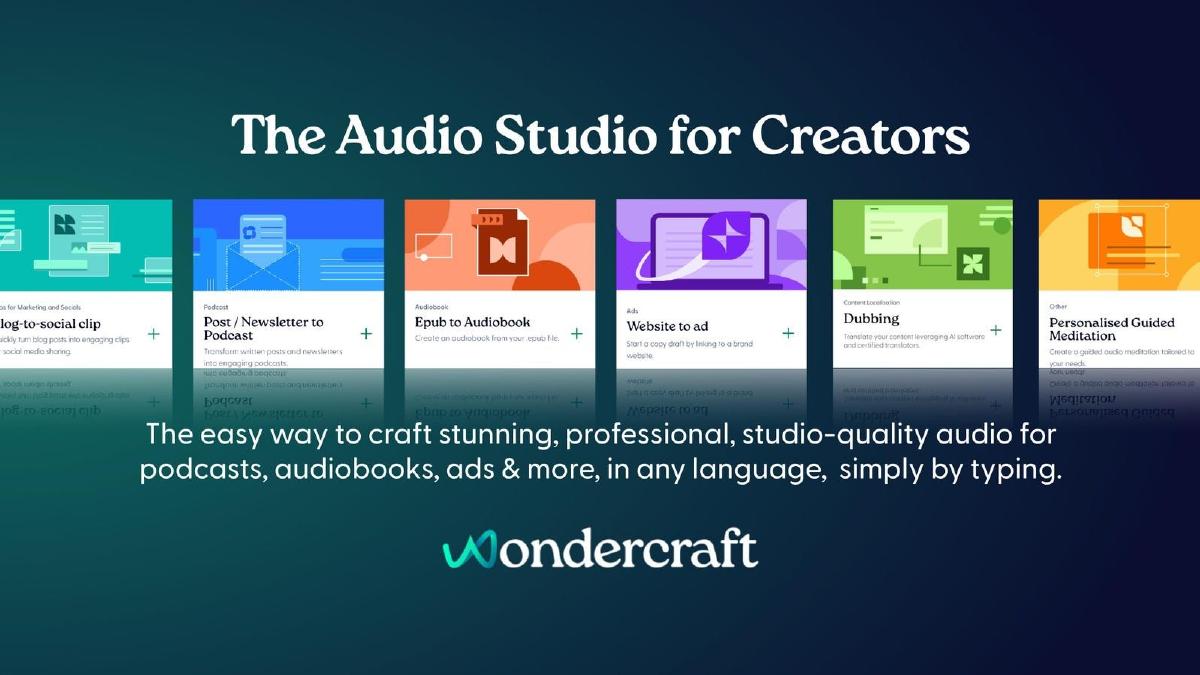
Slide 2 serves as a summary of the product's versatility. Titled "The Audio Studio for Creators," it uses a grid of six colorful cards to show specific use cases: Blog-to-social clip, Post/Newsletter to Podcast, Epub to Audiobook, Website to ad, Dubbing, and Personalised Guided Meditation. The bottom of the slide contains the core mission statement: "The easy way to craft stunning, professional, studio-quality audio for podcasts, audiobooks, ads & more, in any language, simply by typing." This slide effectively answers 'What is it?' before the investor can even ask.
Slide 3: Defining the Problem
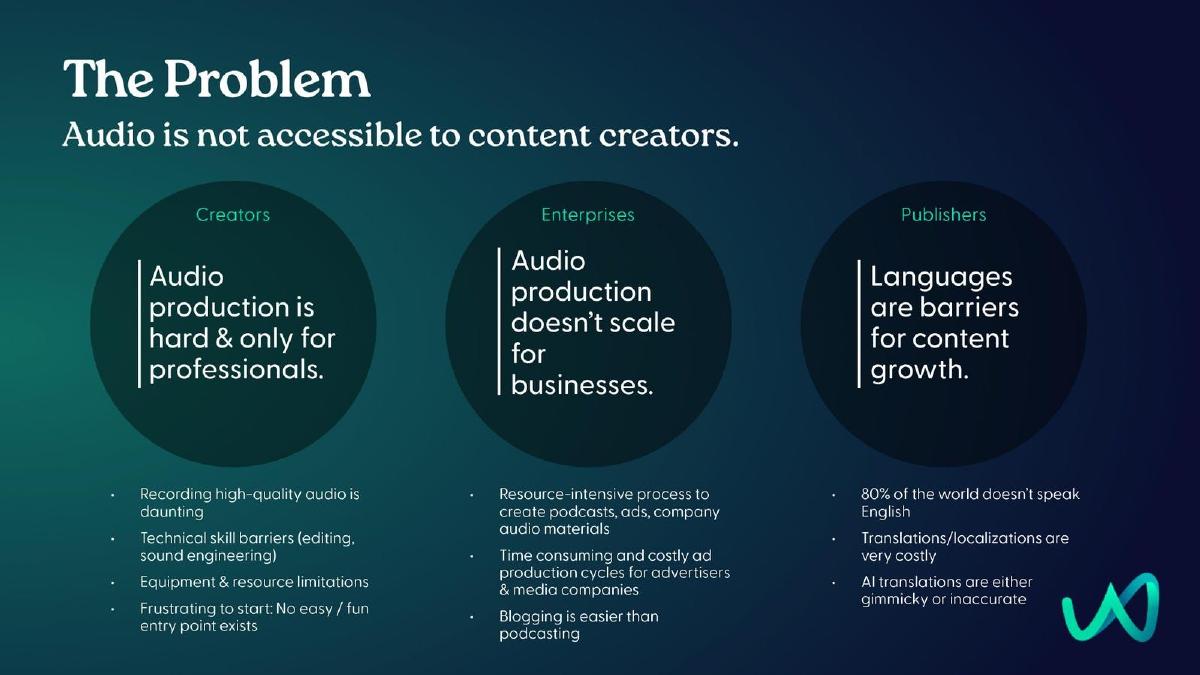
The problem is segmented into three buckets: Creators, Enterprises, and Publishers. For creators, the barrier is technical skill and equipment. For enterprises, the issue is that audio production does not scale. For publishers, the barrier is language, noting that "80% of the world doesn't speak English." By identifying these three distinct pain points, Wondercraft justifies why a horizontal platform is necessary rather than a niche tool.
Slide 4: The Solution (Product UI)
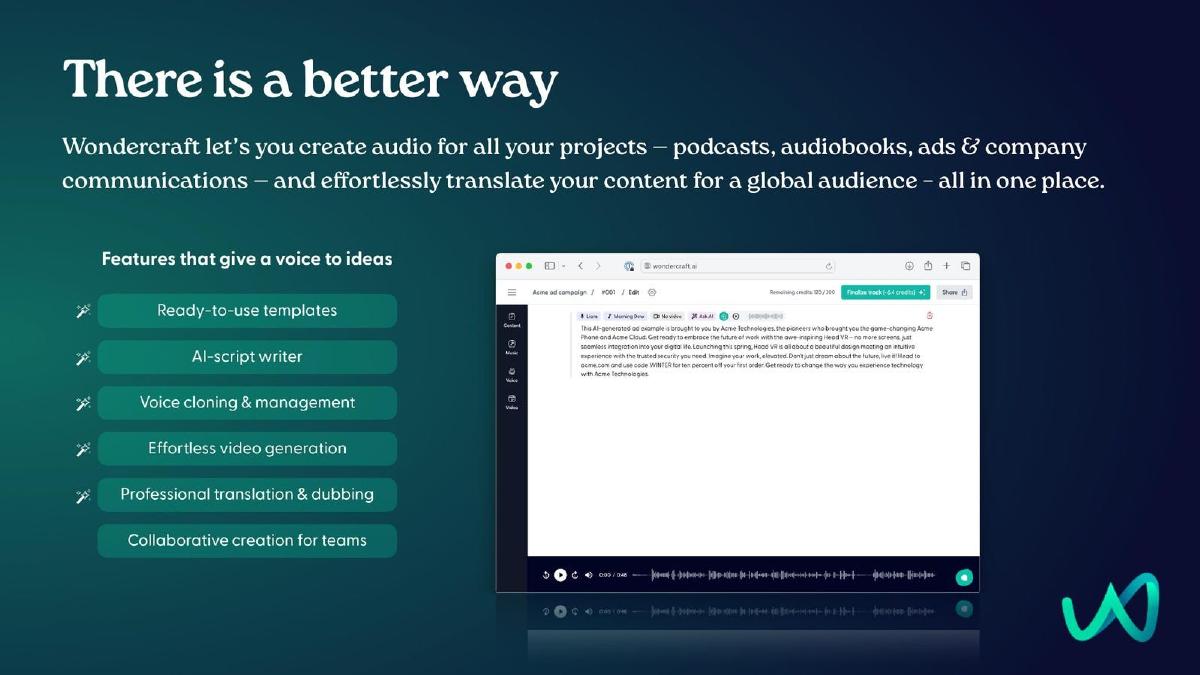
Slide 4 introduces the "better way" by showing a high-fidelity screenshot of the Wondercraft interface. The slide lists six key features: Ready-to-use templates, AI-script writer, Voice cloning & management, Effortless video generation, Professional translation & dubbing, and Collaborative creation for teams. The UI shows a script editor with time-stamped audio blocks, giving investors confidence that the product is functional and user-friendly.
Slide 5: Product Depth and Features
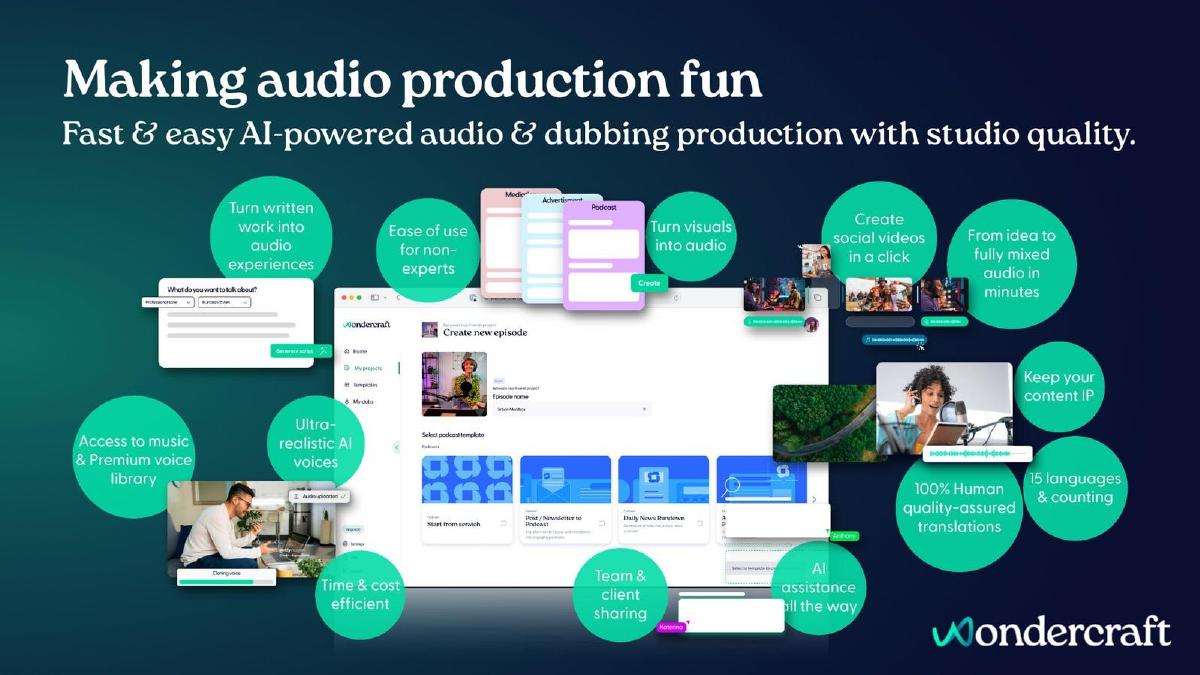
Titled "Making audio production fun," this slide is a collage of features and benefits. It reiterates the "studio quality" and "fast & easy" nature of the tool. Key callouts include "Ultra-realistic AI voices," "100% Human quality-assured translations," and "15 languages & counting." This slide aims to prove that the tool handles the entire production lifecycle, from "idea to fully mixed audio in minutes."
Slide 6: Market Opportunity
Wondercraft maps out the "Creator Markets" using a series of overlapping circles. They cite specific figures for 2023: $24Bn for Podcast Creators & Advertisers, $30Bn for YouTube & video creators, $40Bn for Music Streaming & Advertising, and $24Bn for Translation & dubbing services. They anchor these in a total "Creator Economy" valued at $250Bn in 2023, projected to reach $500Bn by 2030. The slide uses reputable sources like Statista, PwC, and Goldman Sachs to lend credibility to these massive numbers.
Slide 7: Target Personas
Slide 7, "The Wondercrafters," identifies nine specific customer segments. This is a crucial slide for a Seed round because it shows the founders have thought deeply about their Go-To-Market (GTM) strategy. They list Marketers, Brands, Podcasters, Newsletters, Media Publishers, Book Publishers, Agencies, Translators, and Educational Content Creators. Each segment has a specific value prop, such as "Scale your advertising operation" for media publishers or "Elevate e-learning" for educators.
Slide 8: Traction and Validation
This is arguably the strongest slide in the deck. It lists four major milestones: 30,000 users in beta since May 2023, the viral success of the Hacker News Recap Podcast, being named Product of the Month on Product Hunt, and being backed by Y Combinator. The right side of the slide features social media testimonials from X (formerly Twitter), including a shoutout from Jason Calacanis's "This Week in Startups." The bottom of the slide displays logos from Forbes, Wired, TechCrunch, and the Financial Times, providing massive third-party validation.
Slide 9: The Team
The final slide introduces the four-person core team. The pedigree is high: Oskar Serrander brings deep audio industry experience from Spotify, iHeartMedia, and Acast. Dimitris Nikolaou and Youssef Rizk provide the engineering and operations backbone with their history at Palantir. Julian Vossen, the founding engineer, adds academic weight from Imperial College London. This mix of "Engineering expertise paired with deep industry knowledge" is exactly what Seed investors look for in a technical AI play.
What Works in This Deck
Visual Hierarchy: The deck is professionally designed with a consistent color palette and clear typography. It avoids the 'wall of text' trap by using icons, circles, and UI screenshots to convey information.
Social Proof: Wondercraft leans heavily on its YC association and media mentions. For a Seed round, where financial metrics are often thin, these 'signals' are the primary currency of trust.
Clear Use Cases: Instead of selling 'AI audio,' they sell 'Audiobooks,' 'Podcasts,' and 'Ads.' This makes the technology feel practical and immediately billable.
What Is Missing
The Ask: The deck does not specify how much money they are raising, what the valuation is, or what the milestones for the next 18 months look like. While common in 'teaser' decks, a full pitch usually requires a 'Use of Funds' slide.
Unit Economics: There is no mention of pricing tiers, Customer Acquisition Cost (CAC), or Lifetime Value (LTV). While it is early for a Seed company, some indication of the business model (SaaS vs. Credit-based) would be helpful.
Competitive Landscape: The deck does not address competitors like ElevenLabs, Descript, or Murf. Investors will inevitably ask how Wondercraft defends its position against these well-funded incumbents.
Founder's Playbook: What to Copy
The Persona Grid: Copy the way Slide 7 breaks down the market. By showing nine different ways to use the product, you expand your perceived Total Addressable Market (TAM) without needing to change your core technology.
The Traction Collage: Slide 8 is a perfect template for early-stage startups. If you don't have $1M in ARR, you must show 'momentum.' Combining user counts, awards, and social media screenshots creates a sense of inevitability.
Pedigree Mapping: If your team has worked at 'Big Tech' or industry leaders, put those logos front and center on the team slide. Wondercraft's use of the Spotify and Palantir logos immediately communicates that they have the 'DNA' to build and scale this specific product.
Frequently asked questions
- How much did Wondercraft raise with this deck?
- According to publisher reports from Business Insider, Wondercraft raised $3M in a Seed round in 2024. The deck itself does not state the amount being raised or the terms of the round.
- What is the primary value proposition of the platform?
- Wondercraft aims to be the 'Canva of audio.' As stated on Slide 2, it provides an easy way to create studio-quality audio for podcasts, audiobooks, and ads in any language simply by typing, removing the need for expensive equipment or technical editing skills.
- Who are the founders of Wondercraft?
- The founding team consists of Oskar Serrander (Business Development, ex-Spotify/Acast), Dimitris Nikolaou (Product & Operations, ex-Palantir), and Youssef Rizk (Engineering, ex-Palantir), supported by founding engineer Julian Vossen (Slide 9).
- What specific traction did the company show?
- Slide 8 highlights 30,000 beta users since May 2023, the viral success of the 'Hacker News Recap' podcast, a Product Hunt 'Product of the Month' win, and participation in Y Combinator.
- What languages does the platform support?
- Slide 5 notes that the platform supports 15 languages and counting, specifically targeting the problem that 80% of the world does not speak English (Slide 3).