Condense is a European deep-tech startup that raised a $4.5M Seed round to solve a specific limitation in virtual events: the lack of true live interaction. While massive concerts in Fortnite featuring Travis Scott and Ariana Grande proved the market's scale, Condense points out these were pre-recorded animations. Their technology acts as a 'pipe' to stream real-world 3D video into game engines like Roblox and Rec Room in real-time. The deck relies heavily on a strong management team with a previous exit to Twitter and a clear dual-revenue model consisting of software licenses and infrastruct…
Key takeaways
- The deck identifies a major market gap: current virtual concerts are pre-recorded animations rather than live performances (Slide 2).
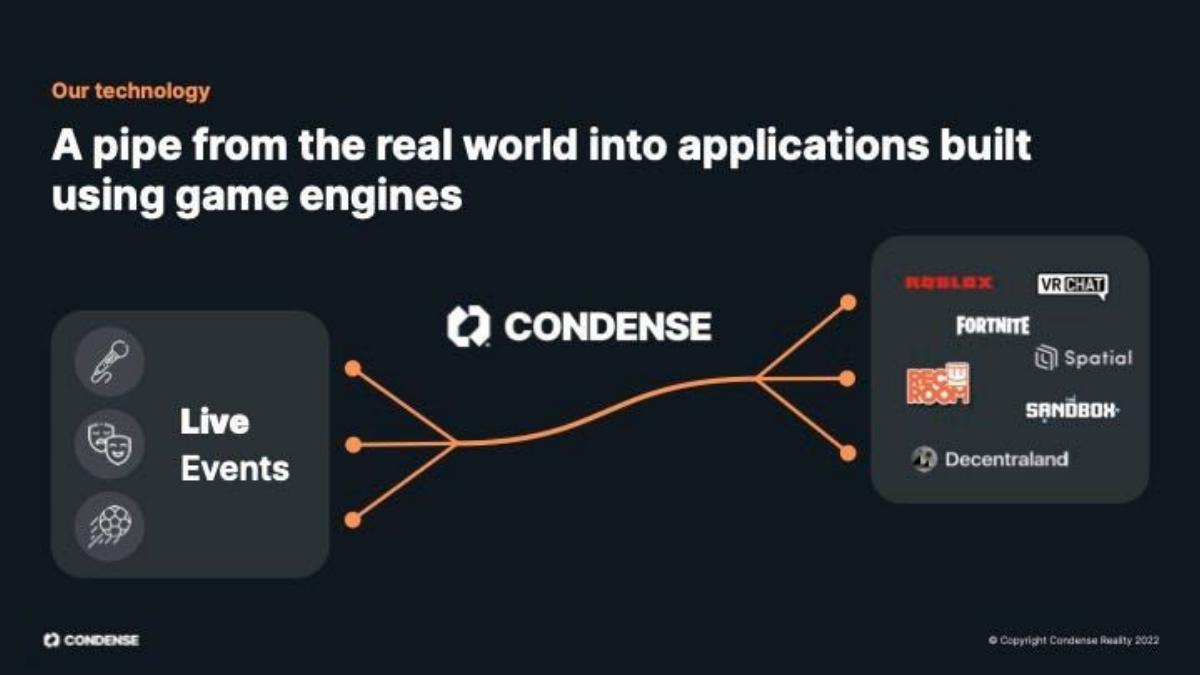
- Condense positions its technology as a universal 'pipe' connecting live events to multiple game engines including Fortnite, Roblox, and Decentraland (Slide 3).
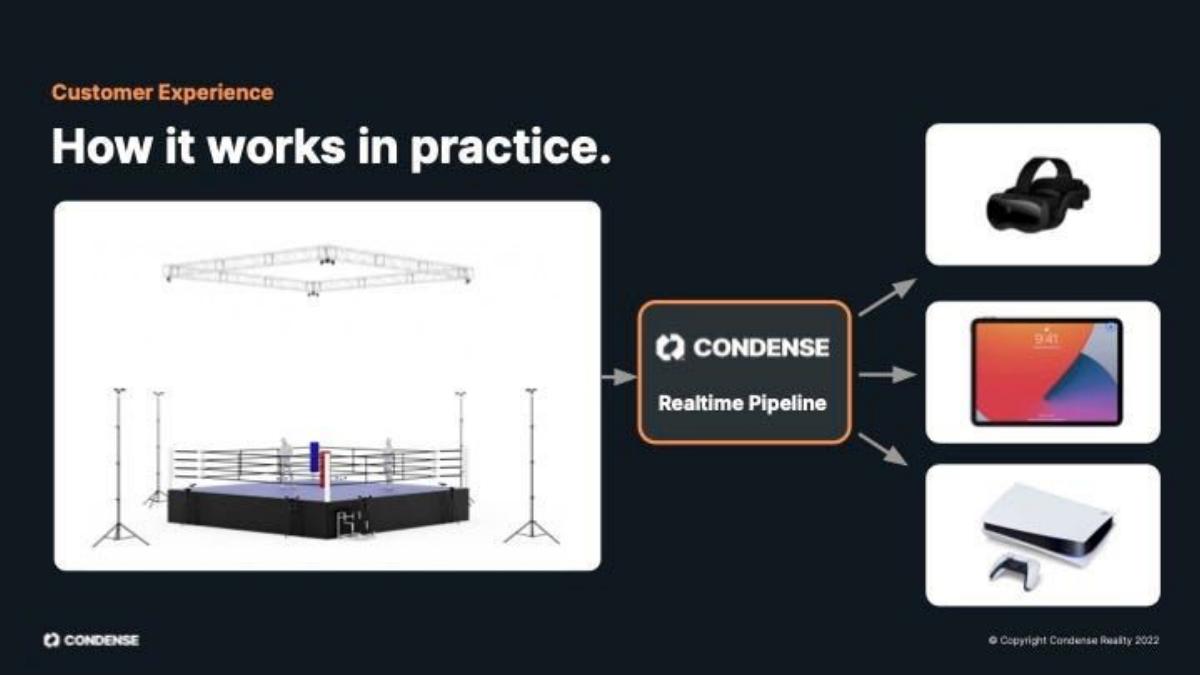
- The product vision extends beyond gaming to augmented reality home entertainment, such as 3D boxing matches on a coffee table (Slide 4).
- A dual-revenue model is proposed, combining a yearly software license for creators with per-minute streaming fees for infrastructure (Slide 6).
- The company identifies 'Minutes streamed per month' as its North Star Metric for growth (Slide 6).
- Market sizing is calculated by filtering 2.8 billion gamers down to 1 billion who spend money on virtual items, resulting in a $9BN potential revenue target (Slide 7).
- The founding team features deep domain expertise, including a CTO who headed live video engineering at Twitter and a COO with a previous exit to Twitter (Slide 8).
- The deck uses a 'Deep Learning Moat' diagram to explain how more data from live captures leads to improved quality and increased demand (Slide 5).
The Vision: Real-Time 3D Streaming for the Metaverse
Condense entered the market during a period of high interest in virtual environments, often referred to as the metaverse. While many companies focused on building the worlds themselves, Condense focused on the plumbing. As reported by Business Insider, the company raised $4.5M in a 2024 Seed round to commercialize their 3D live-streaming technology. The deck is a masterclass in identifying a specific technical limitation in a popular trend and positioning a product as the definitive solution.
Slide 1: Title Slide
The opening slide is minimalist, featuring the Condense logo and the tagline: "Streaming live events into the metaverse." It establishes the category immediately without unnecessary jargon.
Slide 2: The Problem and Opportunity
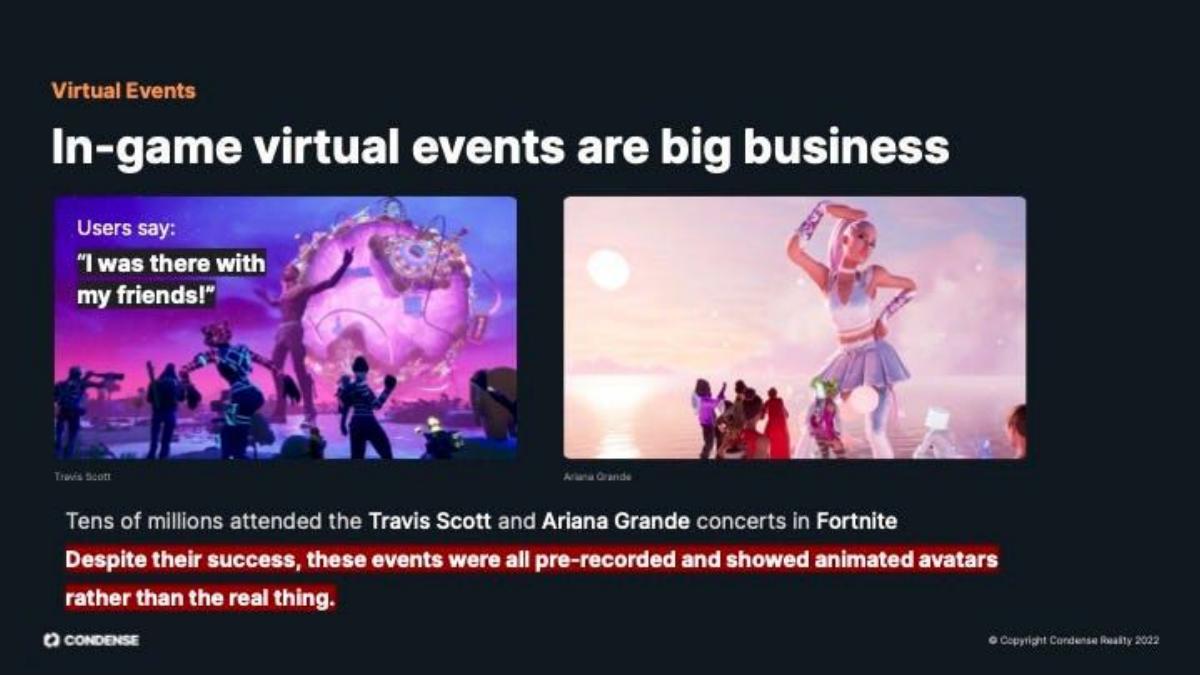
Slide 2, titled "Virtual Events: In-game virtual events are big business," uses massive cultural touchpoints to validate the market. It cites the Travis Scott and Ariana Grande concerts in Fortnite, noting that "tens of millions" attended. However, the slide contains a critical red-text callout: "Despite their success, these events were all pre-recorded and showed animated avatars rather than the real thing." This identifies the 'enemy'—pre-recorded animation—and sets the stage for Condense's live 3D video solution.
Slide 3: The Technology as a Pipe
Slide 3 provides a high-level architectural view. It describes the product as "A pipe from the real world into applications built using game engines." The graphic shows "Live Events" (represented by icons for music, theater, and sports) flowing through Condense into a variety of platforms including Roblox, Fortnite, Rec Room, VRChat, Spatial, The Sandbox, and Decentraland. This positioning is vital because it suggests Condense is platform-agnostic; they aren't competing with Roblox, they are enabling it.
Slide 4: Future Use Cases
Slide 4 shifts from the current state of gaming to the future of home entertainment. It features a conceptual image of people wearing AR glasses in a living room, watching a 3D boxing match ("Cooper v Reading") projected onto their coffee table. The text states, "Our technology has the potential to transform entertainment." This slide serves to expand the investor's imagination beyond just 'kids playing Fortnite' to a broader AR/VR hardware play.
Slide 5: The Data Moat
Slide 5 addresses the question of defensibility. Titled "Deep learning improves quality and provides a moat," it uses a double-loop feedback diagram. The 'Product' loop shows that live capture leads to more data, which leads to improved quality through deep learning. The 'Business' loop shows that improved quality leads to more events, increased demand, and organic marketing. This argues that the more the platform is used, the harder it becomes for competitors to catch up in terms of visual fidelity.
Slide 6: Revenue Streams
The business model on Slide 6 is clear and follows standard SaaS/IaaS patterns. They list two primary streams: Licence Fee (Yearly software license for content creation) and Infrastructure as a Service (Streaming costs per/min streamed to end users). Crucially, they define their North Star Metric as "Minutes streamed per month," which gives investors a clear KPI to track in future board meetings.
Slide 7: Market Sizing (TAM)
Slide 7 uses a funnel approach to calculate market size. It starts with 2.8 billion gamers, narrows to 1.54 billion who use games to socialize, and finally to 1 billion who spend money on virtual items. By applying an estimated $85 yearly spend per user, they arrive at a TAM of $91BN. They then project a "Potential streaming revenue for Condense" of $9BN, based on a 10% capture rate. While the 10% figure is an assumption, the funnel logic is sound.
Slide 8: The Management Team
The final slide in this set focuses on the team, titled "Experienced entrepreneurs with previous exit to Twitter." This is a high-signal slide. It lists CEO Nick Fellingham, CTO Dan Fairs (formerly head of live video engineering at Twitter), CSO Dr. Ollie Feroze (computer vision expert), and COO Andy Littledale (whose previous startup was acquired by Twitter). Having a team that has already built and sold video infrastructure to a major social network significantly de-risks the technical execution for Seed investors.
What Condense Does Well
The Condense deck excels at contrast . By highlighting that the world's most famous virtual concerts were actually "pre-recorded animations," they create an immediate 'aha' moment for the investor. They aren't just adding another feature to the metaverse; they are fixing a fundamental flaw in the current user experience.
Furthermore, the platform-agnostic positioning on Slide 3 is a strategic masterstroke. Instead of picking a winner in the 'metaverse wars,' Condense positions itself as the toll booth that every artist must pass through to reach any of these audiences. This makes the business model feel much more resilient to the shifting popularity of individual games.
What is Missing from the Deck
While the technical and team slides are strong, the deck (as presented in these 16 slides) lacks unit economics . While they mention a $9BN potential revenue, they do not provide the specific cost of the yearly license or the exact margin on the per-minute streaming fee. For a Seed round, this is common, but sophisticated investors would eventually want to see the relationship between the cost of 3D capture and the revenue generated per stream.
There is also no competitor slide . While they mention that current events are pre-recorded, they don't address other volumetric capture companies (like Microsoft Mixed Reality Capture Studios or 8i). Acknowledging the competitive landscape and explaining why their 'live' capability is technically superior or more scalable would have strengthened the 'moat' argument.
Founder Takeaways
Identify the 'Fake' Version: If your industry is currently using a workaround (like pre-recorded animations instead of live video), point it out clearly. Highlighting the limitations of the status quo makes your solution feel inevitable. · Define Your North Star: Don't just list revenue. Tell investors exactly which metric (e.g., "Minutes streamed") drives your business. It shows you understand your own growth levers. · Leverage Past Wins: If your team has an exit or worked at a relevant tech giant (like Twitter for video), make that the headline of your team slide. Pedigree is a powerful shortcut to trust in deep-tech fundraising. · Visual Use Cases: Use high-quality conceptual imagery (like the boxing match on the coffee table) to show the long-term vision. It helps investors see your company as a platform rather than just a single-feature tool.
Frequently asked questions
- What is the primary problem Condense is solving?
- Condense addresses the 'authenticity gap' in virtual events. As noted on Slide 2, even record-breaking virtual concerts like those of Travis Scott were pre-recorded and used animated avatars. Condense provides the technology to stream real-world, 3D video of artists into these environments live, allowing for actual real-time interaction and performance.
- How does Condense plan to make money?
- According to Slide 6, the company uses a two-pronged business model. First, they charge a 'Licence Fee,' which is a yearly software license for content creation. Second, they operate as 'Infrastructure as a Service,' charging streaming costs per minute for content delivered to end users.
- Which platforms is Condense compatible with?
- Slide 3 illustrates that Condense acts as a bridge to various applications built on game engines. Specific logos shown include Roblox, Fortnite, Rec Room, VRChat, Spatial, The Sandbox, and Decentraland.
- What is the background of the Condense founding team?
- The team has significant high-level tech experience. Slide 8 highlights that CTO Dan Fairs headed live video engineering at Twitter, and COO Andy Littledale founded a TV analytics startup that was acquired by Twitter. The team also includes a computer vision expert and a university professor as an advisor.
- What is the 'North Star Metric' for this business?
- As stated on Slide 6, Condense focuses on 'Minutes streamed per month.' This metric aligns with their Infrastructure as a Service revenue model, where they earn fees based on the volume of content consumed by end users.