Connectly’s 16-slide deck is a masterclass in platform-specific positioning. By anchoring their value proposition to the massive reach of WhatsApp (2.5B+ users) and the broader CPaaS market ($72B TAM), they create a compelling narrative for investors. The deck effectively balances high-level vision with granular product features like unified inboxes and in-thread transactions. Notable for its strong team pedigree—featuring alumni from Facebook, Google, and Uber—the presentation uses social proof through diverse case studies (Treinta and ISA Lab) to validate its 2-way messaging model. While it…
Key takeaways
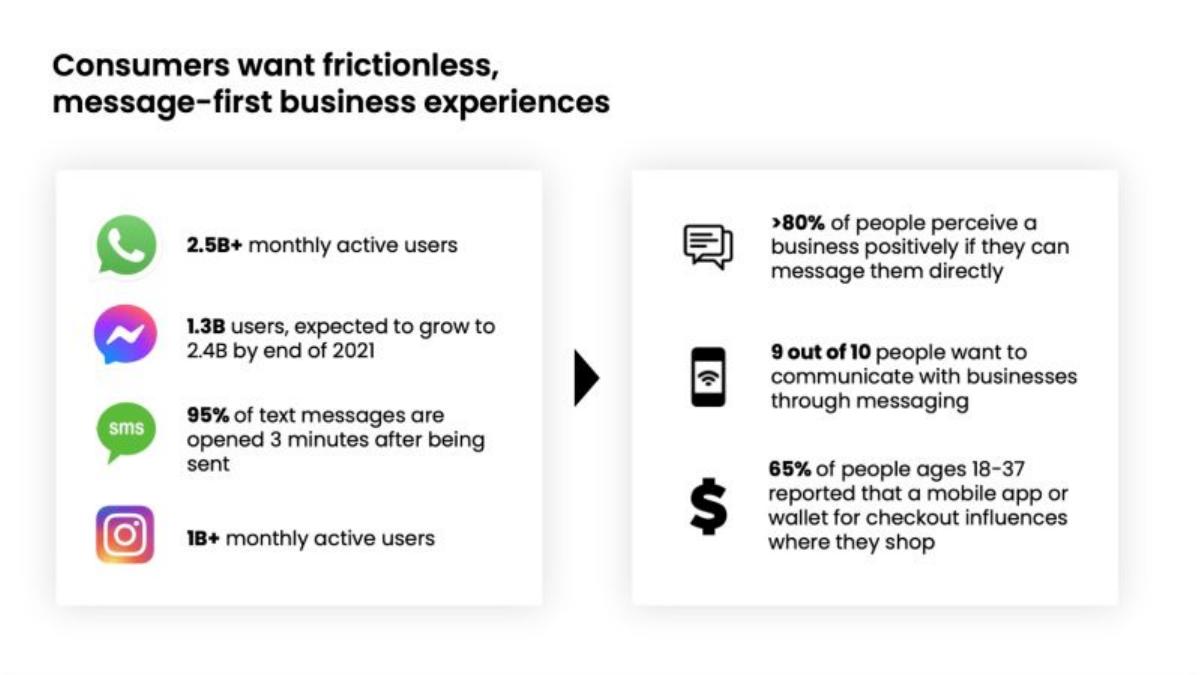
- The platform targets a massive user base, citing 2.5B+ monthly active users on WhatsApp and 1.3B on Messenger (Slide 3).
- Connectly identifies a 'personalization gap' where 80% of marketers are expected to drop personalized advertising by 2025 (Slide 5).
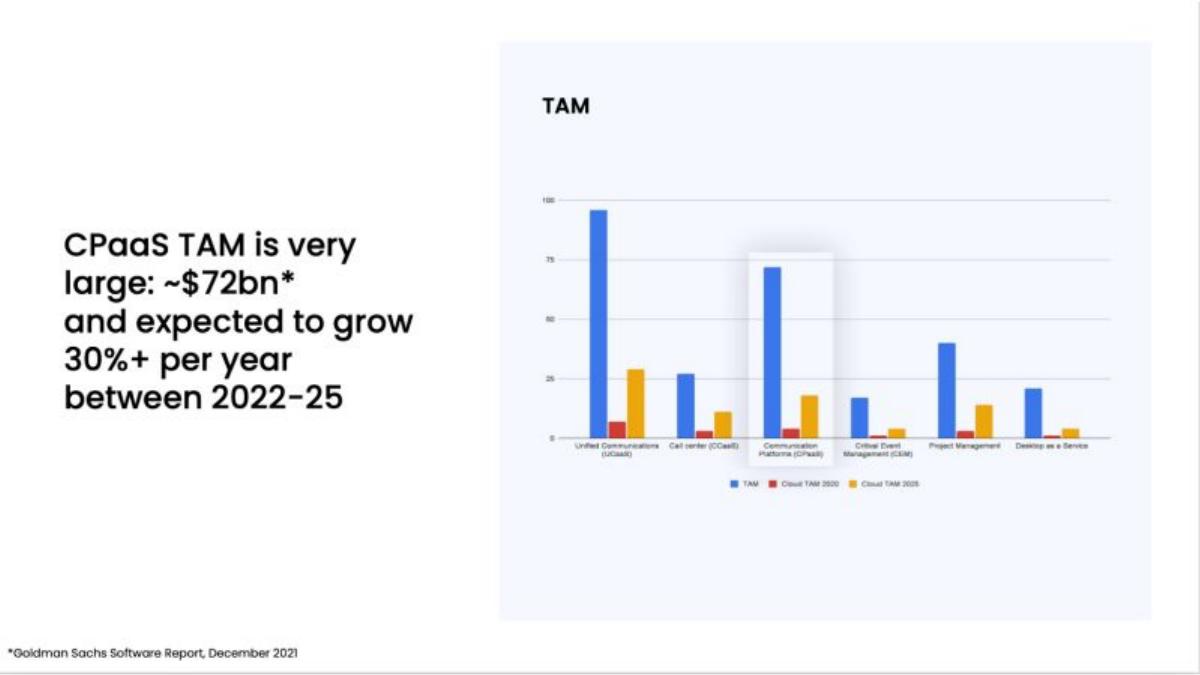
- The total addressable market (TAM) for CPaaS is valued at ~$72bn with a 30%+ annual growth rate (Slide 6).
- The product offers a unified inbox and deep integrations with Shopify profiles to facilitate 2-way dialogue (Slide 7).
- Connectly is a verified WhatsApp Business Solution Provider (BSP), granting them direct API access (Slide 9).
- The company reported approximately 60 customers at the time of the deck, with top markets in Brazil, India, the US, and Indonesia (Slide 10).
- Case studies show significant ROI, such as a 10x performance improvement over other channels for Treinta (Slide 12).
- The business model combines flat subscriptions with a 5-20% margin on message costs and a percentage of transaction values (Slide 14).
Executive Summary and Team Pedigree
Slide 1: Vision
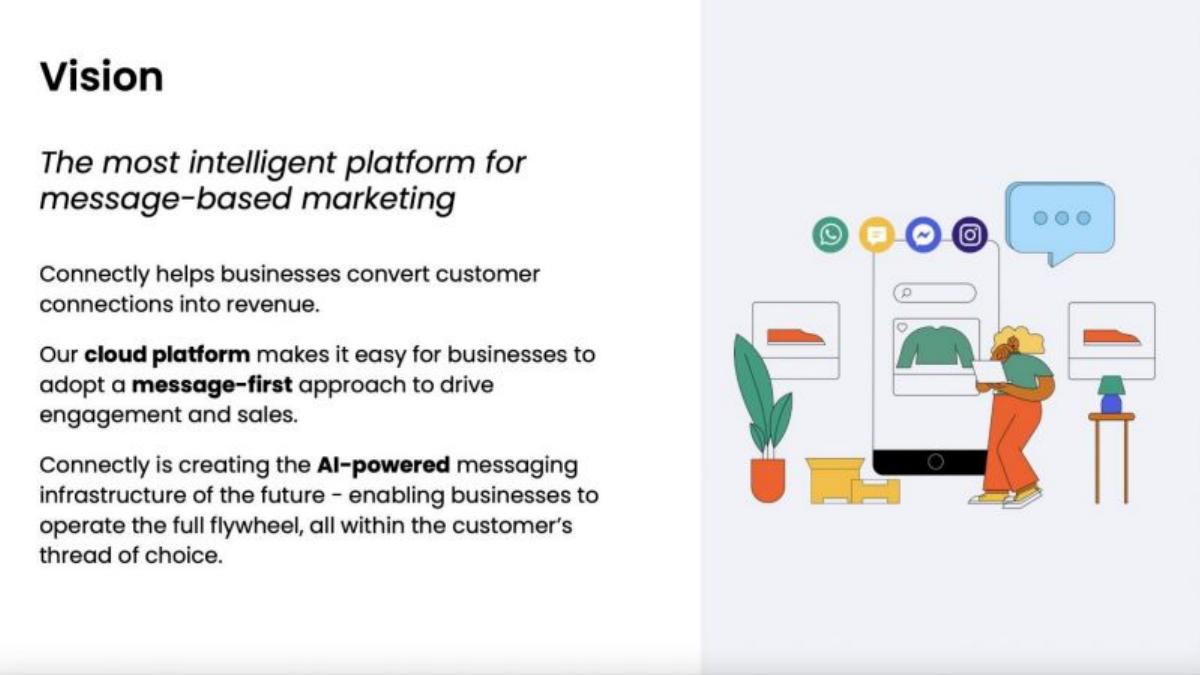
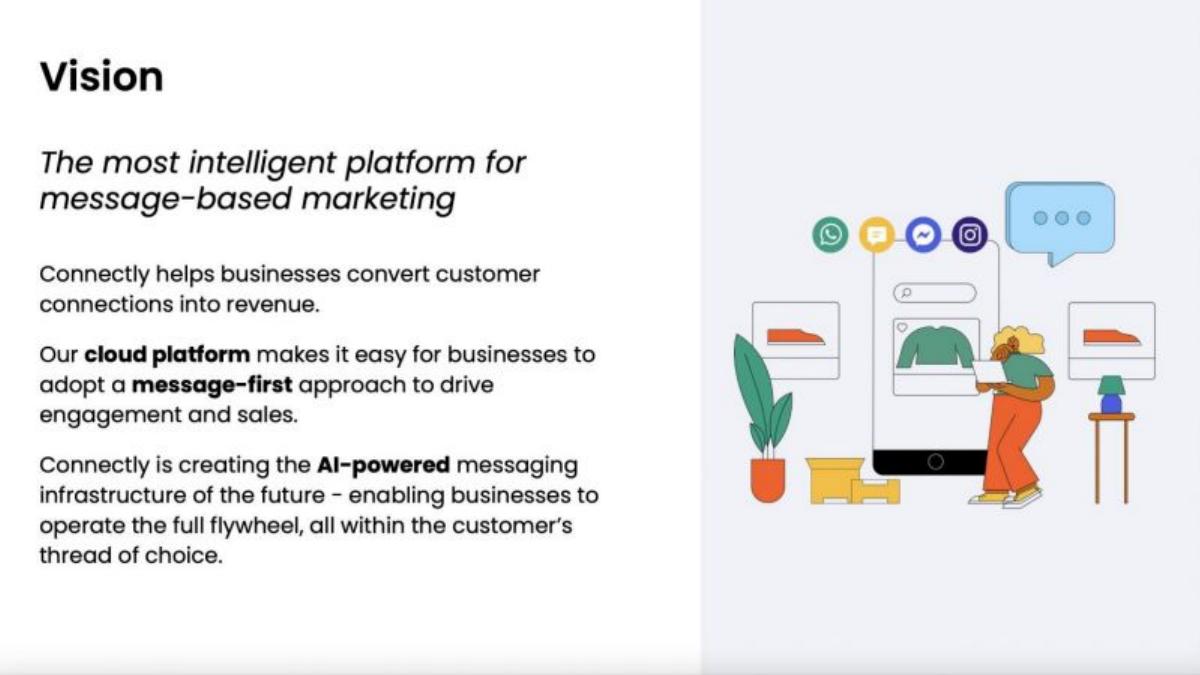
The deck opens with a clear vision statement: "The most intelligent platform for message-based marketing." It positions Connectly as a cloud platform that helps businesses adopt a "message-first" approach to drive sales. The slide emphasizes an AI-powered infrastructure that operates the full customer flywheel within a single messaging thread. The visual shows a user interacting with various Meta-owned platforms (WhatsApp, Messenger, Instagram), establishing the company's ecosystem focus immediately.
Slide 2: Team
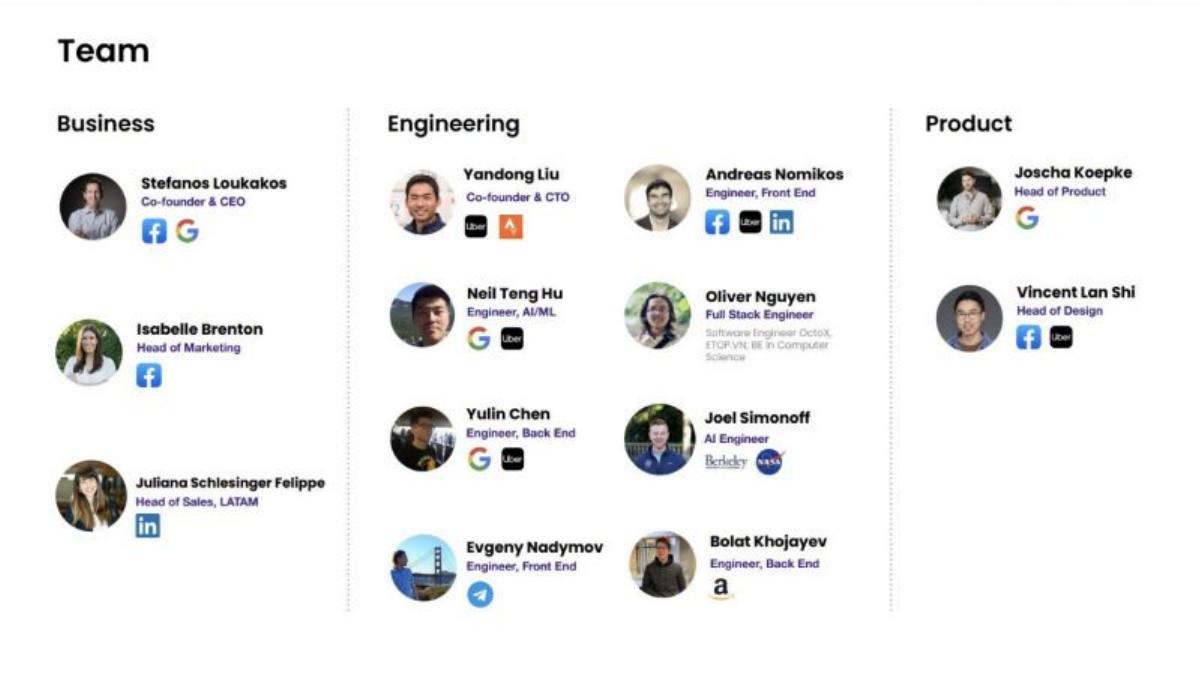
This is a high-signal team slide. The founders, Stefanos Loukakos (CEO) and Yandong Liu (CTO), bring experience from Facebook, Google, and Uber. The broader team is categorized into Business, Engineering, and Product, with logos from NASA, Amazon, Berkeley, and Telegram appearing under various members. This slide serves to validate the technical and operational capability of the startup to handle complex messaging infrastructure at scale.
The Market Opportunity
Slide 3: Consumer Behavior
Connectly builds its case on massive user statistics. It cites 2.5B+ monthly active users for WhatsApp and 1B+ for Instagram. More importantly, it provides behavioral data: 9 out of 10 people want to communicate with businesses through messaging, and 95% of text messages are opened within 3 minutes. This establishes the "why now"—consumers are already on these platforms, but businesses are not yet meeting them there effectively.
Slide 4: The Problem with Current Solutions
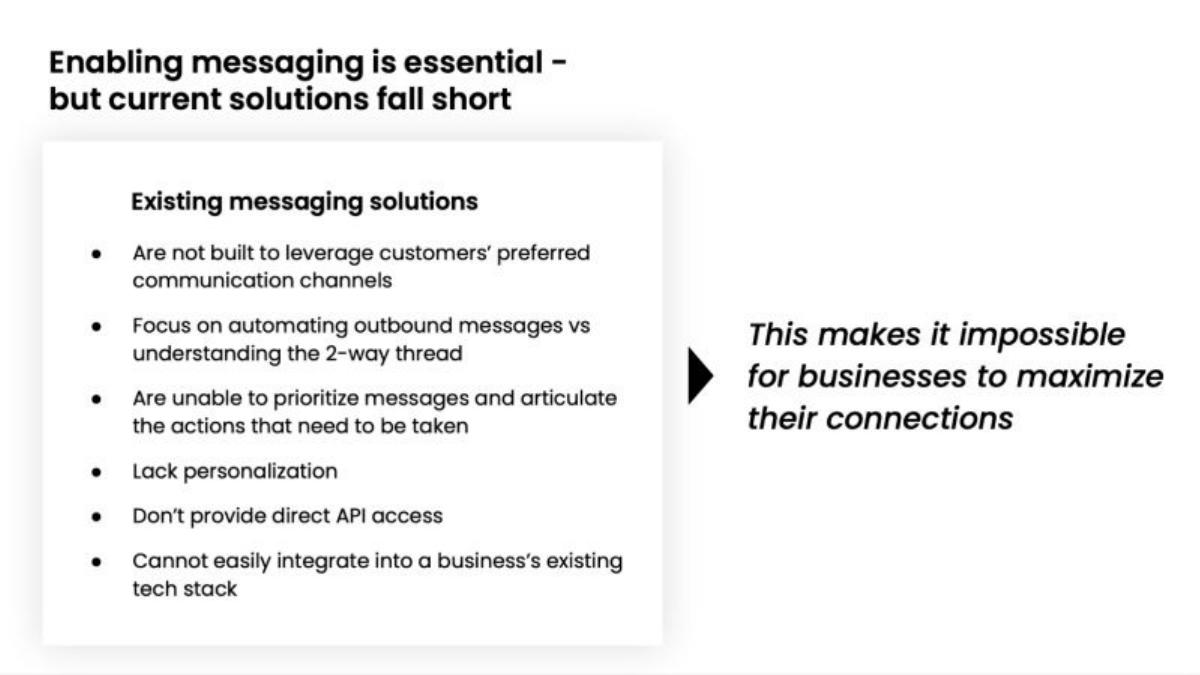
The deck identifies six specific failings of existing messaging solutions: they aren't built for preferred channels, they focus on outbound vs. 2-way threads, they can't prioritize messages, they lack personalization, they lack direct API access, and they are hard to integrate. This slide sets up the gap that Connectly intends to fill.
Slide 5: What We're Building
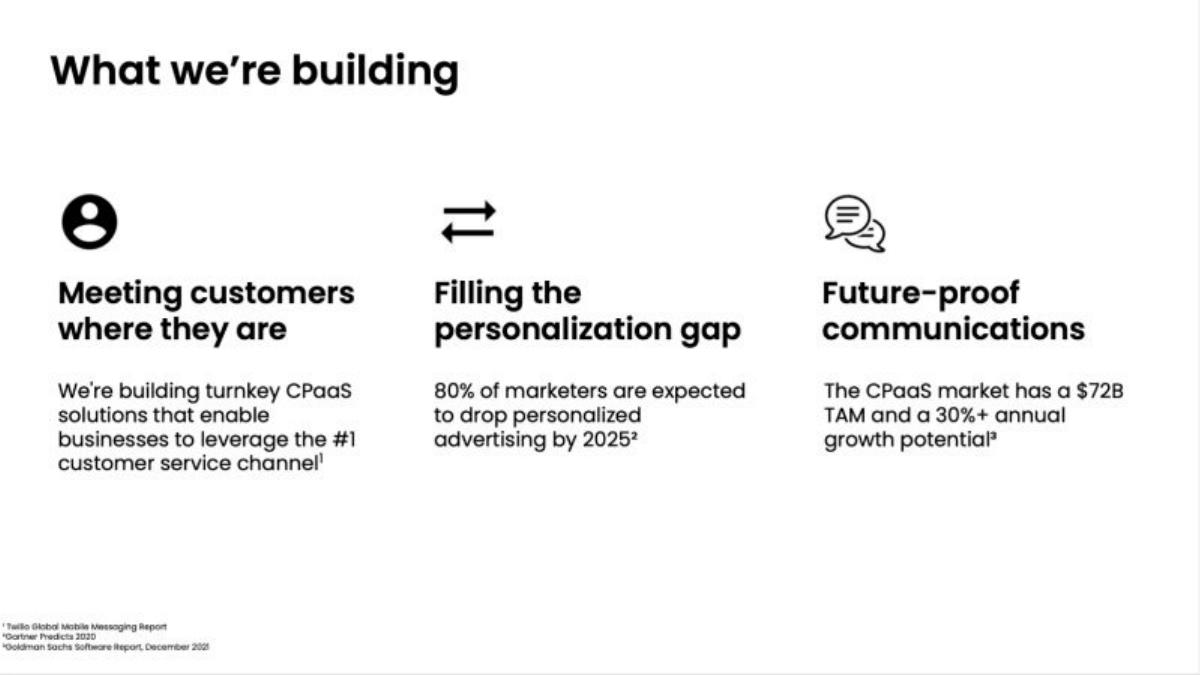
This slide bridges the problem to the solution. It highlights three pillars: meeting customers where they are (turnkey CPaaS), filling the personalization gap (noting that 80% of marketers will drop traditional personalized ads by 2025), and future-proofing communications within a $72B market.
Slide 6: Total Addressable Market (TAM)
Using data from a Goldman Sachs Software Report (December 2021), Connectly visualizes the CPaaS TAM at ~$72bn. The bar chart compares various sectors, showing Communication Platforms (CPaaS) as a high-growth area expected to expand by 30%+ annually between 2022 and 2025. This provides the macro-economic justification for the investment.
Product and Differentiation
Slide 7: Product Interface
This slide provides a visual walkthrough of the software. Key features highlighted include a Unified Inbox, an Insight-driven dashboard, a Website widget, and CRM integrations (specifically showing a Shopify profile). It also notes automated notifications and marketing activation. The screenshot shows a clean, professional UI that manages multi-channel conversations in one place.
Slide 8: Conversion and Transactions
Connectly demonstrates the full funnel. The slide shows a mobile interface where a user can "Get Offer" via WhatsApp, receive a personalized message, and complete a transaction. This reinforces the "full flywheel" concept mentioned in the vision slide—moving from lead generation to conversion to transaction within the chat app.
Slide 9: Differentiation
The company leans into two main differentiators: being "Message-first" and "AI-powered." Crucially, they mention they are a "WhatsApp BSP" (Business Solution Provider), which is a significant barrier to entry and a mark of legitimacy in the Meta ecosystem. They also highlight no-code campaign builders and AI that helps businesses prioritize which messages to respond to first.
Traction and Social Proof
Slide 10: Learnings and Footprint
Connectly shares that they have approximately 60 customers. They identify their product-market fit as being best suited for "growing companies... and large companies that can move quickly." Their top markets are listed as Brazil, India, the US, and Indonesia, showing a strong international focus where WhatsApp dominance is highest.
Slide 11: Customer Logos
A standard but effective logo slide. It categorizes customers into Ecomm (e.g., More Labs, Needi), Fintech (e.g., Bitso, Nu, Carbon), and Other (e.g., Cadbury, Wolt, Aegean). The presence of large global brands like Cadbury alongside high-growth fintechs like Nubank (Nu) suggests the platform scales across different company sizes.
Slide 12 & 13: Case Studies
The deck provides two detailed case studies. For Treinta (a biz-tech startup), Connectly delivered 10x better performance than other channels, >80% read rates, and >60% CTR. For ISA Lab (a digital health lab), the platform automated 300 patient matches per day with a 60% response rate. These specific metrics move the narrative from theoretical benefits to proven ROI.
Business Model and Future
Slide 14: Business Model
This is a critical slide for investors. Connectly outlines a three-pronged revenue stream: 1) Flat subscription fees, 2) A 5-20% margin on the cost per message, and 3) A percentage of transaction value for in-thread payments. They also provide expected ACVs: $2k-$20k for SMBs and $30k-$200k+ for Enterprise. This shows a clear path to high-value contracts.
Slide 15: Product Roadmap
The roadmap is divided into "Now," "Next," and "Later." It moves from scaled 2-way communication to AI-enabled automation (prioritization and agent assistants) and finally to end-to-end CPaaS solutions for specific verticals like Fintech and Healthcare. It also mentions enabling cross-channel customer identity as a long-term goal.
Slide 16: Closing
The final slide is a generic placeholder from the source library and does not contain company-specific information or an 'Ask' for the round.
What Works and What is Missing
What Works: The deck is exceptionally strong on Team and Market Timing . By focusing on WhatsApp, they are riding a wave of consumer behavior that is already established but under-monetized by businesses. The inclusion of specific case study metrics (80% read rates) provides the "hard proof" needed for a Series A. The business model slide is also very transparent about how they make money beyond just SaaS seats.
What is Missing: There is no Competition slide. In the crowded CPaaS and marketing automation space, investors would want to know how they stack up against Twilio, MessageBird, or Gupshup. Additionally, the Financials are thin; while they mention 60 customers, there is no mention of current ARR or growth rates. Finally, the Ask is missing—we know from the catalogue they raised $4M, but the deck itself doesn't state the target or the use of proceeds.
Founder Takeaways
Anchor to a Giant: If your product relies on a major platform (like WhatsApp), lean into that platform's scale. Connectly uses Meta's 2.5B users as their own potential reach. · Quantify the 'Un-quantifiable': Marketing decks often talk about "engagement." Connectly uses specific case study numbers like "60% CTR" and "10x performance" to make engagement tangible. · Tiered Revenue Models: Don't just stick to a flat subscription. Connectly's model of subscription + message margin + transaction percentage shows they can capture value at every stage of the customer interaction. · Vertical Specificity: Even if your tool is horizontal, showing you understand specific verticals (Fintech, Healthcare) in your roadmap and customer list builds confidence that you can solve industry-specific compliance or workflow needs.
Frequently asked questions
- What is Connectly's primary value proposition?
- Connectly positions itself as an 'intelligent platform for message-based marketing.' It enables businesses to convert customer connections into revenue by facilitating 2-way dialogues on platforms like WhatsApp, Instagram, and Facebook Messenger. The core focus is moving away from one-way outbound automation toward a message-first approach that handles the full sales flywheel within a single chat thread.
- How does Connectly differentiate itself from existing messaging tools?
- According to Slide 4 and Slide 9, existing solutions focus on outbound automation and lack personalization or direct API access. Connectly differentiates by being an official WhatsApp Business Solution Provider (BSP) with direct API access, offering no-code campaign builders, and using AI to interpret and prioritize 2-way conversations rather than just sending bulk notifications.
- What are the key markets and verticals for the company?
- Slide 10 identifies Brazil, India, the US, and Indonesia as the top markets. The product is primarily used in eCommerce, Fintech, Travel, and Healthcare. Their customer list on Slide 11 includes recognizable names like Cadbury, Aegean, and Bitso, showing a broad geographic and sectoral reach.
- What does the revenue model look like?
- The business model is multi-layered (Slide 14). It includes a flat monthly license fee for tools, a 5-20% margin on the cost per message (WhatsApp/SMS), and a percentage of transaction value for payments made within the thread. Expected annual contract values (ACVs) range from $2k-$20k for SMBs to over $200k for enterprise clients.
- What is missing from this pitch deck?
- The deck lacks a specific 'Ask' slide detailing the exact amount of capital being raised and the intended use of funds. It also omits a detailed competition matrix and historical financial growth charts (e.g., MRR growth over time), though it does provide a current customer count of ~60.