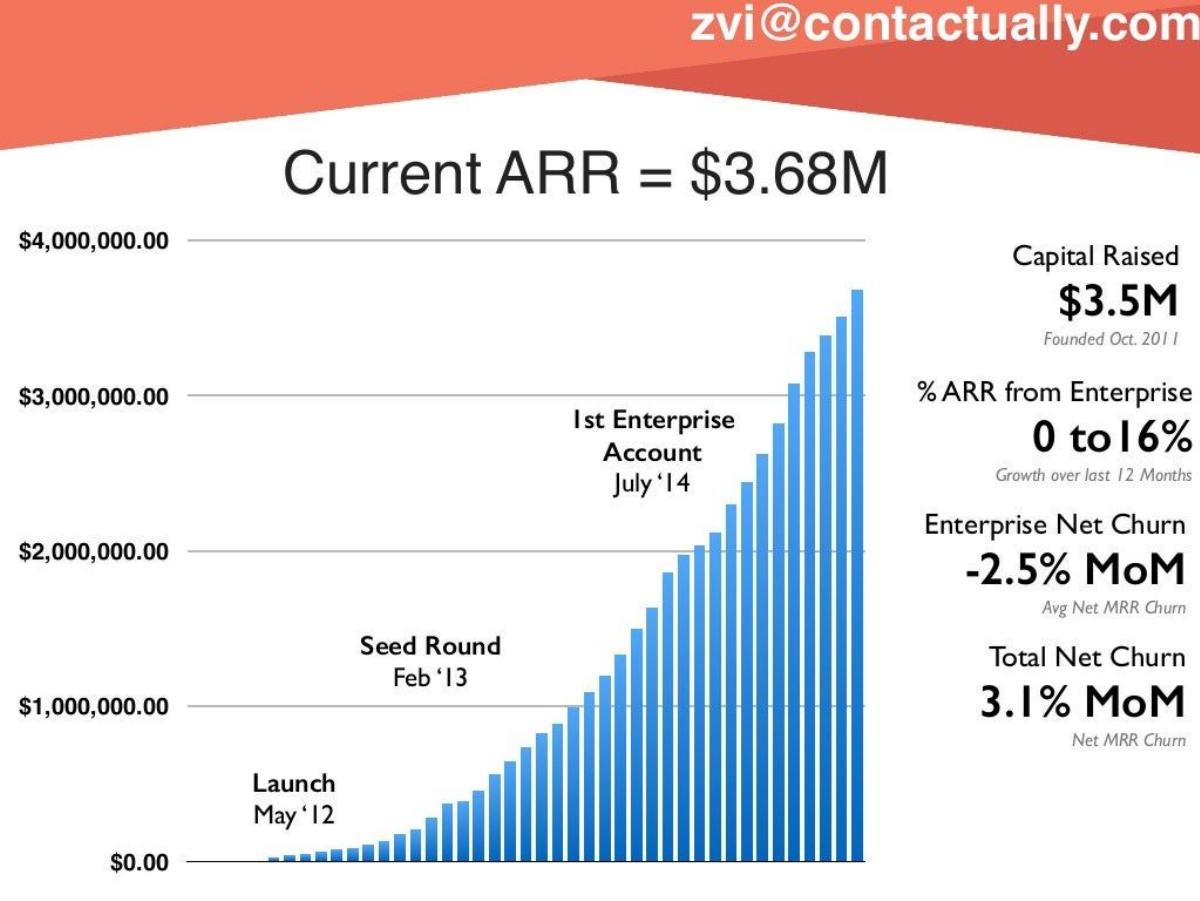
Contactually’s 2016 deck is a concise, data-driven presentation that successfully argues for the necessity of a 'non-transactional' CRM. At the time of this deck, the company had reached $3.68M in ARR with a notable shift toward enterprise accounts, which grew from 0% to 16% of ARR in just 12 months (Slide 6). The deck relies heavily on quantifiable outcomes rather than just features, citing a 34% increase in referrals for its users (Slide 3). While the deck lacks a specific 'Ask' slide regarding valuation or terms, it provides a transparent look at unit economics, including a $140 CAC and $1…
Key takeaways
- The company identifies a specific market of 7.8M professional services workers where referrals drive 85% of business (Slide 2).
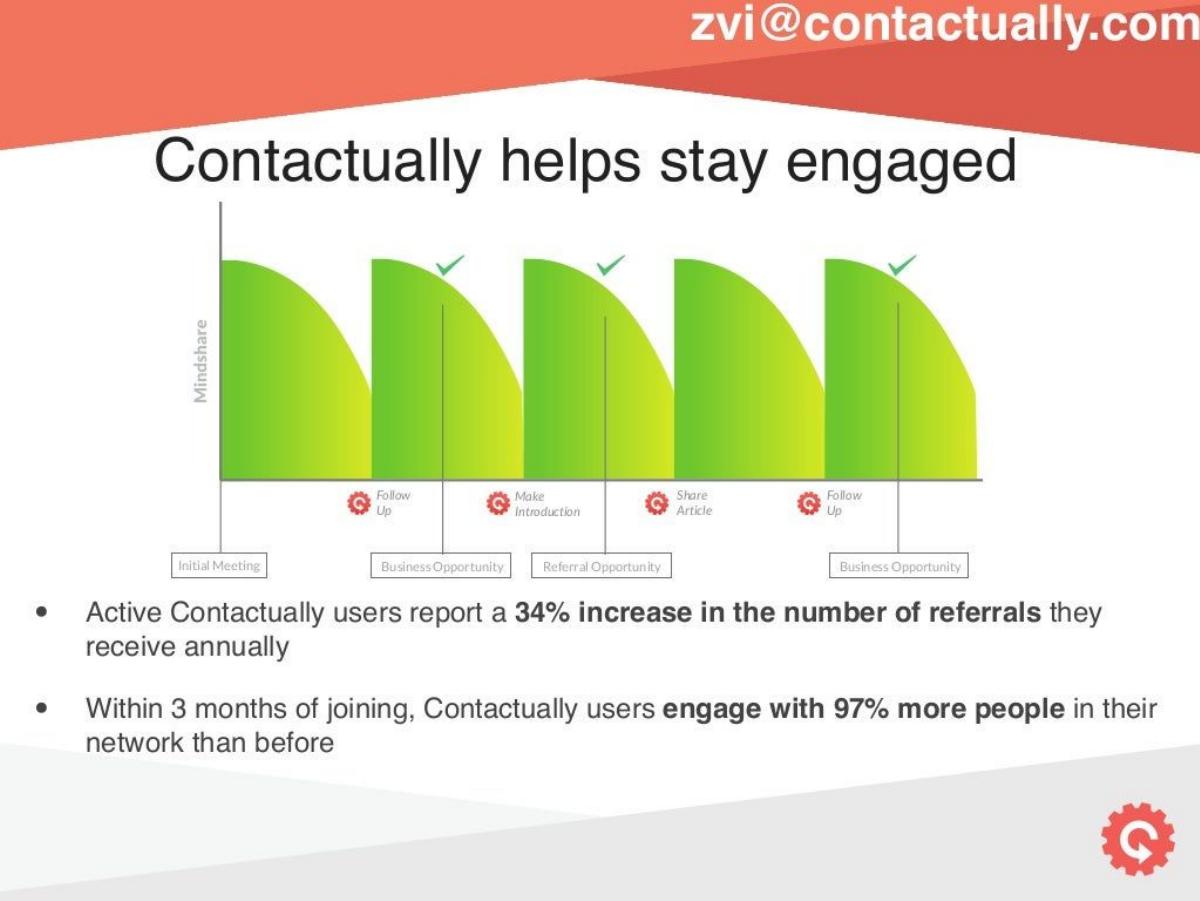
- Product efficacy is validated by a 97% increase in network engagement within three months of joining (Slide 3).
- The business demonstrated significant scale with $3.68M ARR and a launch date of May 2012 (Slide 6).
- Enterprise expansion is a core growth lever, showing -2.5% MoM net churn for enterprise accounts compared to 3.1% for the total base (Slide 6).
- The unit economics for individual users are healthy, with a $508 ACV and a CAC of $140, implying a quick payback period (Slide 7).
- The deck targets a 'gap' in the $36.5B CRM market, arguing that existing CRMs fail to drive bottom-up adoption (Slide 8).
- The founding team has relevant pedigree, including a previous acquisition (Workstreamer) and education from MIT and Princeton (Slide 10).
- The investor list is prestigious for the stage, featuring Point Nine Capital, 500 Startups, and founders of YouTube and Nuzzle (Slide 10).
Executive Summary: The Relationship CRM
Contactually’s 2016 pitch deck is a 10-slide document used during a period of significant transition for the company. Positioned as a CRM for professional services, the deck highlights a move from serving individual real estate agents to securing large enterprise contracts with firms like RE/MAX and Keller Williams. With $3.68M in ARR and a proven 'land and expand' model, the deck focuses on the quantifiable ROI the software provides to its users.
Slide 1: Title Slide
The deck opens with a clean title slide. It identifies Zvi Band as the CEO and provides a clear tagline: "Contactually powers great relationships. CRM for Professional Services." The inclusion of the CEO's email address in the header of every slide is a notable tactical choice for accessibility.
Slide 2: The Problem - Mindshare Decay
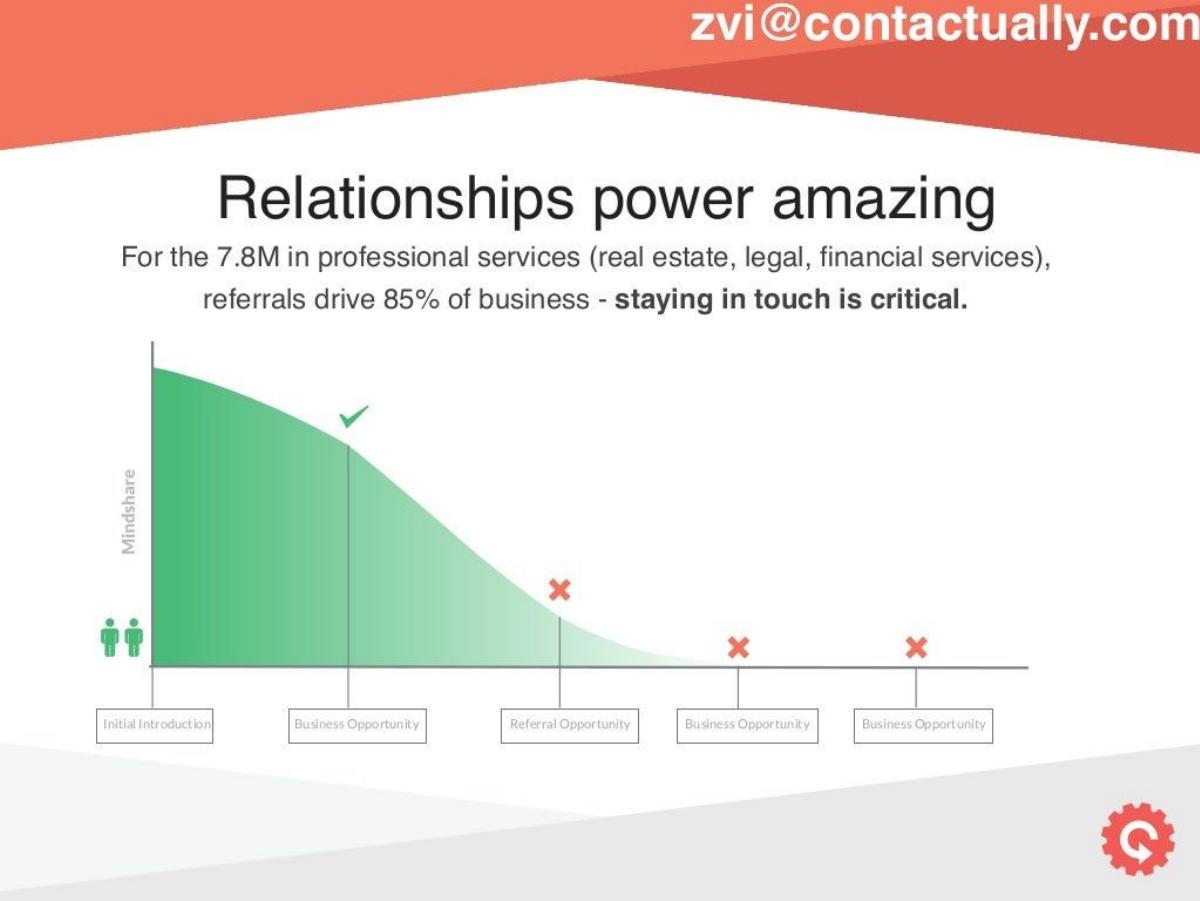
Slide 2 frames the problem through the lens of "Mindshare." It targets a market of 7.8M professionals in real estate, legal, and financial services. The core insight is that 85% of business in these sectors is driven by referrals. A decay curve graph shows that after an initial introduction, mindshare drops rapidly, leading to missed business and referral opportunities. This slide successfully quantifies the cost of inaction.
Slide 3: The Solution - Staying Engaged
The solution slide mirrors the graph from the previous slide but shows 'Mindshare' being maintained through automated or prompted actions: Follow Up, Make Introduction, and Share Article. The slide includes two powerful traction metrics: active users see a 34% increase in referrals and engage with 97% more people in their network within three months.
Slide 4: Product Interface - Individual View
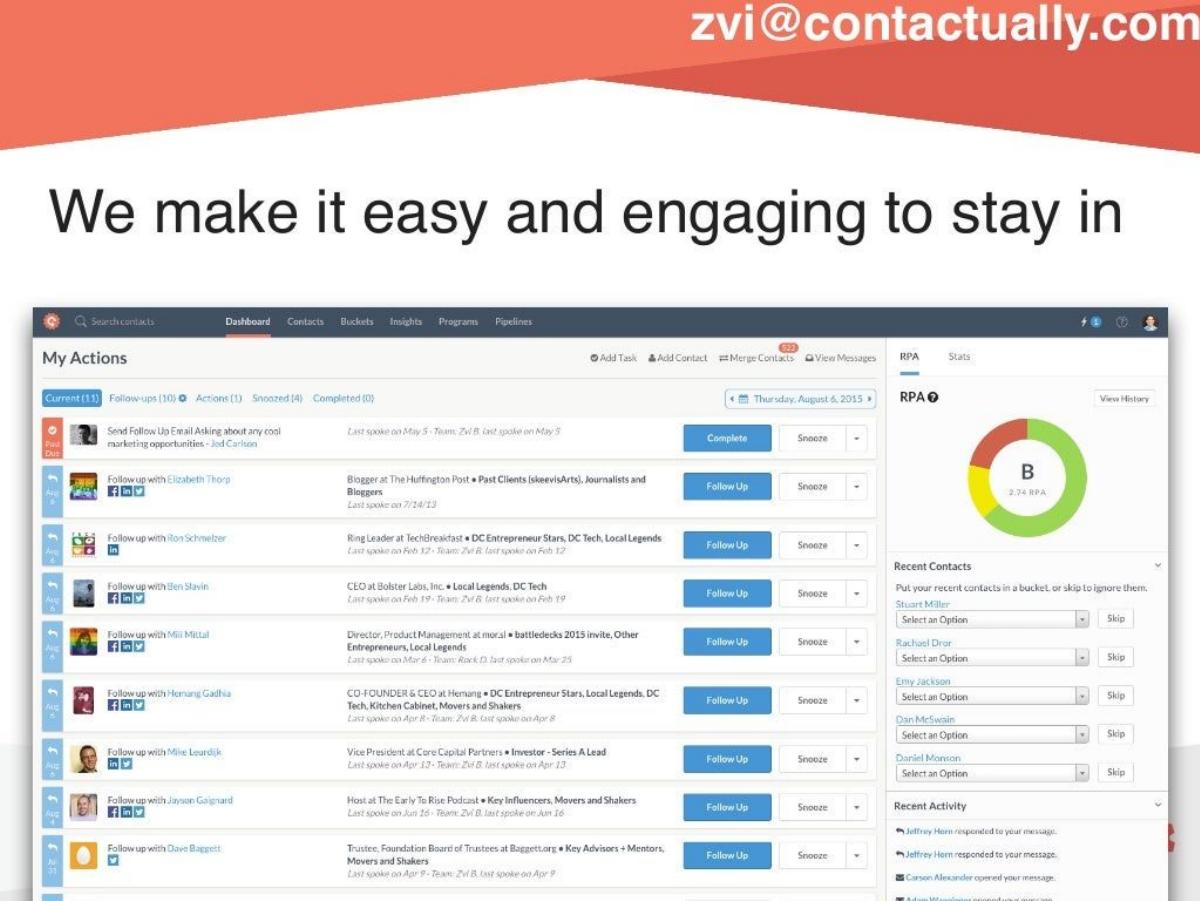
This slide provides a high-fidelity screenshot of the 'My Actions' dashboard. It shows a list of contacts with specific follow-up prompts and a 'Relationship Point Average' (RPA) score. The interface emphasizes ease of use, with 'Follow Up' and 'Snooze' buttons prominently displayed for each contact.
Slide 5: Product Interface - Team Insights
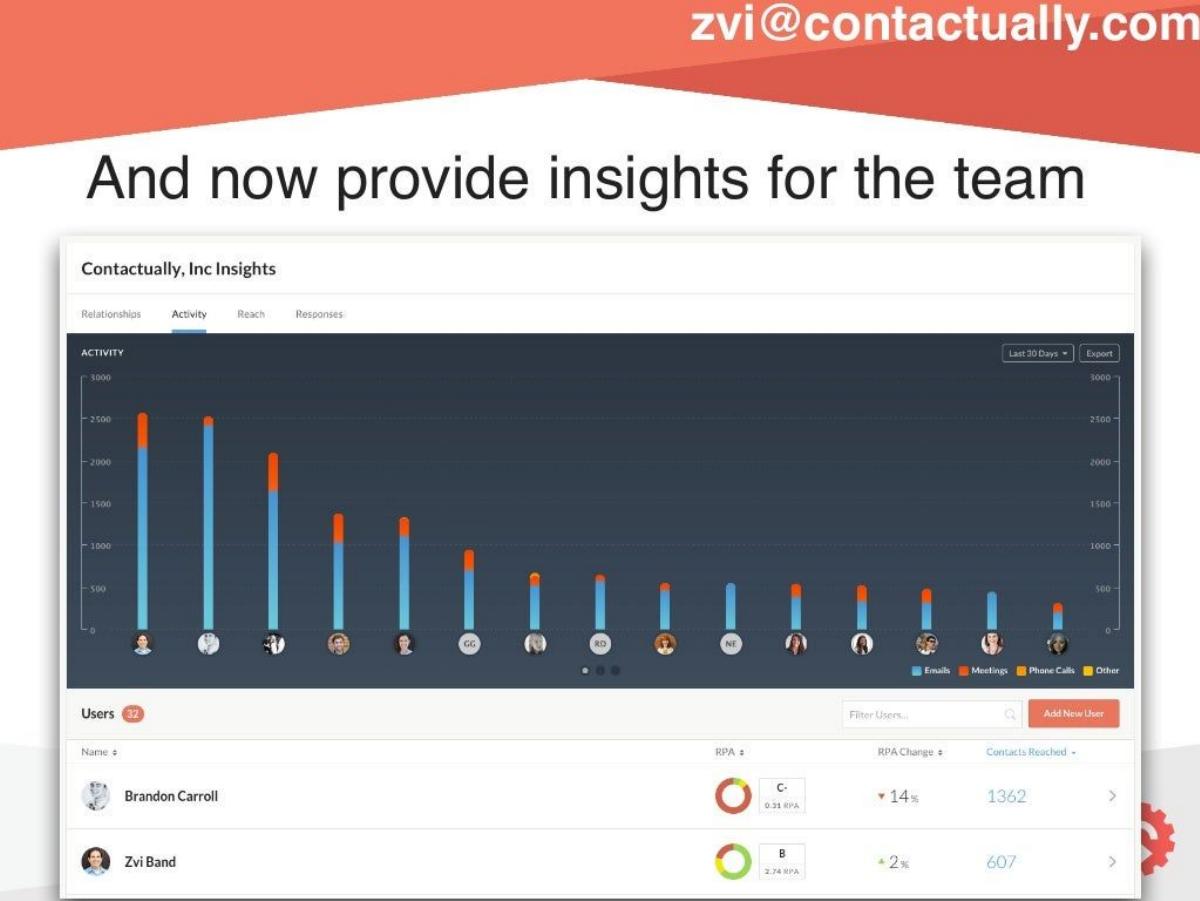
Moving from the individual to the manager, Slide 5 shows the 'Insights' dashboard. This view allows team leaders to see activity levels (emails, meetings, phone calls) across the organization. It introduces the 'RPA Change' metric, which tracks whether a team member's relationship strength is increasing or decreasing.
Slide 6: Traction and Revenue Growth
This is the 'money slide' of the deck. It shows a bar chart of ARR growth from launch in May 2012 to a current ARR of $3.68M . Key milestones like the Seed Round (Feb '13) and the 1st Enterprise Account (July '14) are marked. The slide also discloses critical SaaS metrics: 3.1% MoM total net churn and a shift to 16% of ARR coming from enterprise accounts.
Slide 7: Business Model and Unit Economics
Slide 7 explains the 'land and expand' strategy. It breaks down the individual user economics: $140 CAC, $1,247 LTV, and $508 ACV . It then shows the transition to Enterprise, citing an Average ACV of $80K . Logos for major real estate brands like RE/MAX, Keller Williams, and Coldwell Banker are used to provide social proof of this transition.
Slide 8: Market Opportunity
The deck positions Contactually within a growing CRM market, forecasted to reach $36.5B by 2017. The slide argues that less than half of professional service providers use a CRM because existing tools are "transactional databases" rather than relationship drivers. This creates a clear 'gap' for Contactually to fill.
Slide 9: Future Roadmap
This slide outlines the 'Next Steps' for the company across Product and Growth. Product goals include a data insight team and mobile expansion. Growth goals focus on expanding the enterprise sales practice and capturing more of the SMB market. It mentions that $3.5M in capital has already been raised, though it does not specify the terms of the current round.
Slide 10: Team and Investors
The final slide introduces the three founders: Zvi Band (CEO), Tony Cappaert (COO), and Jeff Carbonella (CTO), noting affiliations with the University of Maryland, MIT, and Princeton. The right side of the slide is dedicated to a 'who's who' of early SaaS investing, listing Point Nine Capital, 500 Startups, and individuals like Gil Penchina and the founders of YouTube and SwapDrive.
What Contactually Does Well
Contactually excels at quantifying the value proposition . Instead of saying "we help you stay in touch," they state that users get 34% more referrals. This is a bottom-line metric that justifies the software's cost. Furthermore, the deck provides a very clear path to scale . By showing the unit economics of an individual user ($508 ACV) versus an enterprise account ($80K ACV), they demonstrate a clear 'North Star' for the company's sales efforts.
What is Missing from the Deck
The most glaring omission is a specific 'Ask' slide . While the deck mentions they have raised $3.5M previously, it does not state how much they are currently seeking or what the valuation expectations are. Additionally, there is no competitive landscape slide. While they mention that existing CRMs are 'transactional,' they do not name or directly compare themselves to specific competitors like Realvolve or Top Producer, which are common in the real estate niche.
What Other Founders Should Copy
Founders should emulate the visual representation of the problem found on Slide 2. The 'Mindshare' decay curve is an intuitive way to explain a complex behavioral problem. Additionally, the transparency of the metrics on Slide 6 and Slide 7 is exemplary. Providing net churn, CAC, and LTV in a clear, un-hyped format builds immediate credibility with sophisticated investors. Finally, the use of customer logos as a bridge between the individual and enterprise models (Slide 7) is a powerful way to prove that a 'prosumer' tool can successfully move upmarket.
Frequently asked questions
- What is the primary problem Contactually is solving?
- Contactually addresses the 'mindshare' decay that occurs after an initial introduction. In professional services like real estate and legal, 85% of business comes from referrals, yet professionals struggle to stay in touch. Slide 2 visually demonstrates how business and referral opportunities are lost when engagement drops off over time.
- How does Contactually's business model work?
- The company uses a bottom-up SaaS model. They sell initially to individuals with an ACV of $508 and then 'upsell into the Enterprise' where the average ACV jumps to $80,000. This transition is supported by a 95% non-paid acquisition strategy involving content, SEO, and partners (Slide 7).
- What are the key growth metrics disclosed in the deck?
- As of the 2016 deck, Contactually had $3.68M in ARR. Their enterprise segment was growing rapidly, moving from 0% to 16% of total ARR in one year. They also reported a total net MRR churn of 3.1% MoM, though the enterprise-specific churn was much healthier at -2.5% MoM (Slide 6).
- Who are the competitors mentioned in the deck?
- The deck does not name specific competitors like Salesforce or HubSpot. Instead, it categorizes the competition as 'Existing CRMs' that are 'transactional databases' not built for bottom-up adoption. Slide 8 positions Contactually as a 'fundamentally different model of CRM' needed for relationship management.
- What is the company's plan for the capital raised?
- According to Slide 9, the focus is split between Product and Growth. Product goals include building a data insight team and expanding the mobile roadmap. Growth goals focus on expanding the enterprise sales practice and capturing more customers in the SMB and professional services markets.