The Contenttools seed deck from 2019 is a masterclass in 'show, don't tell.' Instead of abstract market sizing, the founders dedicate five slides to specific product workflows, including pipeline management, creation, and distribution. The deck is anchored by a significant traction milestone: growing from zero to over $600,000 in ARR by early 2018. While it lacks a formal 'Ask' slide and detailed unit economics, the sheer volume of integrations (700+) and a clear competitive positioning on the axis of Machine Learning and Team Experience make a compelling case for a Seed-stage investment. It…
Key takeaways
- The company achieved a growth milestone of +$600,000 ARR, scaling steadily from February 2016 to February 2018 as shown on slide 13.
- Contenttools positions itself against competitors like Percolate and NewsCred by focusing on 'Machine Learning' and 'Good Team Experience' on slide 10.
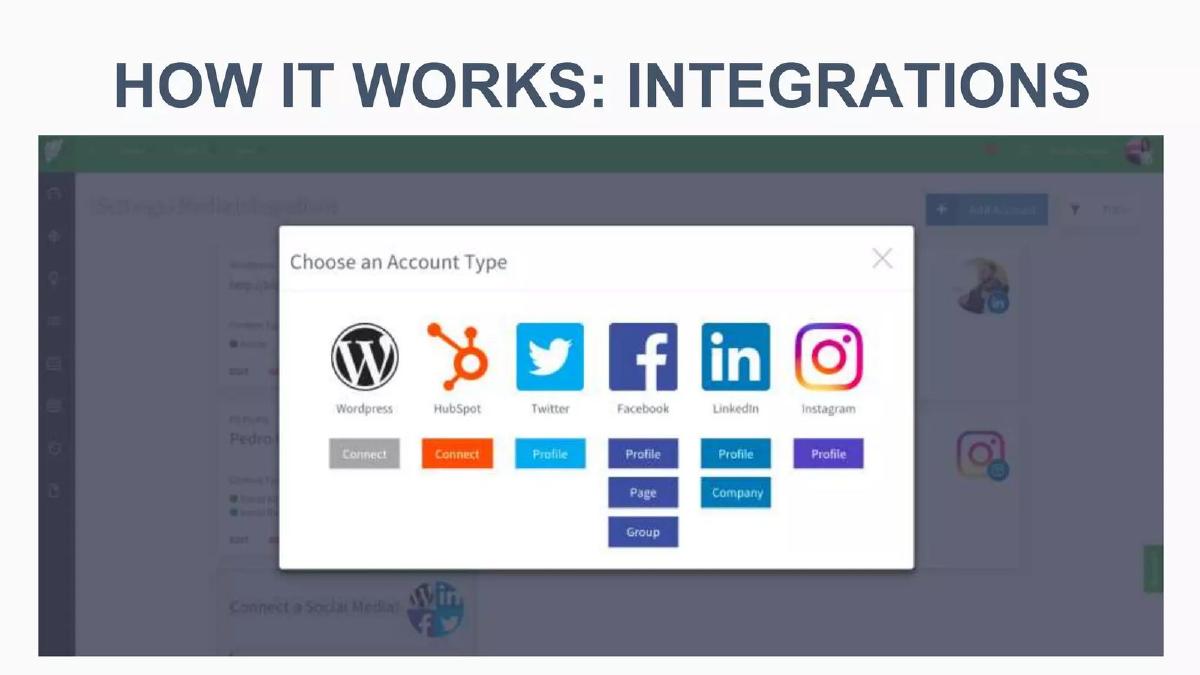
- The platform boasts a significant ecosystem of +700 applications and integrations, including WordPress, HubSpot, and Slack, detailed on slides 6 and 7.
- User adoption is high for a seed stage, with +13,000 users across +70 countries and +400 customers cited on slide 12.
- The deck heavily emphasizes product functionality, using five distinct 'How It Works' slides to demonstrate the full content lifecycle (slides 4-9).
- The 'Problem' is defined as content being 'time consuming and hard to manage,' illustrated by a chaotic collage of spreadsheets and emails on slide 2.
- The team slide (slide 14) highlights backing from 500 Startups and Silicon Valley Growth Syndicate, providing institutional validation.
- The deck completely omits a financial 'Ask' or use of funds slide, leaving the specific investment requirements unclear.
Introduction: The All-In-One Content Hub
Contenttools entered the market at a time when 'content marketing' was shifting from a buzzword to a core business function. Their 2019 seed deck reflects a company that has moved past the ideation phase and into significant commercial execution. With 15 slides, the deck focuses heavily on product utility and proven traction, rather than theoretical market potential. The narrative is simple: content management is a mess of spreadsheets, and Contenttools is the automated, AI-driven solution to clean it up.
The Hook and The Headache (Slides 1-2)
Slide 1 opens with a clean hero image of the platform on a laptop, immediately establishing the brand as a 'Content Marketing Platform.' The sub-headline—'Create. Collaborate. Publish. Every tool you need to create content'—is a direct value proposition. It doesn't waste time with vague mission statements.
Slide 2 defines 'The Problem' with high visual impact. By using a collage of messy spreadsheets, Gmail inboxes, and a photo of a frustrated worker, they tap into the 'tool fatigue' experienced by marketing managers. The text is minimal: 'Content is GREAT! But it's time consuming and hard to manage.' This slide effectively sets the stage for a consolidation play.
The Solution and Product Deep-Dive (Slides 3-9)
Slide 3 introduces the 'All-In-One' solution. It uses a central pencil icon (the company logo) surrounded by social and productivity icons (Facebook, LinkedIn, Twitter, etc.). This visualizes the platform as the 'brain' of a marketing operation, connecting disparate channels through workflow management and SEO analytics.
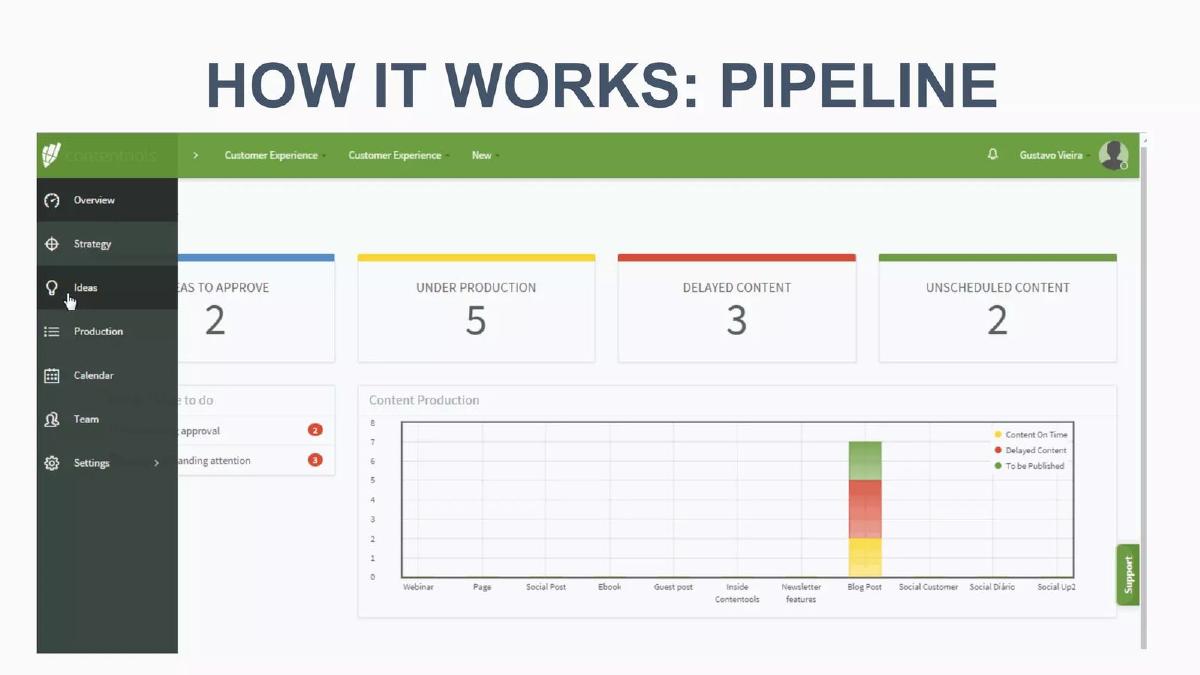
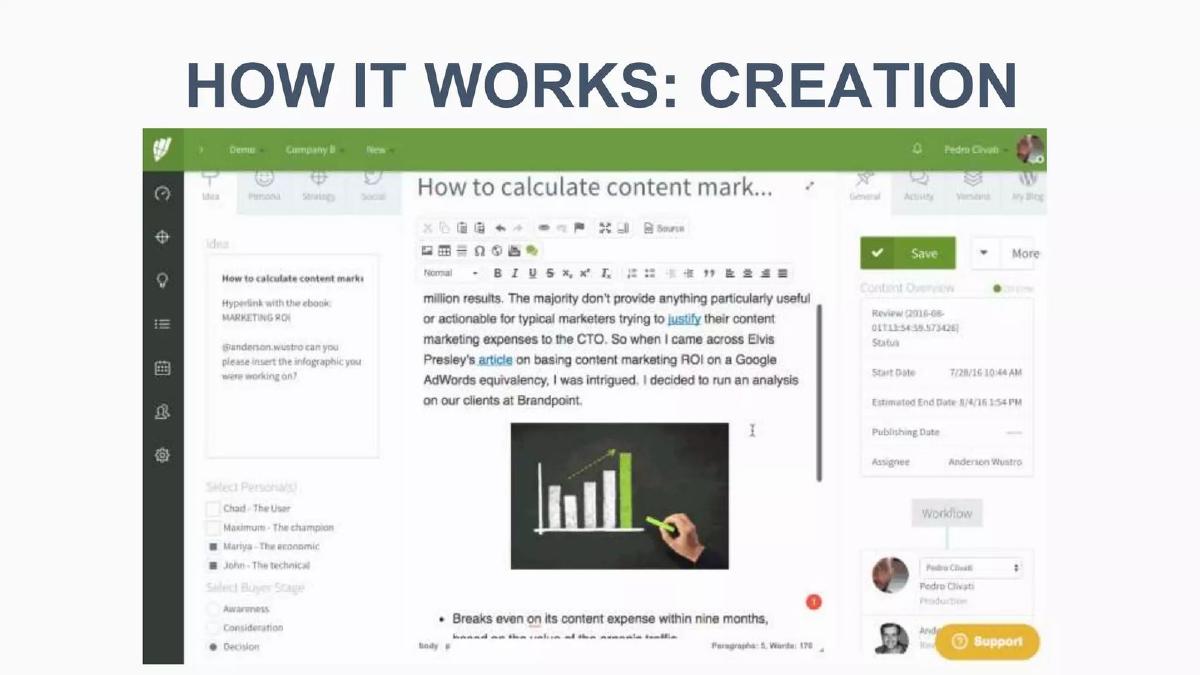
The deck then spends an unusual amount of time—six slides—on product walkthroughs. Slide 4 (Pipeline) shows a dashboard with clear buckets for 'Ideas to Approve,' 'Under Production,' and 'Delayed Content.' Slide 5 (Creation) demonstrates a built-in text editor that includes persona selection and buyer stage tracking, showing that the tool is built for strategic marketers, not just writers. Slide 6 and 7 (Integrations) are perhaps the most important for a SaaS play; they claim '+700 Applications' and show native connectors for WordPress, HubSpot, and social platforms. This proves the product can fit into existing enterprise stacks. Slide 8 (Distribution) shows a calendar view, and Slide 9 (Insights) returns to the dashboard to show how managers track volume and velocity.
Strategic Positioning and AI Roadmap (Slides 10-11)
Slide 10 is a standard 2x2 competitive matrix, but the axes are chosen carefully: 'Team Experience' vs. 'Machine Learning.' By placing themselves in the top-right quadrant, Contenttools claims to be the only player that is both easy to use and data-intelligent. They explicitly name heavyweights like Percolate and NewsCred , positioning them as 'Manual Data' solutions, which is a bold claim intended to make the incumbents look legacy.
Slide 11 elaborates on the 'ML | AI' promise. It lists four predictive capabilities, including 'Which content should I create NEXT?' and 'What's the best TIME TO SCHEDULE?' This slide is crucial for justifying a tech-company valuation rather than a simple workflow-tool valuation. It suggests the platform doesn't just host content; it optimizes it.
Traction and Team (Slides 12-14)
The 'Traction' section is the strongest part of the deck. Slide 12 (Customers) lists '+400 customers,' '+1,100 marketing projects,' and '+13,000 users in +70 countries.' This global footprint is impressive for a seed-stage company. Slide 13 (Growth Over Time) provides the 'money shot': a bar chart showing growth from zero to +$600,000 ARR . The chart covers a two-year period (Feb '16 to Feb '18), showing a steady, non-volatile upward trend. The inclusion of small red bars for churn shows a level of transparency that investors appreciate.
Slide 14 introduces the team. Emilia Chagas (CEO) and Elton Miranda (Product) are the featured leads. The slide also highlights their pedigree via 500 Startups and Silicon Valley Growth Syndicate , and mentions Will Bunker as an advisor/investor. This provides the necessary social proof to close the deck.
What Works in the Contenttools Deck
Specific Traction: Stating a specific ARR figure ($600,000) and showing the month-by-month growth curve is the most effective way to build trust. It proves the 'All-In-One' promise isn't just a theory; 400 customers are already paying for it.
Product-Led Narrative: Many decks stay too high-level. Contenttools shows the actual UI. For a workflow tool, the 'feel' of the software matters. By showing the persona-selection tool and the integration pop-ups, they prove the product is mature and feature-rich.
Integration Focus: In modern SaaS, no tool is an island. By highlighting 700+ integrations, they mitigate the 'switching cost' fear that investors often have. It shows the tool is a 'connector,' not another silo.
What is Missing from the Contenttools Deck
The Ask: There is no slide detailing how much money they are raising, at what valuation, or what the milestones for the next 18 months are. This is a significant omission for a fundraising deck.
Market Size (TAM): The deck assumes the investor already knows the content marketing market is huge. While often true, a slide showing the total addressable market helps frame the 'ceiling' for the investment.
Unit Economics: While they show ARR and churn, they don't mention CAC (Customer Acquisition Cost) or LTV (Lifetime Value). Investors want to know if the $600k ARR was bought at a loss or grown efficiently.
What a Founder Should Copy
The Competitive Axis: Don't just use 'Price' and 'Features' for your competitive matrix. Contenttools used 'Team Experience' and 'Machine Learning.' Find the two trends that define the future of your industry and put yourself at the intersection of them.
The 'Problem' Visualization: Slide 2 is excellent. It doesn't use bullet points to describe a 'fragmented workflow.' It shows a screenshot of a messy spreadsheet. If your product solves a 'messy' problem, show the mess.
Transparency in Growth: If you have a growth chart, include the churn or 'down' months. The small red bars on slide 13 make the blue bars look much more believable. It shows you understand your metrics deeply.
Conclusion
The Contenttools deck is a 'traction-first' pitch. It relies on the fact that the company has already reached a significant revenue milestone and has a product that users in 70 countries are actively using. While it lacks some of the formal structural elements of a classic venture pitch (like the Ask and TAM), the strength of the product screenshots and the ARR growth likely did the heavy lifting in their investor meetings. It is a solid example of how to pitch a 'better mousetrap' in a crowded market by focusing on superior integration and data intelligence.
Frequently asked questions
- What is the primary value proposition of Contenttools?
- Contenttools positions itself as an 'All-In-One' content marketing platform. According to slide 3, it consolidates marketing calendars, social media scheduling, social automation, workflow management, SEO analytics, and API integrations into a single interface. The goal is to replace the fragmented workflow of spreadsheets and emails shown on slide 2 with a centralized, collaborative system.
- How much revenue had the company generated at the time of this deck?
- Slide 13 shows a clear growth trajectory from February 2016 to February 2018. The company states it grew 'From zero to +$600,000 ARR.' The chart indicates monthly revenue was approaching $55,000 by the end of the period shown, with very minimal churn represented by the small red bars below the axis.
- Who are Contenttools' main competitors according to their analysis?
- On slide 10, Contenttools maps the competitive landscape. They identify Percolate, DivvyHQ, and CoSchedule as competitors with good team experience but manual data. NewsCred, Kapost, and Contently are grouped as having manual data and 'bad' team experience. BrightEdge and Curata are noted for machine learning but lower team experience scores.
- What is missing from this pitch deck?
- The deck is notably missing an 'Ask' slide, which would typically detail how much capital is being raised and the intended use of funds. It also lacks a 'Market Size' (TAM/SAM/SOM) slide and detailed unit economics like Customer Acquisition Cost (CAC) or Lifetime Value (LTV), which are standard for SaaS seed rounds.
- What role does AI play in the Contenttools platform?
- Slide 11 outlines the ML/AI roadmap. The technology is intended to analyze existing content to determine what is working, suggest what content to create next, identify which channels bring the most results, and optimize the 'best TIME TO SCHEDULE' to maximize reach for the user.