Contact Us Plus is a sales prospecting tool designed to help users find verified emails and employee contact information directly through a browser extension. The deck positions the company within a rapidly growing sales acceleration market, citing 14,000,000 sales reps on LinkedIn (Slide 9). The product strategy focuses on '1-click' availability and verified data to reduce the friction of prospecting. Financially, the company seeks a $100,000 seed round at a $1.67mm valuation (Slide 15). While the deck provides clear pricing tiers and a competitive comparison, it relies heavily on future pro…
Key takeaways
- The company is raising a $100,000 seed round at a $1.67mm valuation (Slide 15).
- The product is a browser extension that allows users to find employees and verified emails while browsing company websites (Slides 4-6).
- Pricing is tiered based on email volume, ranging from $39/mo for 50 emails to $249/mo for 500 emails (Slide 10).
- The deck identifies 14,000,000 sales reps on LinkedIn as a primary target audience (Slide 9).
- Competitive advantages cited include lower barriers to entry ($39/mo) and '1-click' availability compared to Salesloft and Data.com (Slide 11).
- Milestones show a transition from a private beta with 40+ users in January to a target of 200 paying users by April (Slide 13).
- The team consists of two members: CEO Peter Kell and CTO Marius Cristea (Slide 14).
- The exit strategy explicitly references Rapportive and targets a 10X+ ROI (Slide 16).
Executive Summary and Brand Identity
Slides 1-3: The Hook
The deck opens with a minimalist title slide featuring the Contact Us Plus logo and the tagline: "Contact the Right Person Instantly." The visual style is clean, utilizing a blue and white color palette that persists throughout the presentation. Slide 2 immediately addresses the pain point with the blunt statement "prospecting sucks," accompanied by a stock photo of a frustrated office worker. Slide 3 provides the counter-narrative, promising to help users "make more in less time." These opening slides follow a classic problem/solution framework but lack specific data points or industry-specific context at this stage.
Product Walkthrough and Features
Slides 4-6: Core Functionality
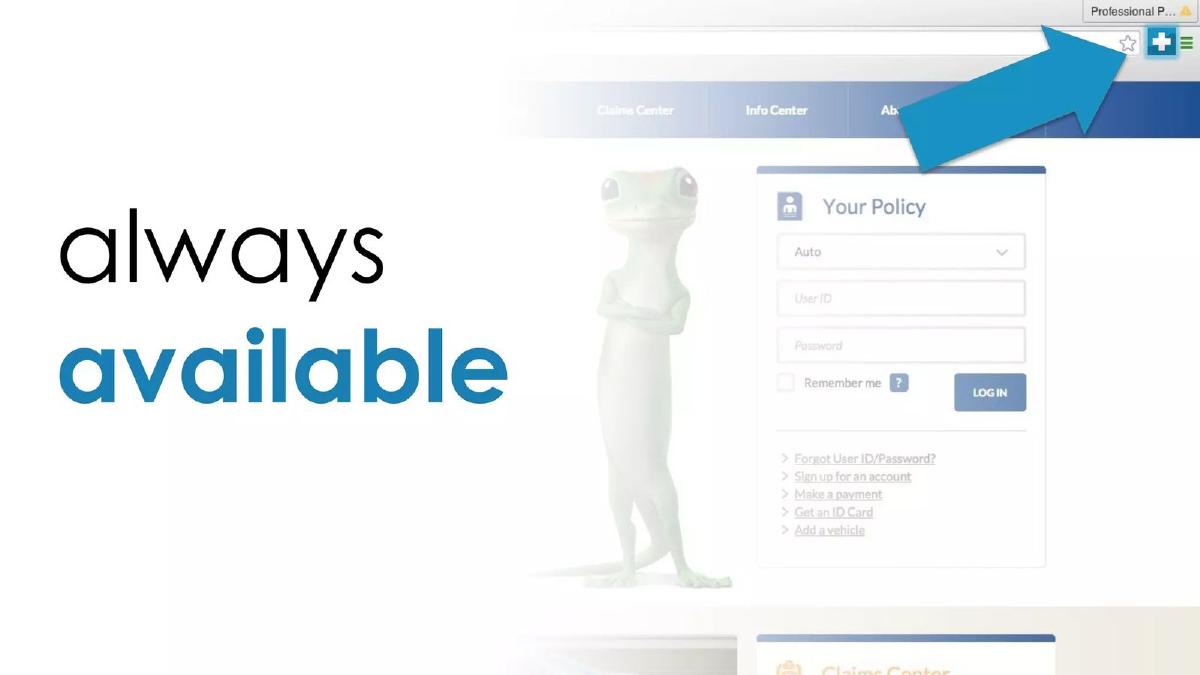
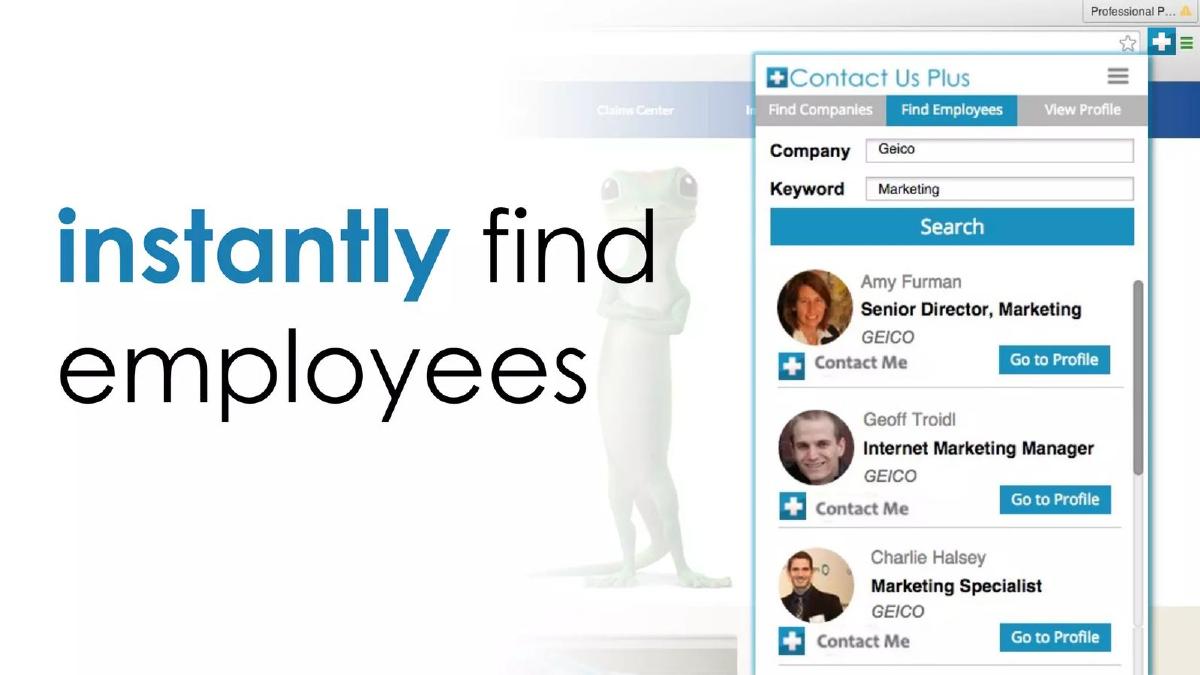
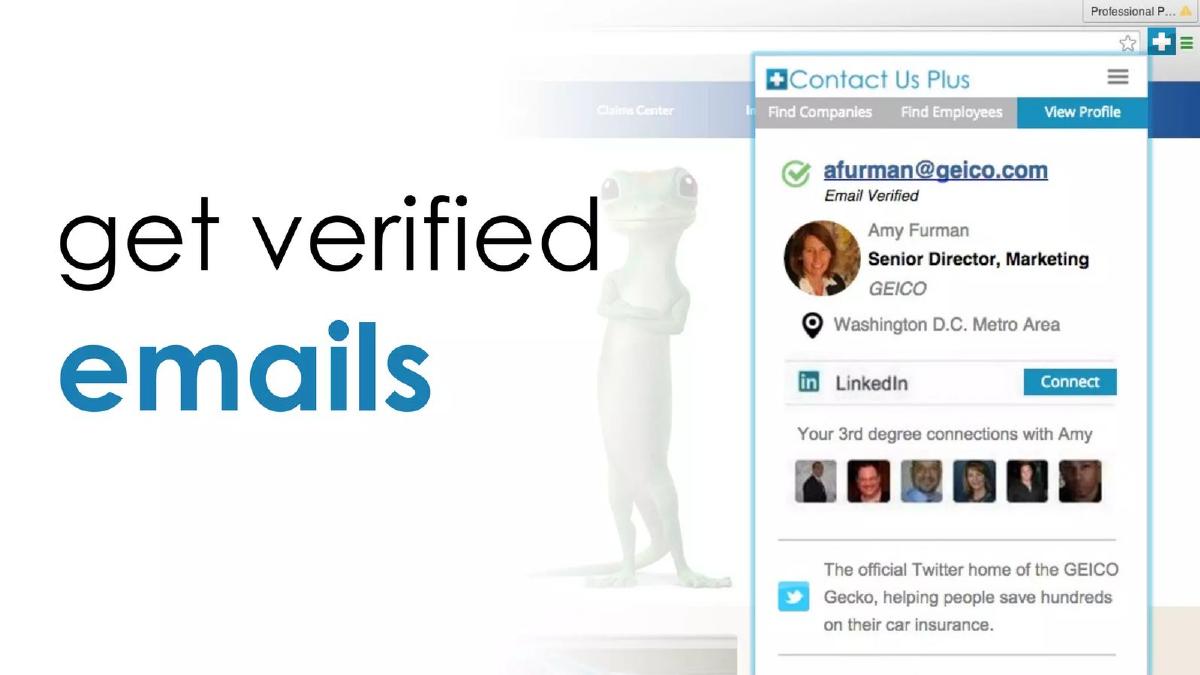
Slide 4 introduces the product interface, showing a browser extension icon (a blue square with a white plus sign) situated in the browser toolbar. The text "always available" emphasizes the friction-less nature of the tool. Slide 5 demonstrates the "instantly find employees" feature, showing a search overlay on top of the Geico website. The UI allows users to search by company and keyword (e.g., "Marketing") to generate a list of specific employees like "Amy Furman, Senior Director, Marketing." Slide 6 highlights the "get verified emails" feature, showing a checkmark next to a specific email address and providing social links (LinkedIn) and connection depth (3rd degree).
Slides 7-8: Advanced Features
Slide 7 shows the integration of a messaging interface, allowing users to "send your message fast" directly from the tool. The screenshot depicts a Gmail-style compose window. Slide 8 introduces a discovery feature: "find similar prospects." Using the Geico example again, the tool suggests competitors like Progressive, State Farm, and Nationwide, assigning each a "relevancy" percentage (e.g., 99%). This suggests an underlying data layer that categorizes companies by industry and scale.
Market Opportunity and Business Model
Slides 9-10: Market Size and Pricing
Slide 9 defines the "rapidly growing industry" of the Sales Acceleration Market. It includes a line graph showing market growth from $12 billion in 2014 to a projected $30+ billion in 2017. A key metric provided is the existence of 14,000,000 sales reps on LinkedIn , which serves as the primary Total Addressable Market (TAM) indicator. Slide 10 outlines "simple pricing" tiers. The model is a freemium approach: free sign-up plus 10 free emails. Paid tiers are $39/mo for 50 emails , $99/mo for 150 emails , and $249/mo for 500 emails . This pricing structure suggests a focus on individual contributors or small teams rather than enterprise-wide deployments.
Slide 11: Competitive Landscape
The company uses a standard grid to compare itself against LinkedIn, Salesloft, and Data.com. The primary axes of comparison are cost per email, barrier to entry, live data, and "1-Click Away" accessibility. Contact Us Plus claims the lowest barrier to entry at $39/mo, whereas Salesloft is listed with a $3,900 annual barrier ($350/mo x 12). The deck claims Contact Us Plus is the only solution that is "1-Click Away," emphasizing its browser-native utility.
Execution Strategy and Team
Slides 12-13: Marketing and Milestones
Slide 12 lists three customer acquisition channels: LinkedIn Ads, Guest Posts on Popular Sales Blogs, and Affiliate partnerships. This is a standard, albeit high-level, marketing strategy for a B2B SaaS tool. Slide 13 provides a timeline of "milestones and objectives." The "past" section shows the company moved from an idea in November to a private beta with 40+ sign-ups in January. The "future" section sets aggressive targets: 200 sign-ups (1 paying) in February, 600 sign-ups (50 paying) in March, and 2,000 sign-ups (200 paying) by April. This slide is critical as it shows the company was at a very early stage (beta) when this deck was used for fundraising.
Slide 14: The Team
The team is comprised of two co-founders. Peter Kell (CEO) is credited with previously owning three online marketing companies, focusing on marketing and business development. Marius Cristea (CTO) is described as a full-stack developer with five years of experience. The deck does not mention any other employees, advisors, or board members, indicating a very lean operation.
The Ask and Exit Strategy
Slides 15-17: Funding and Exit
Slide 15 contains the formal ask: a Seed Round of $100,000 at a $1.67mm evaluation . The use of funds is broad, covering payroll, product-market fit, consumer acquisition, and preparation for a second round. Slide 16 explicitly mentions an "exit like rapportive" (a tool acquired by LinkedIn). It lists LinkedIn, Infusionsoft, and Salesforce as potential acquirers and targets a "Solid potential 10X+ ROI." The deck concludes on Slide 17 with contact information for the founders.
What Works and What Is Missing
The Contact Us Plus deck is a functional example of a pre-seed/seed stage presentation. It clearly defines the product's utility through screenshots and provides a transparent pricing model. The competitive matrix (Slide 11) is effective because it focuses on "Barrier to Entry," a common pain point for individual sales reps who cannot afford enterprise software. By positioning itself as a $39/mo tool, the company carves out a specific niche below the major players.
However, the deck has significant omissions. There is no mention of unit economics (CAC or LTV), which is vital for a SaaS business, even at an early stage. The marketing strategy (Slide 12) is generic and lacks specific testing results or cost-per-lead data. Furthermore, the "Future" milestones (Slide 13) are highly speculative; jumping from 40 beta users to 200 paying users in three months is a significant hurdle that requires a more detailed growth engine description than what is provided. Finally, the team slide is thin; while the founders have relevant experience, the lack of an advisory board or a larger technical team might be a red flag for investors concerned about execution risk.
Founder's Takeaway
Founders should copy the clear product walkthrough seen in Slides 4-8. Using a consistent example (Geico) to show how the tool finds employees, verifies emails, and discovers competitors makes the value proposition tangible. The competitive comparison on Slide 11 is also a strong model; rather than just listing features, it compares the actual financial "barrier to entry," which is a compelling argument for a bottom-up adoption strategy. Founders should avoid the vague use of funds seen on Slide 15; a $100,000 round is small, and investors will want to know exactly how many months of runway that provides and what specific technical or growth milestones it will unlock.
Frequently asked questions
- What is the specific problem Contact Us Plus aims to solve?
- The deck identifies that 'prospecting sucks' (Slide 2) because it is time-consuming and inefficient. The solution is designed to help sales professionals 'make more in less time' (Slide 3) by providing a tool that is 'always available' (Slide 4) to find verified contact information without leaving the browser or navigating complex databases.
- How does the pricing compare to competitors?
- Contact Us Plus positions itself as a low-cost alternative. Slide 11 shows a 'Barrier to Entry' of $39/mo, which is significantly lower than Salesloft ($3,900 annual commitment) or Data.com ($125/mo). However, its cost per email ($0.78 - $0.49) is higher than Data.com ($0.43 - $0.50) but lower than LinkedIn ($4).
- What is the current traction of the company according to the deck?
- As of the 'Jan' milestone on Slide 13, the company was in a 'private beta' with '40+' sign-ups. The subsequent months (February through April) are listed under 'future' objectives, indicating that the higher user counts (up to 2,000) were projections at the time the deck was authored.
- What are the primary use of funds for the seed round?
- The $100,000 seed investment is earmarked for four areas: Payroll, achieving product-to-market fit, consumer acquisition, and positioning the company for a second round of funding (Slide 15). The deck does not provide a specific breakdown of how the $100,000 is distributed among these categories.
- Who are the key team members?
- The team features two individuals on Slide 14: Peter Kell (CEO), who is described as having previously owned three online marketing companies, and Marius Cristea (CTO), a full-stack developer with five years of experience. No other advisors or employees are listed.