Get on Board's 23-slide seed deck from 2014 targets the fragmented $100 billion tech recruiting market, specifically in Latin America. The company positions itself as a unified ecosystem combining sourcing, tracking, and screening, moving away from traditional CV-based hiring toward a meritocratic, skills-based model. With 110% YoY revenue growth in 2019 and 1,500 paying customers, the deck highlights strong traction and a clear value proposition for both tech professionals and companies. The founders, Sergio Nouvel and Jorge Rodríguez, bring extensive experience in building startups and digi…
Key takeaways
- Tech recruiting is identified as a $100 billion market growing at 10% annually, but it is currently fragmented across sourcing, tracking, and screening (Slides 2-3).
- Get on Board aims to replace shallow CV crunching with unbiased, skills-based evaluation at scale (Slide 4).
- The platform has already achieved significant traction with 110% YoY revenue growth in 2019 and 1,500 paying customers (Slide 10).
- The company leverages data from 450,000+ applications to provide unique insights into talent performance that competitors like LinkedIn and Indeed lack (Slides 8-9).
- Pricing is structured across three tiers: Concierge ($3k-8k per hire), Subscription ($1k-7k yearly), and Pay-as-you-go ($149-2599 per post) (Slide 15).
- A major strategic focus is helping North American companies access a pool of 130,000 remote professionals in the same time zone (Slide 18).
- The founding team has deep roots in the ecosystem, with the CTO having founded a $2M revenue consulting firm (Slide 20).
- The deck omits a specific breakdown of the $600,000 investment ask and detailed future financial projections.
Introduction and Market Context
Slide 1: Title Slide
The deck opens with a clean, branded title slide featuring the Get on Board logo and the tagline 'Awesome jobs for awesome people.' The design is modern and professional, setting a positive tone for the presentation.
Slide 2: The Problem - Tech Recruiting is Broken
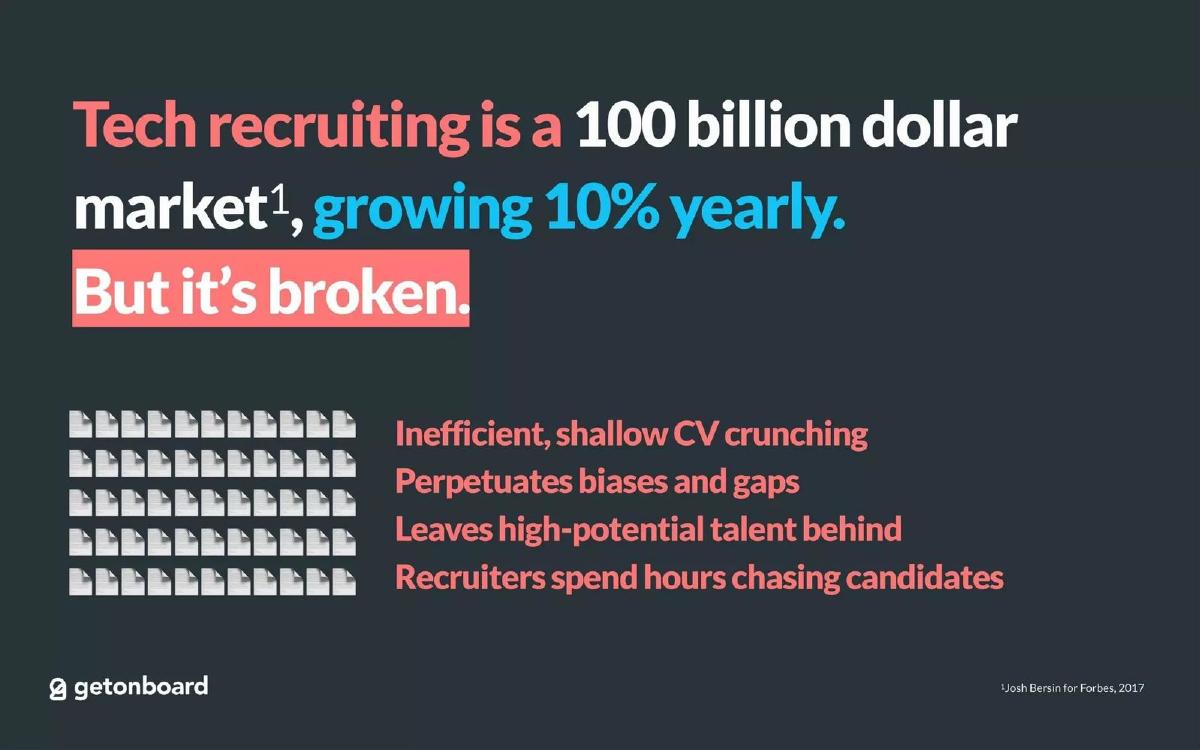
This slide establishes the market size and the core pain points. It cites a $100 billion dollar market growing at 10% yearly , based on a 2017 Forbes article by Josh Bersin. The 'broken' aspects include inefficient CV crunching, biases, and recruiters spending hours chasing candidates. This effectively frames the opportunity by highlighting a large, growing market with significant inefficiencies.
Slide 3: Fragmentation in the Ecosystem
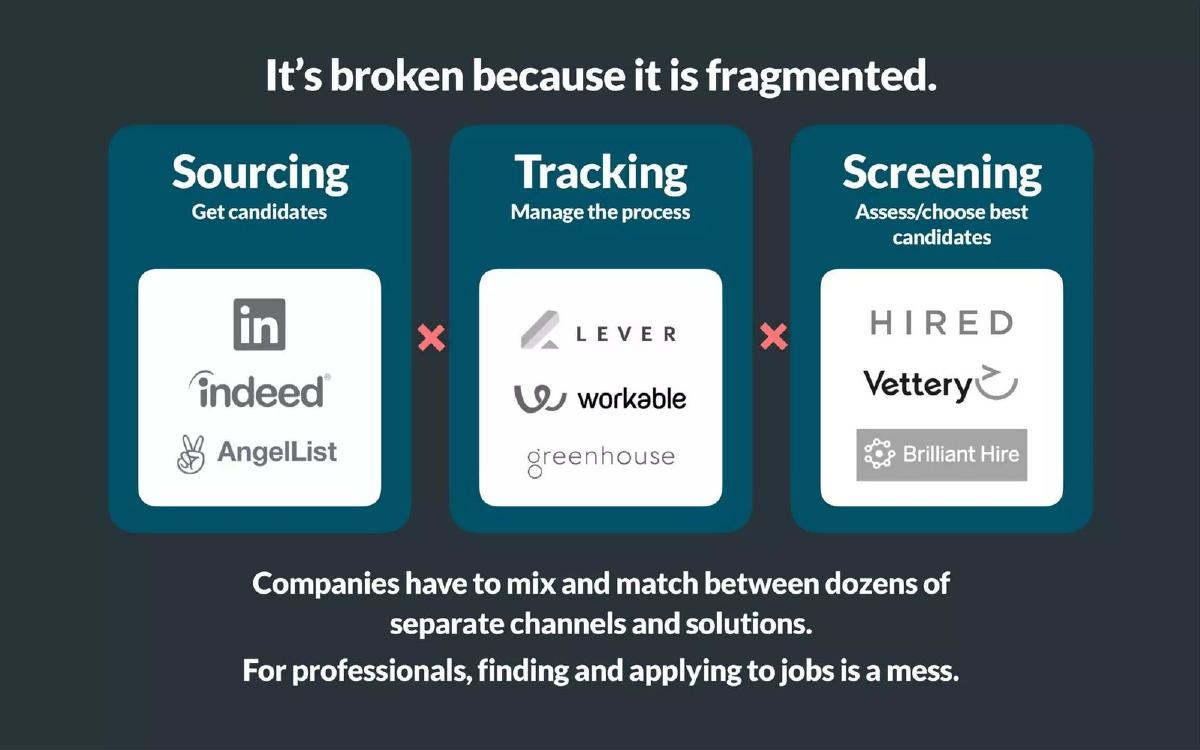
The deck identifies fragmentation as the root cause of the problem. It categorizes existing solutions into three silos: Sourcing (LinkedIn, Indeed, AngelList), Tracking (Lever, Workable, Greenhouse), and Screening (Hired, Vettery, Brilliant Hire). The slide notes that companies have to 'mix and match between dozens of separate channels,' creating a 'mess' for both professionals and recruiters.
The Solution and Product
Slide 4: The Vision
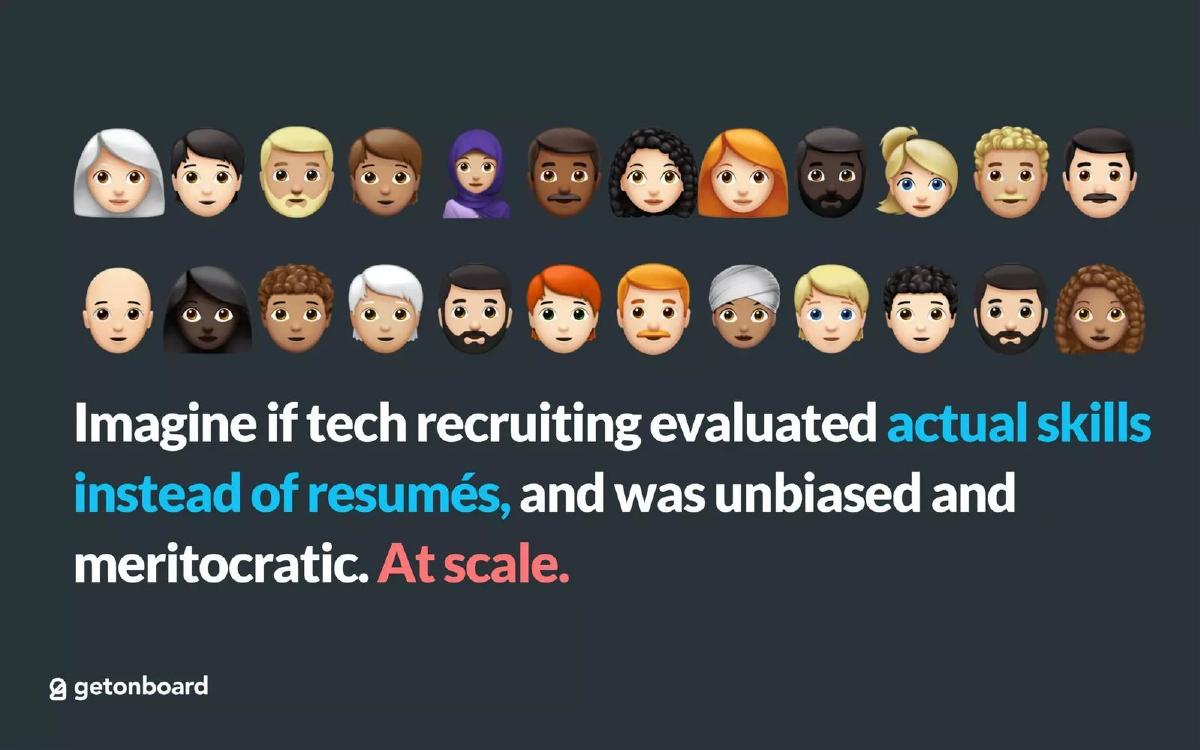
Using a grid of diverse emojis, this slide asks the audience to 'Imagine if tech recruiting evaluated actual skills instead of resumés , and was unbiased and meritocratic. At scale.' This is a high-level vision statement that transitions from the problem to the proposed solution.
Slide 5: Product Overview
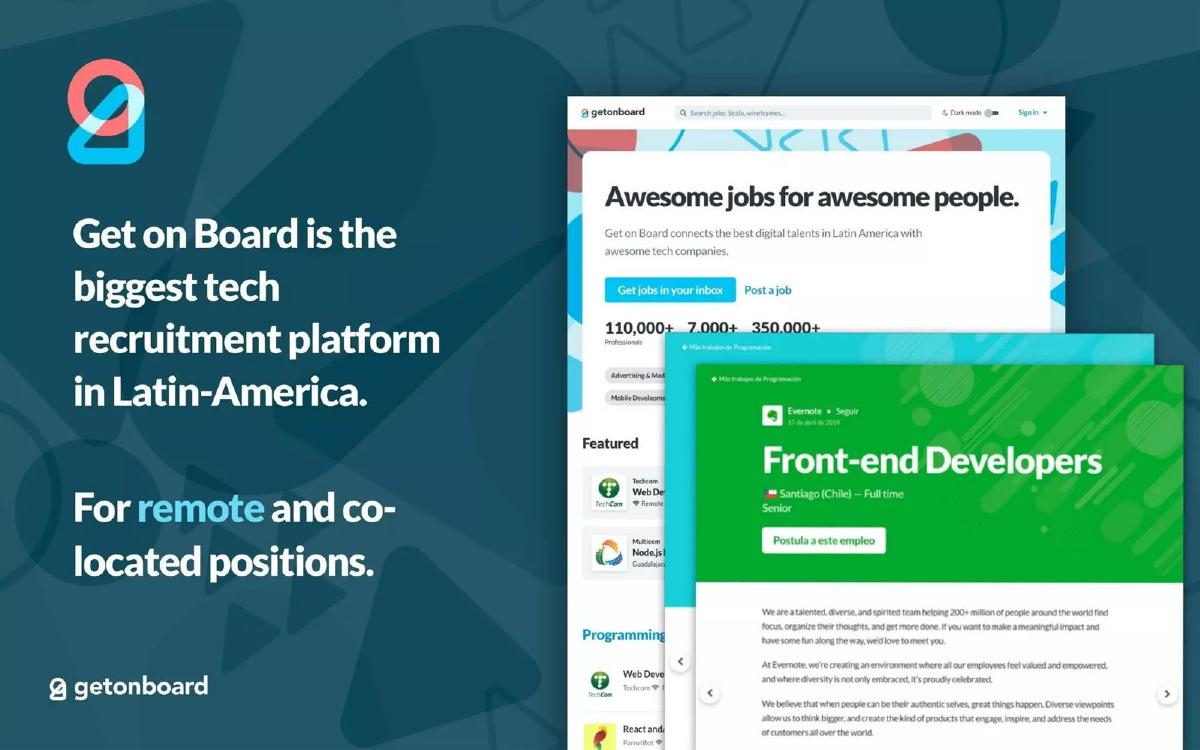
Get on Board is introduced as the 'biggest tech recruitment platform in Latin-America' for both remote and co-located positions. The slide includes screenshots of the platform, showing a clean UI and key metrics: 110,000+ professionals , 7,000+ companies , and 350,000+ applications (though these numbers differ slightly from later slides, suggesting growth over time).
Slide 6: The Unified Ecosystem
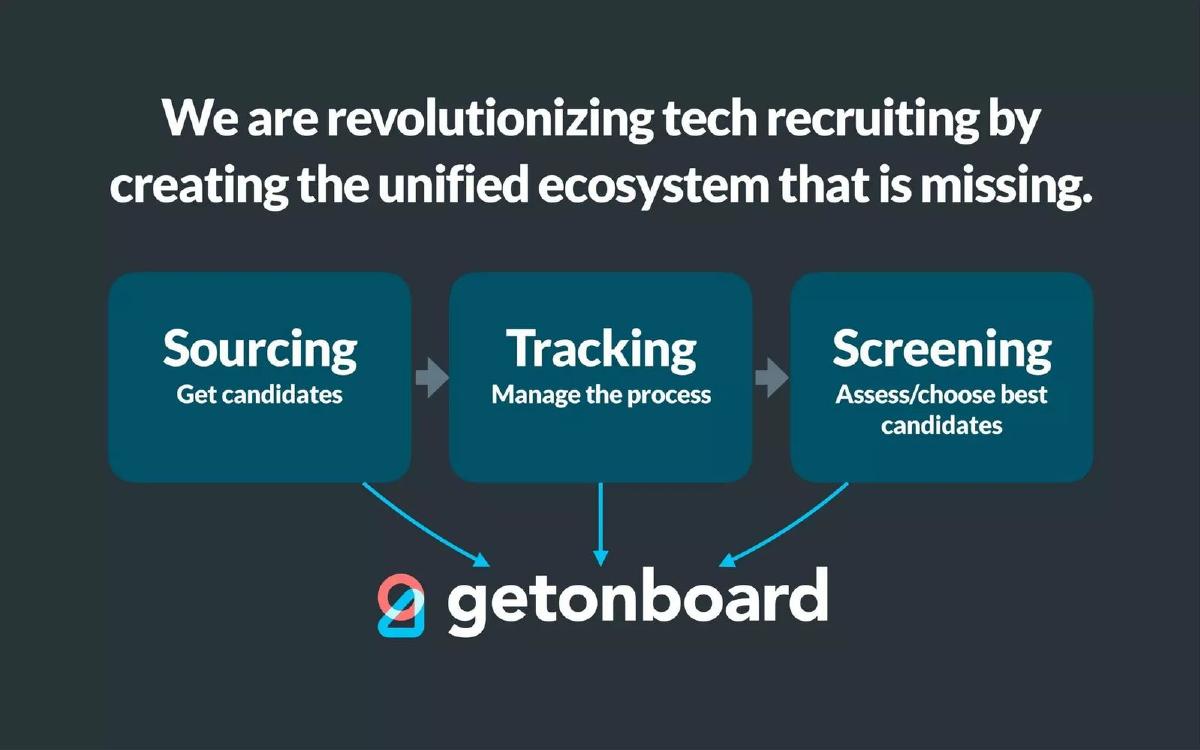
This slide directly addresses the fragmentation mentioned in Slide 3. It shows how Get on Board unifies Sourcing , Tracking , and Screening into a single platform. This is a crucial value proposition, suggesting a more efficient and integrated workflow for hiring teams.
Slide 7: Data-Driven Matching
The platform leverages 'deep knowledge about skills and performance of 130,000 candidates ' to offer unbiased screening. A UI mockup shows candidates like 'Diego Ramos' and 'Esther González' with percentage match scores (e.g., 94% match) based on specific skills like React, JavaScript, and REST API. This moves the conversation from generic job boards to a sophisticated matching engine.
Slide 8: The Power of Data Points
This slide emphasizes the scale of their data, citing millions of data points in 450,000+ applications . It shows a candidate profile for 'Esther González' that tracks her history across multiple applications, including her ranking (e.g., 'Ranked 5/215') and the outcome (e.g., 'Hired 3 months ago'). This historical performance data is a significant competitive advantage.
Slide 9: Unique Insights
Building on the previous slide, this one highlights 'unique insights on talent performance that neither LinkedIn nor Indeed have.' It shows a granular breakdown of how a candidate ranks for specific technologies and how companies have evaluated them (e.g., '+6 for being hired,' '-3 for failing tests'). This level of detail is rare in traditional recruitment platforms.
Traction and Social Proof
Slide 10: Market Traction
The 'revolution' is already underway in Latin America. Key metrics include 110% YoY revenue growth in 2019 , 1,500 paying customers , and 8,000 hires made to date . These are strong indicators of product-market fit and commercial viability.
Slide 11: Value for Tech Professionals
This slide focuses on the candidate experience, noting that tech pros love the platform because it curates jobs for quality, offers an 'awesome job-finding experience,' spotlights startups/remote jobs, and is an active part of the tech ecosystem. This highlights the supply-side strength of the marketplace.
Slide 12: Value for Companies
For the demand side, the platform delivers fast sourcing, unique access to a regional talent pool, and savings in recruiter fees. Logo proof includes major companies like LATAM , Evernote , Groupon , Cornershop , Havas , and Engie .
Slide 13: Social Proof - Twitter Testimonials
A collage of tweets (mostly in Spanish) provides authentic social proof from users who have found jobs or successfully hired through the platform. This adds a layer of credibility and community support.
Slide 14: Quote Slide
A simple, high-impact slide featuring a one-word quote: 'Unrivaled.' attributed to Telefónica I+D Chile. This is a strong endorsement from a major regional player.
Business Model and Future Strategy
Slide 15: Product-Pricing Tiers
Concierge: Expert-vetted recruitment with a 10% success fee ( $3k-8k per hire ). · Subscription plans: Yearly access to job posting and the Talent Database ( $1k-7k yearly ). · Pay-as-you-go: Individual job posts for small companies ( $149-2599 one-time ).
This shows a diversified revenue stream catering to different company sizes and needs.
Slide 16: The Future of Work
A transition slide stating 'Future is remote.' over an image of Earth from space. This aligns the company with the broader trend of remote work, which was particularly relevant in the late 2010s.
Slide 17: The Remote Advantage
This slide argues that remote work allows for 'less money on real estate, more money on talent' and a 'truly global footprint.' It positions Get on Board as the enabler of this transition.
Slide 18: Strategic Opportunity - North America
A key strategic pillar is helping North American companies 'kickstart their remote workforces' by unlocking a pool of 130,000 remote professionals in the same time zone . This 'nearshoring' angle is a powerful value proposition for US-based investors and companies.
Team and Vision
Slide 19: Remote Culture
A screenshot of a Zoom-style team meeting with the caption 'We’ve been working remotely for years.' This demonstrates that the company 'walks the talk' and has the internal culture to support its external mission.
Slide 20: The Founders
Sergio Nouvel (CEO): 15+ years exp, former CEO of Continuum Peru (grew to $500k revenue), former McKinsey Digital Labs contractor. · Jorge Rodríguez (CTO): 20+ years exp, polyglot dev (8 languages!), founded Continuum ($2M global revenue), former McKinsey Digital Labs contractor.
The team has significant entrepreneurial and technical experience, which is a major plus for a seed-stage company.
Slide 21: Next Milestones
The immediate goal is to 'Accelerate our expansion into the US market from the company side, and consolidate our position in Latin-America from the talent side.' This provides a clear roadmap for the next phase of growth.
Slide 22: Closing Vision
A final call to action: 'We are prepared to continue growing and advancing the future of work. Unbiased, meritocratic, and remote. Partner with us.'
Slide 23: Contact Information
The deck concludes with the CEO's photo and contact email, providing a clear next step for interested investors.
What Works
Strong Traction: The 110% YoY revenue growth and 1,500 paying customers (Slide 10) provide concrete evidence of market demand. · Clear Differentiation: The focus on 'real skills, not CVs' and the unique data points on candidate performance (Slides 7-9) set them apart from generic job boards. · Strategic Positioning: The 'same time zone' remote talent angle for North American companies (Slide 18) is a highly compelling and logical expansion strategy. · Experienced Team: The founders' backgrounds in building and scaling consulting firms (Slide 20) instill confidence in their ability to execute.
What is Missing
Financial Projections: While current traction is shown, there are no forward-looking financial projections or a clear path to profitability. · Detailed Use of Funds: The deck mentions 'Partner with us' but doesn't provide a specific breakdown of how the $600,000 investment will be allocated. · Competitive Landscape: While they mention LinkedIn and Indeed, a more detailed competitive matrix would help investors understand their moat against other emerging tech-focused platforms. · Unit Economics: There is no mention of Customer Acquisition Cost (CAC) or Lifetime Value (LTV), which are critical metrics for a SaaS/marketplace hybrid.
What a Founder Should Copy
Problem-Solution Alignment: The way the deck identifies fragmentation (Slide 3) and then presents a unified ecosystem (Slide 6) is a textbook example of clear problem-solution framing. · Visualizing Data: The use of mockups to show how their data-driven matching works (Slides 7-9) makes a complex backend process easy to understand. · Tiered Pricing: Laying out the business model clearly (Slide 15) shows that the founders have thought through different customer segments and monetization strategies. · Leveraging Social Proof: The combination of big-name logos (Slide 12) and authentic user testimonials (Slide 13) builds significant credibility.
Frequently asked questions
- What is the primary problem Get on Board is solving?
- Get on Board addresses the fragmentation in tech recruiting, where companies must mix and match dozens of separate solutions for sourcing, tracking, and screening. This leads to inefficient 'CV crunching' and biases. By unifying these functions into a single ecosystem, the platform aims to provide a more meritocratic and streamlined experience for both recruiters and job seekers.
- How does Get on Board differentiate itself from LinkedIn or Indeed?
- The platform differentiates itself through deep data points collected from over 450,000 applications. Unlike LinkedIn or Indeed, Get on Board tracks how candidates rank in relation to specific technologies and their performance in actual hiring processes (e.g., technical interview results, test scores). This allows for high-quality matching based on proven skills rather than just self-reported resumes.
- What is the company's current traction in the Latin American market?
- As of the deck's creation, Get on Board reported 110% year-over-year revenue growth in 2019. They had 1,500 paying customers and had facilitated 8,000 hires to date. Their talent pool included over 130,000 professionals, positioning them as a dominant player in the regional tech recruitment space.
- What is the business model and pricing strategy?
- The company uses a tiered pricing model to cater to different needs. Small companies can use 'Pay-as-you-go' job posts starting at $149. Larger entities can opt for yearly subscriptions ranging from $1k to $7k for database access. They also offer a high-touch 'Concierge' recruiting service with a success fee of 10% of the annual salary ($3k-8k per hire).
- What are the founders' backgrounds?
- The founders have significant experience in the digital and startup space. CEO Sergio Nouvel has 15+ years of experience and previously grew a branch of a consulting firm to $500k in yearly revenue. CTO Jorge Rodríguez has 20+ years of experience and founded Continuum, a consulting firm with $2M in global yearly revenue. Both are former contractors for McKinsey Digital Labs.