Boon's 7-slide deck is a masterclass in brevity, though it leaves significant questions unanswered for a $2.5M Seed round. The deck successfully identifies a specific friction point in the HR tech space—the 'Referral Gap'—citing that while 88% of employees are willing to refer, only 22% actually do (Slide 3). By showcasing a high-fidelity product UI (Slide 4) and a $100,000 revenue milestone achieved in under three months (Slide 6), Boon demonstrates immediate market resonance. However, the total absence of a team slide, business model details, or a specific 'Ask' makes this a 'teaser' deck r…
Key takeaways
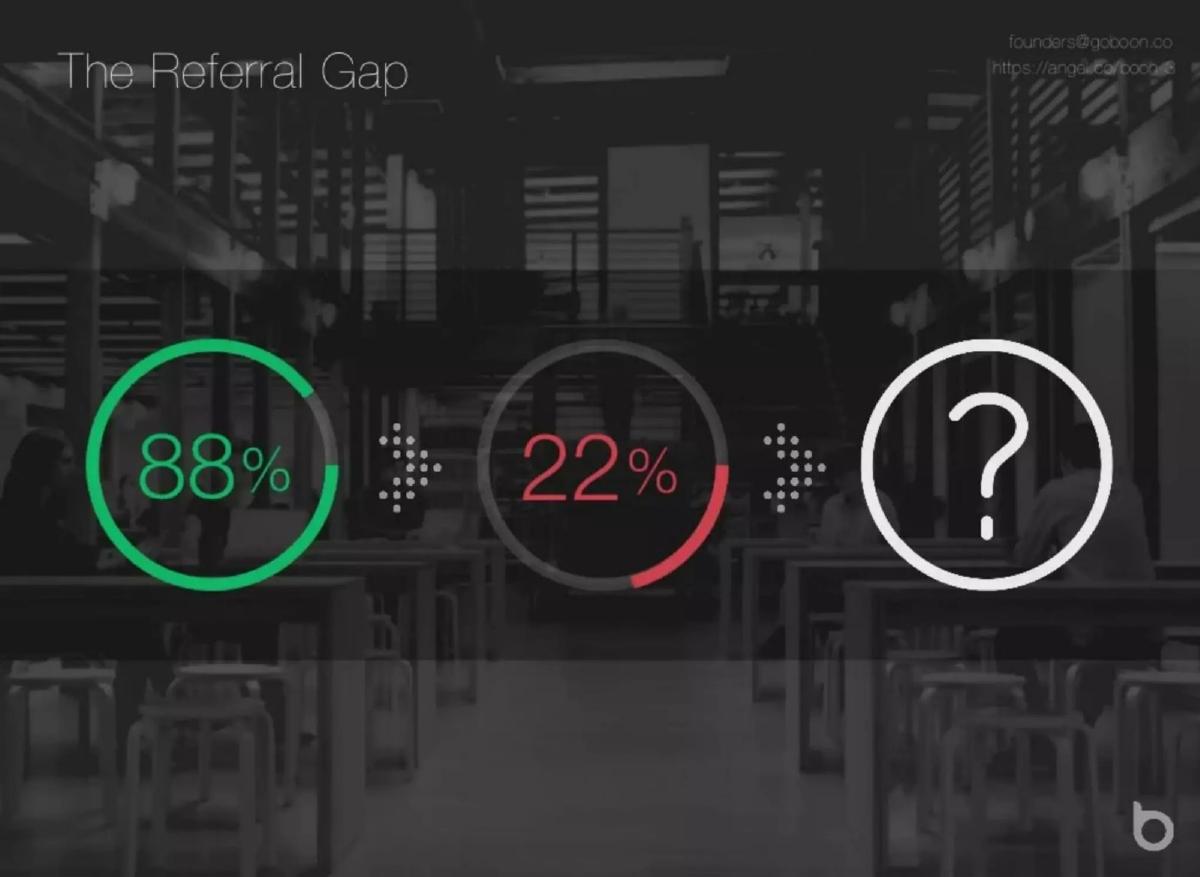
- The deck identifies a massive discrepancy in employee behavior, noting that 88% of employees want to help with hiring but only 22% do (Slide 3).
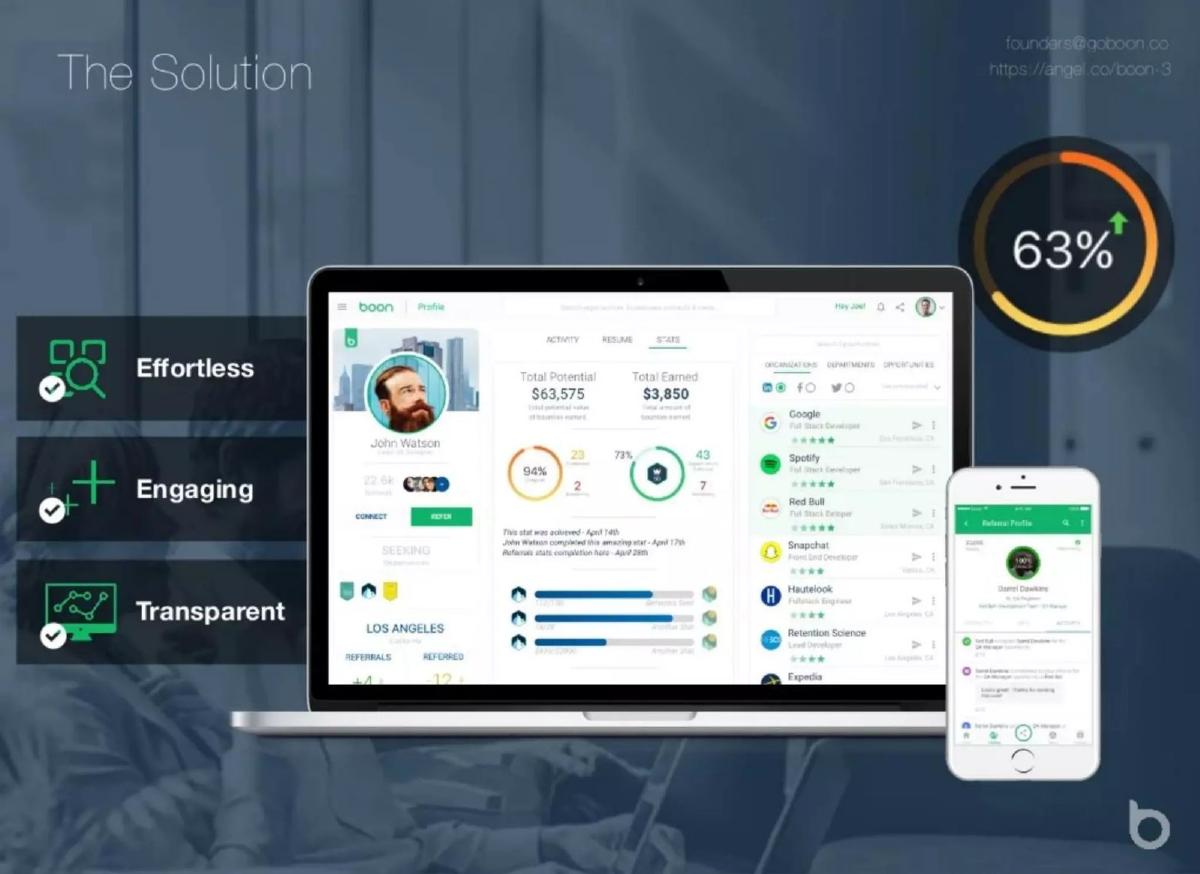
- Boon positions itself as a solution that is 'Effortless, Engaging, and Transparent' through a gamified dashboard (Slide 4).
- The product UI showcases a 'Total Potential' earnings metric of $63,575 for a single user, suggesting a high-incentive model (Slide 4).
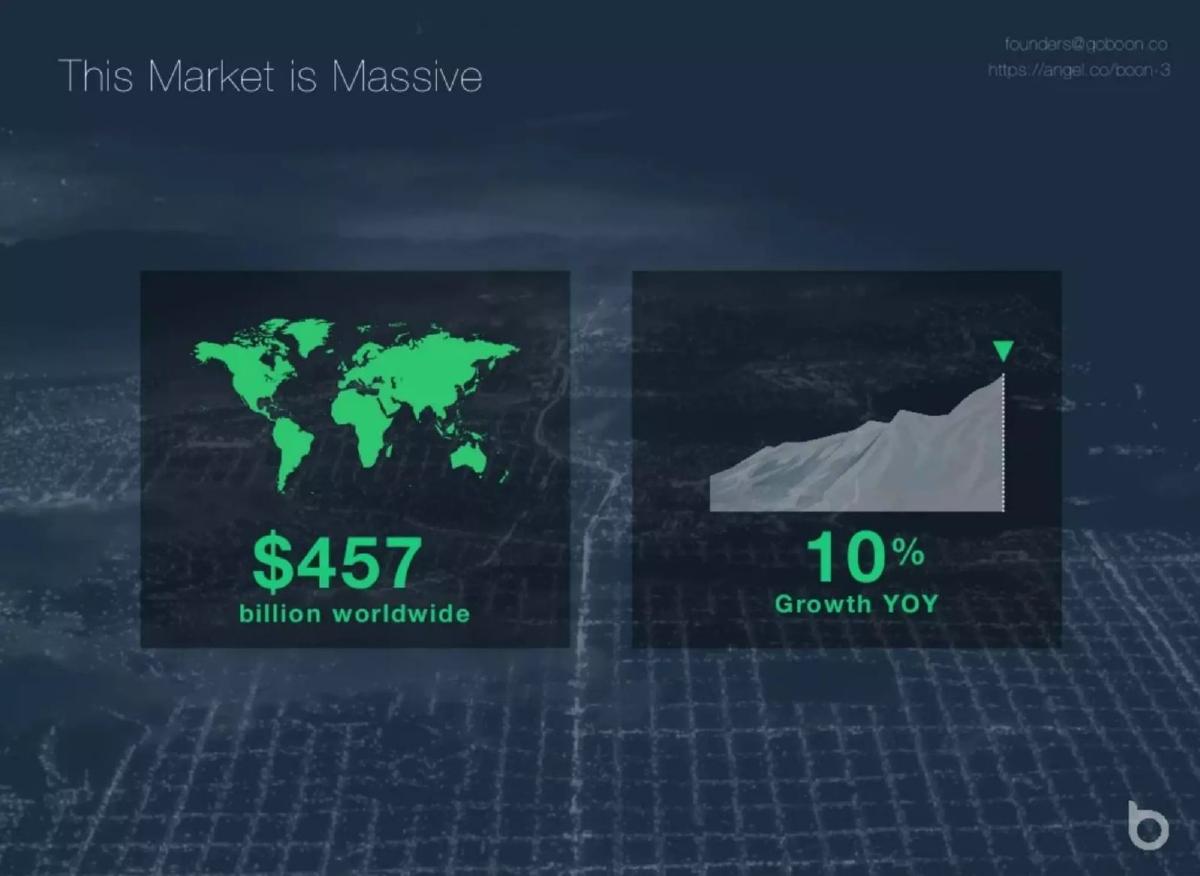
- Market size is framed globally at $457 billion with a 10% year-over-year growth rate (Slide 5).
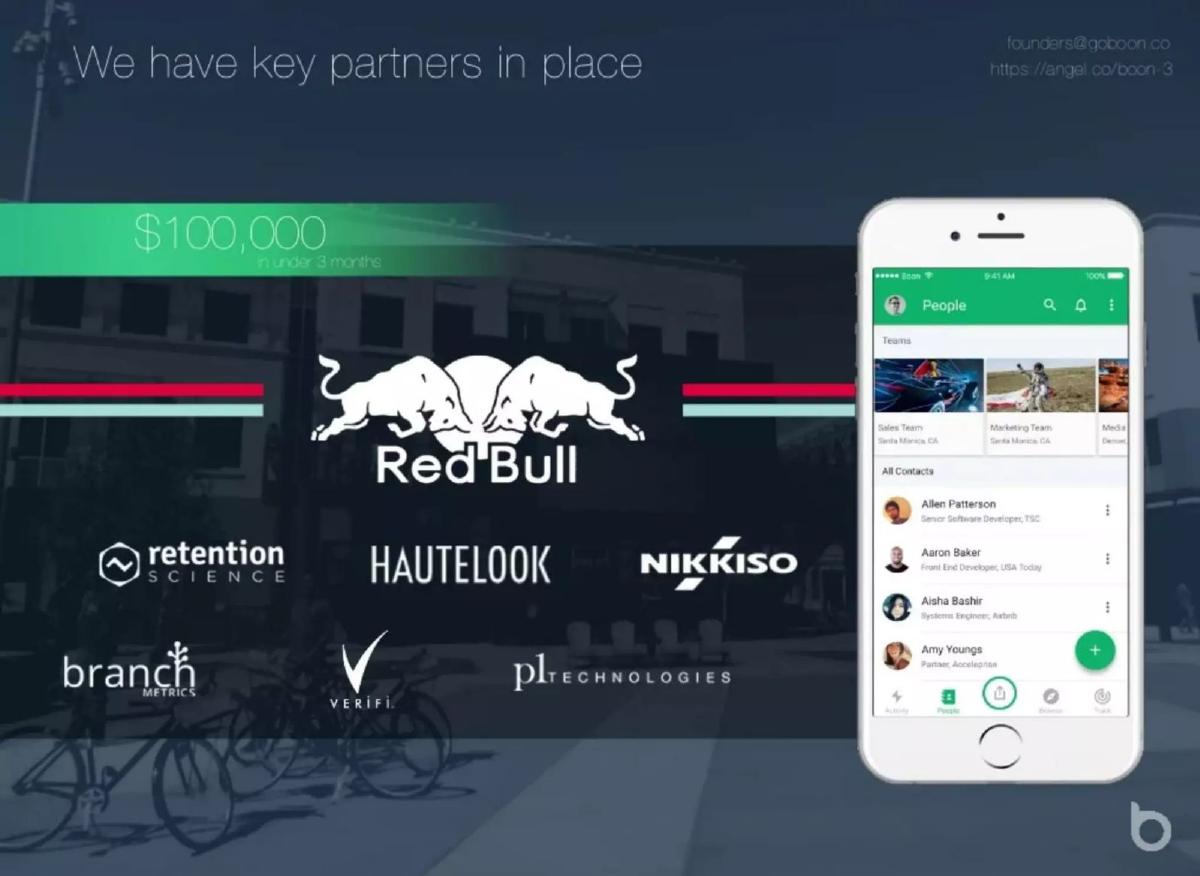
- The company achieved $100,000 in revenue in under three months, a critical traction signal for a Seed round (Slide 6).
- Key early partners include recognizable brands such as Red Bull, HauteLook, and Retention Science (Slide 6).
- The deck completely omits a team slide, failing to highlight the founders' backgrounds or technical expertise.
- There is no mention of the specific fundraising goal, valuation, or use of proceeds within the 7 slides.
The 7-Slide Pivot: How Boon Framed a New Opportunity
Boon’s pitch deck is an exercise in extreme minimalism. At only seven slides, it bypasses many of the traditional components of a Seed deck—such as a team slide, a roadmap, or a detailed financial breakdown—to focus almost exclusively on a single behavioral insight: the referral gap. According to catalogue data, the company raised $2,500,000 in 2019, a significant sum for a deck that functions more like a high-level teaser than a full business plan.
What is most striking about this deck is the disconnect between the company’s origins and this presentation. While the catalogue describes Boon + Gable as a virtual personal shopper, this deck presents 'Boon,' a platform designed to 'Turn every employee into your best recruiter.' This suggests the founders realized their recommendation engine, originally built for clothes, had a higher-value application in the friction-heavy world of corporate recruiting. The teardown below examines how they sold this new vision.
Slides 1-2: The Emotional Hook
Slide 1: Title Slide The deck opens with a dark, blurred image of an office environment, overlaid with the Boon logo and the tagline: 'Turn every employee into your best recruiter.' The contact information in the top right corner (founders@goboon.co) and an AngelList link suggest this deck was used for broad outreach or as a follow-up to initial conversations. The branding is clean, using a vibrant green that suggests growth and action.
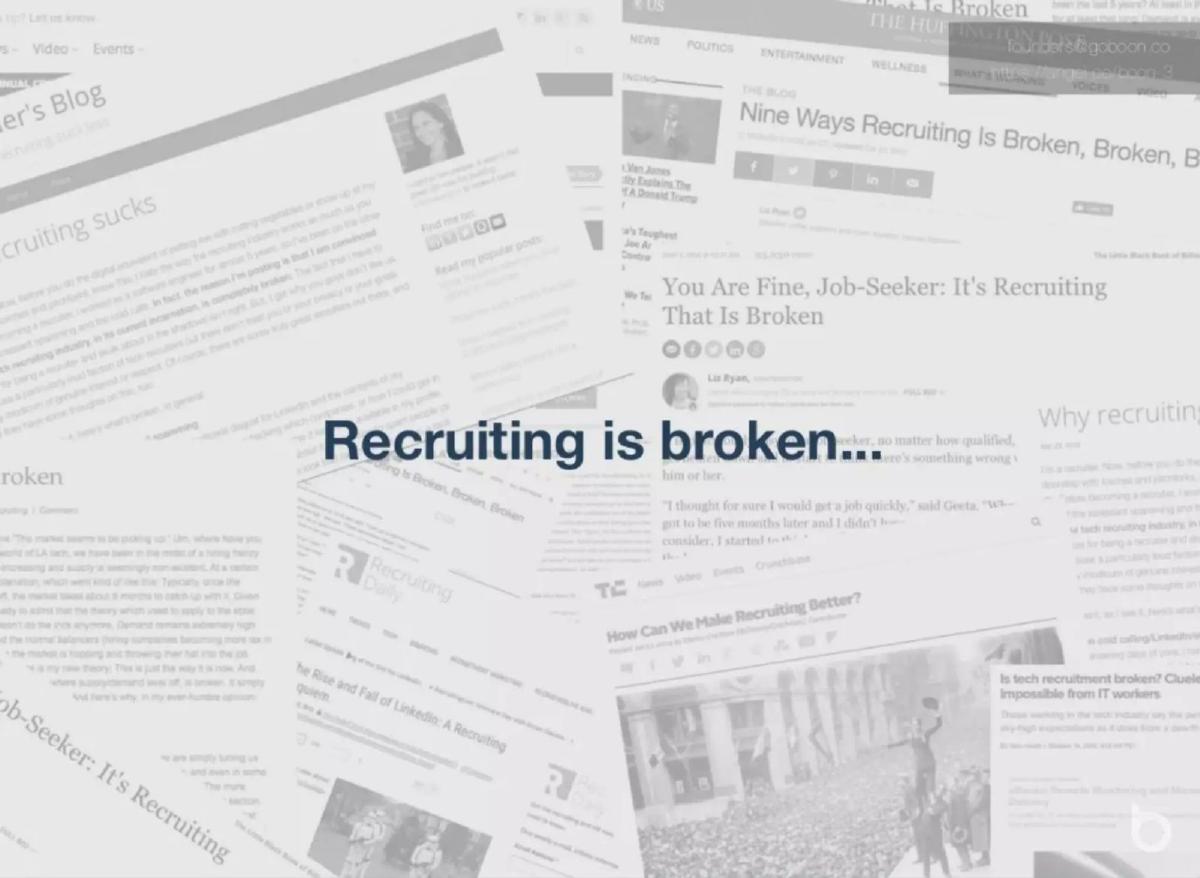
Slide 2: The Problem Boon uses a collage of news headlines to establish the 'Recruiting is broken' narrative. Headlines from The Huffington Post, TechCrunch, and various blogs scream that 'Recruiting sucks' and 'Nine Ways Recruiting is Broken.' This is a standard 'villain' slide, designed to get investors nodding in agreement that the status quo is untenable. However, it lacks specific data points on why it is broken (e.g., cost per hire or time to fill), relying instead on general sentiment.
Slide 3: The Referral Gap
This is the 'aha' moment of the deck. Boon identifies a specific inefficiency they call 'The Referral Gap.' The slide features three circles: 88% (green), 22% (red), and a question mark (white). The implication is that while 88% of employees are willing to help their companies hire, only 22% actually do. This 66% delta represents the market opportunity. By quantifying a psychological barrier, Boon moves from a general 'recruiting is bad' argument to a specific 'referrals are underutilized' argument. This is the strongest slide in the deck because it defines the exact problem the software intends to solve.
Slide 4: The Solution and Product UI
Slide 4 introduces the product interface. The slide lists three value propositions: Effortless, Engaging, and Transparent. The UI shown on a laptop and mobile device is dense with information, which actually works in its favor here. It shows a user profile (John Watson) with 'Total Potential' earnings of $63,575 and 'Total Earned' of $3,850. This suggests a gamified, bounty-based system where employees are financially incentivized to share job openings with their network. A '63%' metric with an upward arrow is highlighted in a circular graphic, though the slide does not explicitly state what this 63% represents (likely an increase in referral rates or engagement).
Slide 5: Market Size
Titled 'This Market is Massive,' Slide 5 provides two macro figures: '$457 billion worldwide' and '10% Growth YOY.' While these numbers are large, they are also very broad. A $457B market likely encompasses the entire global HR and staffing industry. For a Seed round, investors usually prefer to see a Bottom-Up market analysis showing how many companies might pay for a referral tool specifically. However, in a 7-slide deck, these 'big numbers' serve to check the box that the ceiling for the company is high enough to justify venture returns.
Slide 6: Traction and Partnerships
This is the 'proof' slide. It features the Red Bull logo prominently, alongside other partners like HauteLook, Nikkiso, Retention Science, and Branch Metrics. The most important text on this slide is the small green banner in the top left: '$100,000 in under 3 months.' For a startup at the Seed stage, $33k in monthly revenue shortly after launch is a powerful indicator of demand. It proves that companies are willing to pay for a solution to the 'Referral Gap.' The inclusion of a mobile screen showing a list of 'People' and 'Teams' suggests the product is already live and being used by these organizations.
Slide 7: The Close
The final slide is a simple contact page: 'Contact us at founders@goboon.co.' Notably, there is no 'Ask' slide. There is no mention of how much they are raising (though we know from the catalogue it was $2.5M), what the valuation is, or what the milestones for the next 18 months look like. This reinforces the idea that this deck was a teaser meant to secure a meeting rather than a standalone document to close a deal.
What Works in This Deck
The 'Referral Gap' Insight: Slide 3 is the anchor of the entire pitch. It takes a complex problem (hiring) and reduces it to a simple, solvable behavioral gap. Investors love 'gap' stories because they imply a clear path to value creation.
High-Fidelity UI: The product screenshots on Slide 4 look polished and professional. In the HR tech space, where legacy software is often clunky and unattractive, having a modern, consumer-grade UI is a competitive advantage.
Rapid Revenue: Stating that they hit $100,000 in revenue in under three months (Slide 6) is the ultimate de-risking mechanism. It moves the conversation from 'Will this work?' to 'How fast can we scale this?'
What is Missing
The Team: This is the most glaring omission. In a Seed round, investors are primarily betting on the founders. Without a team slide, there is no way to know if the founders have the technical chops or the industry experience to navigate the HR tech landscape. The catalogue mentions a 'recommendation engine called Clark,' but the deck doesn't explain who built it.
Business Model: While Slide 4 shows 'bounties' earned by employees, it doesn't explain how Boon makes money. Do they take a percentage of the bounty? Is there a flat SaaS fee per employee? Investors need to see the unit economics to understand the scalability of the revenue.
Competition: The recruitment space is crowded with giants (LinkedIn) and niche players (Jobvite, Lever). Boon does not address how they differentiate from existing referral modules within larger Applicant Tracking Systems (ATS).
The Ask: A pitch deck without an 'Ask' is like a sales pitch without a price. It leaves the investor wondering what the capital will be used for—hiring, marketing, or product development?
What a Founder Should Copy
Focus on a Single Metric: If you have a 'gap' metric like Boon’s 88% vs. 22%, make it the centerpiece of your deck. It is memorable and easy to repeat to other partners in a venture firm.
Show, Don't Just Tell, Traction: Instead of saying 'We have great partners,' Boon put the Red Bull logo front and center and paired it with a specific revenue figure ($100k). This combination of social proof and hard dollars is very persuasive.
Minimalist Design: The deck uses a consistent color palette and avoids walls of text. This ensures that the investor stays focused on the key takeaways rather than getting lost in the weeds of feature lists.
Final Thoughts
Boon’s deck is a 'hook' deck. It is designed to create enough intrigue and provide just enough proof of life to get a partner at a VC firm on the phone. While it breaks several 'rules' of pitch decks—most notably the omission of the team—it succeeds by identifying a massive inefficiency in a huge market and proving that they have already started to monetize it. For founders with strong early traction, sometimes less is indeed more.
Frequently asked questions
- Why is the company name different in the deck versus the catalogue?
- The catalogue listing refers to 'Boon + Gable,' a personal styling service. However, the deck itself is branded simply as 'Boon' and focuses entirely on employee recruitment referrals. This indicates a significant pivot or a spin-off of the core technology (the 'Clark' recommendation engine) into the B2B HR tech space. The deck reflects the company's new direction as a recruitment tool.
- How does Boon justify the 'Referral Gap'?
- On Slide 3, Boon uses a simple three-ring visualization to show that 88% of employees are willing to refer candidates, yet only 22% actually follow through. The third ring contains a question mark, implying that Boon is the missing link that converts willingness into action. By framing the problem as a behavioral gap rather than a lack of talent, they create a clear niche for their software.
- What traction does the deck show to support a $2.5M raise?
- The most compelling traction point is on Slide 6, which states the company generated '$100,000 in under 3 months.' This rapid revenue generation, combined with a list of high-profile pilot partners like Red Bull and Branch Metrics, provides the 'social proof' necessary to convince investors that the product-market fit is emerging quickly.
- Is the market size of $457 billion realistic for this niche?
- Slide 5 cites a $457 billion worldwide market. This figure likely represents the total global spend on recruitment and staffing, rather than the specific sub-sector of referral software. While it makes the opportunity look 'massive,' sophisticated investors would likely require a more granular breakdown of the Serviceable Obtainable Market (SOM) during due diligence.
- What are the biggest risks in this deck's presentation?
- The primary risk is the lack of information regarding the team and the unit economics. Without a team slide, investors cannot vet the founders' ability to execute. Furthermore, while Slide 4 shows a user could potentially earn over $60,000, it doesn't explain the cost of acquisition for these users or the margin Boon retains, leaving the long-term profitability of the model unclear.