The Bookneto pitch deck represents a classic early-2010s approach to the burgeoning creator economy within education. Led by Iyinoluwa Aboyeji, who would later become one of Africa’s most prominent tech founders, the deck proposes a 'WordPress for online courses' model. It identifies a clear gap between heavyweight institutional LMS tools like Blackboard and commoditized marketplaces like Udemy. By offering a 20% revenue-share model and custom branding, Bookneto aimed to empower 'talented individuals' to reach millions. While the deck is light on technical architecture and specific traction m…
Key takeaways
- The founder, Iyinoluwa Aboyeji, highlights his early career success, including working at the UN at age 17 and running Canada’s largest college newspaper at 18 (Slide 3).
- Bookneto positions itself as a white-label solution, allowing experts to host courses on their own subdomains, such as sethgodin.bookneto.com (Slide 5).
- The business model is a straight 20% commission on revenue generated from paid courses, leaving 80% for the creator (Slide 7).
- The deck uses a competitive matrix to differentiate from Blackboard (too expensive), Udemy (no custom branding), and WordPress (requires a developer) (Slide 9).
- The advisory board includes notable academic and industry figures from the University of Waterloo, Temple University, and UofT (Slide 3).
- The vision slide compares the potential impact of Bookneto to transformative platforms like YouTube, iTunes, and WordPress (Slide 11).
- The deck lacks a formal 'Ask' slide, financial projections, or a detailed product roadmap in the provided six-slide sample.
- The solution emphasizes ease of use, claiming to make teaching online courses as 'free and easy as blogging' (Slide 5).
Introduction: The Genesis of a Serial Founder
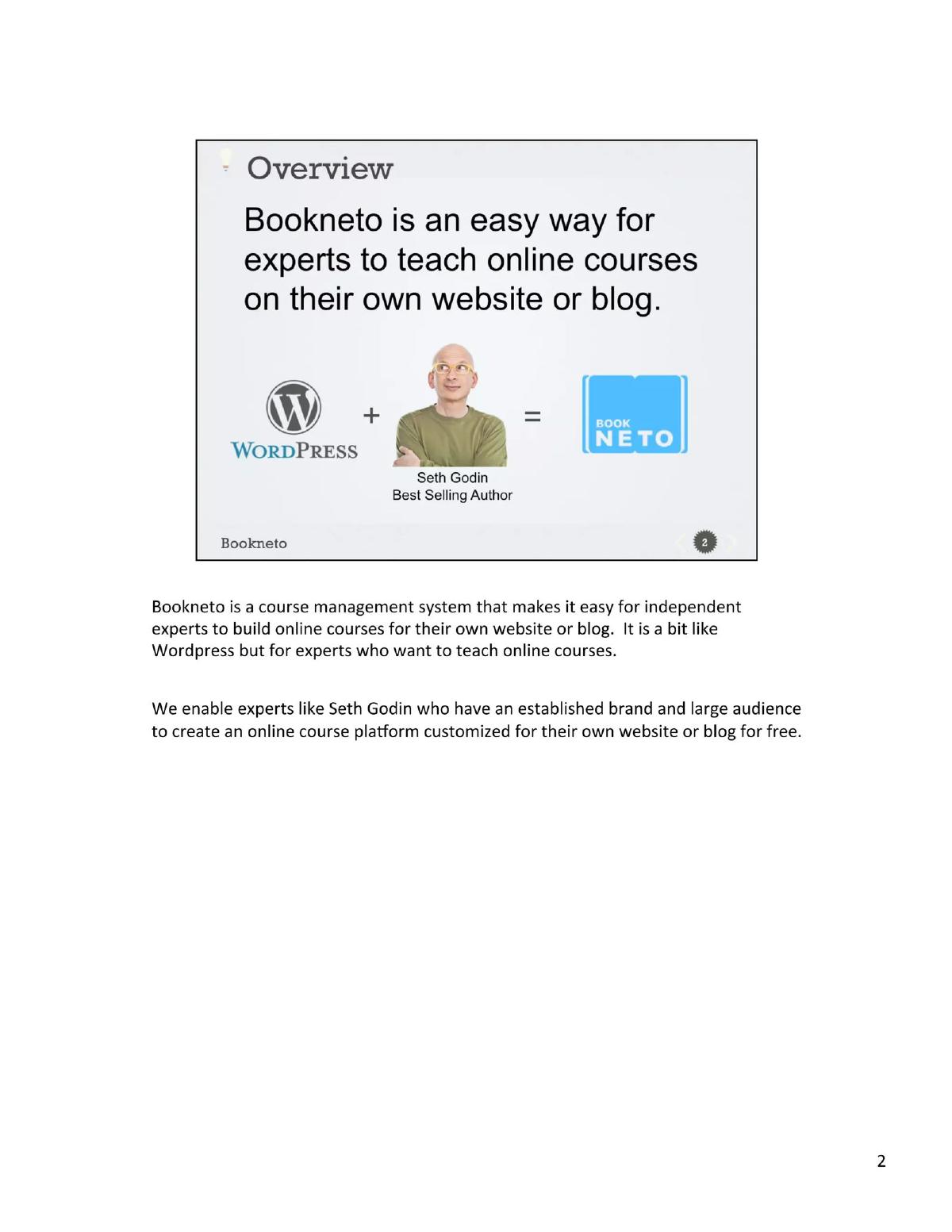
The Bookneto pitch deck is a fascinating historical artifact in the African and global EdTech landscape. It features Iyinoluwa Aboyeji, a founder who would go on to co-found Andela (a unicorn talent accelerator) and Flutterwave (a payments giant). At the time of this deck, the focus was on the 'expert economy.' The deck presents a vision for a platform that simplifies online course creation, positioning itself as the infrastructure layer for independent educators.
Slide 1: Title and Contact
The cover slide is minimalist, featuring the Bookneto logo—a stylized book icon—and the contact information for Iyin Aboyeji. The inclusion of a personal email and website (www.bookneto.com) is standard. The speaker notes indicate a direct, informal opening: 'My name is E and I am CEO of Bookneto.' This suggests the deck was designed for a live presentation where the founder's personality and narrative were intended to drive the engagement.
Slide 3: Founding Team and Advisors
Slide 3 is the 'Founding Team' slide. It is heavily weighted toward the founder's early achievements and the credibility of his advisors. Aboyeji lists four key milestones: working at the UN at 17, running Canada’s largest college newspaper at 18, being a 'Top 20 Nigerian under 20,' and his degree from the University of Waterloo. This is a 'bet on the founder' slide, common in pre-revenue startups.
The bottom half of the slide lists four advisors: Larry Smith (UW, TED), Andrew Maxwell (TempleU, CIC), Mo Abdelrazik (IBM, D2L, UofT), and Jim De Wilde (UofT, McGill). The speaker notes clarify that Andrew Maxwell was also the company's first customer, which provides a small but important signal of early product-market fit or at least initial validation.
Slide 5: The Solution
The 'Solution' slide defines Bookneto as a tool that 'makes teaching online courses on your website free and easy.' The key features listed are:
Create a free account (with a subdomain example: sethgodin.bookneto.com) · Create one or several courses · Upload and organize content (video, text, audio) · Set a price or offer for free · Publish and promote to audience
The emphasis here is on the 'own website' aspect. By using subdomains, Bookneto promised creators they wouldn't be swallowed by a marketplace, a common pain point for high-profile experts who already have an established brand.
Slide 7: Business Model
The business model is presented with extreme simplicity on Slide 7: 'Bookneto takes 20% of experts revenue from paid courses.' A blue arrow graphic illustrates the flow: Students pay for courses, the expert sets the pricing, and Bookneto skims 20% off the top. The speaker notes argue that this 80% retention for the expert is a 'much better rate than other platforms (like Udemy) offer,' particularly when considering the 'level of customization and control' provided.
Slide 9: Competition
Slide 9 uses a standard feature-comparison matrix. It compares Bookneto against three tiers of competitors:
WordPress + Developer: Offers custom branding but fails on ease of use and carries a '$$' cost. · Marketplaces (Udemy, Skillshare, Lynda): Offer ease of use and are 'Free' to start but fail on custom branding. · LMS (Blackboard): Fails on branding and ease of use, while being the most expensive ('$$$').
Bookneto claims the 'green checkmark' in every category: Custom Branding, Ease of Use, and a 'Free' starting cost. The speaker notes provide a deeper critique, suggesting that marketplaces lead to experts losing potential customers to 'less qualified competitors' and that custom WordPress builds 'degrade ease of use' over time.
Slide 11: Vision
The 'Vision' slide attempts to place Bookneto in the pantheon of great internet platforms. It asks: 'Can one talented individual change the lives of millions?' The slide features icons for YouTube, iTunes, and WordPress, alongside a globe. The speaker notes draw parallels between Michael Jackson (TV), Justin Bieber (YouTube), and Jay-Z (iTunes), arguing that Bookneto will be the platform that 'empowers the world’s best teachers to touch the lives of millions of students.'
What Works in This Deck
Founder Pedigree: For a young founder, Aboyeji does an excellent job of framing his early-life achievements as evidence of high agency. Mentioning the UN and the leadership of a major college newspaper suggests a level of maturity and execution capability that offsets a lack of long-term corporate experience.
Clear Differentiation: The competition slide (Slide 9) is effective because it doesn't just list features; it identifies a specific psychological pain point for 'experts'—the loss of brand identity. By positioning Bookneto as the 'WordPress for courses,' they tap into a proven mental model of successful internet infrastructure.
Simple Monetization: The 20% revenue share is easy to understand and aligns the company's success directly with the success of its users. There are no complex licensing fees or tiered subscriptions mentioned, which lowers the barrier to entry for new creators.
What Is Missing from This Deck
Traction Metrics: While the speaker notes mention a 'first customer,' there is no data on how many courses have been created, how many students are enrolled, or what the Gross Merchandise Volume (GMV) looks like. Even for an early-stage deck, some indication of user engagement is usually necessary to move past the 'vision' stage.
The 'Ask': The six slides provided do not include a slide detailing how much capital the company is seeking, the valuation, or how the funds will be allocated. Without an 'Ask' slide, the deck feels more like a product pitch than a fundraising pitch.
Technical Depth: The deck claims the platform is 'easy' and supports video, text, and audio, but it provides no insight into the technology stack or how it handles hosting and bandwidth—significant costs for a video-heavy platform taking only 20% of revenue.
Go-To-Market Strategy: There is a mention of 'publish and promote to audience,' but no detail on how Bookneto will acquire these experts. Relying on experts to bring their own audience is a valid strategy, but the deck doesn't explain how they will convince the first 100 high-value experts to switch from their current solutions.
Founders: What to Copy and What to Avoid
Copy the 'Advisor' Strategy: If you are a first-time founder, surrounding yourself with high-profile advisors from relevant industries (in this case, EdTech and Academia) adds immediate institutional credibility. Slide 3 is a masterclass in using 'borrowed' authority to bolster a young team.
Copy the 'Mental Model' Comparison: Comparing your startup to successful, well-understood platforms (WordPress, YouTube) helps investors quickly categorize your business. It reduces the cognitive load required to understand your value proposition.
Avoid the 'Empty' Vision Slide: While Slide 11 is aspirational, it lacks substance. Comparing a pre-revenue startup to YouTube and iTunes can come across as hyperbolic if not backed by significant early growth data. Use vision slides to show where the market is going, not just to list famous logos.
Avoid Omitting the Unit Economics: A 20% cut sounds generous to the creator, but for the platform, it must cover hosting, payment processing, and customer support. Founders should include a slide that briefly explains how that 20% covers costs and leads to profitability at scale.
Frequently asked questions
- What was the primary value proposition of Bookneto?
- Bookneto aimed to provide experts with a platform to create, host, and sell online courses under their own brand. Unlike marketplaces like Udemy, which aggregate content under a single brand, Bookneto focused on 'Custom Branding' and 'Ease of Use,' allowing creators to maintain their own audience relationship via unique URLs (Slide 5 and 9).
- How did Bookneto plan to make money?
- The company utilized a transaction-based revenue model. According to Slide 7, Bookneto took a 20% cut of the revenue generated by experts from their paid courses. The slide notes that experts set their own pricing, and the platform's take is presented as a 'better rate' than competitors, though it does not specify which competitors it is cheaper than.
- Who were the key people behind the project?
- The deck was led by CEO and Founder Iyinoluwa Aboyeji. His background includes a Legal Studies degree from the University of Waterloo and early leadership roles at the UN and Imprint Publications. He was supported by four advisors: Larry Smith, Andrew Maxwell, Mo Abdelrazik, and Jim De Wilde, representing institutions like IBM and UofT (Slide 3).
- What market gap did the deck identify?
- Slide 9 identifies three categories of competitors that failed to meet the needs of independent experts: expensive and difficult Learning Management Systems (Blackboard), commoditized marketplaces where experts lose their brand (Udemy/Skillshare), and complex custom builds using WordPress that require expensive developers.
- What is missing from this pitch deck?
- Based on the provided slides, the deck is missing several critical components for a late-stage seed or Series A round, including a clear 'Ask' (how much money is being raised), a detailed Go-To-Market strategy, current traction metrics (users/revenue), and a technical roadmap. It functions more as a conceptual or very early seed-stage vision deck.