Book My Activity presents a marketplace solution for the fragmented Indian education and activity sector, aiming to streamline the discovery and booking of both offline and online classes. The deck relies heavily on a 'X for Y' analogy, comparing itself to the ticketing giant BookMyShow. With a stated presence in 67 cities and a focus on the Nashik, Pune, and Mumbai regions, the company reports 7,193 educators and over 17,000 end users. However, the deck suffers from dated market data (citing an HSBC report from 2013) and lacks a clear financial 'ask' or specific use-of-funds breakdown. While…
Key takeaways
- The company uses a clear 'X for Y' positioning, describing itself as 'BookMyShow for Learning domain' on slide 1.
- Market size calculations for offline education in India are based on a 2013 HSBC report, which may be outdated for a modern pitch (slide 6).
- Traction metrics show a concentrated geographic focus, with primary operations in Nashik, Pune, and Mumbai (slide 9).
- The platform reports 7,193 educators and 17,166 end users, but daily active users (DAU) are relatively low at 150 (slide 9).
- Revenue streams are diversified across service provider subscriptions, consumer memberships, and sponsored blogging (slide 8).
- The business plan projects $49M in revenue by 2023, assuming a $200/year minimum spend from 0.25M paid educators (slide 13).
- The deck includes a detailed team slide featuring founders with M.S. degrees from U.S. universities like VTECH and Akron (slide 15).
- There is no 'Ask' slide; the deck concludes without specifying the amount of capital sought or the valuation (slide 16).
Executive Summary and Positioning
Slide 1: Title and Hook
The deck opens with a clear value proposition: "We are BookMyShow for Learning domain." This is a classic 'X for Y' pitch strategy, leveraging the brand recognition of India's largest ticketing platform to explain a marketplace model. The subtitle emphasizes "Real-Time Instant gratification of booking verified, rated, recommended learning activities!" and introduces the tagline "Find What You Love."
Defining the Market Friction
Slide 2: The Problem
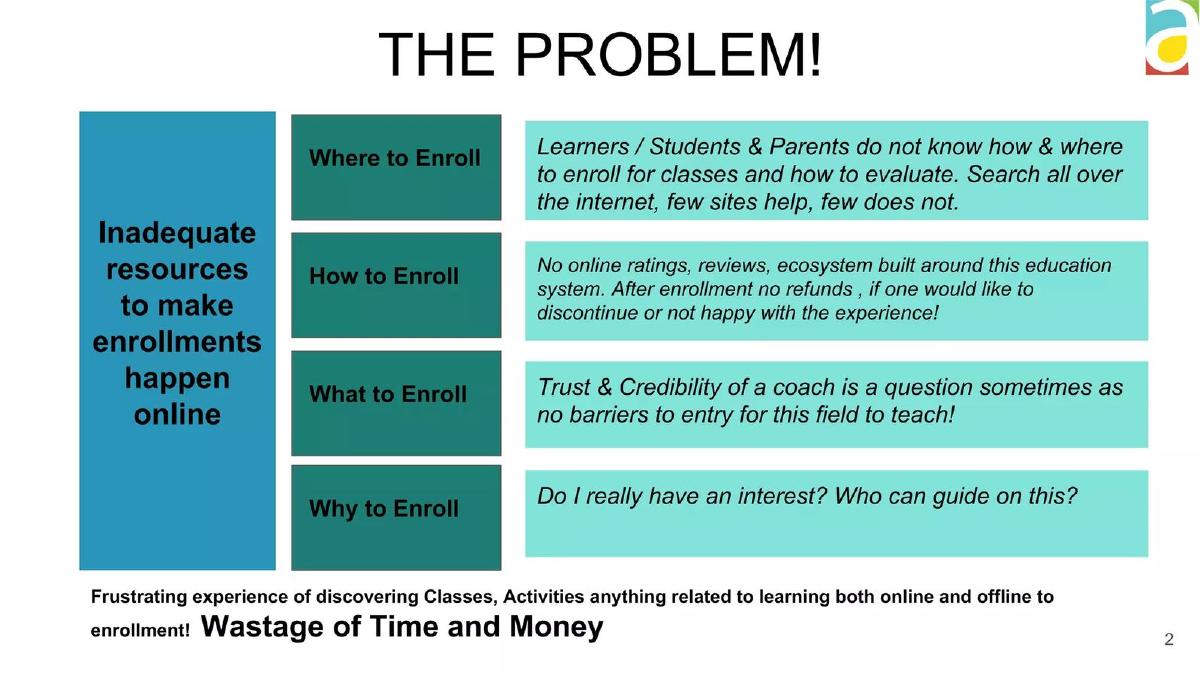
The problem is categorized into four quadrants: Where to Enroll (lack of search resources), How to Enroll (no ratings/reviews), What to Enroll (trust and credibility issues), and Why to Enroll (lack of guidance). The slide concludes that the current experience is a "Frustrating experience... Wastage of Time and Money."
Slide 3: Current Scenario
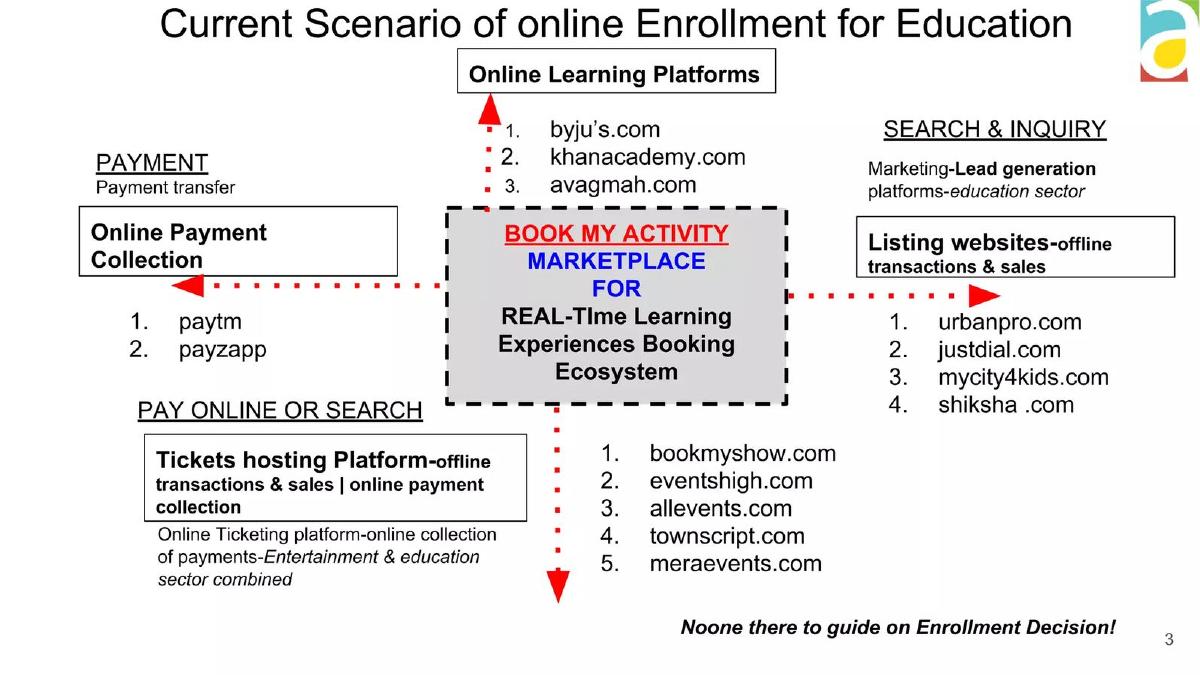
This slide maps the existing ecosystem, placing Book My Activity at the center of a fragmented landscape. It lists competitors in Online Learning (Byju's, Khan Academy), Search & Inquiry (UrbanPro, Justdial), Online Payment (Paytm), and Ticketing (BookMyShow, Townscript). The key takeaway here is the claim that "Noone there to guide on Enrollment Decision!"
Slide 4: Decision Factors
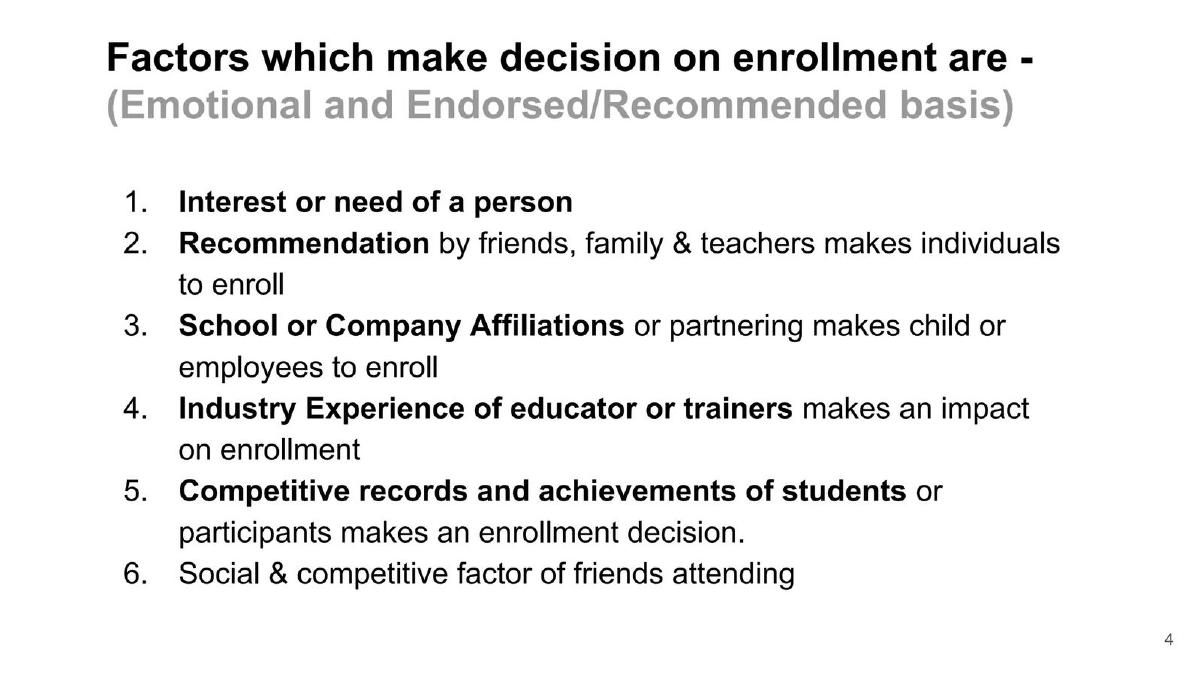
The company identifies six emotional and endorsed factors that drive enrollment, including personal interest, recommendations from family, school affiliations, and the industry experience of the trainer. This slide attempts to build a psychological profile of their target customer's journey.
Market Segmentation and Opportunity
Slide 5: Market Segment
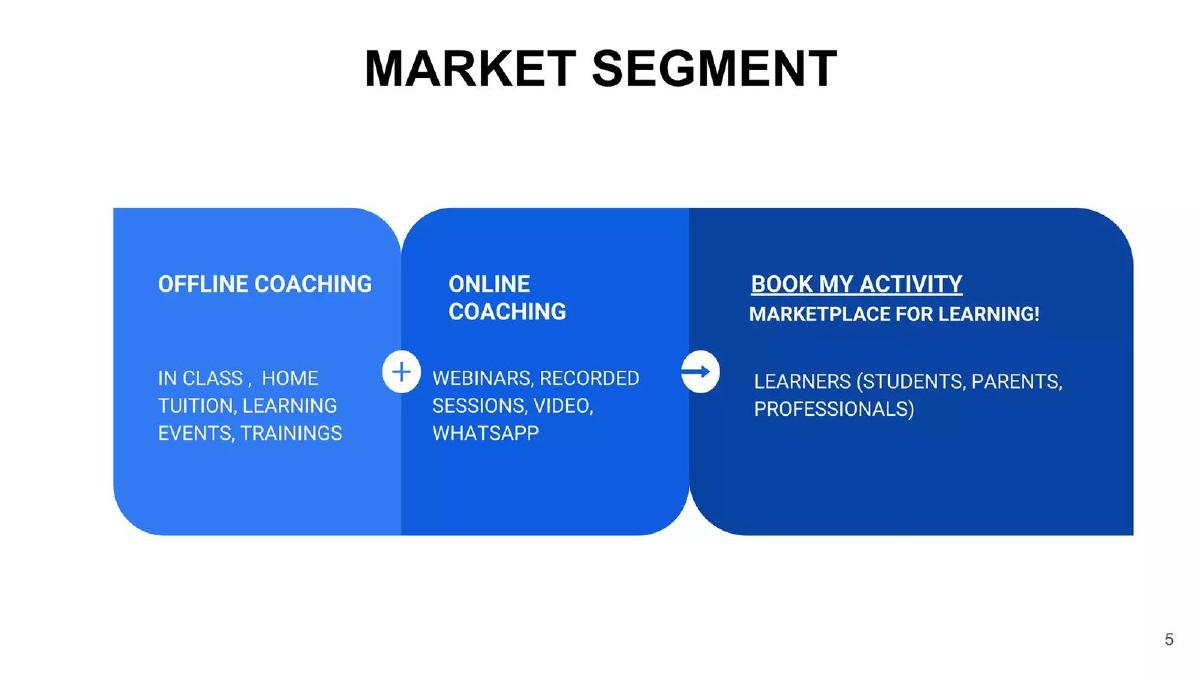
The deck segments the market into Offline Coaching (in-class, home tuition) and Online Coaching (webinars, recorded sessions). Book My Activity aims to serve as the marketplace for both, targeting a broad audience of Learners (Students, Parents, Professionals).
Slide 6: Market Size (Offline Education)
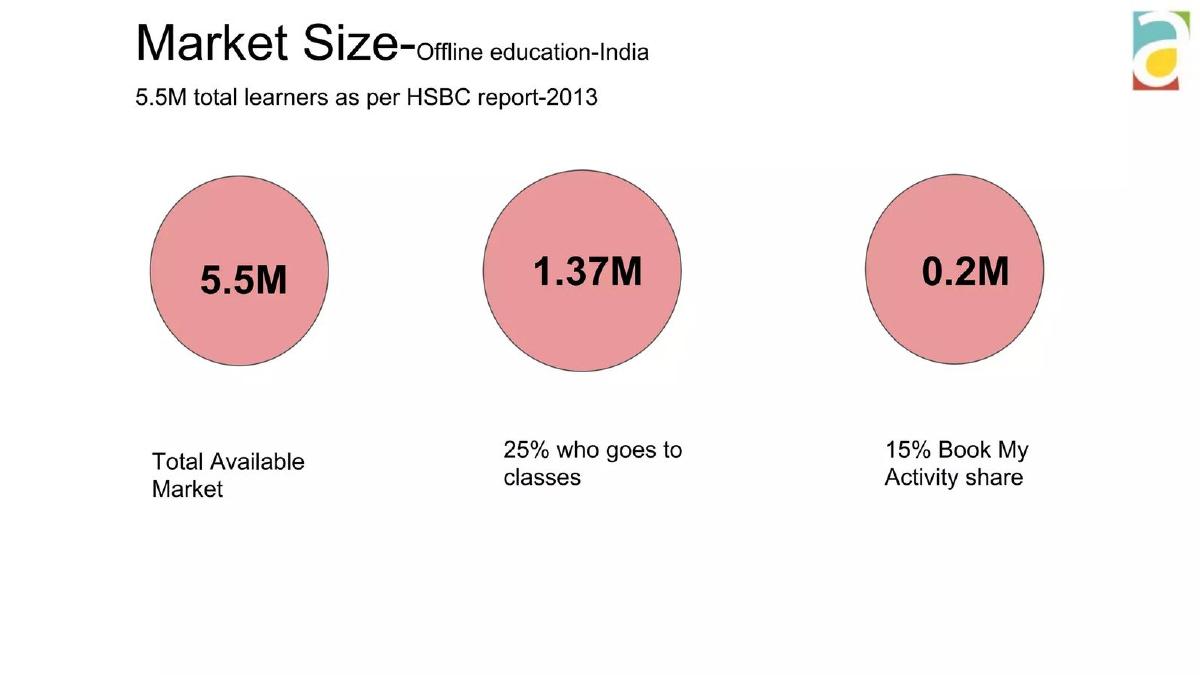
The company cites an HSBC report from 2013 to define the market. It states a Total Available Market of 5.5M learners , with 25% (1.37M) attending classes. The company targets a 15% share, which they calculate as 0.2M . Using 2013 data in a pitch deck is generally a red flag for investors, as the Indian EdTech and activity market shifted significantly between 2013 and the time of this deck's creation.
The Solution and Business Model
Slide 7: The Solution - Social Learning Community
The solution is described as a "Social Learning Community" powered by Big Data, Machine Learning, and AI. Features include a forum for queries, a newsfeed for educator success stories, a booking system, and a reward points program. The slide uses a circular flow diagram to show how these features interact to make the enrollment decision easier.
Slide 8: Revenue Generation Opportunities
01 Customer/Service Provider Side: Subscriptions, Ads, and SMS/Email campaigns. · 02 Consumer & Corporate Side: Membership charges. · 03 Vendors/Educational Brands: Sponsored blogging.
Traction and Validation
Slide 9: Our Journey So Far
This is the traction slide. It lists a presence in 67 cities , with a focus on Nashik, Pune, and Mumbai. Key metrics include:
7,193 Educators · 17,166 End Users · 150 Daily Active Users · 3,031 Website Visits/Day · 23 Leads/Month to Educators · 4 Bookings/Month per Educator
The low DAU relative to the total user base suggests a retention or frequency-of-use challenge.
Slide 10: Network Connect
This slide illustrates the B2B2C strategy, showing how the platform connects Companies (Corp Acc), Associations, Institutes, and Consumers through an "Influencer's Corner."
Slide 11: Unique Selling Proposition (USP)
The USP slide compares Book My Activity to specific competitors, claiming to combine the activity focus of UrbanPro, the real-time booking of BookMyShow, the listings of Justdial, and the social aspects of Quora/Facebook, but specifically for the "Learning & Education Domain."
Financial Projections
Slide 12: Market Size - Educator Subscription Model
The deck pivots to the supply side market size. It claims a Total Available Market of 1M educators , with a goal of 70% registration (0.7M) and 35% becoming paid customers ( 0.25M ).
Slide 13: Business Plan
Using the 0.25M paid customer figure from the previous slide and a minimum spend of $200/year , the company projects a Revenue of $49M by 2023. This is a top-down projection that assumes high penetration in the educator market.
Slide 14: Benefits for Educators
This slide functions as a sales pitch for the supply side, detailing features like Webinar conversion, Attendee Management (QR code scanning), Payment Acceptance (EMI facilities), and Student Management.
The Team and Conclusion
Slide 15: The Team
Shilpa Dhamne (Founder & CEO): 10+ years experience, M.S. from VTECH, USA. · Chinmay Dhamne (Co-Founder): 10+ years experience, M.S. from VTECH, USA. · Aparna Ghate (Technical Head): 10+ years experience, M.S. from University of Akron, USA. · Uday Musale (Advisor): 35+ years experience, former startup founder.
The team appears to have strong academic backgrounds and relevant professional experience.
Slide 16: Thank You
The final slide includes the company logo, website (www.bookmyactivity.co.in), and a link to a video. Notably, there is no mention of a funding ask, valuation, or contact information for the founders.
What Works / What is Missing
What Works: The 'BookMyShow for Learning' analogy is a strong, immediate hook. The deck also does a good job of showing geographic traction in specific Indian hubs (Nashik/Pune), which proves the model can work at a local level. The inclusion of specific lead and booking counts per educator provides a level of transparency often missing in early-stage decks.
What is Missing: The most glaring omission is the Ask Slide . Investors need to know how much capital is required and what it will be used for. The market data is also a major weakness; citing a 2013 report in a deck that projects out to 2023 makes the research feel stale. Furthermore, the jump from 150 daily active users to 250,000 paid educators (as implied by the $49M projection) lacks a clear growth roadmap or customer acquisition cost (CAC) analysis.
Founder Takeaways
Update your data: Never use market reports that are more than 2-3 years old. The Indian education landscape changed drastically with the rise of 4G and post-COVID digital adoption; 2013 figures are irrelevant to a modern investor. Clarify the Ask: A pitch deck without a funding request is just a company presentation. Always include a slide detailing the amount you are raising, the milestones that capital will help you reach, and your current cap table or valuation expectations. Focus on Engagement: With 17,000 users but only 150 daily actives, the 'leaky bucket' problem is evident. A founder should address how they plan to increase frequency of use or why the low DAU is acceptable for this specific business model (e.g., if bookings are high-value but infrequent).
Frequently asked questions
- What is the core problem Book My Activity is trying to solve?
- According to slide 2, the company addresses the 'inadequate resources to make enrollments happen online.' They highlight that parents and students struggle with where, how, what, and why to enroll due to a lack of online ratings, reviews, and verified coach credibility. They characterize the current experience as a 'wastage of time and money' due to the difficulty of discovering classes both online and offline.
- How does the company plan to generate revenue?
- Slide 8 outlines three primary revenue pillars. First, from the service provider side via subscriptions, advertisements, and data-driven SMS/Email campaigns. Second, from the consumer and corporate side through membership charges. Third, from educational brands through a sponsored blogging segment. Slide 13 further clarifies that the educator subscription model is expected to be a major driver, targeting $200 per year per educator.
- What is the current scale of their operations?
- Slide 9 states the company has a presence in 67 cities, though it is 'mainly Nashik, Pune, Mumbai.' They report 7,193 educators, 17,166 end users, and 15,247 Facebook likes. Technical metrics include 3,031 website visits per day and 150 daily active users. They also note receiving 23 leads per month for educators and 4 bookings per month per educator/portal.
- Who are the competitors identified in the deck?
- The deck identifies competitors across several categories on slide 3 and slide 11. These include online learning platforms like Byju's and Khan Academy, listing websites like UrbanPro and Justdial, and ticketing platforms like BookMyShow and EventsHigh. The company argues that while these platforms exist, none provide a comprehensive 'social learning community' specifically for the education domain.
- What is missing from this pitch deck?
- The most significant omission is a formal 'Ask' slide. There is no mention of how much money the company is looking to raise, the intended use of funds, or the current valuation. Additionally, the market data is significantly dated (2013), and the deck lacks a detailed roadmap or milestones beyond a single revenue projection for 2023.