Boomeon was a social network for Baby Boomers that raised on a 16-slide seed deck in September 2014, asking $600,000 for 20% equity. The deck has a live product, dated traffic growth and three modelled revenue streams — but its ask slide states 20% and a $2.4M valuation, which imply two different prices, and its 2015 revenue projection does not reconcile with the only revenue stream that actually existed. It is a case study in how uncrosschecked numbers destroy the credibility of good ones.
Key takeaways
- Boomeon's September 2014 seed deck asked for $600,000 in exchange for 20% equity 'based on a valuation of $2,400,000' — but $600,000 for 20% is a $3M post-money valuation, and $600,000 of a $2.4M valuation is 25%, so the deck's two most important numbers disagree.
- The deck valued the company at 4x projected 2017 earnings of roughly $600,000, applied with no discount for time or risk, which prices a 2014 seed round at what the company might be worth three years later.
- Boomeon reported 10,000+ members but only about 17,000 monthly visits, roughly 1.7 visits per member per month, with no DAU, MAU or retention data anywhere in a deck for a social network.
- The financials projected $120,000 of 2015 revenue while the advertising slide — the only live revenue stream — projected '$43,000+' at 2015 traffic, leaving roughly $77,000 attributed to products the deck described as 'in development' and 'planned'.
- Projected expenditure stayed flat at $300,000 across 2015 and 2016 while revenue tripled, and the use-of-funds allocation of 50% of the $600,000 raise to sales and marketing equals that entire annual cost line, so the raise never appears in the model.
- The retirement community directory projected $600,000 a year by converting 5% of 100,000+ US communities at $120 each, with no sales team, pilot, or letter of intent described anywhere in the deck.
- The strongest evidence in the deck — that 'baby boomer dating' phrases were already among Boomeon's leading organic search terms — was the only revenue stream given no revenue number at all.
- Fourteen of sixteen slides were bullet text on white with no product screenshot, no chart, and no source cited for any market statistic, including the $400 billion annual Boomer spend figure that justified the advertising model.
What this deck actually is
This is a 16-slide seed investor deck for Boomeon, a social network built specifically for Baby Boomers, dated September 2014. It was produced in PowerPoint, exported from a Mac, and posted publicly under the filename boomeon investor pitch deck final . It is a genuine fundraising document, not a company overview or a conference talk: slide 15 makes an explicit ask of $600,000 for 20% equity.
It is also, by its own admission, a template. The final slide states that "this pitch deck was built following a template propagated by Chance Barnett, CEO of Crowdfunder.com." That single line explains most of the deck's structure — the fixed section order, the one-idea-per-slide bullet layout, the separate Problem, Current Solutions, Products/Services and Competition slides that overlap heavily with each other.
Structurally, it is one of the plainest decks in this teardown series. Fourteen of the sixteen slides are a centred grey headline, three to five lines of body text, and the Boomeon logo bottom-left. There is one photographic slide (the vision slide) and one cover image. There is not a single screenshot of the product, not a single chart, not a single table, and not a single cited source across the entire document — in a deck whose entire argument rests on numbers.
Slide-by-slide walkthrough
Slide 1 — Cover
Full-bleed photograph with the positioning line: "Baby Boomers are looking for a social network and community that's by, for and about them. Boomeon is that place." This is the single best sentence in the deck. It states the audience, the category and the claim in one breath, and a stranger could repeat it accurately after hearing it once. Most seed covers manage a logo and a tagline that means nothing; this one manages a thesis.
What is missing from the cover is everything an investor uses to file the deck: no stage, no round size, no date, no location, no contact. The date only exists in the PDF metadata (25 September 2014) and inferentially from the traction slide.
Slide 2 — About Boomeon
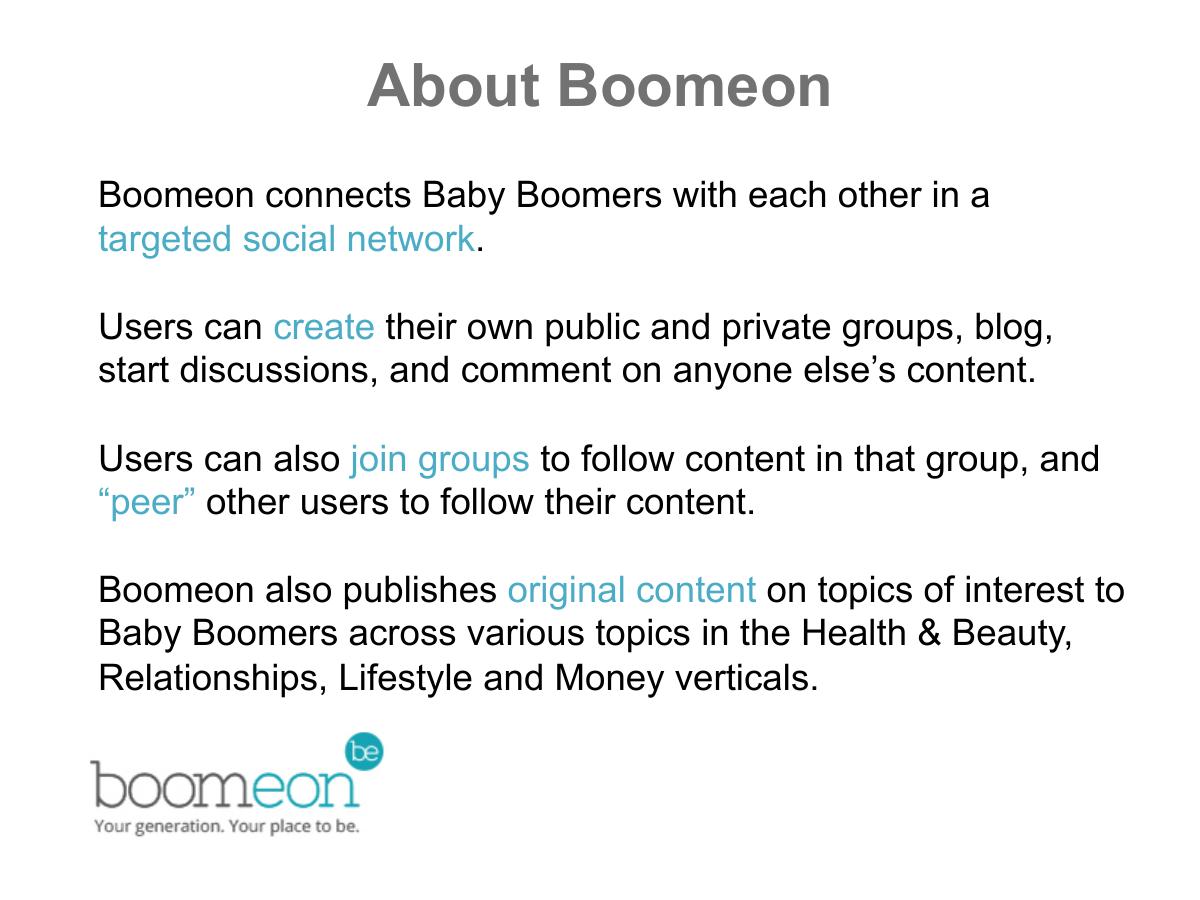
Four paragraphs describing the product: users create public and private groups, blog, start discussions, and comment on other people's content; they can join groups and "peer" other users to follow their content; and Boomeon publishes original editorial across Health and Beauty, Relationships, Lifestyle and Money.
This is a clear description of a feature set, and it quietly reveals that Boomeon is two businesses — a user-generated social network and an editorial publisher. The deck never chooses between them, and never says which one drives the traffic it later monetises.
Slide 3 — Boomeon's Vision
The only image-led slide: "We believe that Baby Boomers deserve their own special social network and online community. We have worked hard to make Boomeon that place." Sentiment, not vision. A vision slide should describe the world after the company wins; this one restates the cover in the first person and adds an appeal to fairness. It costs a slide and adds no information.
Slide 4 — Traction
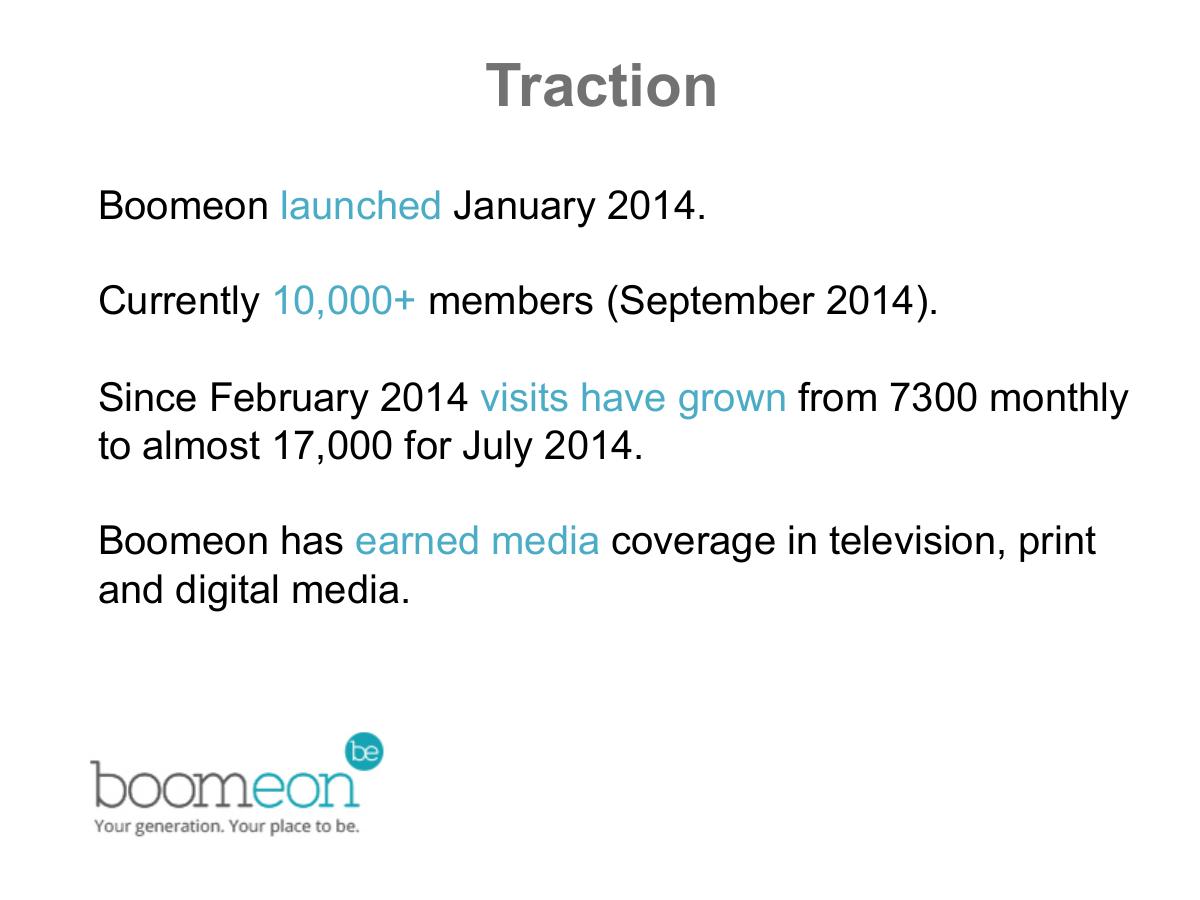
The most important slide in the deck, and the one that undercuts itself. Four facts: launched January 2014; 10,000+ members as of September 2014; visits grew from 7,300 monthly in February 2014 to almost 17,000 in July 2014; earned media coverage across television, print and digital.
Put the first two numbers next to each other. Ten thousand members produce seventeen thousand monthly visits. That is roughly 1.7 visits per member per month — for a social network, a category whose entire value proposition is habitual return. There are no daily actives, no monthly actives, no posts per user, no retention curve, no cohort chart, and no session length. "Members" here is a cumulative registration count, and the traffic number quietly tells you most of them are not coming back.
The traffic range also stops in July while the deck is dated September. Two months of the most recent data are missing from a five-month growth story, which is exactly the interval an investor will ask about first.
Slide 5 — Market Opportunity
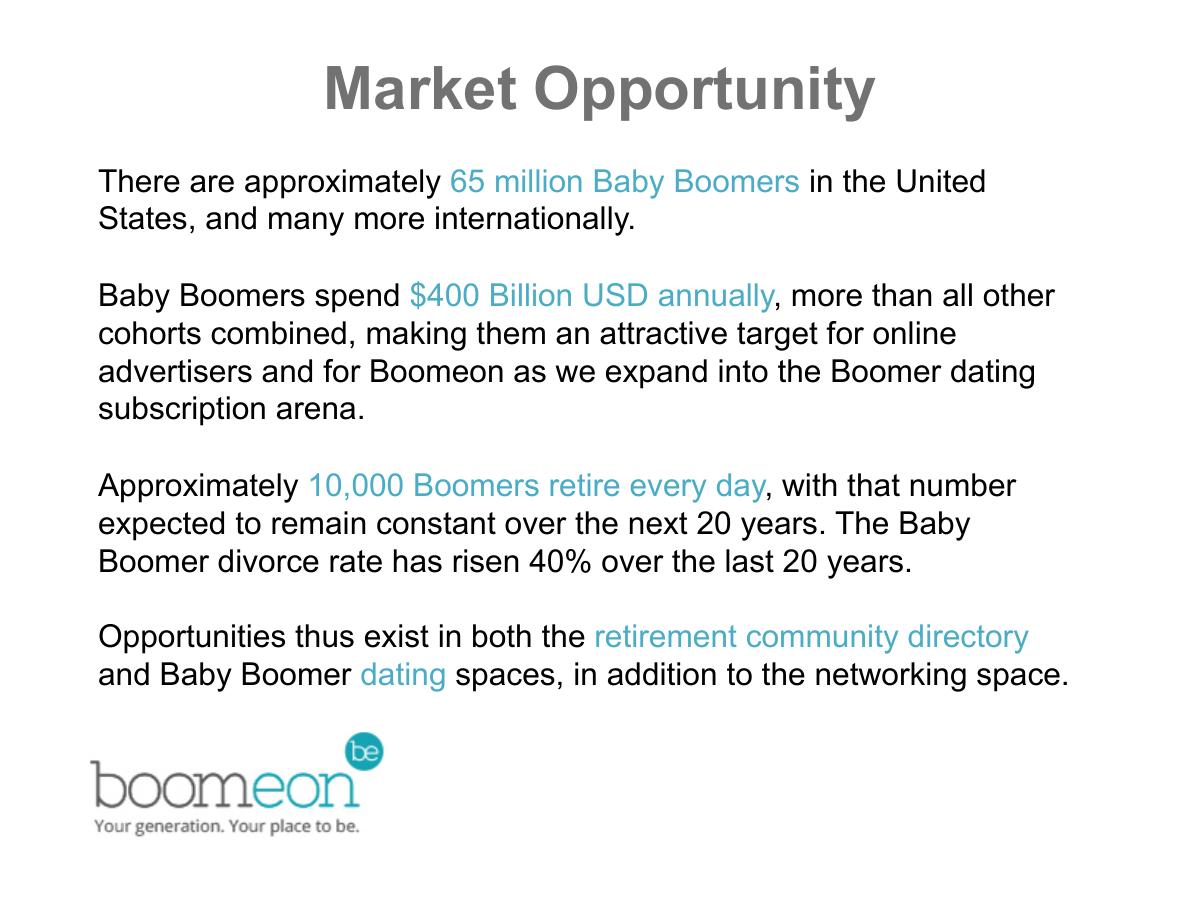
Four claims: approximately 65 million Baby Boomers in the United States; Boomers spend $400 billion annually, "more than all other cohorts combined"; approximately 10,000 Boomers retire every day, expected to hold for twenty years; the Boomer divorce rate has risen 40% over the last twenty years. It concludes that opportunities exist in retirement community directories and Boomer dating as well as networking.
Not one of these four numbers carries a source, a date or a link. The $400 billion figure in particular is doing enormous work — it is the justification for the advertising business — and it is stated without attribution in a document asking for $600,000. There is also no TAM, SAM or SOM arithmetic: the deck jumps from a population statistic to a revenue model without ever calculating the slice of it Boomeon could plausibly capture.
Slide 6 — The Problem / Current Solutions
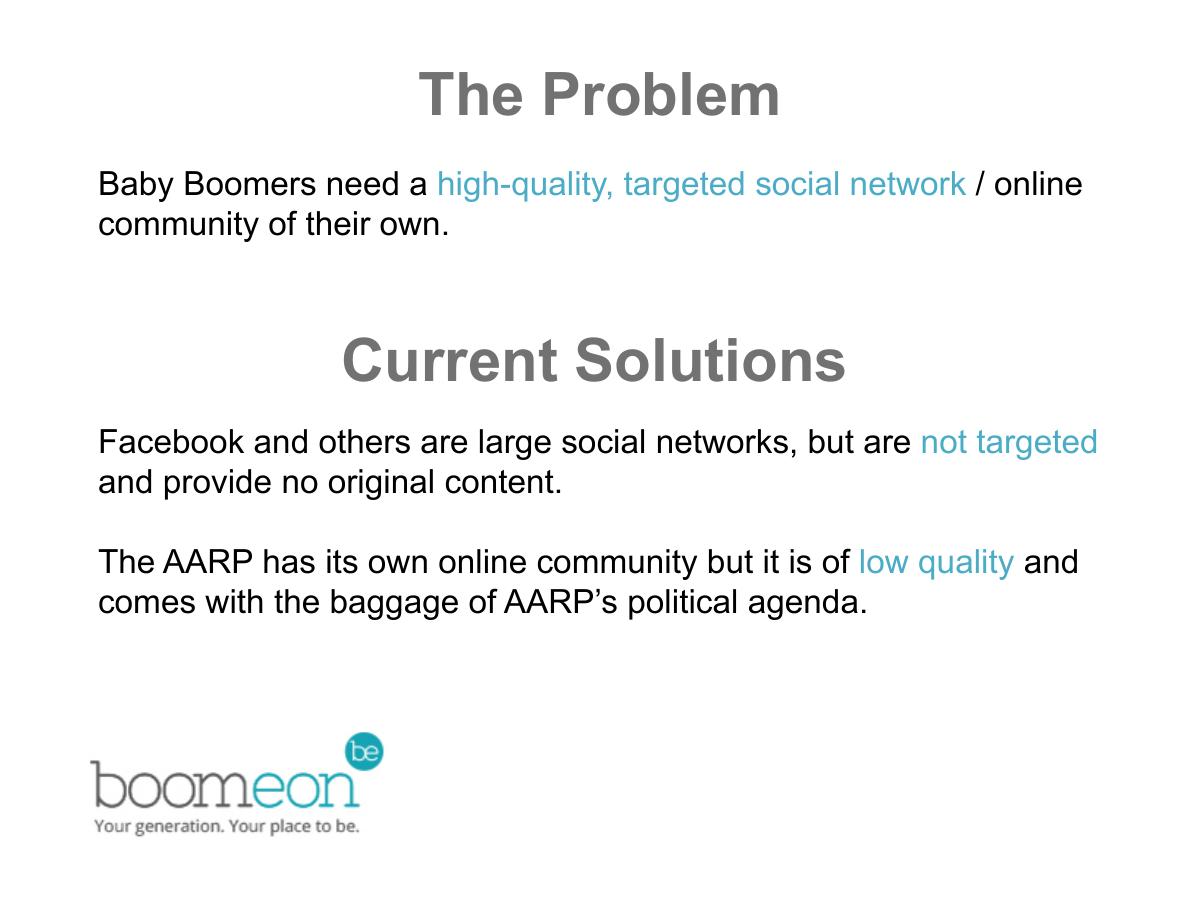
Two sections on one slide. The problem, in full: "Baby Boomers need a high-quality, targeted social network / online community of their own." That is the problem statement restated as the absence of the product — a circular formulation that describes a gap in the market rather than a pain in a person's life.
Current solutions is stronger: Facebook and the large networks are untargeted and publish no original content; AARP has a community but it is low-quality and "comes with the baggage of AARP's political agenda." The competitive read on AARP is genuinely useful. Framing it as ideological baggage is a choice that will land differently in every meeting, and it is not the kind of variance a founder should introduce into a fundraising conversation.
Slide 7 — Products / Services
Argues that Boomers share a generational identity, that Boomeon gives them the place and the tools to express it, and that two further products are coming: a retirement community directory ("in development") and a Boomer dating area ("planned").
This is where the deck's real structure becomes visible. The live product is the social network. The two products carrying most of the projected revenue are not built. The words "in development" and "planned" are honest, and they are also the load-bearing caveat for the next three slides.
Slide 8 — Revenue Stream: Online Advertising
The in-place model. Target price points of $15 to $18 CPM. Most pages carry four ad slots, "generating $60 - $72 per page CPM and thus $43,000+ in revenue from this stream at projected 2015 traffic levels." The stream is said to curve upward as impressions and achievable CPMs rise.
Two problems. First, the unit language is wrong: four slots at $15–18 gives $60–72 per thousand page views, not a "per page CPM," and getting the vocabulary of your only live revenue stream wrong in front of investors who buy media for a living is expensive. Second, and more seriously, $15–18 CPM is a premium direct-sold rate. A 17,000-visit-per-month lifestyle community in 2014 was not selling direct; it was selling remnant inventory through networks at low single-digit CPMs. The deck asserts the premium rate without a single signed advertiser, rate card, or pilot campaign to support it.
Work the arithmetic backwards and $43,000 at roughly $66 per thousand implies about 650,000 page views in 2015, against a current run rate of roughly 200,000 visits a year. The required 3x-plus growth is real and possibly achievable — but it is never stated, so the investor has to derive the deck's own biggest assumption themselves.
Slide 9 — Revenue Stream: Retirement Community Directory
Revenue comes from paid featured placements and from selling captured request-for-information leads. Converting 5% of the 100,000+ US retirement and active adult communities at $120 per year yields $600,000 annually. Separately, 500,000 directory page views a year converting at 1% into leads sold at $25 each yields $125,000.
The arithmetic is internally correct — 5,000 × $120 = $600,000, and 5,000 leads × $25 = $125,000. The assumptions are not. A 5% cold conversion of an entire national category into paying subscribers, with no sales team named, no pilot, no letters of intent, and no channel described, is the single most aggressive number in the deck. And the 500,000 annual page views assumed for the directory alone are more than double the traffic the entire site currently produces, for a product that does not yet exist.
Slide 10 — Revenue Stream: Subscription Dating Features
Boomer divorce is up 40% over twenty years while other cohorts decline; "baby boomer dating" phrases are already among Boomeon's top organic search terms; the planned dating area will have three subscription tiers with a projected 80% of users choosing a $9.99/month middle tier.
The organic search observation is the best piece of evidence in the entire deck — it is a real demand signal, generated by the company's own product, pointing directly at the next product. And then the slide stops. There is no user count, no conversion rate, no revenue figure. The one stream with genuine bottom-up evidence is the only one without a number attached, while the stream with no evidence at all (the directory) gets a $725,000 total.
Slide 11 — Marketing and Growth Strategy
Facebook ads have been "a high-converting, low-acquisition-cost source of new members since launch"; organic traffic is strong and growing with published content; and "we are not aware of any large-scale competitor marketing. We believe we can own the advertising in this space."
"Low acquisition cost" without the cost is not a claim, it is an adjective. The company has been buying users for eight months and therefore knows its blended CAC to the cent; omitting it while the following slides spend 50% of the raise on marketing is the deck's most conspicuous gap. And the absence of competitor marketing in a market described as $400 billion is presented as an opportunity when a disciplined investor reads it as a question: why is nobody else bidding?
Slide 12 — Management Team
Three people. William Murphy, founder and president, described as a "Baby Boomer extraordinaire," who has owned, led and exited several businesses including Esquire Chemical Company, OBF Technologies and Bottom Line Marketing Group. David Dewhirst, nine years of software engineering and marketing, formerly a developer at AgingCare.com and co-founder and CEO of ThreeTwelve Creative. Natalie Dewhirst, web design and marketing since the early 2000s, formerly Creative Director at AgingCare.com and co-founder of ThreeTwelve Creative.
The founder-market fit here is real and underplayed: two of the three built and marketed AgingCare.com, a large site serving an adjacent demographic. That is the most investable fact on the slide and it is buried mid-paragraph. What is missing is whether any of them is full-time on Boomeon — two are co-founders of an operating agency — plus equity split, and any named advisor or board.
Slide 13 — Financials
Three years of projections. 2015: revenue $120,000, expenditure $300,000, loss of $180,000. 2016: revenue $420,000, expenditure $300,000, profit $120,000. 2017: revenue $1,005,000, expenditure $400,000, profit $605,000. A side note says the projections are based on current growth rate and user acquisition costs and include revenue from the directory and dating products.
Three things break here. First, 2015 revenue of $120,000 does not reconcile with slide 8, where the only live stream produces "$43,000+" at 2015 traffic; the remaining $77,000 comes from products the deck says are unbuilt, and no line-item split is given. Second, expenditure is flat at $300,000 across 2015 and 2016 while revenue triples — a company that grows 3.5x without adding cost is not a company, it is a spreadsheet. Third, the whole table appears to ignore the raise: slide 15 allocates 50% of $600,000 to sales and marketing, which is $300,000, equal to the entire annual expenditure line.
Slide 14 — Competition
Five bullets. Boomeon contends with Facebook; it is "much more agile" and more responsive; it is targeted at a specific demographic; it blends original content with networking; and AARP blends content with community but on outdated technology and design, with an ideology many Boomers reject.
Agility is not a moat; it is a temporary consequence of being small. The one durable asset the deck could have claimed here — the organic search position on Boomer dating terms mentioned on slide 10 — never appears. There is no competitive matrix, and no mention of the actual field in 2014 (niche communities, dating incumbents already courting the 50+ segment, and the vertical publishers competing for the same ad dollars).
Slide 15 — Investment
"We are seeking a $600,000 seed round in exchange for 20% equity in Boomeon based on a valuation of $2,400,000." The valuation is justified as projected 2017 earnings of approximately $600,000 at a 4x multiplier, "conservatively below historical industry multipliers." Use of funds: 25% existing staff salaries, 10% new hires, 50% sales and marketing, 10% new product development, 5% infrastructure and overhead.
The headline sentence does not reconcile with itself. $600,000 for 20% is a $3,000,000 post-money valuation, or $2,400,000 pre-money. Written as "20% equity based on a valuation of $2,400,000," the arithmetic gives 25%, not 20%. The deck never says pre or post, so the two most important numbers in the document — price and dilution — are ambiguous by $600,000 on the single slide whose only job is to be unambiguous.
The valuation method is worse than the arithmetic. Applying a 4x earnings multiple to a profit figure three years in the future, with no discount for time or risk, prices the company today at what it might be worth in 2017 if every unbuilt product ships and every unsourced assumption holds. An investor buying at that price earns nothing for taking three years of execution risk. Consumer networks at this stage are also not priced on earnings multiples at all — the comparable set is users, engagement and revenue multiples, none of which appear.
Finally, the ask and the plan disagree. The projections show a maximum annual loss of $180,000 and profitability from 2016. Raising $600,000 to fund $180,000 of burn is either an over-raise or, more likely, evidence that the financial model and the funding ask were built separately and never reconciled.
Slide 16 — Thanks and Contact
Credits the Crowdfunder template and its author, thanks the reader for their time, and gives three founder email addresses. Naming the template is disarmingly honest and strategically poor: it tells an investor that the structure of the argument was chosen by someone else. The tone — "we know your time is valuable," "we'd love to hear from you, in any capacity" — is apologetic where a closing slide should be directive. There is no specific next step, no data room, no meeting request.
What this deck does better than most startup pitch decks
The cover states a real thesis. One sentence that names the audience, the category and the claim, repeatable after a single read. Most seed covers are a logo and an abstraction. · The product is live and the traction is dated. Launch month, member count with an as-of date, and a month-to-month traffic range. Plenty of decks at this stage show nothing dated at all. · Every revenue stream is shown as arithmetic, not asserted. Price, volume, conversion rate and result appear on the slide. The assumptions are aggressive, but they are visible and therefore arguable — which is what a good revenue slide is for. · Use of funds is broken out in percentages. Five categories summing to 100%. Many decks at this size just say "18 months of runway." · The valuation methodology is stated. It is the wrong method, but the founder shows the work instead of naming a number and daring the investor to argue. · There is real founder-market fit. Two of three founders built and marketed a large site for an adjacent demographic. · It is 16 slides. No filler, no appendix, no thirty-slide product tour. A reader gets the whole business in five minutes.
Where this deck would fail in an investor meeting
The price is arithmetically ambiguous. $600,000 for 20% is a $3M post; the deck says $2.4M. Pre versus post is never specified, so dilution is undefined. · The valuation is derived from undiscounted 2017 profit. A 4x multiple on earnings three years out, applied today, leaves the investor with no return for the risk taken. · Revenue projections do not reconcile with the revenue slides. $120,000 in 2015 against "$43,000+" from the only live stream, with the balance unexplained. · Costs are flat while revenue triples. $300,000 of expenditure in both 2015 and 2016 against $120,000 then $420,000 of revenue. · The raise is not in the model. 50% of $600,000 for sales and marketing equals the entire annual expenditure line, which never moves. · 10,000 members produce 17,000 monthly visits. No DAU, MAU, retention curve, posts per user or session data on a deck for a social network. · CAC is claimed but never given. Eight months of paid acquisition and no cost per member, in a plan that spends half the raise on acquisition. · Two of three revenue streams are unbuilt. The directory is "in development," dating is "planned," and together they carry the majority of projected revenue. · The directory conversion assumption is unsupported. 5% of a national category converting to a paid annual product, with no sales motion, pilot or letter of intent described. · Not a single number is sourced. 65 million Boomers, $400 billion of spend, 10,000 retirements a day, 40% divorce growth — no citation, no date, no link. · No product visuals at all. Fourteen of sixteen slides are bullets on white. A consumer social product with no screenshot asks the investor to imagine the thing being funded. · Competition rests on agility and ideology. No matrix, no defensibility, and a political framing of AARP that introduces avoidable risk into the room. · The close asks for nothing. No meeting, no data room, no next step — and it names the template the deck was built from.
2014 seed deck versus what the same round needs today
Element Boomeon, September 2014 Expected for the same raise today
Traction Cumulative members plus monthly visits MAU/DAU, cohort retention curve, weekly active per member
Market sizing Population and spend statistics, unsourced Bottom-up TAM/SAM/SOM with a dated source per figure
Revenue evidence Target CPMs and assumed conversion rates Actual realised ARPU, signed advertisers, or a paid pilot
Acquisition "Low acquisition cost" on Facebook Blended CAC, payback period, channel-level LTV
Financials Three-line P&L, costs flat across years Monthly model, headcount plan, runway to the next milestone
Valuation 4x projected 2017 earnings, stated on the slide Round size, instrument (SAFE/priced), pre-money, and the milestone the money buys
Product Described in prose, never shown Screenshots or a 30-second product clip
Design Centred grey headline, bullets, logo One idea per slide with a chart or an image carrying the point
How you would rebuild this deck
Fix the price sentence first. One line: "$600,000 on a $2.4M pre-money SAFE, 20% dilution post-round." Pre or post, stated. Nothing else on slide 15 matters until that sentence is unambiguous. · Throw out the earnings-multiple valuation. Do not justify a 2014 seed price with 2017 profit. Price the round against what the money buys — "this $600k gets us to 60,000 members and $30k monthly ad revenue by Q4 2016" — and let comparables do the rest. · Rebuild the traction slide around engagement. Lead with monthly actives, not cumulative members. Show a retention cohort. If the 1.7-visits-per-member ratio is bad, show the sub-segment where it is good — the group members, the newsletter openers, the dating searchers. · Promote the dating search signal to its own slide. "Baby boomer dating terms are already our top organic entry queries" is the strongest evidence in the deck. Put the query list, the monthly volume and the current conversion on one chart, then attach a revenue number to the tier model. · Demote the directory until it has one signed customer. A 5% national conversion assumption with no pilot damages every other number's credibility. Ten paid featured listings from a two-week test are worth more than a $600,000 projection. · Reconcile the financials with the revenue slides. One stacked chart: ads, directory, dating by year, with the totals matching the P&L. Show costs rising with the raise, and show the $600,000 landing in the model. · Put the CAC on the marketing slide. Cost per member, cost per active member, payback period. Then the 50% marketing allocation stops being a hope and becomes a calculation. · Source every market statistic. Name the source and the year in a footnote on the slide. Four footnotes convert a market slide from assertion to research. · Show the product. Three screenshots: a group, a discussion thread, a published article. A consumer network that is never shown is a consumer network the investor cannot picture. · Rewrite the close as an ask. Replace the template credit and the thanks with the next step: what you want, from whom, by when, and where the data room is.
The transferable lesson
Boomeon's deck is not badly argued. It has a live product, a real audience insight, dated traffic growth, three modelled revenue streams and a founder team with genuine adjacency to the market. What sinks it is that the numbers were written slide by slide and never checked against each other. The ad slide says $43,000; the financials say $120,000. The investment slide says 20% and $2.4M, which are two different prices. The use of funds spends $300,000 on marketing that never appears in the cost line. Each of those is a small inconsistency in isolation. Together they tell an investor that nobody read the deck end to end with a calculator — and once that thought lands, every remaining number gets discounted, including the good ones.
That is the failure mode worth stealing the lesson from, because it is almost universal and almost free to fix. Before you send your deck anywhere, open it to the ask slide, write down the price and the dilution, then walk backwards through every number in the document and confirm that each one implies the same business. If any two slides disagree, the investor will find it, and they will find it faster than you did.
Frequently asked questions
- What is Boomeon?
- Boomeon was a social network and online community built specifically for Baby Boomers, launched in January 2014. Members could create public and private groups, blog, start discussions and follow each other, while Boomeon also published original editorial across health and beauty, relationships, lifestyle and money. By September 2014 the company reported more than 10,000 members and almost 17,000 monthly visits.
- How much was Boomeon raising in its 2014 pitch deck?
- The deck asked for a $600,000 seed round in exchange for 20% equity, stated as being based on a valuation of $2,400,000. Those figures do not agree: $600,000 for 20% implies a $3,000,000 post-money valuation, while $600,000 of a $2,400,000 valuation would be 25%. The deck never specifies whether the valuation is pre-money or post-money.
- Is the Boomeon deck a real investor pitch deck?
- Yes. It is a 16-slide seed fundraising deck dated September 2014, with an explicit ask slide, a stated valuation, a use-of-funds breakdown and founder contact details. The final slide notes it was built from a pitch deck template popularised by Chance Barnett, then CEO of Crowdfunder.com, which explains its fixed section order.
- What was wrong with Boomeon's financial projections?
- Three things. The 2015 revenue projection of $120,000 does not reconcile with the advertising slide's '$43,000+' from the only live stream. Expenditure stays flat at $300,000 across 2015 and 2016 while revenue triples. And the use of funds allocates 50% of the $600,000 raise — $300,000 — to marketing, an amount equal to the entire annual cost line, which never changes.
- Which slides from the Boomeon deck should founders copy?
- The cover, which states the audience, category and claim in one repeatable sentence; the revenue slides, which show price, volume and conversion arithmetic openly rather than asserting a number; and the use-of-funds split, which breaks the raise into five categories summing to 100%. The deck also earns credit for being 16 slides with no filler.
- What is the main lesson from the Boomeon pitch deck teardown?
- Cross-check every number against every other number before you send the deck. Boomeon's individual slides are reasonable, but the ad revenue does not match the P&L, the valuation does not match the equity percentage, and the marketing budget does not appear in the costs. Once an investor finds two slides that disagree, they discount all the remaining numbers, including the credible ones.