Beyond Bars presents a specialized platform designed to bridge the gap between social impact funders and service providers, specifically within the prison recidivism sector. The deck identifies a critical lack of data as the primary barrier to effective social investment, proposing a centralized database and impact measurement system. By leveraging Social Impact Bonds (SIBs) and predictive analytics, the company seeks to de-risk investments for foundations and private capital. While the deck is unusually long at 60 slides, the provided samples highlight a clear vertical focus with a long-term…
Key takeaways
- Impact investing is projected to grow from $50 billion in 2008 to $500 billion in 2018 (Slide 13).
- The platform addresses the 'data risk' that currently prevents funders from investing in recidivism programs (Slide 20).
- Beyond Bars aims to establish a centralized database for social impact organizations, which currently does not exist (Slide 25).
- The user experience is built around predictive analytics and data aggregation to serve both funders and service providers (Slide 31).
- Service providers are required to upload specific metrics such as graduate numbers, release dates, and employment duration (Slide 37).
- The company plans a three-year focus on the recidivism vertical before expanding into other social causes (Slide 43).
- Competitive differentiation is based on predictive analytics and a specific focus on one cause, unlike Guidestar or Charity Navigator (Slide 43).
- Expansion criteria for new sectors include market size and the ability to develop standardized measurement frameworks (Slide 49).
Slide-by-Slide Analysis
Slide 1: Title Slide
The deck opens with a minimalist title slide featuring the Beyond Bars logo. The logo consists of a green triangle atop a teal rectangle, followed by the company name in a sans-serif font. There is no tagline or mission statement present on this slide, which is a missed opportunity to immediately define the company's value proposition.
Slide 2: Section Header - About the Company
This is a simple transition slide. While it clearly demarcates the start of the company overview, in a 60-slide deck, such transitions can contribute to a feeling of bloat if not followed by high-impact content.
Slide 13: Changing Donor Landscape
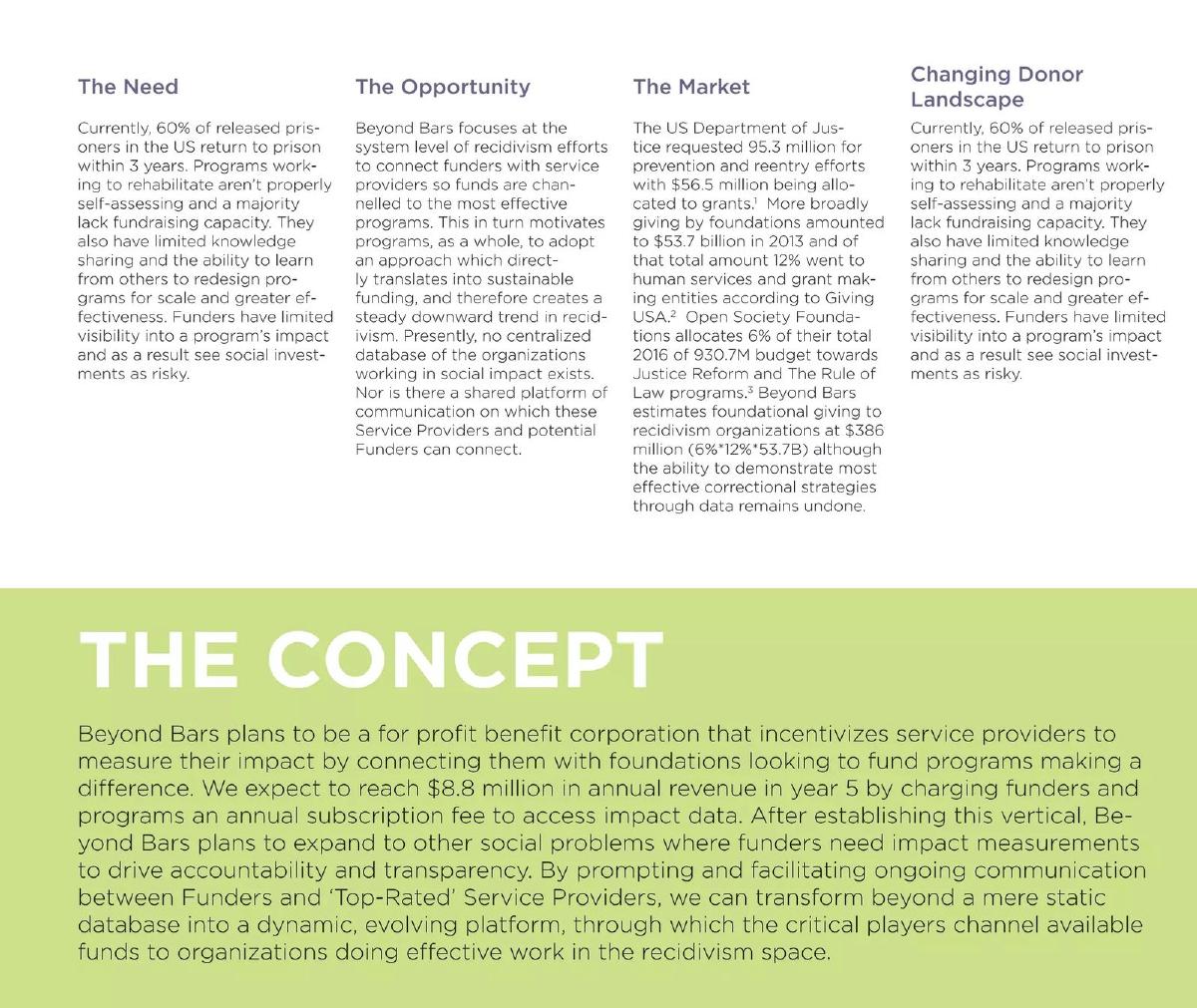
This slide provides the macro-economic justification for the business. It cites the rise of crowdfunding and the transition of charitable giving to pre-recession levels. The core data point is the growth of impact investing, which is estimated to grow from $50 Billion in 2008 to $500 Billion in 2018. The slide also introduces Social Impact Bonds (SIBs) and Pay-for-Success contracts, noting that over 26 states are in the pre-launch phase with 9 states having active SIBs. It mentions major institutional players like Goldman Sachs and Bloomberg Philanthropies to validate the space.
Slide 20: The Data Risk Quote
This slide uses a testimonial from Josh Genser, CEO of Richmond Development Company, to highlight a specific pain point. The quote states: "There's tons and tons of money invested in prison recidivism programs. Funders are willing to take risks, but the risks are huge right now because there's no data." This serves as a powerful validation of the problem statement, framing Beyond Bars as the solution that will "take out the data risk" for funders.
Slide 25: The Opportunity
This slide outlines the structural gap in the market. It identifies a "Lack of 'the right match'" where funds are not allocated to the best service providers because funders lack the capacity to find them, and providers fail to properly self-assess. The slide proposes a centralized database and a shared platform of communication. It mentions drawing on pre-existing resources like GIIN's IRIS to establish rigorous impact measurement systems, effectively creating a catalogue of 'Top-Rated' organizations.
Slide 31: Superior User Experience
This slide focuses on the product's technical edge. It claims the platform uses "predictive analytics" fueled by data gathering and aggregation. The text describes the interface as "highly intuitive, intrinsically motivating, and, ultimately energizing." While the language is somewhat flowery, the core message is that the platform translates complex data into actionable insights for both funders and service providers.
Slide 37: Service Provider Requirements
This slide details the user journey for a service provider. It lists specific data fields the provider must upload to be "confident in receiving funding." These fields include: Number of graduates from my program for the quarter, Release Date, Duration of Time on the outside, Place of Employment, and Duration of Employment. The slide also mentions a "probability rate of a foundation connection" based on past interactions, which suggests an algorithmic matching component.
Slide 43: Competitive Landscape
Beyond Bars compares itself to GIIN, Guidestar, and Charity Navigator using a feature matrix. The company claims to be the only one offering "Predictive Analytics," "Consulting Services," and a focus "Specific to one cause." The text notes that while Guidestar is technologically savvy, they do not currently use predictive analytics. Beyond Bars positions itself as a specialist that will eventually expand, whereas competitors cast a wide net across all nonprofits.
Slide 49: Future Expansion
This slide details the three-year roadmap. Beyond Bars plans to expand into new sectors every three years based on three criteria: Meaningful connection to recidivism, Scaleable model/standardized framework, and Market size. It identifies health, housing, and employment as natural extensions of their recidivism work. This slide is crucial for showing investors that while the current focus is niche, the underlying technology is a horizontal platform for social impact.
Slide 50: Section Header - Team
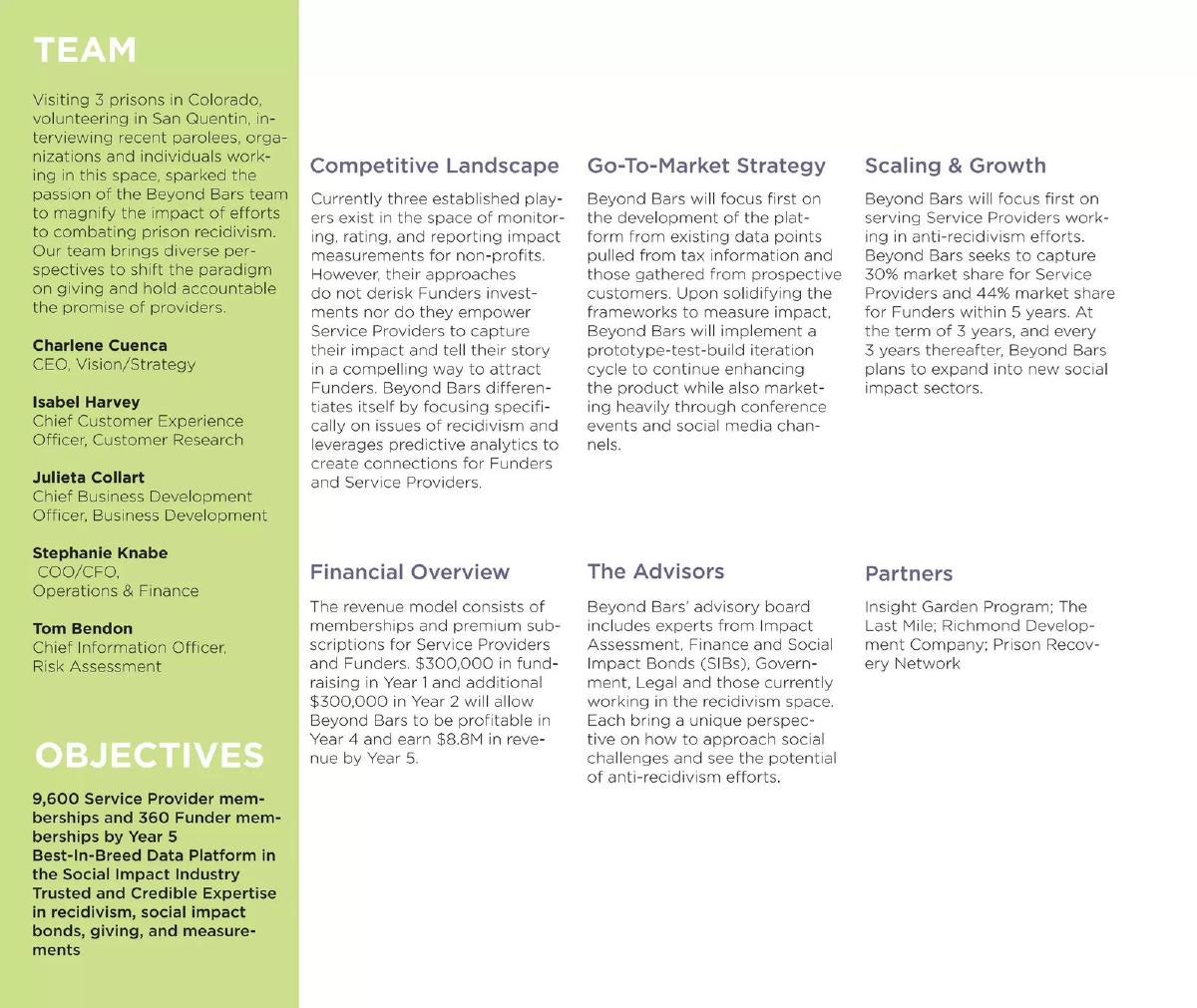
Another transition slide. The sample ends here, so the actual team members, their backgrounds, and their specific expertise in the recidivism or data science sectors are not visible. The omission of the actual team details in this sample is a significant gap, as the success of a data-heavy social impact play depends entirely on the founders' domain authority.
What Works Well
The deck does an excellent job of identifying a specific, high-friction problem: the 'data risk' in social impact investing. By focusing on a single vertical (recidivism) first, the company demonstrates a disciplined go-to-market strategy. The use of a third-party quote on Slide 20 provides immediate credibility to the problem statement. Furthermore, the competitive matrix on Slide 43 is clear and identifies a genuine gap—predictive analytics—that the incumbents are not currently filling. The inclusion of specific data points for the service providers (Slide 37) shows that the founders have thought through the actual implementation of the data collection process.
What Is Missing
The most glaring omission in the provided slides is the lack of a clear 'Ask' and a detailed financial model. While Slide 43 hints at membership fees and consulting, there is no breakdown of unit economics, customer acquisition costs, or projected revenue. Additionally, a 60-slide deck is exceptionally long for a modern pitch. Much of the text is dense and could be simplified into visual infographics. The team slide is a placeholder in this sample, leaving a void regarding who is actually building this. Without seeing the expertise of the team, it is difficult to judge if they can actually deliver on the promise of 'predictive analytics' in a notoriously difficult-to-track sector like prison recidivism.
Founder Takeaways
Vertical Focus is a Strength: Founders should copy the approach of dominating one niche vertical before claiming they can solve a problem for the entire world. Beyond Bars' three-year plan for recidivism makes their expansion into health and housing feel earned rather than speculative. Use Third-Party Validation: The quote on Slide 20 is a masterclass in problem definition. Instead of the founders saying there is a problem, they let a potential customer (a CEO and consultant) say it for them. Define Your Data: If your startup claims to be 'data-driven,' you must show exactly what data you are collecting. Slide 37 does this effectively by listing the specific metrics required from service providers. Shorten the Deck: A 60-slide deck is a burden for any analyst. Founders should aim to condense this information into 15-20 high-impact slides, moving the deep-dive methodology and secondary research to an appendix.
Frequently asked questions
- What specific problem is Beyond Bars trying to solve?
- Beyond Bars addresses the lack of centralized data and impact measurement in the social sector. According to Slide 25, there is no shared platform where service providers and funders can connect based on verified performance. This creates 'data risk,' making social investments feel like a gamble for foundations and private investors who lack the tools to properly self-assess or find the right matches.
- How does the company plan to generate revenue?
- While a dedicated financial slide is not in the provided sample, Slide 43 indicates a business model involving membership fees and consulting services. The company differentiates itself from competitors like Charity Navigator by offering these paid tiers alongside impact measurement and predictive analytics, targeting impact investors and foundations rather than just individual donors.
- What metrics does the platform track for recidivism?
- As shown on Slide 37, the platform requires service providers to upload data including the number of graduates from their programs per quarter, release dates of participants, duration of time spent on the outside, place of employment, and duration of employment. These metrics are used to calculate a 'probability rate' for foundation connections.
- Who are the primary competitors identified in the deck?
- Slide 43 lists GIIN (Global Impact Investing Network), Guidestar, and Charity Navigator as competitors and inspirations. Beyond Bars claims to be superior by offering predictive analytics and an open API, and by focusing exclusively on one cause (recidivism) to build deeper expertise than the broad-net approach of the incumbents.
- What is the long-term expansion strategy?
- The company intends to stay focused on the recidivism vertical for three years to establish a credible framework. Slide 49 outlines that future expansion will target sectors like health, housing, and employment. Criteria for new sectors include a large market size and the potential for a scalable, standardized measurement model.