Bml Collections is a Nigerian manufacturing company focused on the design and production of leather bags and shoes. Their pitch deck centers on the problem of high costs for quality leather goods and the prevalence of imported second-hand items. By producing locally, they aim to offer affordable alternatives while contributing to the national economy. The deck outlines a multi-channel business model including retail, wholesale to malls, and export to other African nations. With a specific funding ask of N3,000,000.00 for equipment and facility expansion, the company leverages the founder's ba…
Key takeaways
- The company identifies a clear market gap between expensive high-end leather and affordable imported used goods (Slide 3).
- Bml Collections positions itself as an import substitution play, aiming to improve the national economy through local production (Slide 4).
- Market assumptions are broad, claiming 80% of the population uses leather shoes and 90% of females will use their bags (Slide 5).
- The business model is diversified across B2C retail, B2B wholesale to boutiques, and international African exports (Slide 6).
- Marketing strategy relies on a mix of digital social media, physical exhibitions, and traditional media advertisements (Slide 7).
- The founder, Bolanle Longe, brings a technical background (B.Sc. Computer Science with Economics) and social impact experience (Slide 8).
- Financial data from January to June 2017 indicates that expenses currently exceed profits, with roughly 100 customers served (Slide 9).
- The funding ask is specific: N3,000,000.00 for equipment, materials, and a larger facility (Slide 10).
Bml Collections: The Local Manufacturing Thesis
Bml Collections presents a straightforward manufacturing pitch centered on the Nigerian leather goods market. The deck is built around the concept of import substitution—replacing expensive foreign goods and low-quality used imports with locally made, affordable alternatives. While the deck is visually simple, it addresses the core components of a physical product business: production, market need, and scaling requirements.
Slide 1: Title Slide
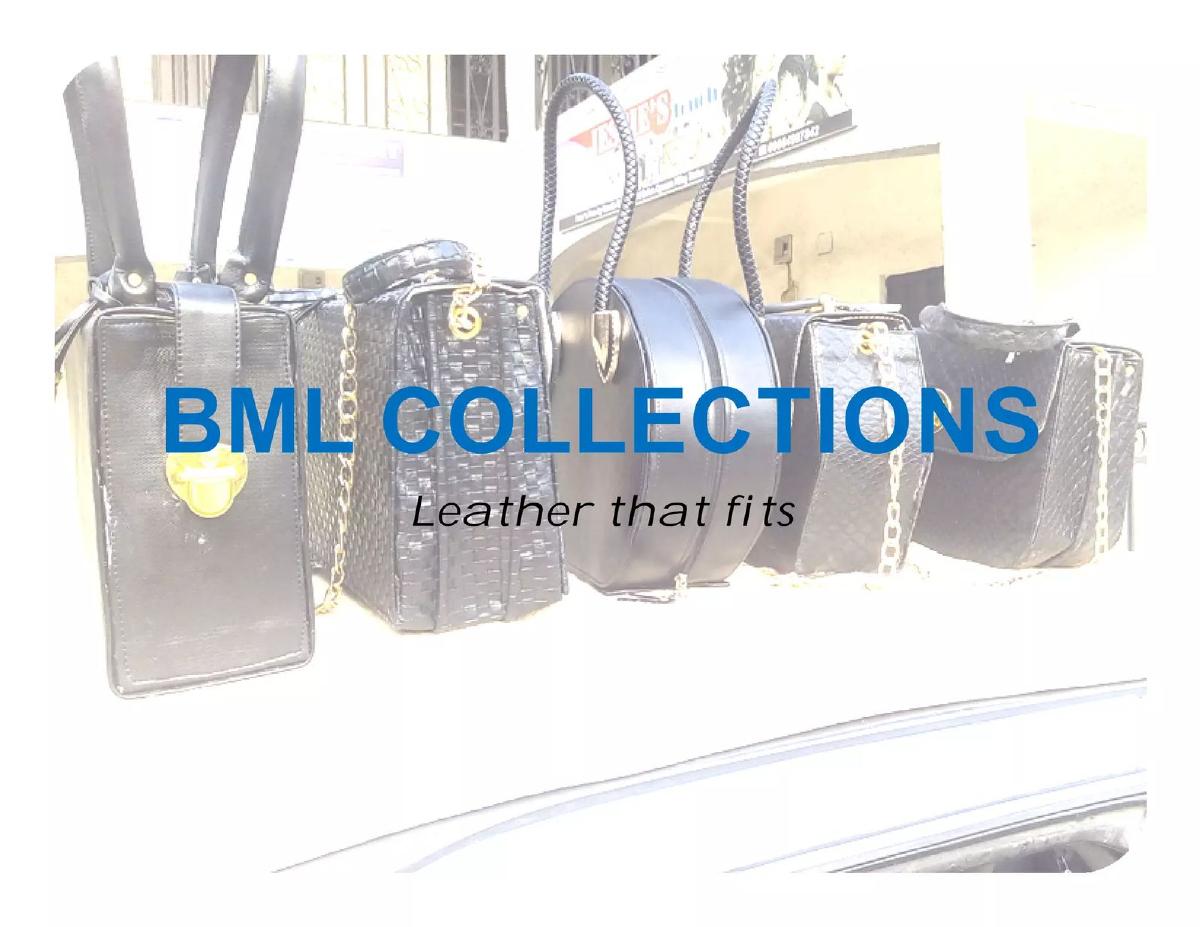
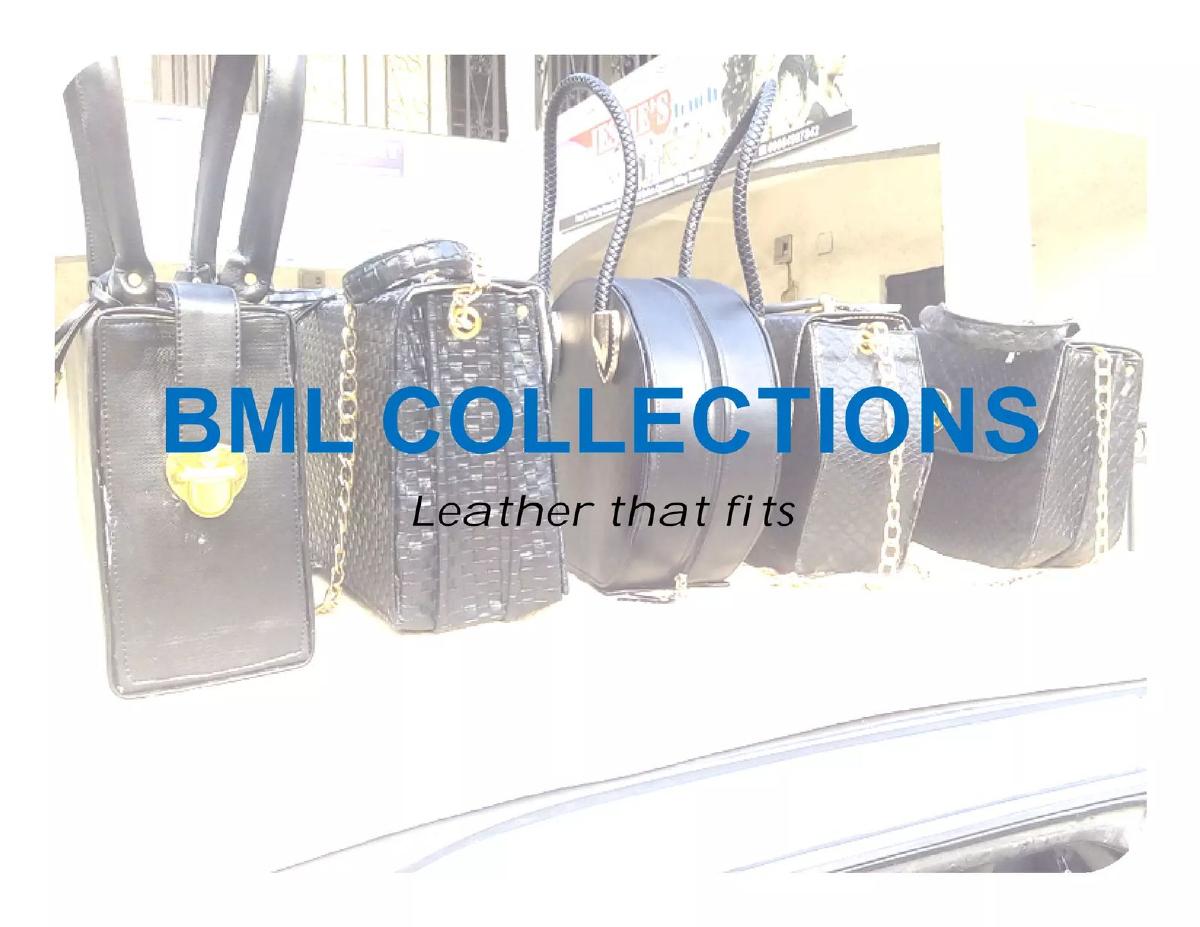
The opening slide features the company name, BML COLLECTIONS , and the tagline "Leather that fits." The background image displays a variety of black leather handbags, establishing the product category immediately. The branding is functional, focusing on the physical output of the company rather than abstract concepts.
Slide 2: Who We Are
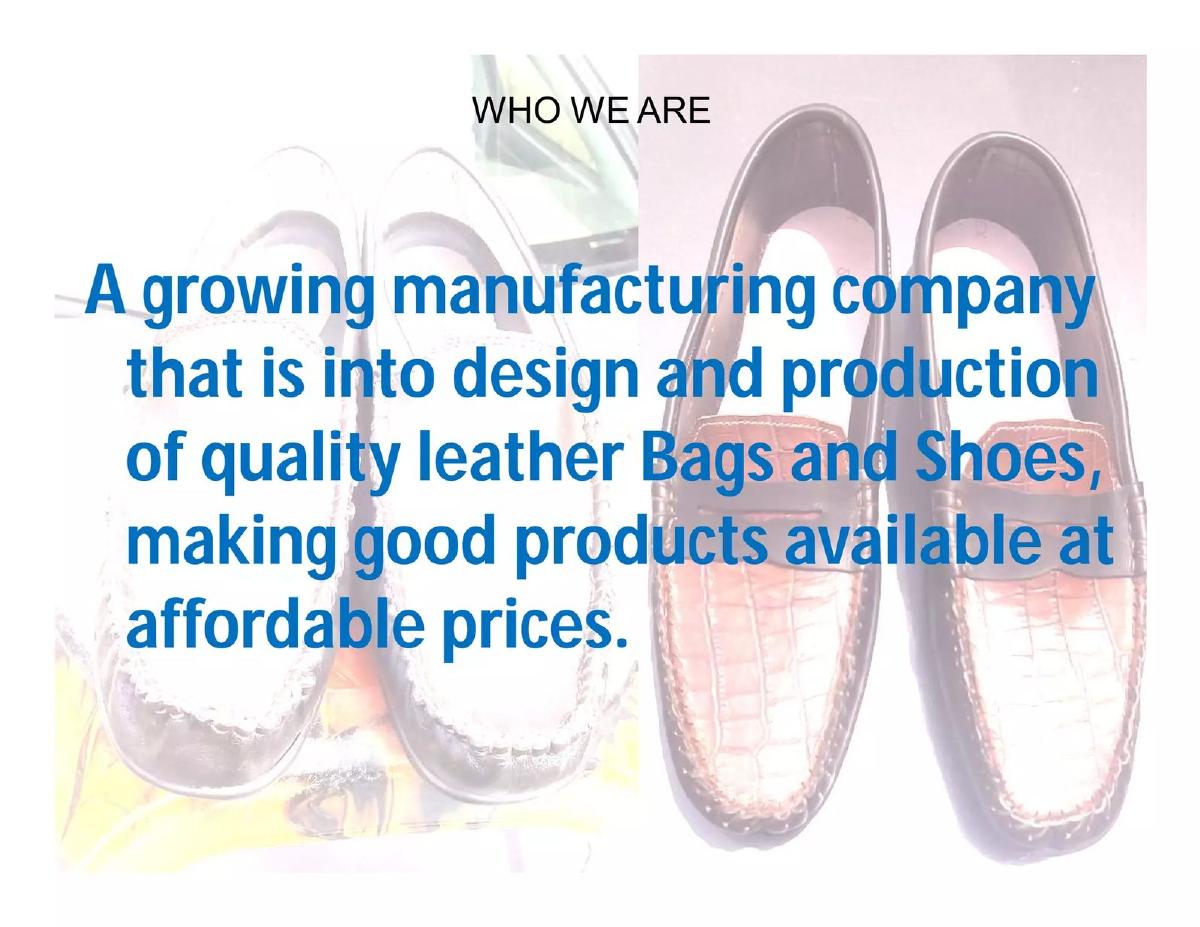
This slide defines the company as a "growing manufacturing company that is into design and production of quality leather Bags and Shoes." The core mission stated here is "making good products available at affordable prices." The background shows a pair of leather loafers, signaling that the brand extends beyond just handbags into footwear.
Slide 3: The Problem
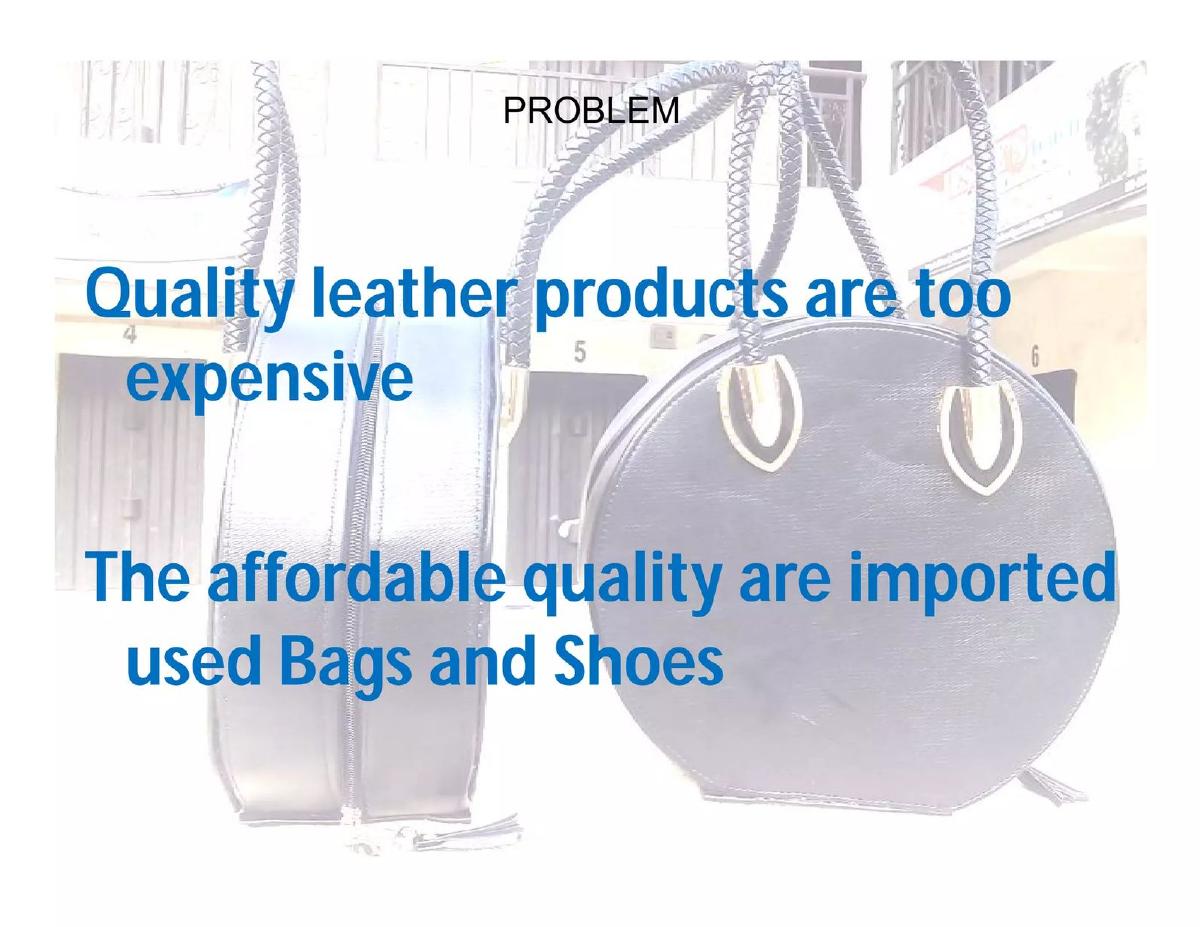
The problem statement is two-fold. First, "Quality leather products are too expensive." Second, "The affordable quality are imported used Bags and Shoes." This highlights a classic market gap in developing economies: the missing middle between luxury imports and second-hand "thrift" items. By identifying the reliance on imported used goods, Bml Collections sets the stage for a domestic solution.
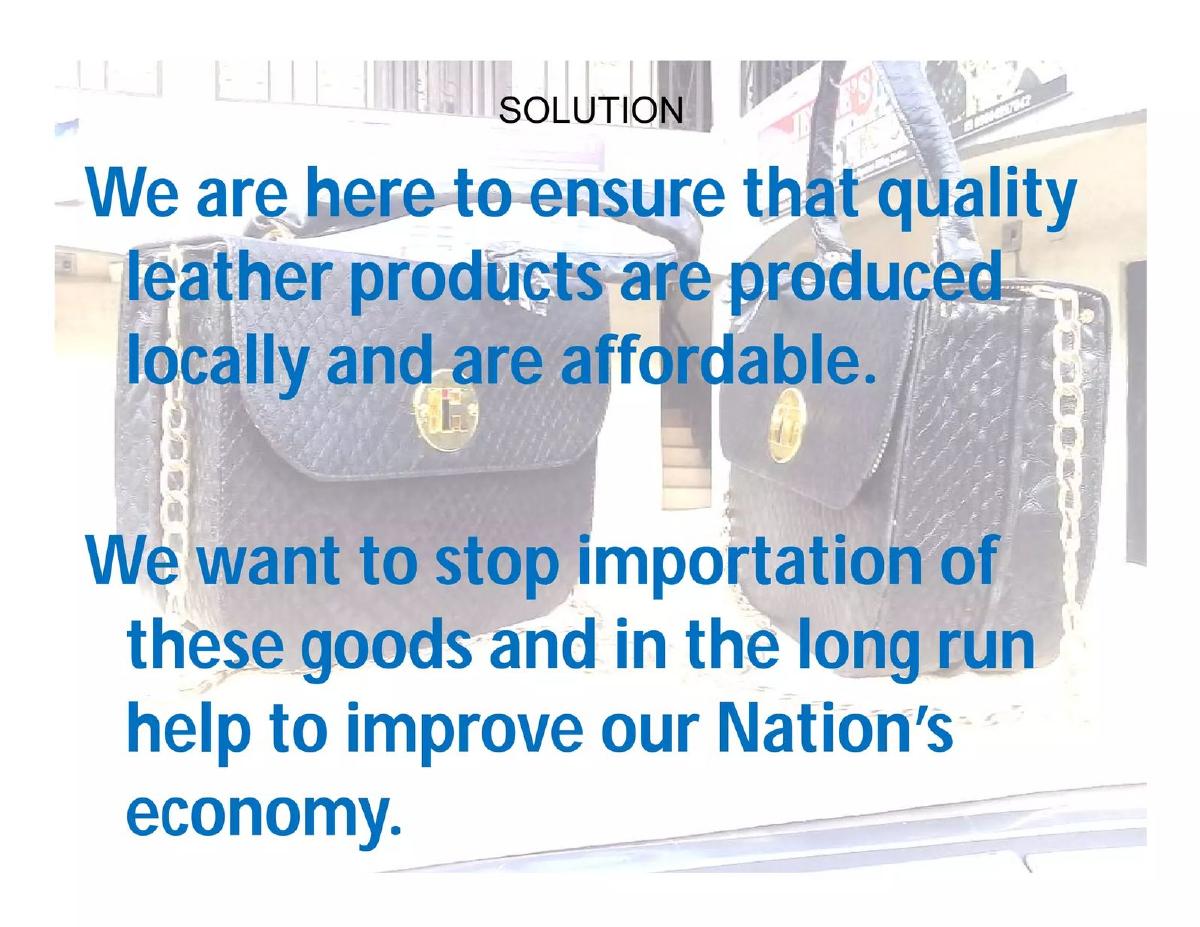
Slide 4: The Solution
The solution slide explicitly links production to national interest. The company aims to "ensure that quality leather products are produced locally and are affordable." More ambitiously, they state a desire to "stop importation of these goods and in the long run help to improve our Nation’s economy." This positioning appeals to investors interested in local industrialization and economic development.
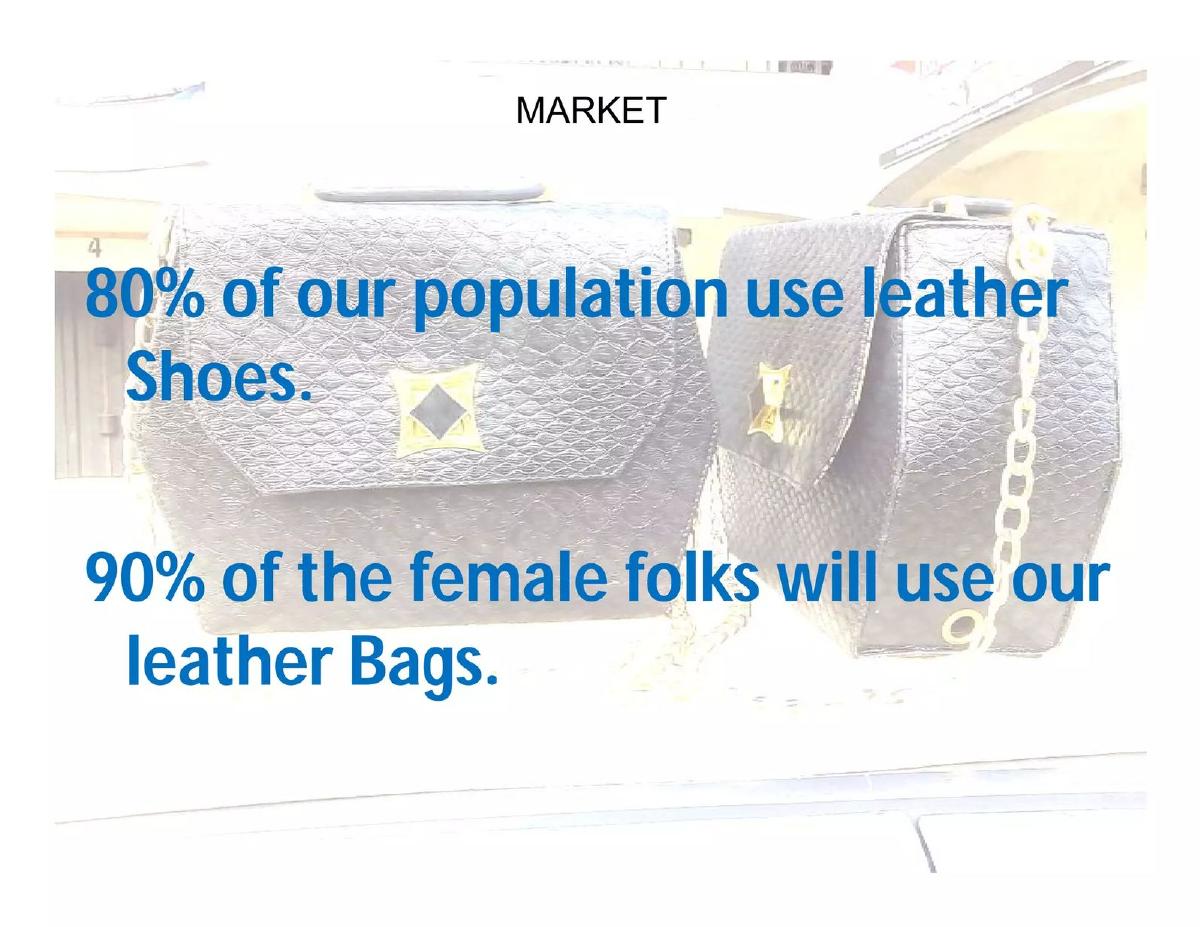
Slide 5: Market Analysis
Slide 5 provides market statistics, though they are presented as broad generalizations rather than sourced data points. It claims "80% of our population use leather Shoes" and "90% of the female folks will use our leather Bags." While these figures illustrate a high total addressable market (TAM), the deck lacks a breakdown of the Serviceable Obtainable Market (SOM) or specific demographic segments.
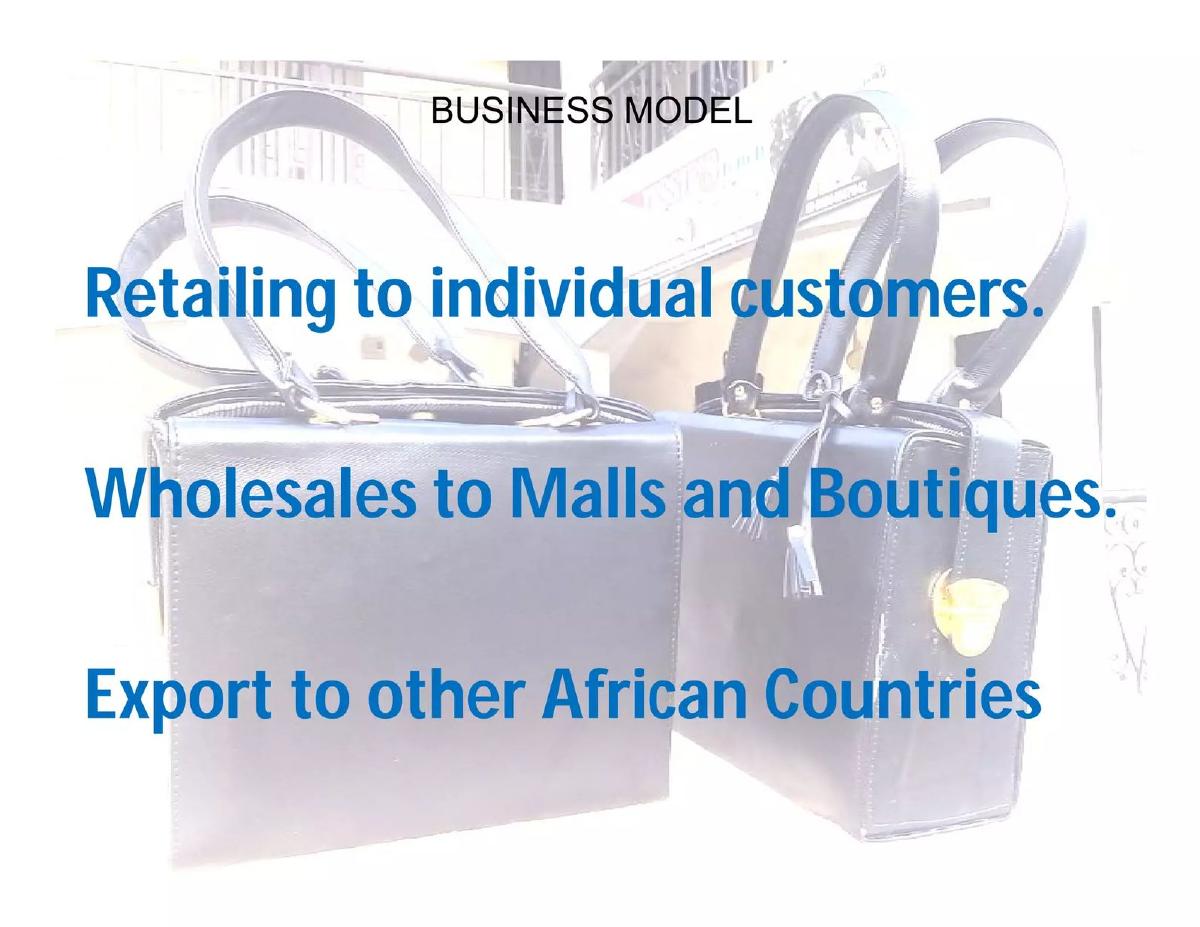
Slide 6: Business Model
The business model is diversified across three channels: "Retailing to individual customers," "Wholesales to Malls and Boutiques," and "Export to other African Countries." This suggests a strategy that balances high-margin direct sales with high-volume wholesale, while keeping an eye on regional expansion through the African Continental Free Trade Area (AfCFTA) context.
Slide 7: Marketing Strategy
The marketing approach is standard for a consumer brand: "Internet and Social Media," "Exhibitions and Promo Sales," and "Traditional Media Advertisements." The inclusion of exhibitions is particularly relevant for leather goods, where tactile quality and physical inspection are key drivers for consumer trust in local brands.
Slide 8: The Team
The team slide focuses on Bolanle Longe , the CEO. Her credentials include a B.Sc. in Computer Science with Economics from O.A.U. Ile-Ife . The slide also highlights her social commitment as a "Mentor/Volunteer with FAECARE Foundation (An N.G.O that Trains Women Living with Disability)." This adds a social impact dimension to the company's leadership profile, though no other team members or advisors are listed.
Slide 9: Financials
Slide 9 provides a snapshot of performance from January 2017 – June 2017 . It uses two bar charts. The first shows Total Customers (near the 20 mark on the scale, though the text suggests a higher relative volume) and Sales (reaching near 100). The second chart compares Expenses (approx. 250,000 N) to Profits (approx. 140,000 N). The currency is denoted as (N), representing the Nigerian Naira. This slide shows that the business was operational but not yet profitable during this period.
Slide 10: Investment and Use of Funds
The company is "raising N3,000,000.00" (Three Million Naira). The use of funds is clearly categorized into three areas: "Equipment," "Leather Materials and Accessories," and "Building a Larger Facility." This is a classic "scale-up" ask, moving from a small-scale craft operation to a more formal manufacturing setup.
Slide 11: Thank You
The final slide is a simple "THANK YOU" over an image of shoes in production, reinforcing the manufacturing focus of the brand.
What Works in This Deck
Clear Problem/Solution Fit: The deck identifies a genuine pain point in the Nigerian market—the lack of affordable, new, high-quality leather goods. · Specific Funding Ask: The N3,000,000.00 request is precise and the allocation (equipment, materials, facility) is logical for a manufacturing business. · Founder Profile: Bolanle Longe’s combination of a technical degree (Computer Science/Economics) and social impact work provides a strong narrative for a modern African entrepreneur. · Product Focus: The use of actual product photography throughout the deck ensures the investor knows exactly what is being manufactured.
What Is Missing
Unit Economics: There is no mention of the cost to produce a single bag or shoe versus the retail price. Investors need to see the margins to understand the path to profitability. · Competitive Landscape: The deck mentions imports but does not address other local manufacturers or how Bml Collections differentiates its designs from competitors. · Detailed Market Data: The 80% and 90% figures are too broad. The deck would benefit from specific data on the size of the Nigerian footwear and accessories market in Naira or USD. · Traction Post-2017: As the data ends in June 2017, an updated deck would need to show how the business has evolved, current revenue runs, and growth since the initial pilot phase. · Milestones: There is no roadmap showing what the N3M investment will achieve in terms of production capacity or revenue targets over the next 12-24 months.
Founder Takeaways
Embrace Local Manufacturing: Bml Collections successfully leans into the "Made in Nigeria" narrative, which is a powerful hook for both impact and commercial investors in the region. · Keep the Ask Grounded: By breaking down the N3M ask into tangible physical assets (equipment and facilities), the founder makes the investment feel de-risked and practical. · Show, Don't Just Tell: Using photos of the workshop and the products (Slides 10 and 11) helps prove that the business is not just an idea, but an active production house. · Refine the Data: Founders should avoid using "100%" or "90%" population statistics. It is better to show a deep understanding of a specific target niche (e.g., working professionals in Lagos) than to claim everyone in the country is a potential customer.
Frequently asked questions
- What is the primary value proposition of Bml Collections?
- Bml Collections focuses on producing high-quality leather bags and shoes locally in Nigeria to provide an affordable alternative to expensive luxury imports and low-quality second-hand goods. Their mission is to stop the importation of these goods and bolster the local economy through domestic manufacturing.
- How does the company plan to reach its customers?
- The marketing strategy is three-pronged: utilizing internet and social media platforms for digital reach, participating in exhibitions and promotional sales for direct engagement, and using traditional media advertisements to capture a broader demographic.
- What are the specific financial goals mentioned in the deck?
- The deck shows performance data from the first half of 2017, indicating a customer base of approximately 100 people. While profits are shown as lower than expenses, the company is seeking N3,000,000.00 to scale operations through better equipment and a larger production facility.
- Who is leading Bml Collections?
- The company is led by CEO Bolanle Longe. She holds a B.Sc. in Computer Science with Economics from O.A.U. Ile-Ife. Additionally, she is a mentor and volunteer with the FAECARE Foundation, which focuses on training women living with disabilities.
- What are the biggest risks identified in this pitch?
- The deck relies on very high market penetration assumptions (80-90%) without citing specific demographic data. Furthermore, the 2017 financials show that the business was not yet profitable, meaning the N3M investment is critical for reaching the scale necessary for sustainability.