Blue Wire Podcasts utilizes a 9-slide deck to argue that traditional sports media is failing to capture younger audiences, specifically Gen-Z. The deck highlights a significant shift in consumer habits, noting that 90 million people are now monthly podcast listeners while TV and print media decline. Blue Wire positions itself as a platform for 'emerging talent,' boasting a roster of 50+ podcasts and influencers with a combined 3.1 million followers. While the traction slide shows impressive growth—doubling listens every quarter to reach 2.5 million total—the deck is notably silent on revenue…
Key takeaways
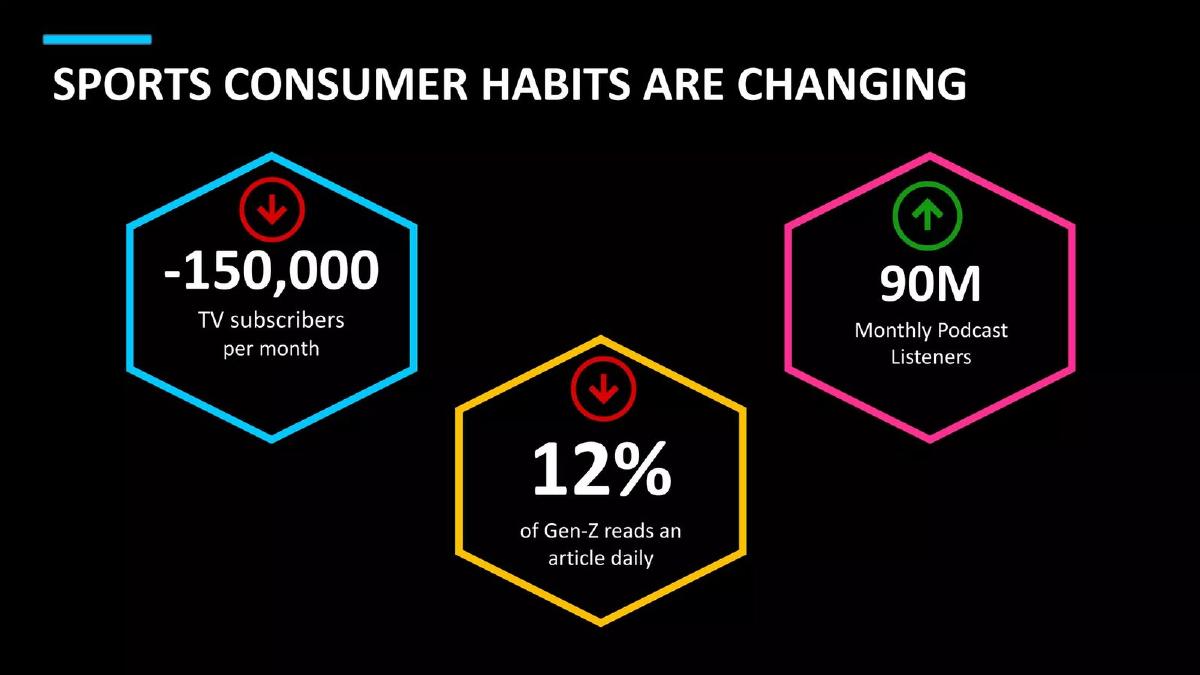
- The company identifies a massive decline in traditional media, citing a loss of 150,000 TV subscribers per month on slide 4.
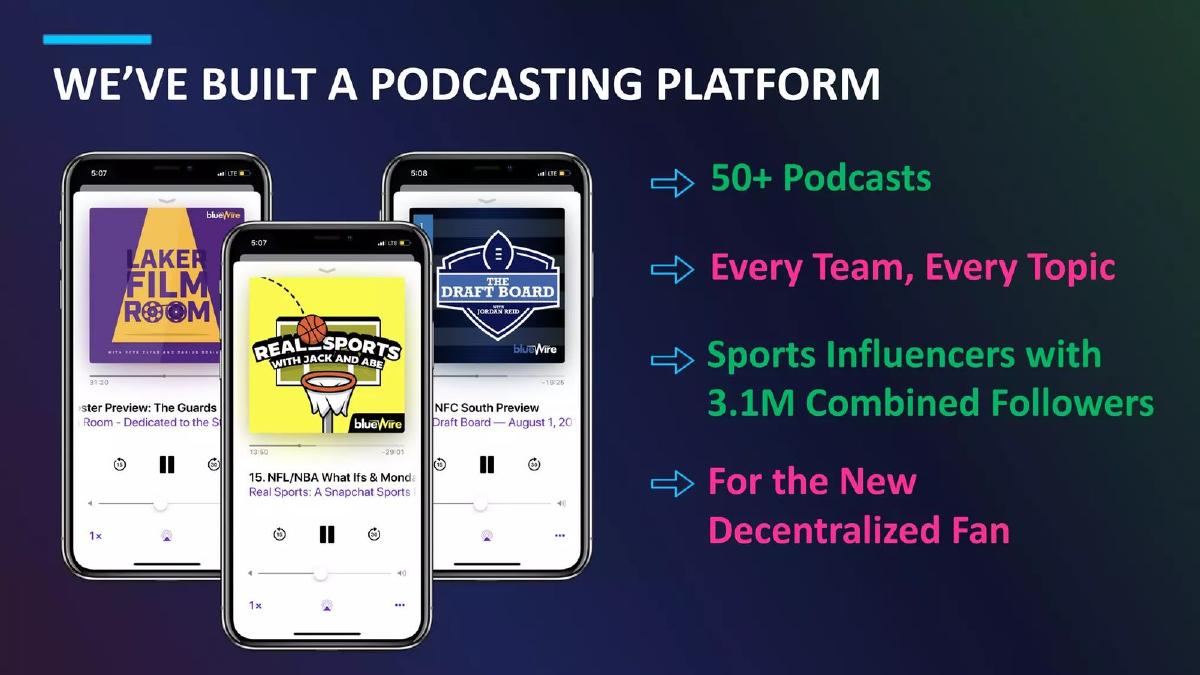
- Blue Wire targets the 'decentralized fan' by aggregating 50+ podcasts covering every team and topic, as shown on slide 5.
- Traction is the deck's strongest point, reporting 2.5 million listens within the first 11 months of operation on slide 7.
- The platform leverages social proof by highlighting influencers with a combined 3.1 million followers on slide 5.
- Market validation projects the podcasting industry to grow into a $24B market by 2030, eating into the $78B sports media pie (slide 8).
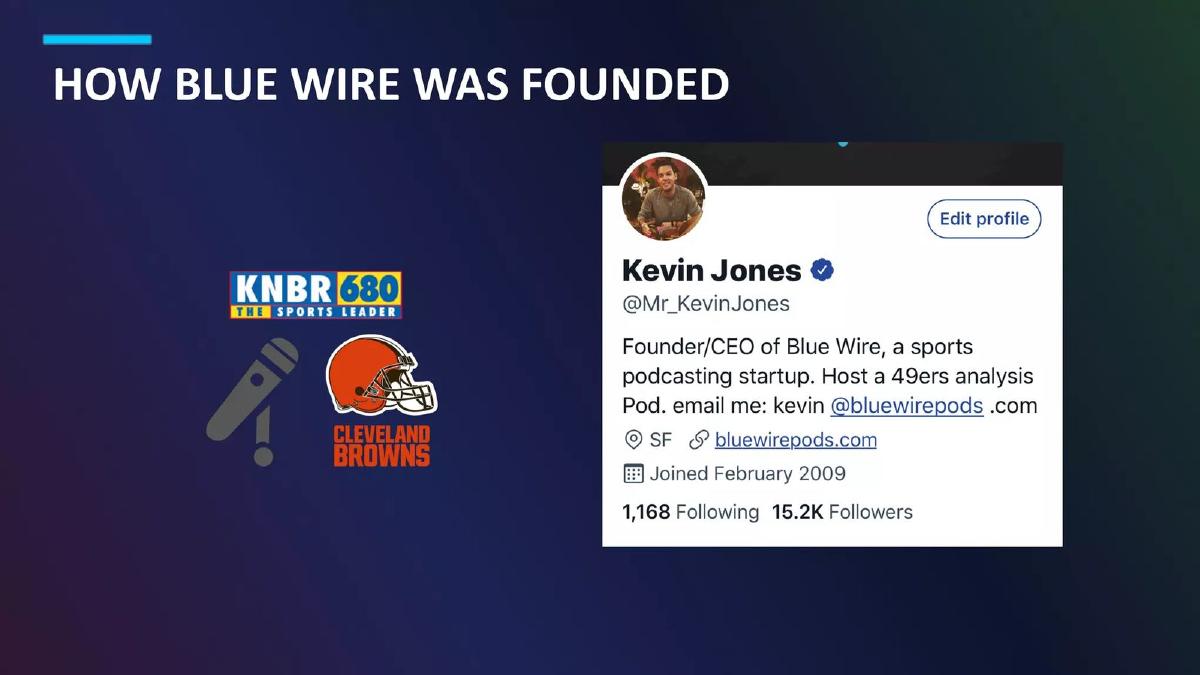
- The deck lacks a formal 'Team' slide, relying instead on the founder's personal Twitter profile and background with KNBR and the Cleveland Browns (slide 2).
- There is no mention of revenue, monetization strategies, or specific capital requirements in the entire 9-slide presentation.
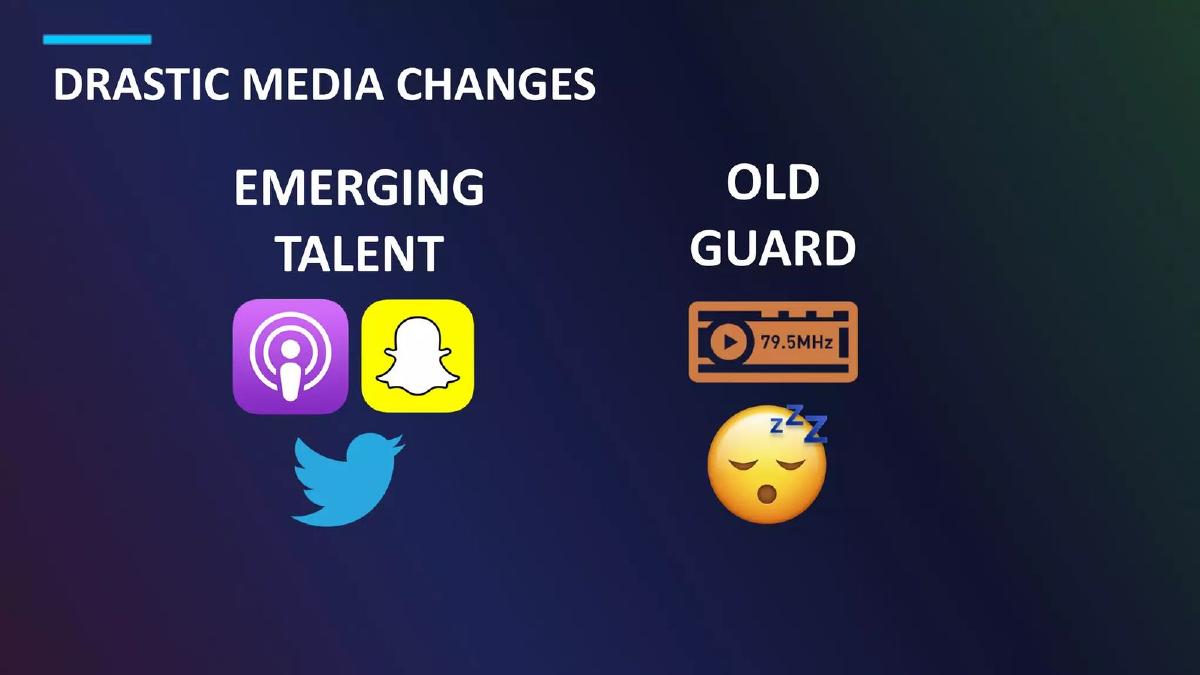
- The deck uses a 'David vs. Goliath' narrative, contrasting 'Emerging Talent' against a 'Zzz' emoji-labeled 'Old Guard' on slide 3.
Blue Wire Podcasts: The Narrative-First Approach to Sports Media
The Blue Wire Podcasts pitch deck is a concise, 9-slide presentation that leans heavily on the 'shifting tides' narrative of modern media. It positions the company not just as a content producer, but as a platform that aggregates the fragmented world of sports podcasting. By focusing on the 'decentralized fan,' Blue Wire attempts to show investors that the future of sports consumption is no longer tied to regional cable networks or legacy radio stations, but to individual creators with loyal followings.
Slide 1: Title Slide
The deck opens with the Blue Wire logo and the tagline: "The Future of Sports Is Podcasting." It is a bold, industry-defining statement that sets the stage for the problem/solution narrative that follows. The branding is clean, using a black background with white and blue accents, establishing a professional yet modern aesthetic.
Slide 2: How Blue Wire Was Founded
Instead of a traditional professional bio, slide 2 uses a screenshot of Founder/CEO Kevin Jones' Twitter profile. This is a tactical choice; it demonstrates that the founder is 'native' to the platforms where his audience lives. The slide highlights his 15.2K followers and his background with KNBR 680 and the Cleveland Browns . By including the logos of these established entities, Jones establishes immediate domain expertise in the sports media world.
Slide 3: Drastic Media Changes
This slide sets up the competitive landscape. It contrasts "Emerging Talent" (represented by Apple Podcasts, Snapchat, and Twitter icons) against the "Old Guard" (represented by a legacy radio icon and a sleeping emoji). This is a classic 'Us vs. Them' slide. It frames Blue Wire as the agile, modern alternative to a stagnant industry that is literally 'falling asleep' at the wheel.
Slide 4: Sports Consumer Habits Are Changing
Slide 4 provides the data to back up the claims made on the previous slide. It cites three specific metrics: -150,000 TV subscribers per month , only 12% of Gen-Z reading an article daily , and a massive 90M monthly podcast listeners . This slide is effective because it uses 'away-from' motivation (the death of TV and print) to justify the 'toward' investment in podcasting. It identifies a clear market opportunity created by changing demographic behaviors.
Slide 5: We’ve Built a Podcasting Platform
This is the product slide. It showcases the Blue Wire interface on mobile devices, featuring shows like "Laker Film Room," "Real Sports," and "The Draft Board." The slide lists four key value propositions: 50+ Podcasts , coverage of "Every Team, Every Topic," a network of influencers with 3.1M combined followers , and a focus on the "New Decentralized Fan." This slide transitions the company from a single show to a scalable network model.
Slide 6: Creators Are Seeking Out Blue Wire
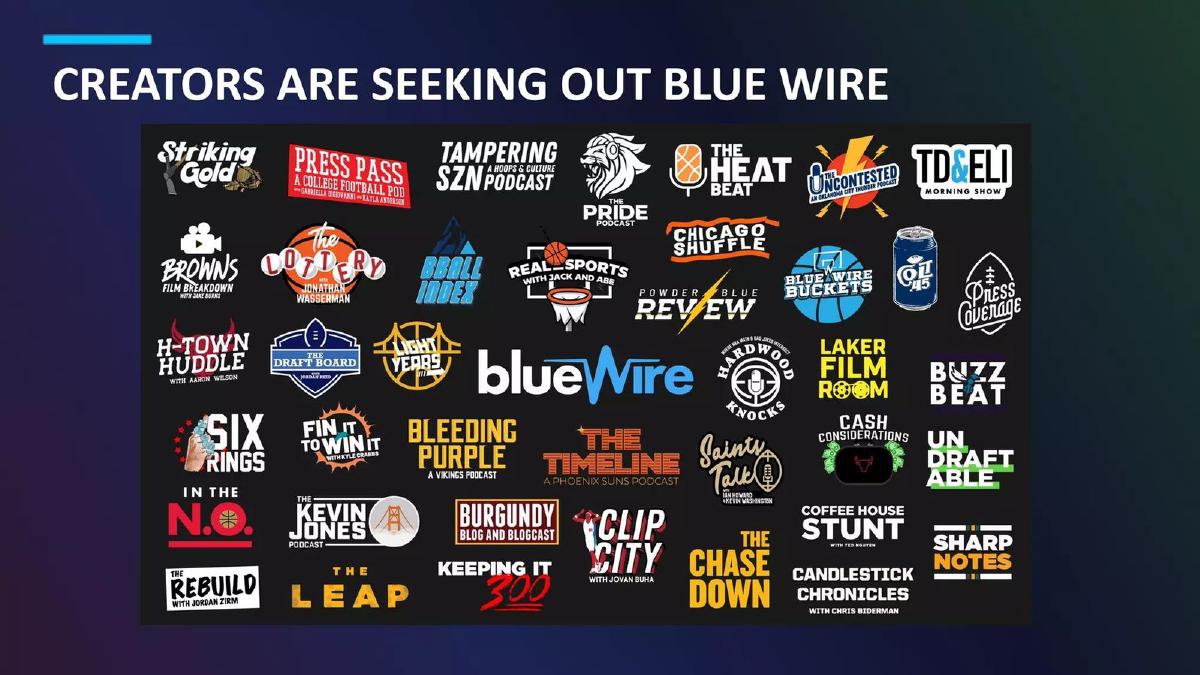
Slide 6 is a 'wall of logos' representing the various podcasts within the Blue Wire network. Names like "Striking Gold," "The Heat Beat," "Six Rings," and "Light Years" are visible. This slide serves as social proof, showing that the platform has successfully recruited a diverse range of creators. It visually reinforces the claim of being a 'platform' rather than just a production house.
Slide 7: Traction
The traction slide is the most data-rich part of the deck. It features a line graph showing listens "Doubling every quarter." The most significant figure is 2.5 Million listens in 11 months . The slide also includes a screenshot of the Apple Podcast charts showing "Real Sports" at #1 , and a New York Times logo, implying media coverage or validation. This slide proves that the model is working and that there is a hungry audience for the content Blue Wire aggregates.
Slide 8: Market Validation
Slide 8 looks at the Total Addressable Market (TAM). It compares the 2019 Radio market ( $17B ) to a projected 2030 market where Podcasting takes a significant share of a $24B audio pie. At the bottom, it highlights the $78B Sports Media market. The goal here is to show that while Blue Wire is starting in audio, it is playing in a massive sandbox with plenty of room for a billion-dollar company to emerge.
Slide 9: The Vision and Contact
The final slide is a summary and call to action. It reiterates three pillars: Experience (the founder's podcast), Traction (the growth curve), and Global Vision (a map of the world). It provides the founder's email address but, notably, does not include a 'The Ask' section. There is no mention of how much the company is raising or what the terms are.
What Blue Wire Does Well
The Blue Wire deck excels at narrative simplicity. It doesn't get bogged down in technical details or complex platform architecture. Instead, it tells a story of a dying old world and a burgeoning new one. The use of social proof—both through influencer follower counts and the 'wall of logos'—is highly effective for a media company where talent is the primary asset. The traction slide is also a standout, providing a clear, upward-trending visual that gives investors confidence in the company's momentum.
What Is Missing from the Blue Wire Deck
Despite the strong narrative, the deck has several glaring omissions that a sophisticated investor would require for a serious due diligence process:
Business Model: There is zero mention of how Blue Wire generates revenue. Do they take a cut of ad sales? Do they own the IP? Is there a subscription component? Without this, it's just a popularity contest, not a business. · Unit Economics: The deck mentions 2.5 million listens, but it doesn't mention the Cost Per Mille (CPM) or the cost to acquire a new listener/creator. · The Ask: A pitch deck without an 'Ask' slide is just a presentation. Investors need to know what the capital will be used for—hiring, marketing, technology, or talent acquisition. · Team Slide: While the founder's background is highlighted, a network of 50+ podcasts cannot be managed by one person. The lack of a broader executive team (COO, Head of Sales, Head of Content) is a red flag for scalability. · Competition: The deck ignores other podcast networks like The Ringer, Barstool Sports, or Wondery. Acknowledging the competitive landscape and explaining why Blue Wire's 'decentralized' approach is superior would strengthen the case.
Founder's Guide: What to Copy
Founders in the creator economy or media space should look at Blue Wire’s Slide 4 (Consumer Habits) . It is a masterclass in using industry macro-trends to create a sense of urgency. If you can prove the 'Old Guard' is failing with specific numbers (-150k subscribers), your solution becomes a necessity rather than a luxury.
Additionally, the Traction Slide (Slide 7) is worth emulating. By combining a growth graph with external validation (Apple Chart rankings and NYT logos), the company creates a 'halo effect' that makes the growth seem inevitable and vetted by third parties. Finally, the Founder Bio (Slide 2) as a social media profile is a clever way to show 'platform fit' for a digital-first company, though it should ideally be followed by a more traditional team slide to show organizational depth.
Frequently asked questions
- How does Blue Wire plan to make money?
- The deck does not explicitly state a business model. While it mentions having 50+ podcasts and 3.1 million combined followers, it omits details on advertising revenue shares, subscription models, or branded content. Investors are left to assume a standard media monetization path based on the traction of 2.5 million listens.
- What is the current scale of the Blue Wire network?
- According to slide 5, the network consists of over 50 podcasts. These shows cover 'Every Team, Every Topic' and are supported by sports influencers who bring a combined social media following of 3.1 million people to the platform.
- What market trends is Blue Wire capitalizing on?
- The deck focuses on the decline of legacy media. Slide 4 notes that only 12% of Gen-Z reads an article daily and TV is losing 150,000 subscribers monthly. Conversely, the monthly podcast listener base has grown to 90 million, creating a gap that Blue Wire intends to fill.
- Who is leading the company according to the deck?
- The deck identifies Kevin Jones as the Founder and CEO. His credentials, listed on slide 2, include experience with KNBR 680 and the Cleveland Browns, as well as hosting a 49ers analysis podcast. The deck does not list any other executive team members or advisors.
- Is there a specific funding goal mentioned?
- No. The final slide provides a contact email and mentions 'Global Vision,' but there is no slide detailing how much money is being raised, the valuation, or the intended use of proceeds. This suggests the deck may be used for early-stage networking or as a teaser.