Bluejay’s seed deck is exceptionally lean, consisting of only 10 slides that prioritize high-level messaging over technical documentation. The narrative centers on a single friction point: the lack of corporate trust in AI voice agents due to reputational risk. By positioning themselves as the 'world’s first QA agency for voice AI,' the founders leverage their Y Combinator and Big Tech backgrounds to validate a $72B market opportunity. While the deck lacks a traditional product walkthrough, competitive landscape, or detailed financial modeling, its aggressive traction claim—reaching '$XXXk+ A…
Key takeaways
- The deck uses a minimalist 10-slide structure that emphasizes speed and narrative over data density.
- Bluejay highlights a specific, high-stakes pain point: the fear that AI voice agents will 'ruin your reputation' (Slide 6).
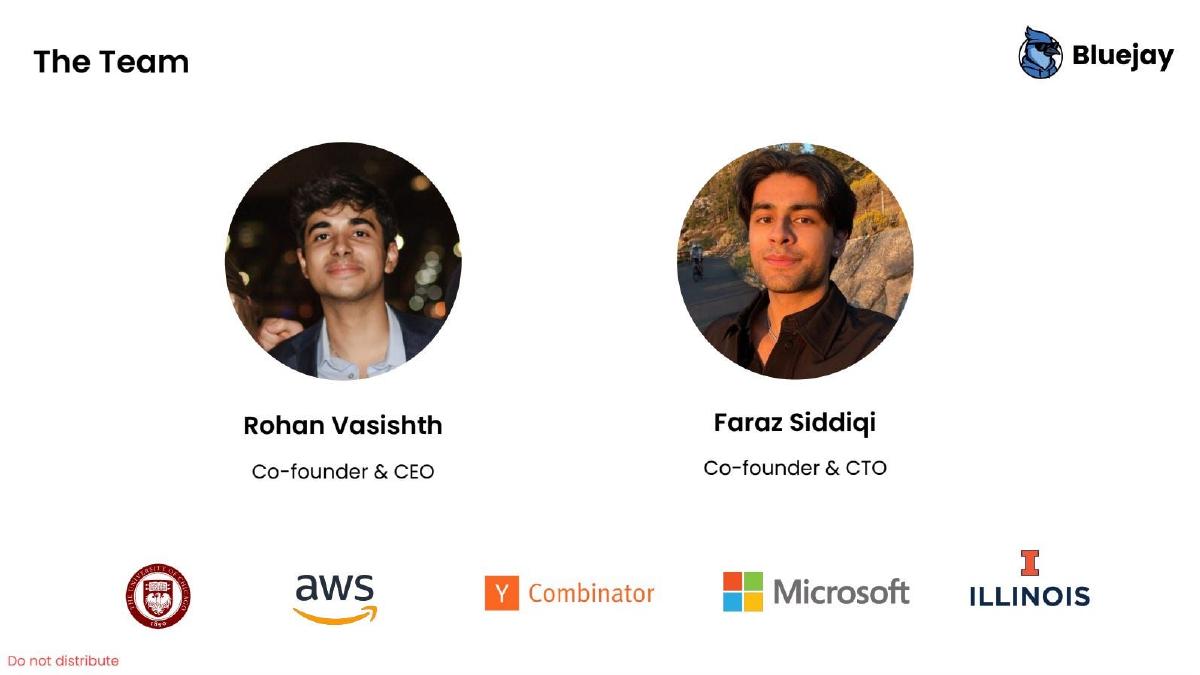
- The team slide (Slide 2) leans heavily on institutional logos including Y Combinator, AWS, Microsoft, and UChicago to establish immediate technical credibility.
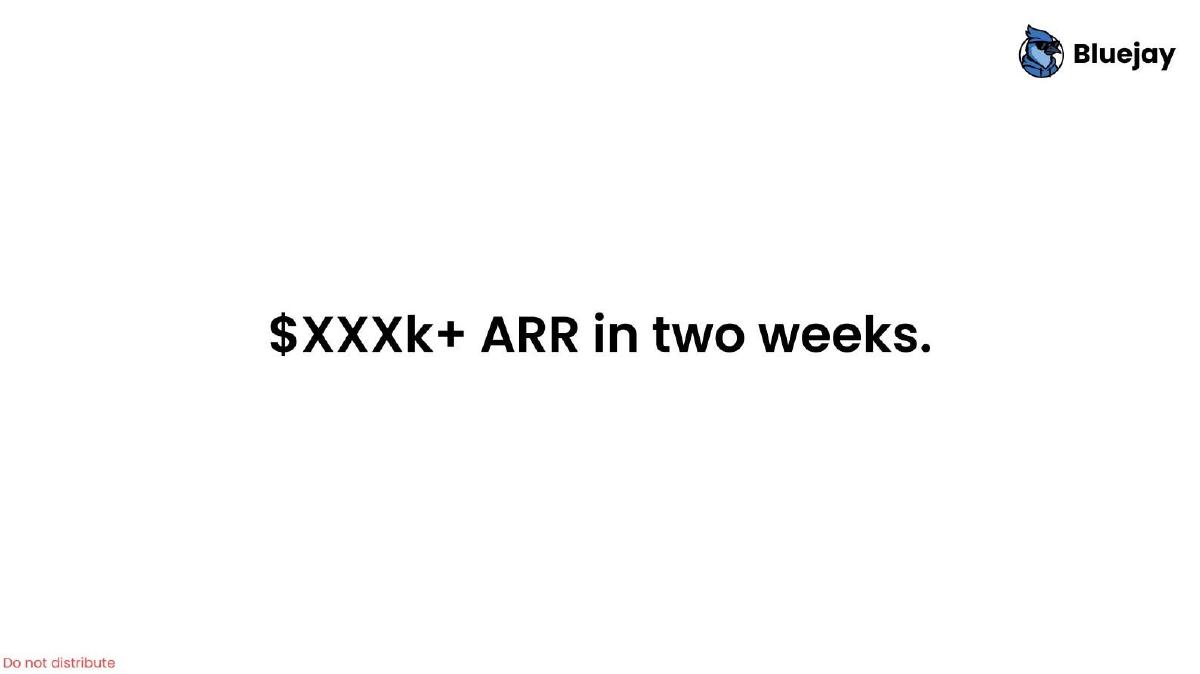
- Traction is presented as a 'blitz' metric, claiming to have reached over $100k in ARR within just two weeks of operation (Slide 3).
- The market sizing (Slide 7) uses a simple top-down calculation: 2M companies multiplied by a $36k annual contract value to reach a $72B TAM.
- The 'Ask' slide (Slide 8) requested $2.5M, though publisher reports indicate the company successfully closed $4M.
- Product functionality is represented purely through icons on Slide 5, omitting actual software interfaces or technical architecture diagrams.
- The deck lacks a competitor slide, a go-to-market strategy detail, and a breakdown of current customer logos.
Bluejay: The Minimalist Path to a $4M Seed Round
The Bluejay pitch deck is a fascinating example of the 'less is more' philosophy in modern AI fundraising. In an era where technical founders often overwhelm investors with architecture diagrams and benchmark data, Bluejay opted for a 10-slide narrative that focuses almost exclusively on team pedigree, a massive market gap, and explosive early traction. As reported by Business Insider, this deck helped secure $4M in 2024, despite the slides themselves only asking for $2.5M.
Slide 1: The Hook
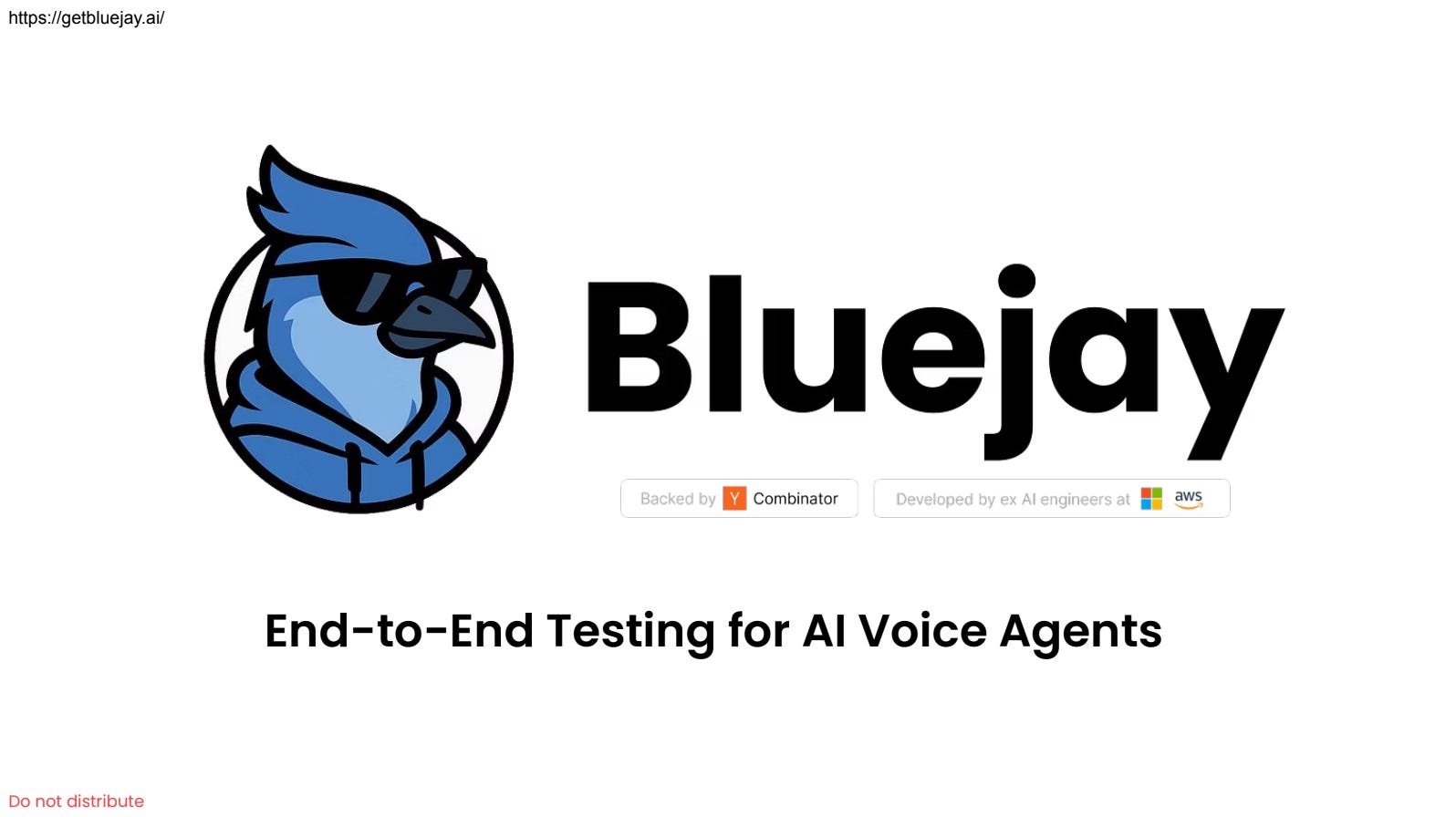
The title slide is functional and clean. It defines the category immediately: End-to-End Testing for AI Voice Agents . By including the Y Combinator and AWS/Microsoft logos directly on the cover, the founders signal that they are insiders within the ecosystem they are looking to disrupt. This 'social proof' is a recurring theme throughout the deck.
Slide 2: The Pedigree
Placing the team slide second is a strategic move common in Seed-stage decks where the product is still evolving. Rohan Vasishth (CEO) and Faraz Siddiqi (CTO) are presented with minimal bios, letting the institutional logos do the talking. The combination of YC, AWS, Microsoft, and top-tier engineering schools (UChicago, Illinois) serves to mitigate the perceived technical risk of building a 'trust layer' for AI.
Slide 3: The Traction Shock
Slide 3 contains only one sentence: $XXXk+ ARR in two weeks. While the exact figure is redacted in the public version, the phrasing implies a number at or above $100,000. For a company in its infancy, reaching a six-figure annual run rate in 14 days is a powerful signal of product-market fit. It suggests that the 'worry' mentioned later in the deck is so acute that customers are willing to pay immediately for a solution.
Slide 4 & 6: The Fear Factor
Slides 4 and 6 identify the psychological barrier to AI adoption. Slide 4 identifies the problem as trust , and Slide 6 gets specific: Bluejay makes sure your voice agent doesn't ruin your reputation. This is a high-stakes value proposition. For a large corporation, the cost of a rogue AI agent making a public mistake far outweighs the $36k/year cost of the software. By framing the product as reputation insurance, Bluejay moves the conversation from 'nice-to-have utility' to 'mission-critical infrastructure.'
Slide 5: The Solution Abstract
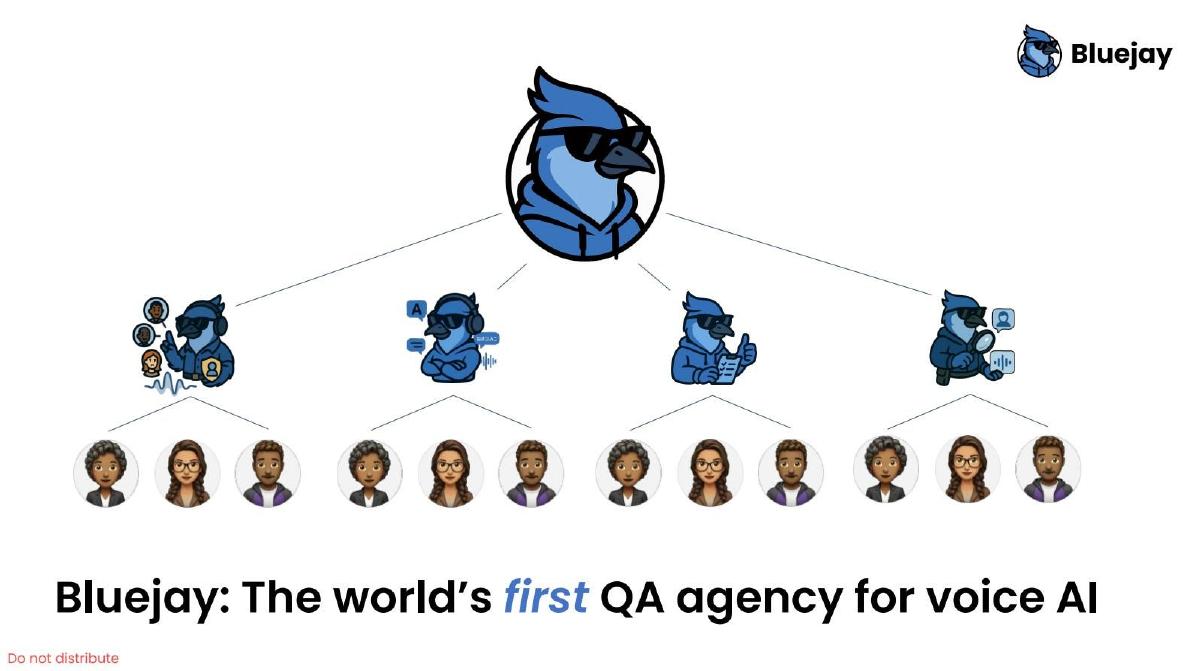
Interestingly, Slide 5 describes Bluejay as the world's first QA agency for voice AI. The use of the word 'agency' alongside icons of AI agents suggests a platform that acts as a supervisor or auditor. The slide uses stylized bird icons (the Bluejay) to represent different QA functions—monitoring, testing, and reporting—overseeing a row of human-like avatars. This implies a layer of software that sits between the AI and the end customer.
Slide 7: The $72B Math
The market slide is a classic top-down calculation. 2M companies x $36k/year = $72B Market Opportunity. While this lacks the nuance of a bottom-up analysis (which would segment companies by those actually using voice AI), it serves the purpose of showing that the ceiling for this business is incredibly high. If every company eventually uses an AI voice agent, every company becomes a potential Bluejay customer.
Slide 8: The Ask
The company sought $2.5m to hit specific milestones: reaching an undisclosed MRR target in 12 months, hiring a full-stack team (devs, researchers, GTM), and maintaining 15% month-on-month growth. The fact that they ultimately raised $4M suggests that the traction mentioned on Slide 3 created a competitive environment among investors.
Slide 9 & 10: The Vision
After a blank Appendix divider, the deck concludes with a vision statement: We will be the trust layer for AI agents across industries. This indicates that while they are starting with voice (a high-complexity, high-risk medium), their ultimate goal is to provide QA for all autonomous AI agents, regardless of the interface.
What Works in the Bluejay Deck
Speed to Value: The deck doesn't waste time. By Slide 3, the investor knows the team is elite and that people are already paying for the product. · Emotional Resonance: Using the phrase 'ruin your reputation' hits a specific nerve for corporate buyers. It transforms a technical QA tool into a risk management necessity. · Logo Density: For a Seed round, the founders maximized their past affiliations to build a 'safe' investment profile.
What is Missing from the Bluejay Deck
Product Screenshots: There is zero visual evidence of the actual software. Investors are buying the vision and the team's ability to build it, rather than the current UI. · Competitive Landscape: The deck claims to be the 'world's first,' ignoring existing LLM monitoring tools or traditional IVR testing companies. This is a common 'bold' claim in Seed decks but leaves a gap for due diligence. · Unit Economics: Beyond the $36k/year ACV assumption, there is no mention of customer acquisition costs (CAC) or the cost of goods sold (COGS), which is relevant given the compute costs associated with AI testing. · Go-To-Market (GTM) Strategy: The deck mentions hiring a GTM team but doesn't explain how they landed the initial customers that generated the $XXXk ARR.
Founder Takeaways
Lead with Traction: If you have a 'wow' metric like six-figure ARR in two weeks, put it on its own slide. Don't bury it in a chart. · Define the 'Fear': In new categories like AI agents, identifying the specific reason a customer won't buy (e.g., fear of reputational damage) is as important as identifying why they will. · Keep it Lean: This deck proves that you don't need 20 slides to raise millions. If the team and the traction are strong enough, the deck only needs to provide enough context to get the meeting. · Vision Expansion: Start with a narrow, defensible niche (Voice QA) but end with a broad, multi-billion dollar vision (Trust Layer for all AI).
Frequently asked questions
- How does Bluejay justify its $72B market opportunity?
- On Slide 7, Bluejay uses a straightforward top-down calculation. They estimate a target market of 2 million companies and assume an average contract value (ACV) of $36,000 per year. This leads to their $72 billion figure. It is a simplified model that assumes broad adoption across diverse corporate scales without segmenting by industry or company size.
- What is the primary problem Bluejay is solving according to the deck?
- The deck identifies 'trust' as the primary barrier to AI adoption. Slide 4 states that corporations are ready for voice AI but fear the technology. Slide 6 clarifies this risk as a reputational one, suggesting that unmonitored AI voice agents could cause public relations damage if they perform poorly or unreliably.
- Does the deck show how the product actually works?
- No. The deck is notably light on technical details. Slide 5 uses abstract icons to represent their 'QA agency' model, and Slide 1 mentions 'End-to-End Testing,' but there are no screenshots of a dashboard, no explanation of the underlying LLM evaluation logic, and no workflow diagrams showing how it integrates with existing voice stacks.
- What was the specific fundraising goal mentioned in the slides?
- Slide 8 explicitly states the company was 'Raising $2.5m.' However, publisher-reported facts indicate the company actually raised $4M in 2024. This suggests the round was oversubscribed or the target was increased during the fundraising process due to high investor demand.
- Who are the founders and what is their background?
- Slide 2 introduces Rohan Vasishth (CEO) and Faraz Siddiqi (CTO). Their pedigree is a core part of the pitch, featuring logos from Y Combinator, AWS, Microsoft, University of Chicago, and the University of Illinois. The slide emphasizes their experience as 'ex AI engineers' at major cloud providers.