Blueboard’s 11-slide deck focuses on a clear market shift: the move from commodity gift cards to high-value experiences. The presentation relies heavily on social proof, dedicating three consecutive slides to a growing roster of enterprise logos including GoPro, Otis, and Chick-fil-A. Financially, the deck demonstrates a clear inflection point, showing a jump from just $30,900 in ARR in early 2014 to $1.44 million by late 2016. While the deck lacks traditional slides on unit economics, competition, or a specific use-of-funds 'ask,' the momentum of their $2.0 million in secured ARR for the upc…
Key takeaways
- The total addressable market for non-cash employee rewards is stated as $46B on Slide 2.
- Blueboard positions itself specifically as a solution for the 'Millennial Workforce' on Slide 1.
- The company achieved a significant growth milestone, reaching $1,440,024 in ARR by late 2016 as shown on Slide 8.
- Social proof is the deck's primary lever, with Slide 7 displaying over 40 enterprise customer logos.
- The platform had already secured $2.0M in ARR for the 2017 fiscal year at the time of the pitch (Slide 9).
- The leadership team features backgrounds from major firms including Accenture, PwC, and FiveStars (Slide 10).
- The deck completely omits a formal 'Ask' slide detailing the amount being raised or the valuation.
- There is no mention of the competitive landscape or direct rivals in the rewards and recognition space.
The Minimalist Path to a $15.8M Series A
Blueboard’s pitch deck is a study in brevity and the power of social proof. In just 11 slides, the company manages to establish a massive market opportunity, a cultural shift in the workforce, and a proven revenue engine. Founded in 2013, the company hit the market at the peak of the 'Millennial' discourse, using that demographic shift as the primary catalyst for their business model. By the time they were raising their Series A in 2014, they had moved past the conceptual phase into significant enterprise scaling.
The Hook: Market Size and Cultural Shift
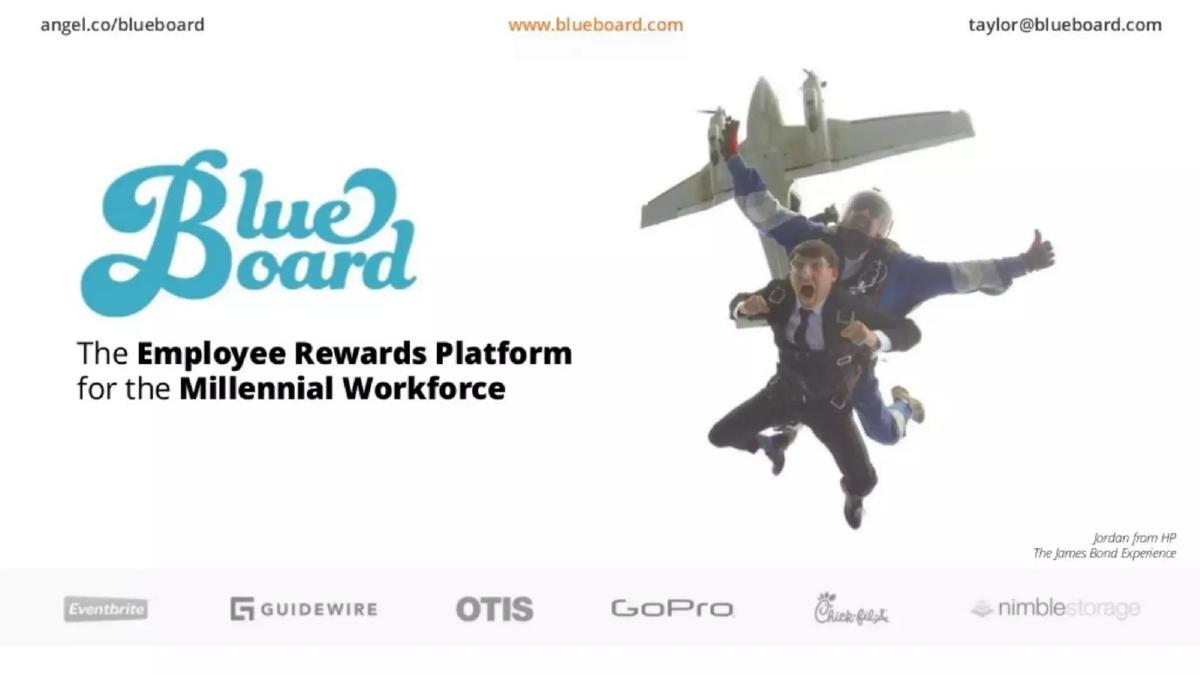
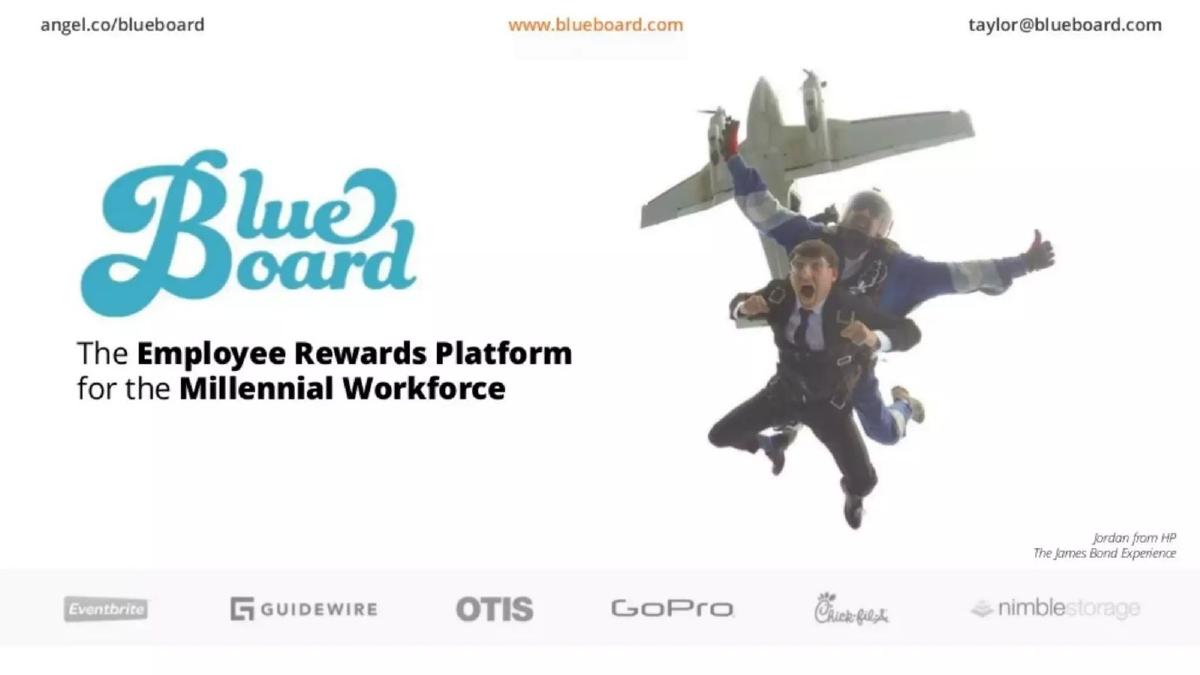
Slide 1: Title Slide The deck opens with a high-energy image of a man in a suit skydiving. The tagline is specific: "The Employee Rewards Platform for the Millennial Workforce." By narrowing the focus to Millennials, Blueboard isn't just selling software; they are selling a solution to a specific generational management problem that was a top-of-mind concern for HR departments in the mid-2010s.
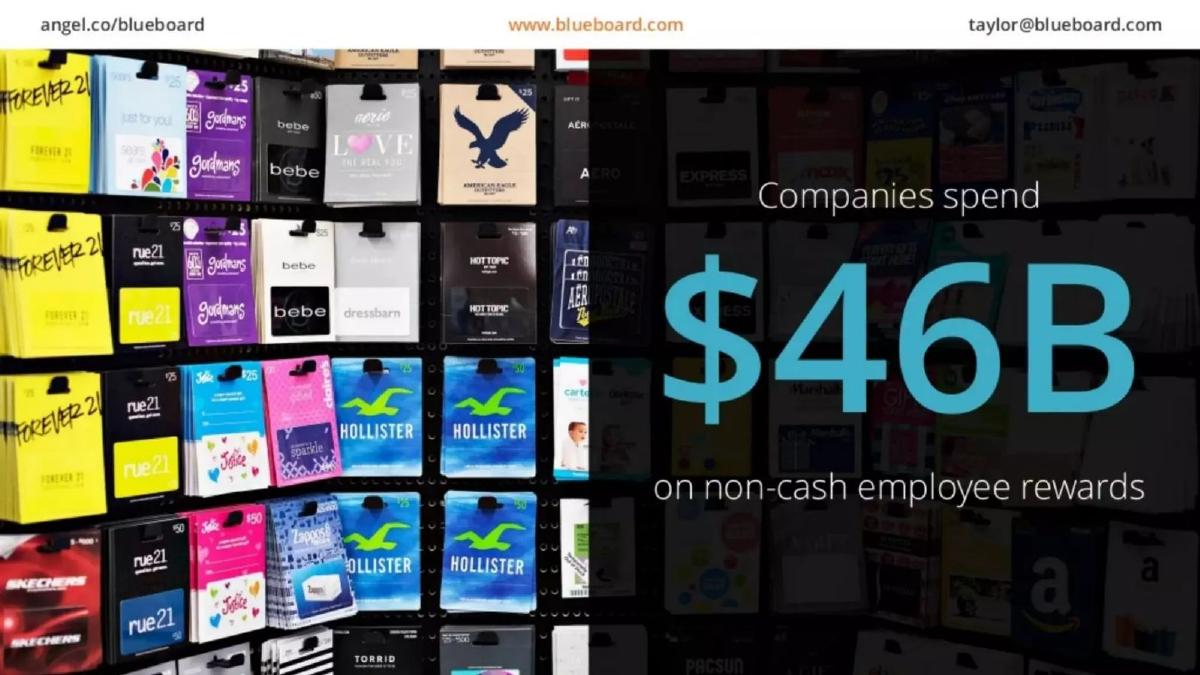
Slide 2: The Problem (The $46B Status Quo) This slide uses a split-screen visual. On the left, a cluttered rack of retail gift cards; on the right, the figure $46B . The text states that companies spend this amount on "non-cash employee rewards." This establishes that the budget already exists; Blueboard doesn't need to convince companies to spend money, only to reallocate it from boring gift cards to their platform.
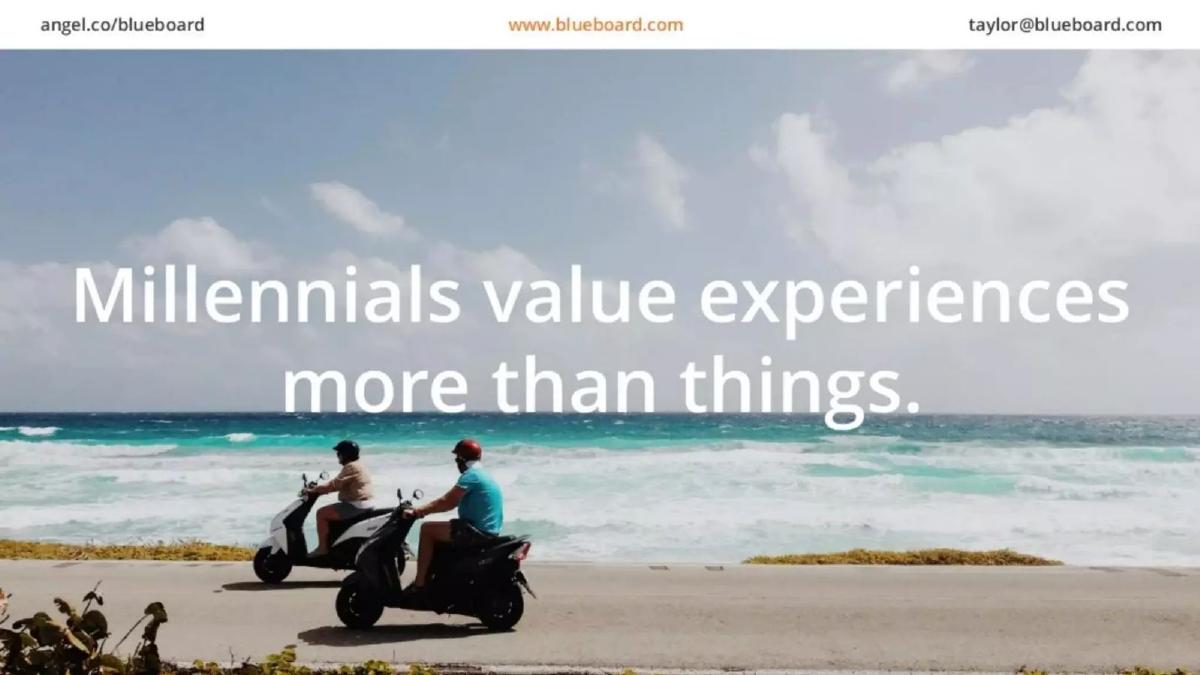
Slide 3: The Thesis A simple full-bleed image of people on scooters by the ocean with the text: "Millennials value experiences more than things." This is the psychological foundation of the company. It justifies why the $46B spent on gift cards (Slide 2) is being wasted on a workforce that doesn't want 'things.'
The Solution and Social Proof
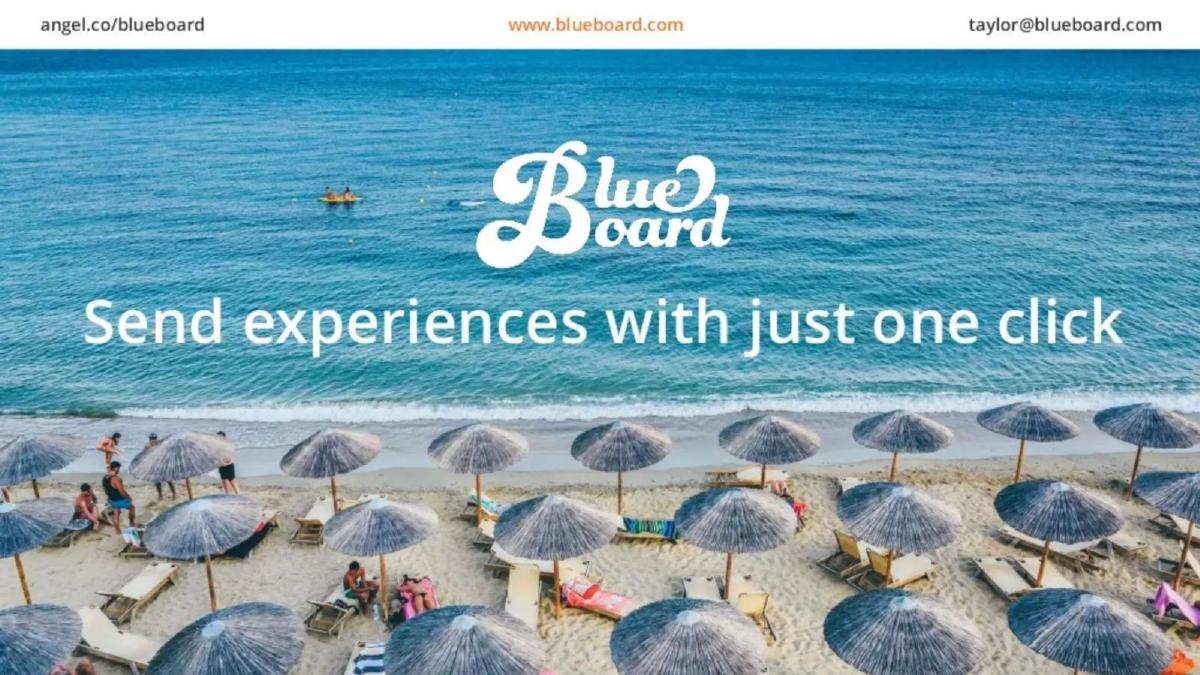
Slide 4: The Value Proposition Blueboard introduces its logo over a beach scene with the promise: "Send experiences with just one click." This addresses the 'how.' For an HR manager, the barrier to giving an 'experience' is usually the logistics. Blueboard claims to reduce that complexity to the ease of a gift card transaction.
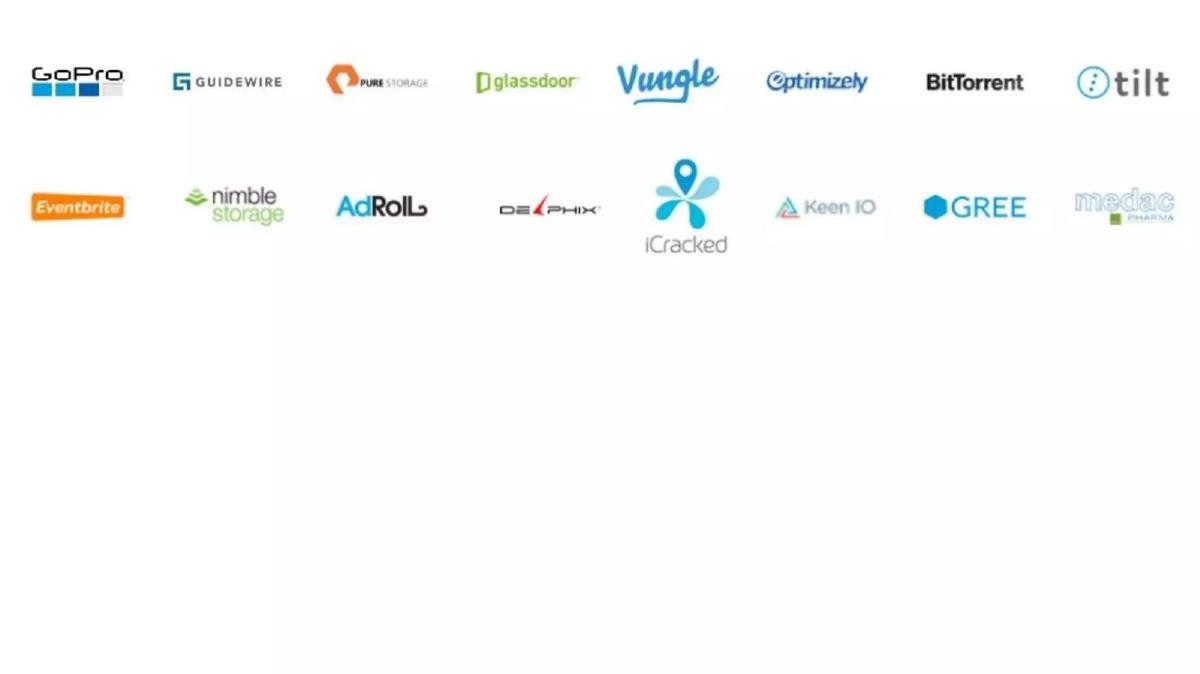
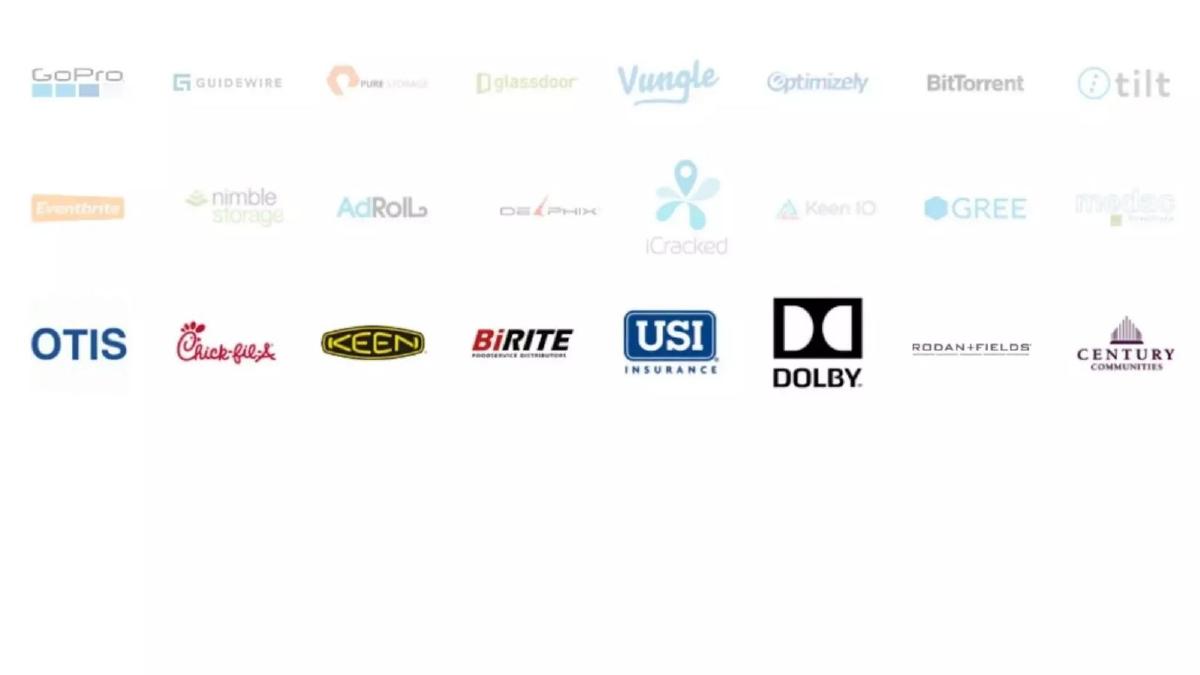
Slides 5, 6, and 7: The Logo Parade These three slides are nearly identical, showing a progressively growing wall of logos. This is a deliberate pacing tactic.
Slide 5 shows 15 early adopters like GoPro and Eventbrite. · Slide 6 adds a second tier of more traditional enterprises like Otis, Chick-fil-A, and Dolby. · Slide 7 fills the entire frame with over 40 logos, including names like Glassdoor, Vungle, and AdRoll.
This sequence visually demonstrates 'momentum' without needing a single bullet point of text. It tells the investor that the market has already 'voted' for Blueboard.
Traction and Future Revenue
Slide 8: ARR Growth This is the 'money slide.' It features a line graph showing ARR growth from February 2014 to late 2016.
Starting Point: $30,900 (Feb-14) · Mid-point: $394,810 (Aug-15) · Ending Point: $1,440,024 (Oct-16)
The chart shows a clear inflection point in late 2015 where growth accelerated. The slide also notes "50+ Enterprise customers."
Slide 9: Forward-Looking Momentum To prove the growth isn't slowing, Slide 9 highlights "New 2017 Customers." It features the logos of SpaceX, Zendesk, and Nestle. Most importantly, it states "$2.0M In ARR secured for 2017." This provides a 'floor' for the company's valuation, showing that they have already surpassed their 2016 totals before the year has even begun.
The Team and Vision
Slide 10: The Team The team slide is standard but effective. It features Taylor Smith (CEO), Kevin Yip (COO), and Michael Su (Head of Engineering). The pedigree is established via logos rather than bios: Cal (UC Berkeley), Accenture, PwC, and FiveStars. It suggests a mix of high-level consulting strategy and technical execution experience.
Slide 11: The Vision The deck closes with a brand-building statement: "We are building the undisputed, go-to brand for memorable and meaningful experiences." It’s a return to the emotional core of the business, leaving investors with the 'why' rather than the 'how.'
What Works in the Blueboard Deck
The 'Show, Don't Tell' Approach to Traction: Instead of listing features, Blueboard uses three slides of logos. For a B2B SaaS company, there is no stronger signal than a diverse list of paying customers. Seeing SpaceX and Chick-fil-A on the same slide tells an investor that the product is versatile and has high 'pull' across different corporate cultures.
The Generational Wedge: By anchoring the pitch in the 'Millennial' shift, Blueboard created a sense of urgency. They framed their product as an essential tool for the 'modern workplace,' making traditional gift card competitors look obsolete by association.
Clear Revenue Inflection: The ARR chart on Slide 8 is excellent. It doesn't just show a total; it shows the journey from $30k to $1.4M. The annotations on the graph help investors see exactly when the company figured out its growth levers.
What is Missing
The 'Ask' Slide: There is no mention of how much money they are raising or what the terms are. While this is common in decks shared after a meeting, it leaves a gap in the narrative regarding capital efficiency and future milestones.
Unit Economics: There is zero mention of CAC (Customer Acquisition Cost), LTV (Lifetime Value), or churn rates. For a Series A, investors usually want to see the 'machine'—if I put $1 into this sales engine, how much comes out the other side? Blueboard relies on top-line ARR growth to tell that story instead.
Competitive Landscape: The deck ignores competitors like Reward Gateway, Fond, or even the incumbent gift card providers. A 'Why we win' slide would have helped clarify their moat beyond just 'having better experiences.'
What a Founder Should Copy
The Logo Build-Up: If you have strong customers, don't just put them in a small row at the bottom of a slide. Give them space. Blueboard’s use of three slides to show the growth of their customer base is a powerful way to visualize 'winning' the market.
The 'Secured Revenue' Metric: If you are raising at the end of a fiscal year, showing 'Secured ARR' for the following year (as seen on Slide 9) is a brilliant way to de-risk the investment. It proves that the growth isn't just a fluke of the current quarter but is baked into the future of the business.
Minimalist Text: Notice that almost no slide has more than 10 words. This forces the audience to listen to the presenter rather than reading the slides. It keeps the energy high and the focus on the big-picture metrics: $46B market, $1.4M ARR, and the 'One Click' simplicity.
Frequently asked questions
- How much did Blueboard raise with this deck?
- According to the catalogue facts, Blueboard raised $15,800,000 in a Series A round. Interestingly, the deck itself does not contain a slide specifying the 'Ask' or how the capital would be deployed, suggesting this deck was likely used as a supporting visual for a verbal presentation where those details were discussed.
- What is Blueboard's core value proposition?
- Blueboard positions itself as an 'experiential rewards' platform. The deck contrasts the $46 billion spent on 'things' (gift cards) with the psychological shift of Millennials who value experiences. Their solution allows HR managers to send curated activities like skydiving or wine tasting with 'one click,' aiming to make recognition more memorable than a standard cash equivalent.
- What does the traction look like in this deck?
- The traction is presented through a hockey-stick ARR growth chart on Slide 8. It shows the company starting at $30,900 ARR in February 2014 and scaling to $1,440,024 by the end of 2016. This is bolstered by Slide 9, which claims $2.0M in ARR was already 'secured' for 2017, indicating strong forward-looking revenue.
- Who are Blueboard's notable customers?
- The deck is heavy on enterprise validation. Notable logos featured across Slides 5 through 9 include GoPro, Eventbrite, Otis, Chick-fil-A, Dolby, SpaceX, Zendesk, and Nestle. This diverse range of industries—from fast food to aerospace—suggests a broad horizontal market appeal for their HR tool.
- What is missing from the Blueboard pitch deck?
- The deck is minimalist and omits several standard venture components. There is no slide for unit economics (LTV/CAC), no competitive matrix, no detailed product walkthrough or dashboard screenshots, and no roadmap for future features. It relies almost entirely on the 'Experience Economy' thesis and existing revenue momentum.