Chillchat’s 14-slide deck is a masterclass in visual storytelling for a product-centric startup. Operating in the social metaverse sector, the company successfully raised $19M by positioning itself as the 'Discord 3.0 of the Metaverse.' The deck focuses heavily on the 'Create2Earn' economy, showcasing a pixel editor, world-building tools, and visual node scripting that allows non-coders to build games. While the deck is light on traditional financial metrics or a detailed competitive landscape, it excels at explaining complex Web3 concepts like tokenomics and NFT minting strategies through cl…
Key takeaways
- The company positions itself as 'The Discord 3.0 of the Metaverse' to bridge social and gaming (Slide 2).
- Chillchat originated as an iOS app in 2018 before pivoting to NFTs in August 2021 (Slide 2).
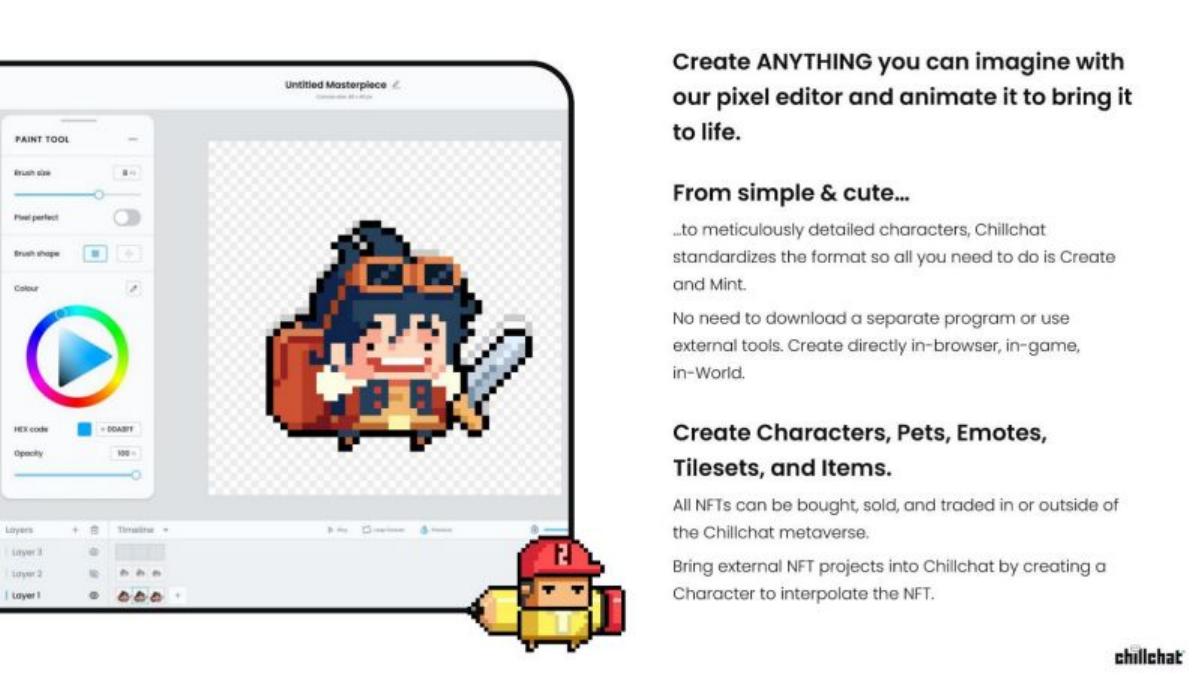
- A core product feature is an in-browser pixel editor that allows users to create and mint characters, pets, and items directly (Slide 4).
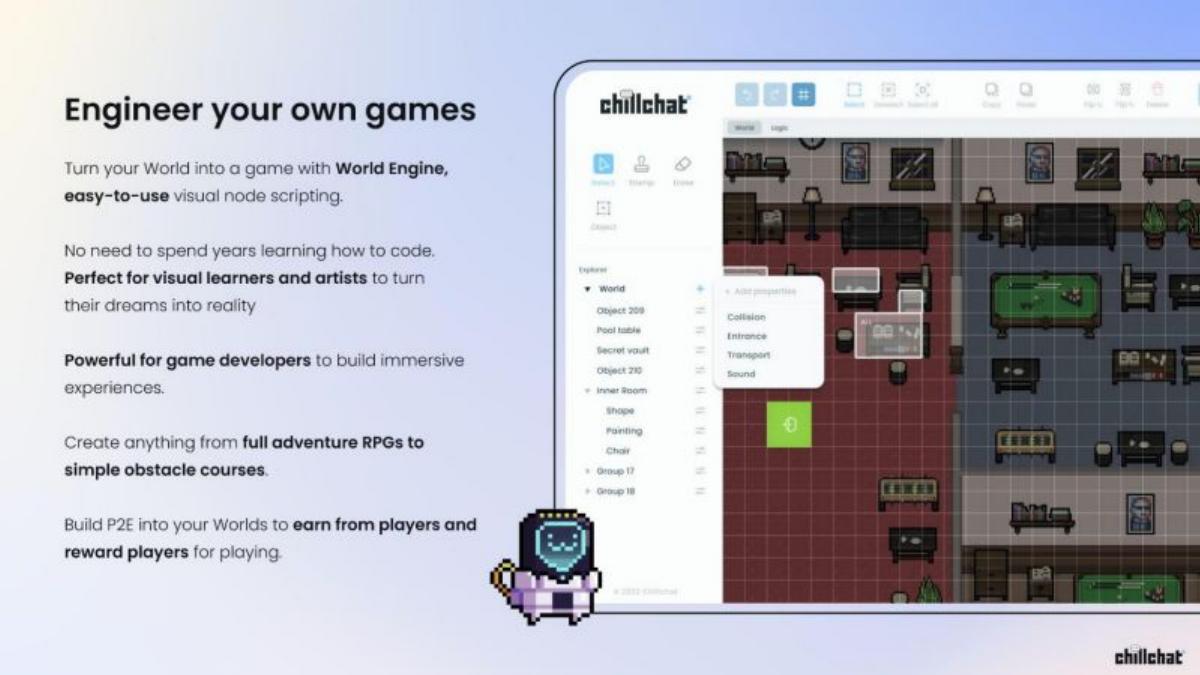
- The 'World Engine' uses visual node scripting to enable non-developers to build RPGs and obstacle courses (Slide 6).
- The platform plans a massive digital real estate offering with 250,000 total available worlds and an initial auction of 50,000 (Slide 9).
- To seed the community, the company released 1,500 unique 'Origin' characters via minting and auctions on Magic Eden (Slide 11).
- The $CHILL token serves three primary functions: Treasury, Staking, and Governance via a DAO (Slide 12).
- The deck omits a traditional team slide, though it mentions advisor Pontus Mähler (Slide 10).
The Visual Language of a Pixel Metaverse
Chillchat’s deck is a striking example of how to align a pitch’s aesthetic with the product’s core identity. As a pixel-art metaverse, the company uses its own assets—characters, world tiles, and UI elements—to populate every slide. This isn't just for decoration; it serves as a continuous product demo. By the time an investor reaches the end of the 14 slides, they have a visceral understanding of the platform's look and feel without ever having opened the app.
Slide 1: The Hook
The cover slide is minimal, featuring the logo and the tagline: "The Create to Earn Social Metaverse." It immediately identifies the company's category (Metaverse) and its unique value proposition (Create to Earn). The use of a pixelated character on a rocket provides a sense of momentum and playfulness.
Slide 2: Positioning and Pivot
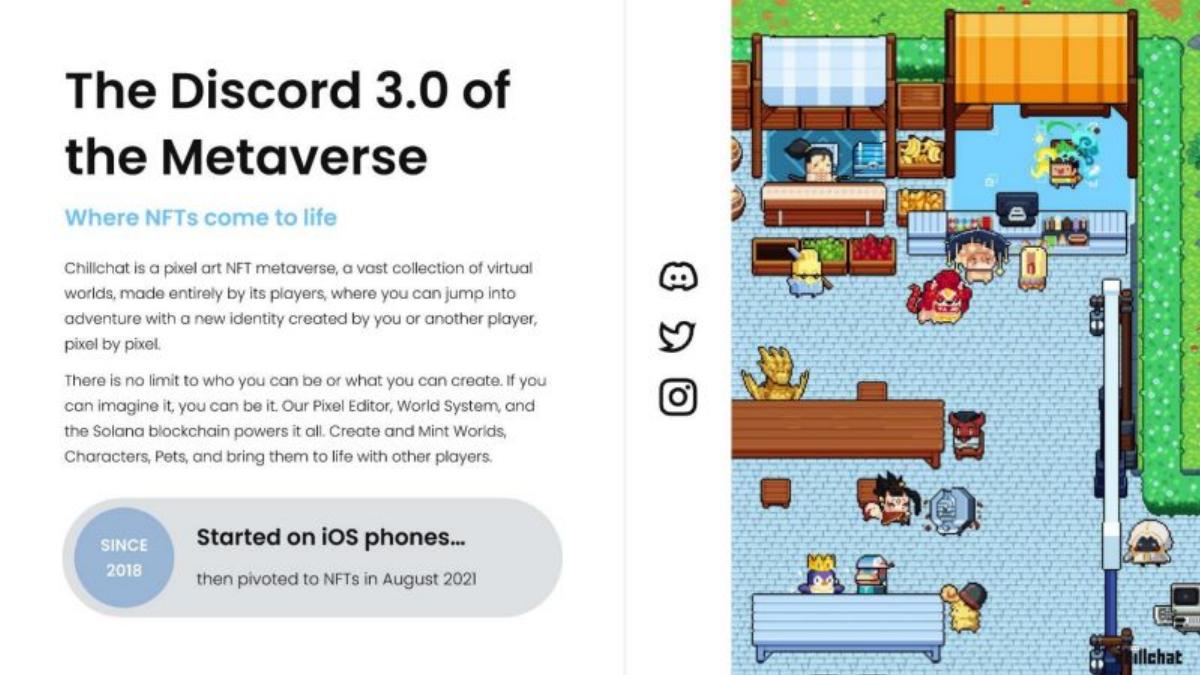
Slide 2 uses a powerful 'X for Y' analogy: "The Discord 3.0 of the Metaverse." This tells investors that social interaction is the primary driver, not just gameplay. Crucially, this slide includes a small badge noting that the company "Started on iOS phones... since 2018" and "pivoted to NFTs in August 2021." This provides historical context and suggests the team has experience building social apps prior to the Web3 boom.
Slide 3: The Core Loop
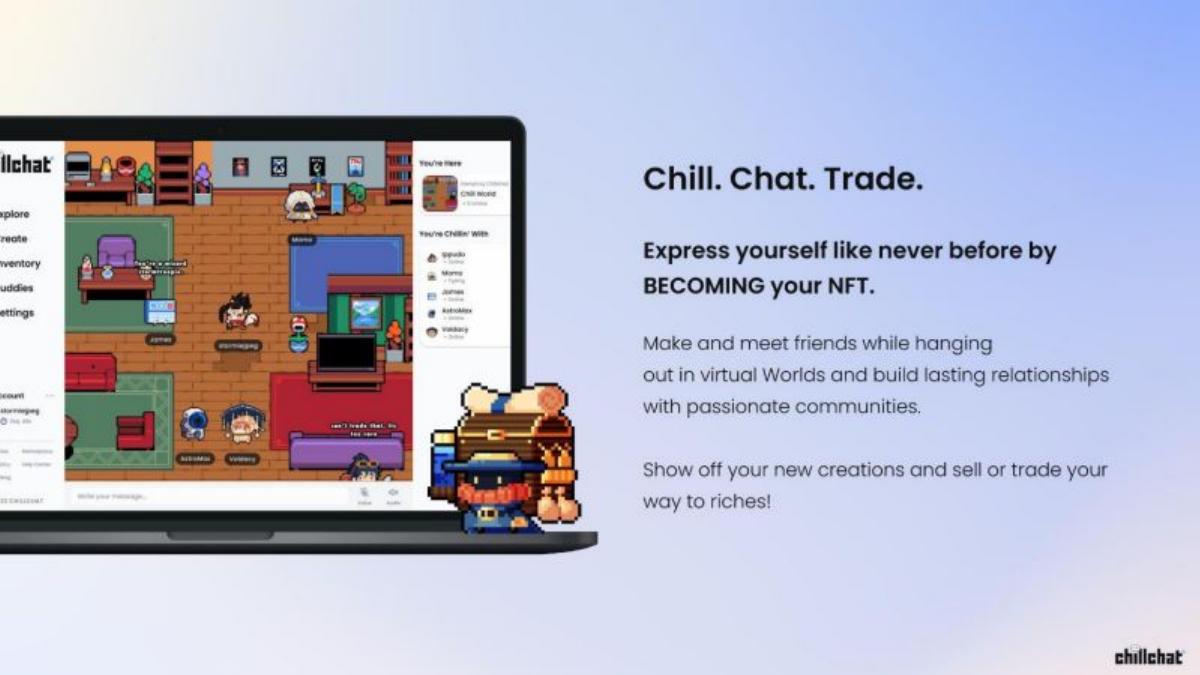
Titled "Chill. Chat. Trade." , this slide shows a laptop mockup of the interface. It emphasizes the social aspect—hanging out in virtual worlds—and the economic aspect—trading creations. The phrase "BECOMING your NFT" highlights the identity-driven nature of the platform.
Slide 4: The Pixel Editor
This is a product-deep-dive slide. It showcases the "pixel editor" and claims users can "Create ANYTHING you can imagine." It lists specific assets: Characters, Pets, Emotes, Tilesets, and Items. The key takeaway here is the lack of friction: "No need to download a separate program... Create directly in-browser." This lowers the barrier to entry for the 'Create2Earn' economy.
Slide 5: World Building
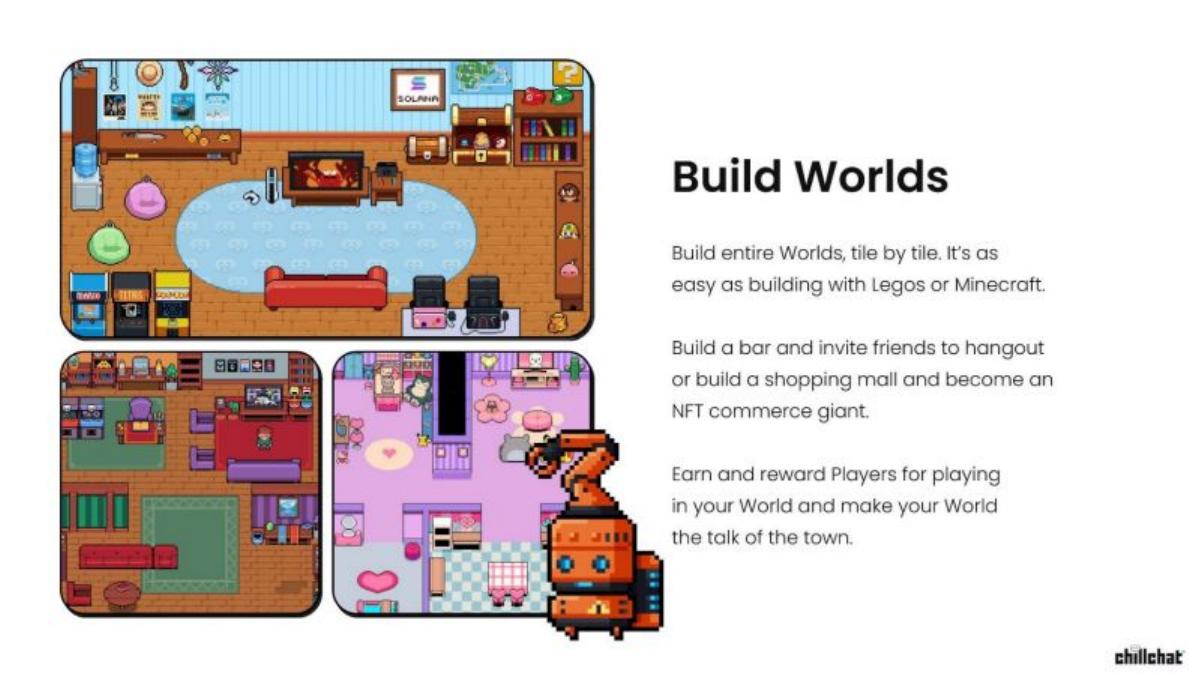
Slide 5 explains the spatial aspect of the metaverse. It compares building worlds to "Legos or Minecraft." It introduces the idea of virtual commerce, suggesting users can "build a shopping mall and become an NFT commerce giant." This appeals to the 'digital real estate' investment thesis popular in 2022.
Slide 6: The World Engine
This is perhaps the most important technical slide. It introduces "World Engine," which uses "easy-to-use visual node scripting." This is a direct play for the 'no-code' movement. It positions Chillchat as a platform where "visual learners and artists" can build full adventure RPGs without knowing how to code.
Slide 7: Market Positioning
Using a Venn diagram, Chillchat places itself at the intersection of Gaming (Minecraft, Roblox) , Social Virtual Worlds (Facebook, Discord) , and Marketplaces (Magic Eden, OpenSea) . It’s a bold claim to sit at the center of three massive industries, but it clarifies the 'platform' play.
Slide 8: Competitive Advantage
This slide uses a simple checklist to compare Chillchat against generic "Competitors." It claims Chillchat is "Accessible," "Easy to use," and has "Perpetual art," whereas competitors are "Complex" with "Depreciating art." While it lacks specific names, it reinforces the theme of simplicity and accessibility.
Slide 9: The Universe Map
Slide 9 provides the scale of the project. It mentions "250,000 Total Available Worlds" and a "500x500 Universe Map." It also introduces the "World Sale" mechanism, noting that an initial auction of 50,000 Worlds will allow players to bid with the platform's native currency, CHILLING .
Slide 10: The Creator Program
This slide addresses the 'cold start' problem of any platform: how do you get content? It mentions Pontus Mähler as an advisor and outlines a program to "incentivize, evangelize, and advise Artists." It explicitly states the goal of reaching into the "traditional gaming industry talent pool."
Slide 11: Origin Minting
To prove market demand, Chillchat details its "Origin" character release. 1,000 were released via private/public mint for 2 SOL , and 400 via auction. This slide is intended to show early traction and community 'evangelists' who will help build the vibrant community.
Slide 12: $CHILL Tokenomics
This slide breaks down the utility of the $CHILL token into three buckets: Treasury (with a 12-month lock-up), Staking (the only way to generate more tokens), and Governance (voting on roadmap features via a DAO). It’s a standard but clear Web3 economic model.
Slide 13: Revenue and Allocation
The final content slide is a flow chart showing how value moves through the system. It shows that 100% of World Sales and 75% of Minting/Transaction fees flow into the Treasury and Staking Pool. The Treasury then feeds the Creator Program (25-50%) and Play-2-Earn Prize Pools . This demonstrates a sustainable circular economy.
What Chillchat Does Well
The deck is exceptionally cohesive. By using the product's own pixel art, the founders prove they have a finished aesthetic and a working set of creative tools. The 'Discord 3.0' analogy is a strong anchor that prevents the project from being seen as 'just another game.' Furthermore, the focus on 'No-Code' tools (the pixel editor and visual scripting) addresses a major pain point in the metaverse space: the difficulty of creating high-quality content.
What is Missing from the Deck
The most glaring omission is a dedicated Team Slide . While Pontus Mähler is mentioned as an advisor, the founders and core engineering team are not featured. In a $19M Seed round, the pedigree of the team is usually a primary factor for investors. Additionally, there is no Financial Projections slide or a detailed Roadmap beyond the initial minting. While the 'World Sale' numbers are large, there is no data on current active users (DAU) or retention from the iOS app mentioned on Slide 2. Finally, the Competitive Advantage slide is quite vague; it doesn't name specific Web3 competitors like The Sandbox or Decentraland, which were the primary benchmarks at the time.
What Other Founders Should Copy
Founders building in the 'Creator Economy' or 'Web3' space should study Slide 13. Explaining token flows can often become overly academic and confusing; Chillchat uses a simple, clean flow chart that shows exactly where the money comes from and where it goes. Also, the use of 'X for Y' positioning (Slide 2) is highly effective for complex products. If you are building a metaverse, don't just call it a metaverse—call it the 'Discord of X' or the 'Shopify of Y' to give investors a mental model they already understand.
Conclusion
Chillchat’s deck succeeded because it sold a vision of a self-sustaining, creator-led ecosystem. It moved away from the 'speculative NFT' narrative and toward a 'platform and tools' narrative. By emphasizing how easy it is for users to create and earn, they presented a scalable model for growth that justified a significant $19M Seed round in the height of the 2022 metaverse cycle.
Frequently asked questions
- How does Chillchat differentiate itself from competitors like Roblox or Minecraft?
- According to Slide 8, Chillchat focuses on 'Perpetual art' and 'Cross play optimization' while maintaining a 'Casual' and 'Easy to use' interface. It contrasts itself against competitors that it labels as 'Complex' with 'Steep learning curves' and 'Depreciating art.' The integration of the Solana blockchain for ownership and monetization is its primary Web3 differentiator.
- What is the 'Create2Earn' model mentioned in the deck?
- The Create2Earn model is centered on giving users tools to build content that they can monetize. Slide 4 and Slide 6 highlight the pixel editor and World Engine, which allow users to create NFTs and games. Slide 13 shows that creators receive a portion of minting and transaction fees, incentivizing them to build engaging content for the platform.
- What are the specific tokenomics for the $CHILL token?
- Slide 12 defines $CHILL as a governance token used for a DAO, staking, and treasury. Staking is described as the only way to generate $CHILL outside of owning an 'Origin' character. The treasury holds tokens with a 12-month lock-up and uses them to incentivize creators to build on the platform.
- How does the platform handle world building and land sales?
- Slide 9 outlines a universe map of 500x500 containing 250,000 total worlds. An initial auction of 50,000 worlds is planned where players bid using the $CHILL token. Interestingly, creators can add 'Levels' to their worlds to gain more space without needing to purchase additional world NFTs.
- Who is the target audience for Chillchat?
- The deck targets two main groups: casual social users and creators. Slide 10 explicitly mentions a 'Creator Program' designed to attract indie game developers and artists from the traditional gaming industry by offering them 'high monetizability' and a 'direct to market platform' that is easier to use than traditional engines.