The July 2010 investor presentation for China RuiTai International Holdings Co. Ltd. (CRUI) outlines a mature manufacturing operation specializing in non-ionic cellulose ether. Based in Shandong, China, the company leverages a massive 555-person workforce and 10 production lines to serve industries ranging from construction to pharmaceuticals. The deck is notable for its transparency regarding historical financials, showing a revenue dip from $41.4 million in 2008 to $35.7 million in 2009, followed by a projected recovery. While the presentation excels at demonstrating physical scale and mark…
Key takeaways
- The company operates 10 production lines with an annual capacity of 8,500 tons of cellulose ether as of slide 6.
- China RuiTai employs 555 full-time staff and maintains 30 distribution offices throughout China, according to slide 6.
- Revenue showed volatility between 2008 and 2010, with a reported $41.4 million in 2008 dropping to $35.7 million in 2009, per slide 18.
- The sales model is heavily weighted toward direct interaction, with 95% of sales going directly to the customer as stated on slide 15.
- International expansion is a core pillar, with exports reaching the US, Europe, Japan, India, and South Korea, noted on slide 15.
- Financial health is detailed through a full income statement on slide 21, showing a net income of $5,675,861 for FY 2009.
- Growth strategy focuses on shifting toward higher-margin products like EC, HPC, HEC, and HPMC, as outlined on slide 24.
- The deck lacks a specific 'Ask' slide or a detailed breakdown of how new investment capital would be allocated among the 26 total slides.
Introduction and Vision
Slide 1: Title Slide
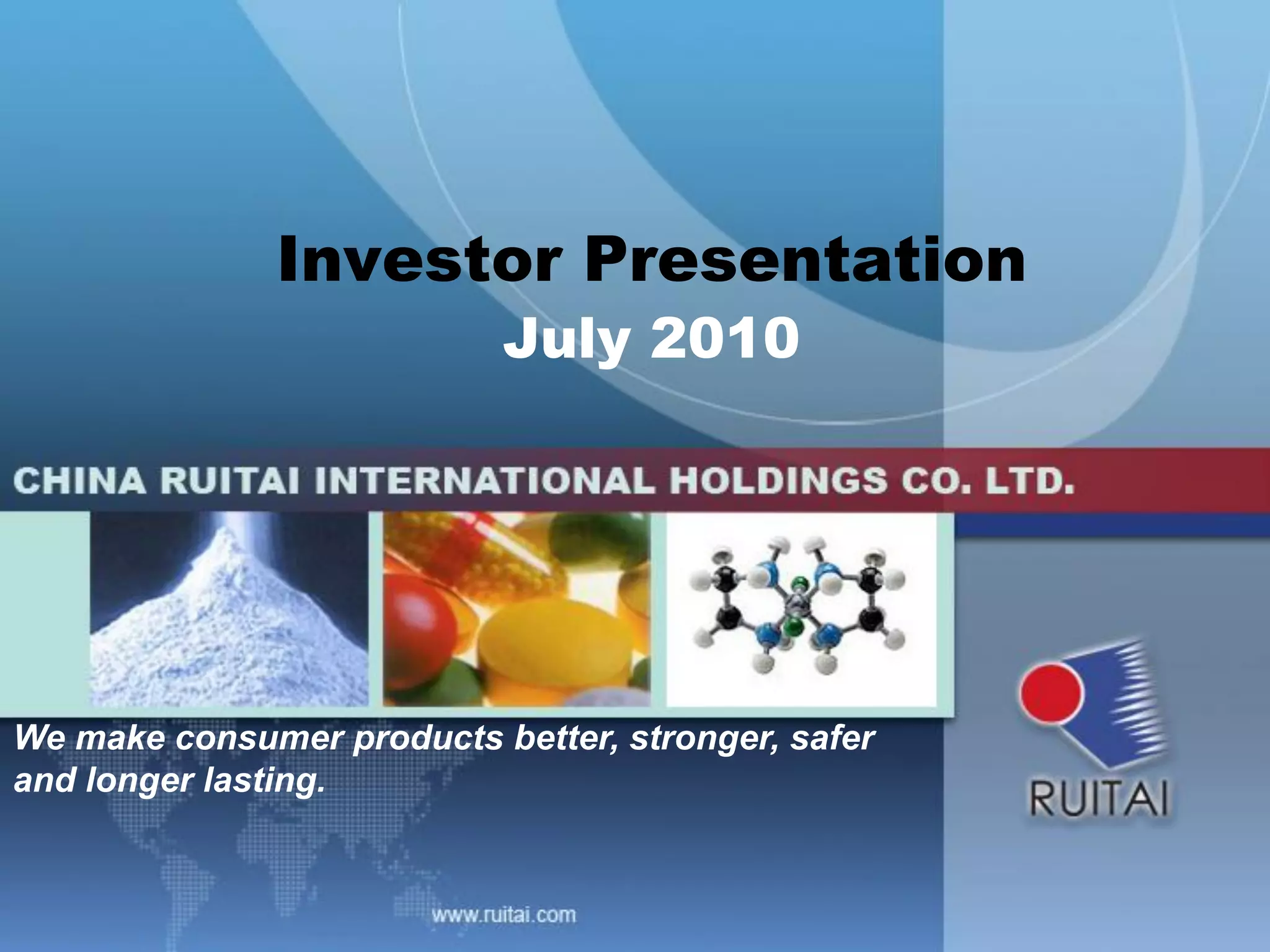
The presentation opens with a standard corporate title: 'Investor Presentation July 2010' for China RuiTai International Holdings Co. Ltd. The visual elements include the company logo (RUITAI) and three small images representing their core business: chemical powders, pharmaceutical capsules, and a molecular model. The tagline 'We make consumer products better, stronger, safer and longer lasting' establishes the company as a B2B chemical supplier rather than a consumer-facing brand.
Slide 2: Company’s Vision
Slide 2 features a formal portrait of President Xing Fu Lu. The text outlines a vision to be the 'leading supplier of cellulose ether in the Chinese market' and a 'recognized exporter' worldwide. It notes the company's genesis in 2000, establishing a decade of history by the time of this presentation. The vision is broad, mentioning expansion of product portfolios and research into new specialty chemicals, but it lacks specific, time-bound milestones.
Operational Scale and Market Presence
Slide 6: Corporate Overview China RuiTai
This slide provides the most significant data regarding the company's physical and operational scale. It identifies the company as the 'Original manufacturer of cellulose ether in China,' located in Wenyang, Shandong province. Key metrics include 12 major product lines under the 'RuiTai' and 'Rutocel' brands, 10 production lines with an annual capacity of 8,500 tons, and a workforce of 555 full-time employees. The inclusion of a map of China with the Shandong location highlighted emphasizes their regional dominance and domestic footprint.
Slide 9: Product Uses and Applications
Slide 9 serves as the 'Problem/Solution' equivalent for an industrial company, explaining where their chemicals end up. It lists five primary sectors: Construction (latex paint, cement), Pharmaceutical (stabilizers, thickeners), Food and Personal Care (jam, toothpaste), Cosmetics (shampoo, lipstick), and Petro-chemical (PVC components). By showing a wide range of everyday applications, the company demonstrates that its demand is diversified across multiple industries, reducing the risk of a downturn in a single sector.
Market Outlook and Sales Strategy
Slide 12: Attractive Industry Outlook
This slide presents the macro-economic thesis for investing in China RuiTai. It splits the opportunity into four quadrants: domestic demand (driven by a 2010 government policy stimulus for construction materials), international markets (looking for lower-cost alternatives), cost advantages (labor and raw materials), and industry consolidation. The mention of a fragmented market offering 'growth through acquisitions' suggests that the company viewed itself as a potential consolidator in the space.
Slide 15: Sales and Customer Base
Slide 15 details the distribution strategy. A key metric is the '95% direct sales to the customer' model, which implies higher margins by cutting out intermediaries. The company lists a massive domestic reach with 30 sales offices across 30 provinces. For international reach, it lists the US, Europe, Japan, India, and South Korea as export destinations. This slide effectively communicates that the company is not just a manufacturer, but a fully integrated sales and distribution entity.
Financial Performance
Slide 18: Revenues
The revenue bar chart provides a transparent look at the company's top-line performance. It shows $41.4 million in 2008, a dip to $35.7 million in 2009, and a '2010TTM' (Trailing Twelve Months) figure of $37.7 million. A '2010G' (Goal or Guidance) of $43.0 million is presented. The right side of the chart compares Q1 2010 ($10.2 million) to Q1 2009 ($8.2 million), providing evidence for the projected recovery. The transparency regarding the 2009 dip is a positive sign of reporting integrity.
Slide 21: Income Statement
Slide 21 provides a detailed P&L for FY 2008, FY 2009, and Q1 2010. Key figures for FY 2009 include a Gross Profit of $11,870,948 on revenues of $35,736,104, representing a gross margin of approximately 33%. Total Operating Expenses were $4,159,409. The statement also shows significant interest expenses ($2.47 million in 2009), suggesting the company carries substantial debt. Net income for 2009 was $5,675,861, resulting in an Earnings Per Share (EPS) of $0.21.
Future Growth
Slide 24: Growth Strategies
The final slide in this selection outlines five strategic pillars: capturing domestic share, expanding capacity for higher-margin products (EC, HPC, HEC, HPMC), growing international markets via distributors, R&D for specific industries, and increasing brand equity. While these are logical steps for a maturing industrial firm, the slide lacks specific targets, such as the number of new tons of capacity or specific revenue targets for the new chemical lines.
What Works and What is Missing
What Works
Operational Transparency: The deck does not shy away from the size of the operation. Citing 555 employees and 8,500 tons of capacity (Slide 6) gives investors a clear sense of the 'bricks and mortar' value. · Detailed Financials: Providing a full income statement (Slide 21) rather than just a few cherry-picked metrics is essential for a company at this stage. · Diversified Applications: Slide 9 effectively communicates that the company is not overly dependent on a single end-market, which is a strong defensive argument.
What is Missing
The Ask: In the provided slides, there is no mention of how much capital is being raised or the valuation being sought. · Use of Proceeds: While 'Growth Strategies' are listed on slide 24, there is no budget allocation showing how investment dollars would be spent. · Competitive Landscape: Slide 12 mentions a 'fragmented market,' but the deck does not name specific competitors or provide a comparison of market share. · Unit Economics: While the P&L is present, the deck lacks a breakdown of the cost per ton or the margin profile of specific product lines versus competitors.
Founder Takeaways
Lead with Scale: For industrial companies, physical assets and workforce size are primary trust signals. China RuiTai places these front and center on slide 6. · Show the Recovery: If your revenue dipped during a global downturn (like 2009), use quarterly comparisons (Slide 18) to show the momentum of the recovery rather than just annual totals. · Direct Sales as a Moat: Highlighting a 'controlled sales network' (Slide 15) demonstrates that the company owns the customer relationship, which is a significant competitive advantage over manufacturers who rely entirely on third-party wholesalers.
Frequently asked questions
- What exactly does China RuiTai manufacture?
- China RuiTai is a manufacturer of non-ionic cellulose ether. As shown on slide 9, this chemical is a versatile additive used as a thickener and adhesive in latex paint and cement (construction), a membrane reagent and stabilizer in pharmaceuticals, a thickening agent in food products like jam and ice cream, and a component in cosmetics like shampoo and lipstick.
- How does the company distribute its products in China?
- The company utilizes a 'controlled sales network' where 95% of sales are direct to the customer. Slide 15 specifies that they have 30 sales offices managing distribution across 30 provinces. Major regional hubs include offices in Beijing, Shanghai, Guangzhou, Qingdao, Nanjing, Chongqing, Chengdu, Shenyang, and Urumqi.
- What were the financial trends for the company leading up to 2010?
- The company experienced a revenue decline in 2009 ($35.7M) compared to 2008 ($41.4M), likely reflecting global economic conditions. However, slide 18 shows a recovery trend with Q1 2010 revenues reaching $10.2M compared to $8.2M in Q1 2009. Net income remained positive throughout, increasing from $5.2M in 2008 to $5.6M in 2009.
- What is the competitive advantage cited in the deck?
- According to slide 12, the company relies on China's labor and raw material cost advantages. They claim their products are less expensive than imports and highly competitive in export markets. Additionally, they cite a 'policy stimulus' from the Chinese government in 2010 regarding construction materials as a domestic demand driver.
- What are the primary growth drivers for the future?
- Growth is predicated on three pillars: aggressive domestic market share capture, international expansion via distributors, and a shift in production capacity toward higher-margin specialty chemicals. Slide 24 specifically identifies EC, HPC, HEC, and HPMC as the target products for higher-margin capacity expansion.