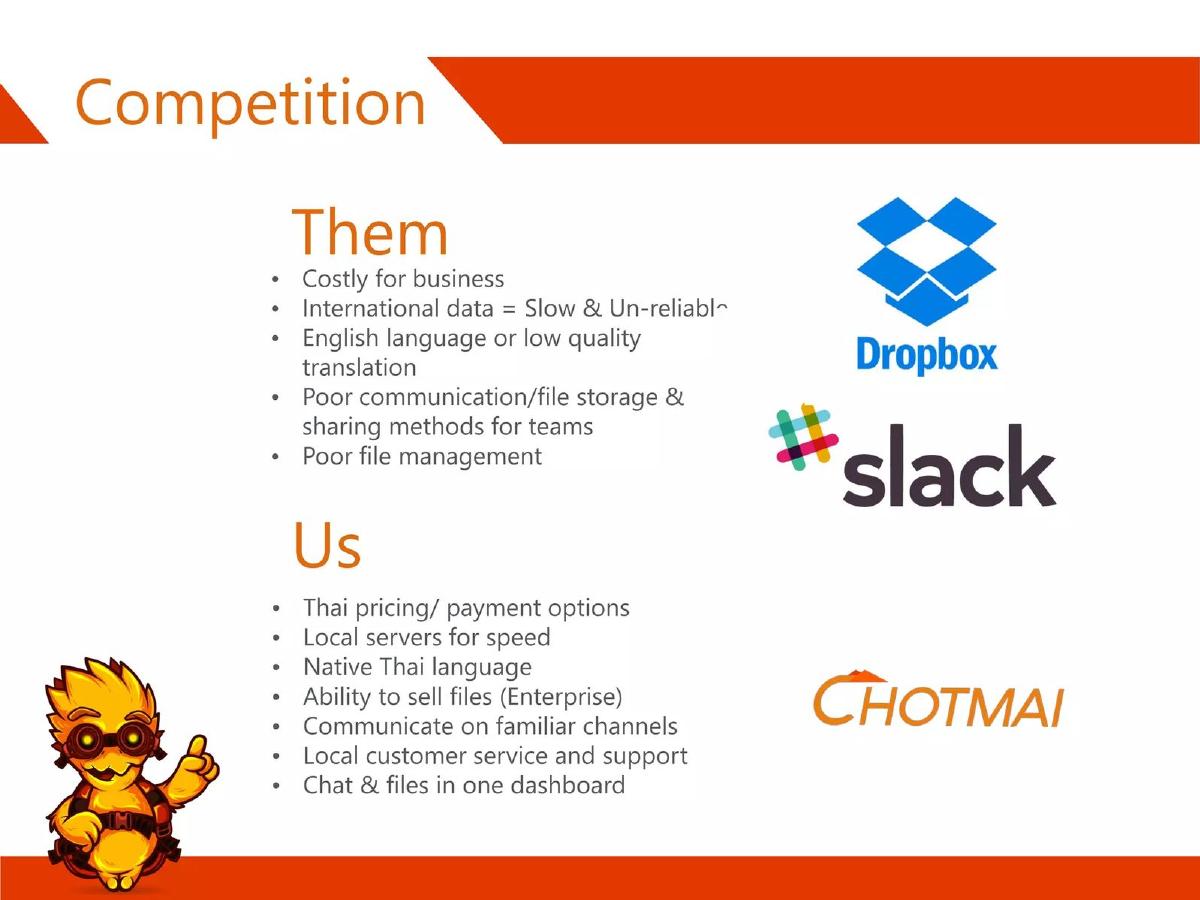
Chotmai’s pitch deck presents a localized software-as-a-service (SaaS) solution tailored for the Thailand market, described as 'Slack Meets Dropbox For Asia-Pac' (Slide 1). The company emphasizes its competitive advantage through native Thai language support and localized server infrastructure (Slide 3). The deck is notable for its transparency regarding its current user base, citing a 3.81% conversion rate from traffic to active accounts (Slide 5) and a current Cost Per Acquisition (CPA) of 24 THB (Slide 8). While the product features like file transfers up to 20GB for enterprise users are c…
Key takeaways
- The product is positioned as a localized hybrid of Slack and Dropbox specifically for the Asia-Pacific region (Slide 1).
- The company claims a current conversion rate of 3.81% from traffic to active accounts (Slide 5).
- User demographics are heavily skewed toward males (71.6%) and the 25-34 age bracket (44.98%) (Slide 8).
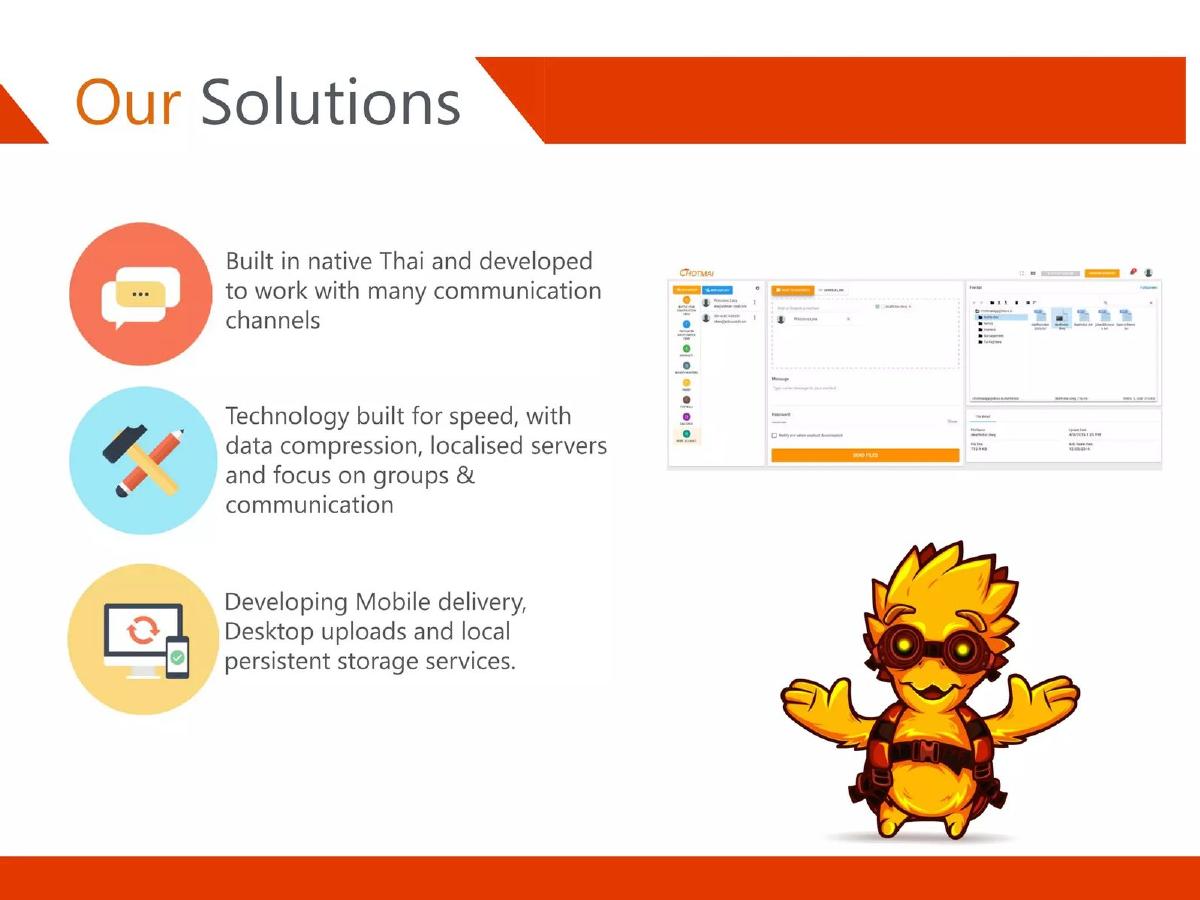
- Localization is the primary value proposition, featuring native Thai language support and localized servers (Slide 3).
- The freemium model offers 10GB of storage for 14 days, while the enterprise tier offers 1TB of persistent storage (Slide 4).
- Current acquisition costs are highly efficient, with a current CPA of 24 THB compared to an all-time average of 108 THB (Slide 8).
- The exit strategy explicitly targets acquisition by Dropbox, Slack, WeTransfer, or Google Drive (Slide 7).
- Market size is defined specifically for Thailand, citing 19 million+ internet users (Slide 5).
Executive Summary: The Regional Specialist
Chotmai’s pitch deck is a study in regional specialization. By branding itself as the 'Slack Meets Dropbox for Asia-Pac,' the company attempts to carve out a territory that global incumbents often treat as secondary markets. The deck is data-heavy regarding user behavior and acquisition costs, which provides a level of transparency often missing in early-stage pitches. However, the reliance on a single-country market size and the absence of a core team slide suggest a company still in the early stages of professionalizing its narrative.
Slide 1: Title and Positioning
The cover slide introduces the brand 'Chotmai' alongside a cartoon mascot. The subtitle, 'Slack Meets Dropbox For Asia-Pac,' is a classic 'X for Y' positioning statement. This immediately tells the investor that the company is a horizontal productivity tool with a geographic focus. The branding is playful, which may be intended to appeal to the 'Gamers/Film watchers' demographic mentioned later in the deck.
Slide 2: Our Shareholders
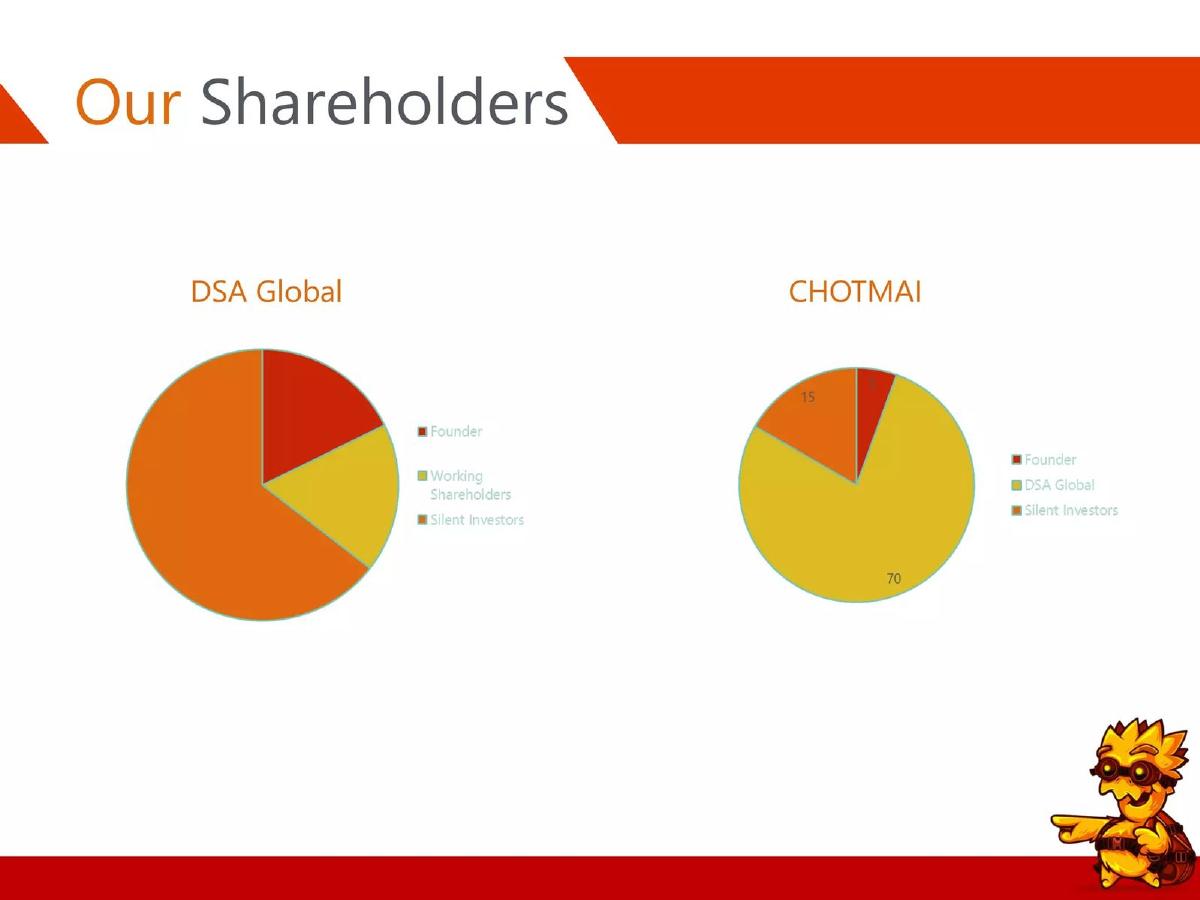
This slide provides a breakdown of the company's ownership structure. It shows two pie charts: one for 'DSA Global' and one for 'CHOTMAI.' For CHOTMAI, the equity is split between 'Founder' (5%), 'DSA Global' (70%), and 'Silent Investors' (15%). This is an unusual slide to include so early in a deck, as it reveals a founder who has already been significantly diluted, which might be a red flag for venture capital investors looking for highly incentivized founders.
Slide 3: Our Solutions
The solution slide focuses on three pillars: localization, speed, and platform expansion. It explicitly mentions being 'Built in native Thai' and using 'localised servers.' This is the core of their competitive moat—serving a specific linguistic and infrastructure need that US-based companies might ignore. The slide also mentions data compression and a focus on 'groups & communication,' alongside a screenshot of a web-based interface that resembles a file-sharing dashboard.
Slide 4: Product Overview
This slide details the tiered service model. The 'Freemium' tier allows users to store up to 10GB for 14 days and send 10GB files. The 'Enterprise' tier offers 1TB of persistent storage, the ability to 'Sell files,' and 'Task Lists & reminders.' A large overlay states 'V3 COMING SOON,' suggesting the current product is in an iterative phase. The inclusion of 'Conversations on social messaging channels' in the enterprise tier hints at an integration strategy with popular regional apps like LINE or Facebook Messenger.
Slide 5: Market Size
Chotmai narrows its focus to 'Thailand only.' It cites 19 million+ internet users in the country. It then filters this down to a 'User Demographic' of 3.6 million (25-34 year old males in Bangkok and university towns). Finally, it calculates an 'Expected User Number' of 137,160 based on a 'current conversion of 3.81% of traffic to active accounts.' This is a bottom-up market sizing approach, which is generally more respected by analysts than top-down 'trillion-dollar market' claims.
Slide 6: Marketing Strategy
The marketing plan is divided into three standard channels: Paid Search (targeting active seekers), Social Media (targeting users of competitors), and Traditional/Publicity (targeting those unaware of the technology). The mention of 'physical distribution' as the only current alternative for some users suggests that Chotmai sees itself as a digital transformer for traditional Thai businesses or consumers who still rely on USB drives or physical media.
Slide 7: Exit Strategy
The exit slide is bold, featuring the logos of Dropbox, WeTransfer, Slack, and Google Drive. It outlines two paths: selling the 'transfer audience' to a provider or splitting the company into 'transfer services & E-comm' and selling or IPO-ing either one. While it is common to list potential acquirers, listing them as the primary 'strategy' without a clear path to scale can sometimes signal that the founders are looking for an early out rather than building a standalone giant.
Slide 8: User Profile
This is the most data-dense slide in the deck. It provides a granular look at their current user base: 69.25% are on Windows, 96.17% are in Thailand, and 70.57% are in Bangkok. It also includes vital SaaS metrics: a 30.24% returning user rate, an average file size of 111 MB, and a 'Cost per active user' of 20 THB. The 'CPA Current' of 24 THB against an 'all time average' of 108 THB shows a positive trend in marketing efficiency.
What Chotmai Does Well
The deck excels at providing specific, verifiable data points. By including exact percentages for operating systems, geographic distribution, and conversion rates, the founders demonstrate that they are tracking their metrics closely. The focus on a specific geographic niche (Thailand) is also a strength; it allows them to claim a 'home field advantage' through native language support and local servers, which is a legitimate strategy against global incumbents.
What is Missing from the Deck
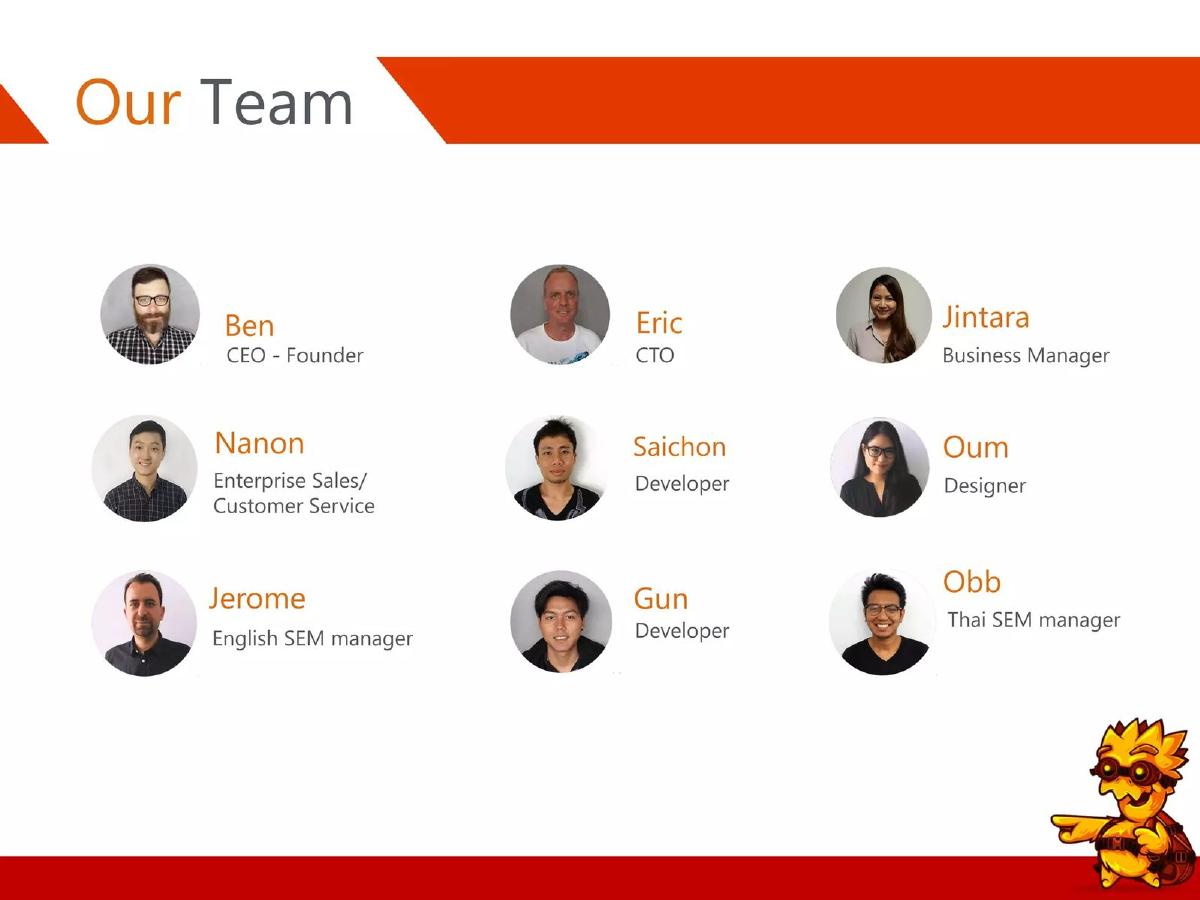
The most glaring omission is a Team Slide . Investors invest in people, especially at the early stage, and this deck provides no information on who is building the technology. Furthermore, there is no Financial Ask . A pitch deck is a fundraising tool, yet this document does not state how much money is being raised, the valuation sought, or the specific milestones the funding will help achieve. There is also a lack of Unit Economics beyond acquisition costs—specifically, there is no mention of Lifetime Value (LTV) or churn rates, which are critical for a freemium SaaS model.
Founder's Takeaway: What to Copy
Founders should emulate the Bottom-Up Market Sizing seen on Slide 5. Instead of claiming they will capture 1% of a global market, Chotmai starts with the total internet users in their region and applies their actual conversion rates to find a realistic target. Additionally, the User Profile slide (Slide 8) is an excellent example of how to present 'traction' through data. It shows the investor that the founders understand exactly who their user is, what devices they use, and what it costs to acquire them. This level of detail builds trust and suggests a disciplined approach to growth.
Frequently asked questions
- What is Chotmai's core product offering?
- Chotmai is a communication and file-sharing platform that combines features of instant messaging and cloud storage. According to Slide 3 and 4, it includes native Thai language support, data compression, and localized servers. It offers a freemium model for sending files up to 10GB and an enterprise version that includes 1TB of persistent storage, task lists, and integration with social messaging channels.
- How does Chotmai plan to compete with global giants like Slack?
- The company relies on hyper-localization. Slide 3 highlights that the technology is 'Built in native Thai' and utilizes 'localised servers.' This suggests a focus on speed and cultural relevance that global platforms might overlook in the Thai market. Additionally, Slide 8 shows that 96.17% of their current users are in Thailand, with 59.60% using the Thai language interface.
- What do the unit economics look like for Chotmai?
- Slide 8 provides specific metrics: the current Cost Per Acquisition (CPA) is 24 THB, which is a significant improvement over their all-time average of 108 THB. The cost per active user is cited at 20 THB. They report a 9.13% organic conversion rate and a 5.93% paid conversion rate, suggesting a relatively healthy funnel for a regional SaaS product.
- What is the company's target market size?
- Slide 5 focuses exclusively on Thailand, noting a total of 19 million+ internet users. Within that, they identify a target demographic of 3.6 million users (25-34 year old males in Bangkok and university towns). Their 'Expected User Number' based on current conversion rates is 137,160, indicating they are targeting a specific niche rather than the entire population.
- What is missing from this pitch deck?
- The provided slides omit several critical components for a professional fundraise. There is no team slide to establish founder credibility, no financial projections or 'burn' data, and no specific 'ask' detailing how much capital is being raised or how it will be spent. The deck also lacks a roadmap beyond the mention of 'V3 Coming Soon' on Slide 4.