Choosly presents a 17-slide deck focused on a specific niche: integrating professional athlete endorsements directly into e-commerce product pages. The deck argues that while brands spend billions on sports sponsorships ($51.1bn in 2012, Slide 3), this influence is often lost at the online point of sale. Choosly's solution involves embedding professional player images, reviews, and videos into retail sites like Sportsmans Warehouse. The deck highlights a potential 100% conversion uplift (Slide 9) and a massive $278bn market. While the team includes former Air Force pilots and an IBM veteran,…
Key takeaways
- The deck identifies a massive disconnect between sports sponsorship spending ($51.1bn in 2012) and online retail execution (Slide 3, 5).
- Choosly proposes a technical solution to embed 'Pro Images', 'Reviews and Stats', and 'Video' directly into third-party e-commerce sites (Slides 6-8).
- The company claims a potential 100% conversion uplift for retailers using their platform (Slide 9).
- The business model is described as a 'CPM MODEL' targeting global markets including Australia, US, Europe, and Asia (Slide 13).
- Strategic partnerships are hinted at with logos for Getty Images and Velocity Brand Management (Slide 12).
- The distribution strategy relies on integrations with major platforms like Shopify and Bigcommerce (Slide 14).
- The team features a mix of military discipline (Ex Air Force) and technical expertise (IBM), supported by high-profile advisors like NBA player Andrew Bogut (Slide 15).
- The funding ask is $600,000, primarily allocated to Development, Design, and Ops, though specific milestones are not defined (Slide 16).
Executive Summary: The Digital Athlete Endorsement Gap
Choosly's pitch deck addresses a specific inefficiency in the sports marketing and e-commerce sectors. While brands invest tens of billions of dollars in athlete sponsorships, that investment often fails to reach the final 'buy' button on a retail website. Choosly proposes a widget-based or API-driven solution to inject professional athlete content into the e-commerce flow. The deck is highly visual, relying on 'before and after' mockups to prove its point, but it leaves significant questions regarding technical implementation and unit economics unanswered.
Slide 1: Title Slide
The deck opens with a simple, high-contrast logo and the tagline: "RE-INTRODUCING Powerful Content for E-commerce." The use of "Re-introducing" suggests a pivot or a significant update to a previous iteration of the product. The branding is clean, using a teal and orange palette against a black background.
Slide 2: The Hook - What makes it sell?
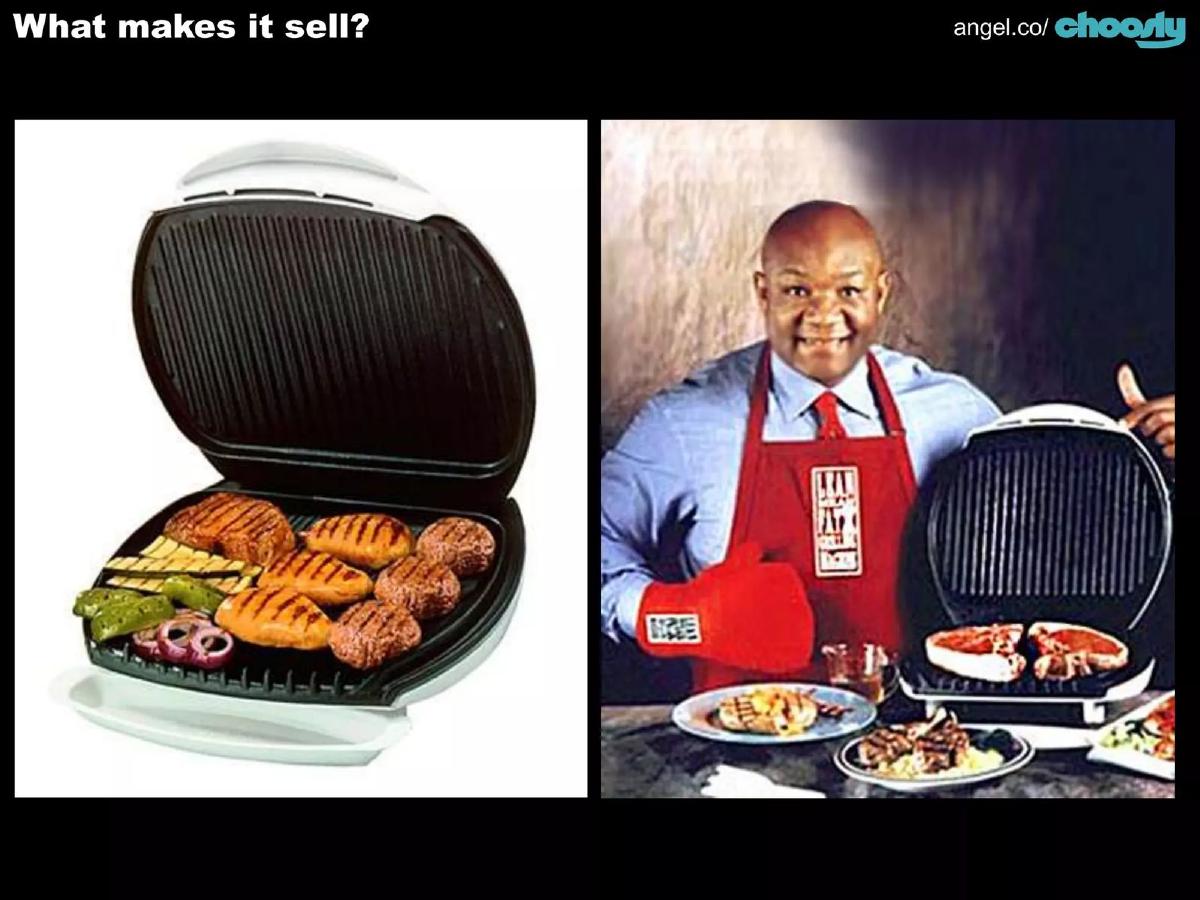
This slide uses the classic George Foreman Grill as a case study. It shows the product alone versus the product with George Foreman. It establishes the foundational thesis of the company: products sell better when associated with a recognizable, trusted face. This is a standard marketing principle applied as a 'Why Now' or 'Problem' hook.
Slide 3: Market Context - Brand Spending
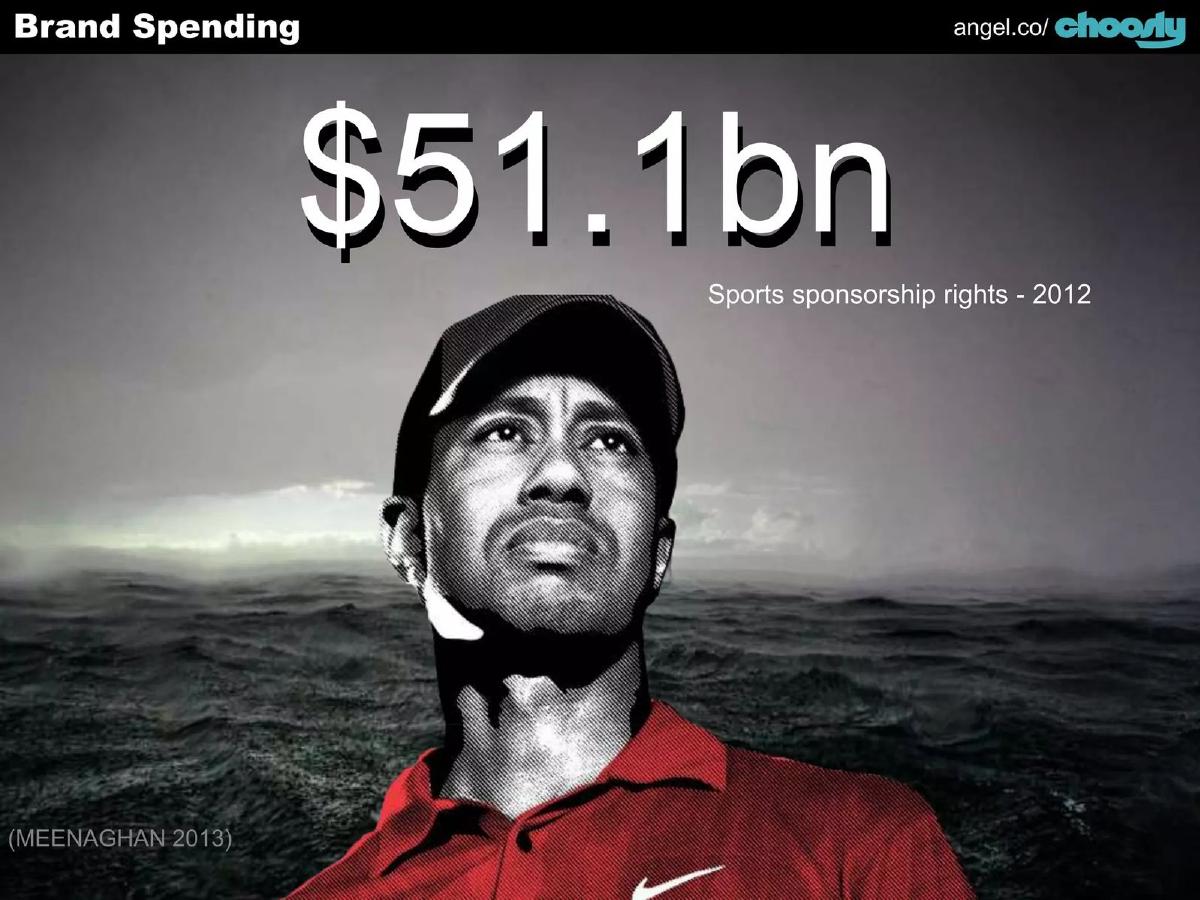
Choosly quantifies the opportunity by citing that $51.1bn was spent on sports sponsorship rights in 2012 (citing Meenaghan 2013). By featuring a stylized image of Tiger Woods, the deck emphasizes that brands are already spending the money; Choosly is simply proposing a way to make that spend more effective at the point of sale.
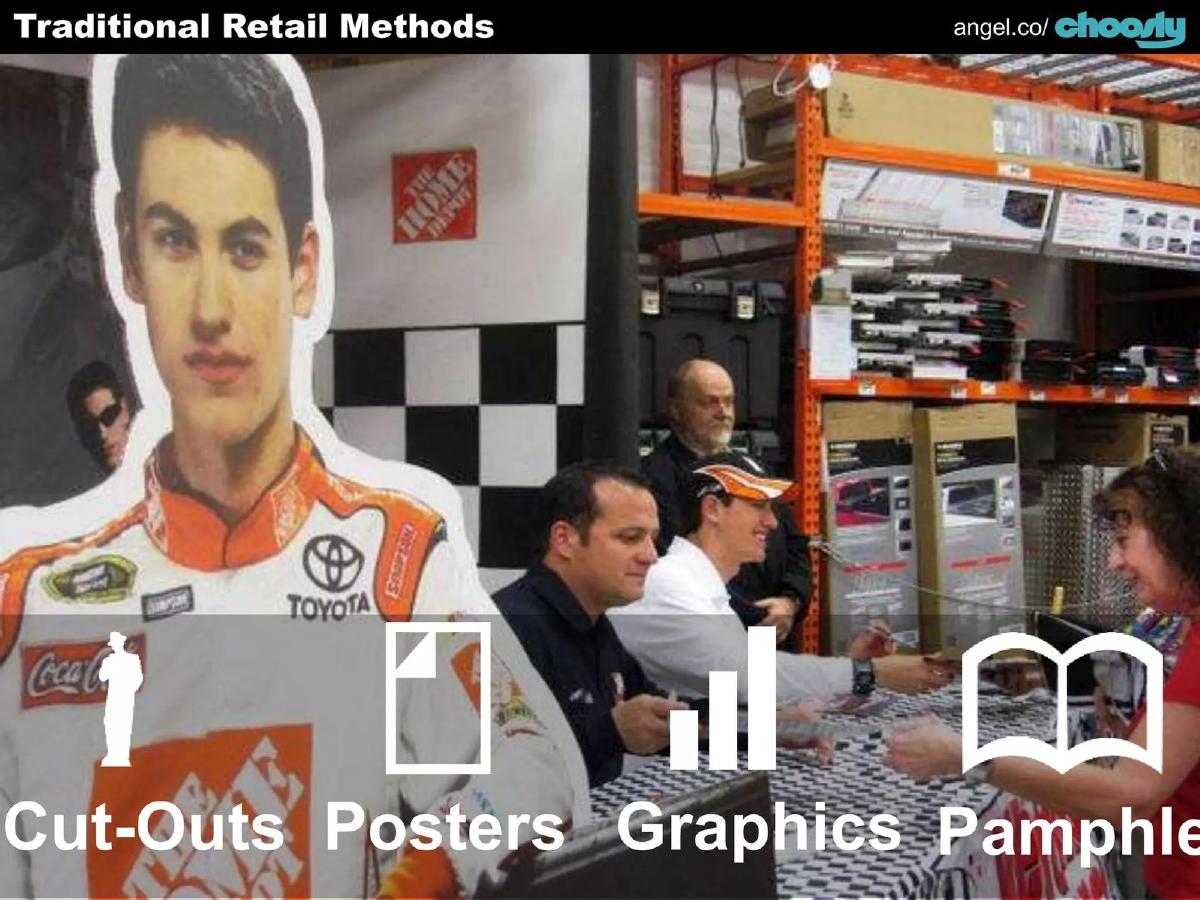
Slide 4: Traditional Retail Methods
This slide illustrates how physical retail uses "Cut-Outs, Posters, Graphics, and Pamphlets" to leverage athlete endorsements. It shows a NASCAR driver cutout in a Home Depot, reminding the investor that this strategy is proven in the physical world but lacks a digital equivalent.
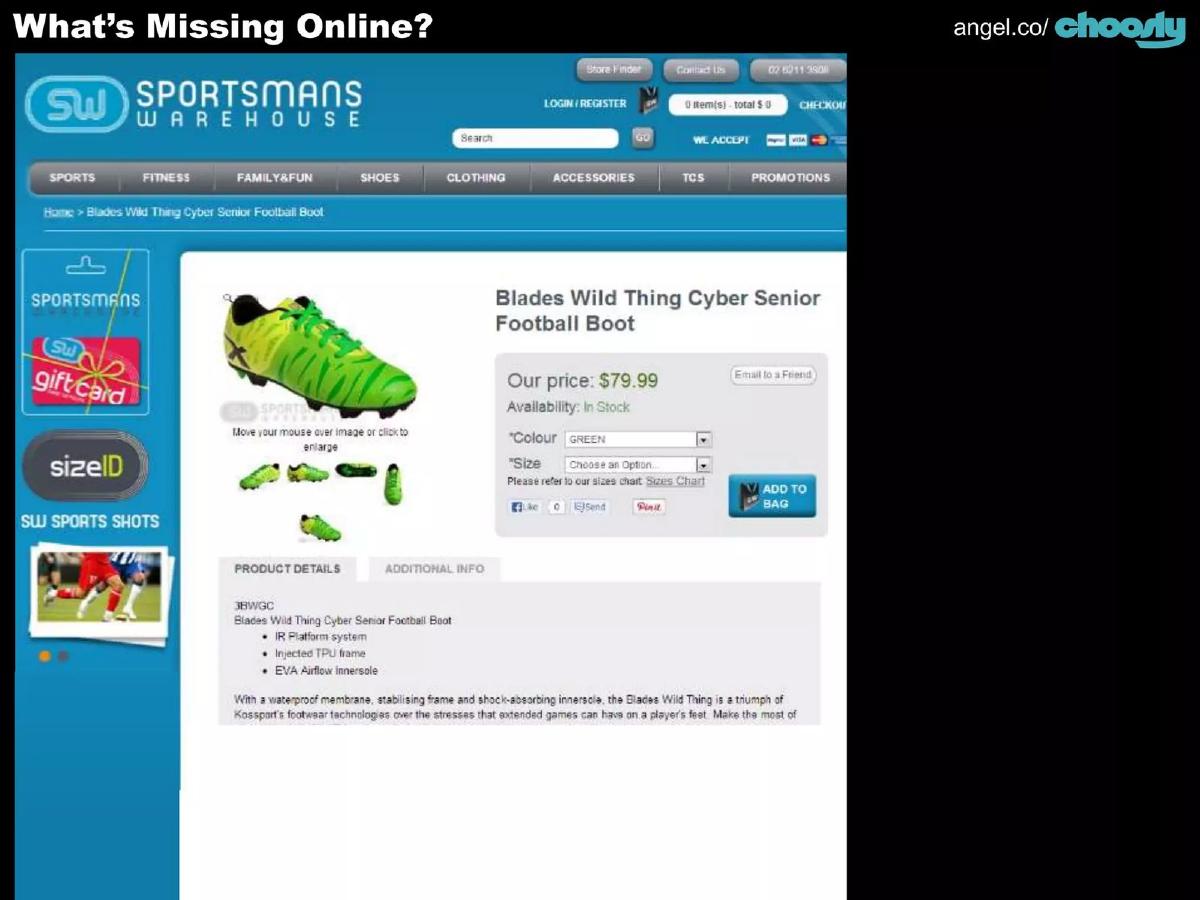
Slide 5: The Problem - What's Missing Online?
Choosly shows a screenshot of a standard e-commerce page for a "Blades Wild Thing Cyber Senior Football Boot" on a site called Sportsmans Warehouse. The page is functional but sterile, lacking any of the 'Brand Power' mentioned in previous slides. This sets the stage for the Choosly solution.
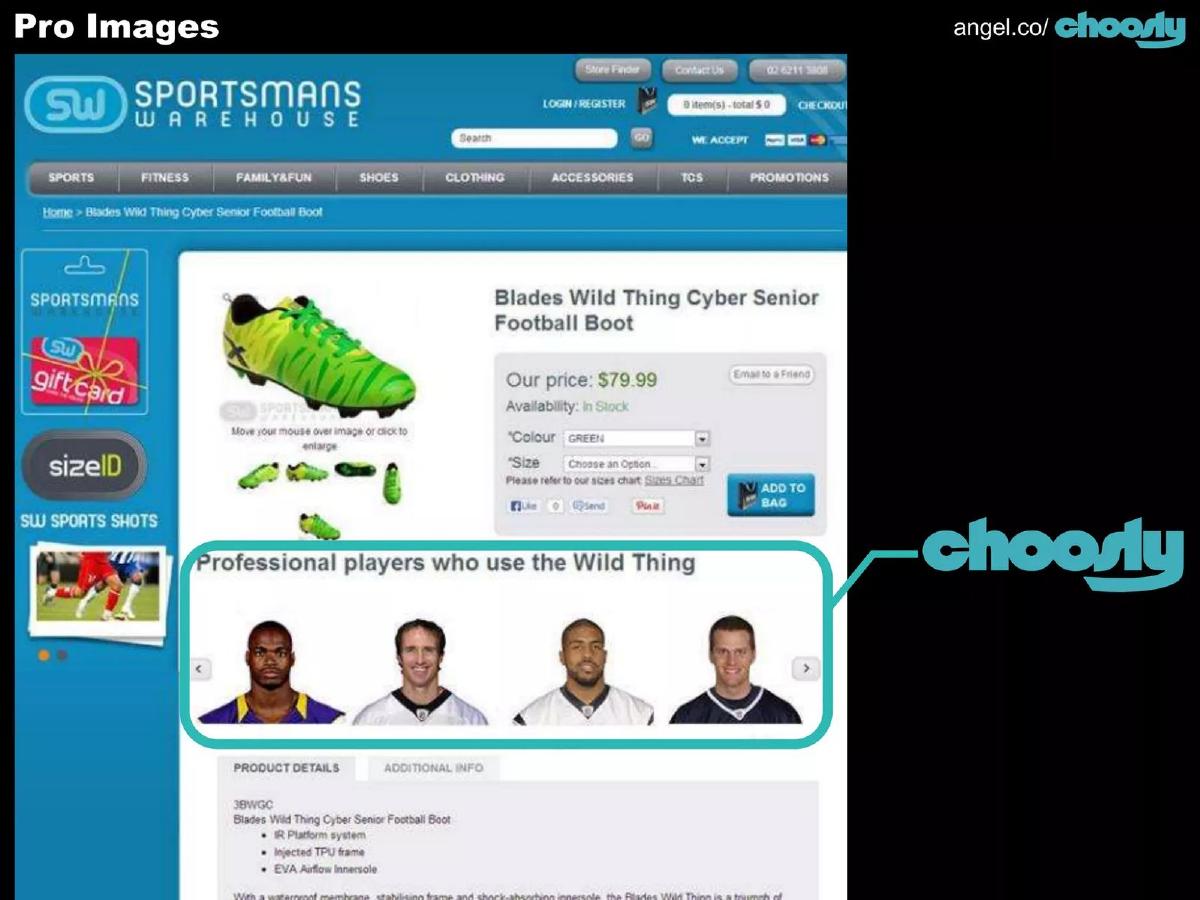
Slides 6, 7, and 8: The Solution - Pro Images, Reviews, and Video
These three slides demonstrate the Choosly product in action via mockups. Slide 6 shows a row of "Professional players who use the Wild Thing." Slide 7 introduces an "Adrian Peterson Product Review" with specific stats for Comfort, Performance, Speed, and Support. Slide 8 adds a video component. The Choosly logo is pointed toward these new elements, clearly defining their contribution to the page layout.
Slide 9: The Value Proposition - Conversion Uplift
This is the 'money slide.' It claims a 100% conversion uplift (indicated by a large upward arrow) and references a $278bn market size citing IBIS World. It also mentions an 11.6% figure, though the specific context for that percentage is not explicitly labeled on the slide, presumably referring to a specific segment of e-commerce growth or current conversion rates.
Slides 10 and 11: Dynamic Content - Brand Power!
These slides show how Choosly can dynamically change content across multiple retailers (Sports Authority, Rebel, Dick's) simultaneously. Slide 10 shows Stuart Appleby "winning today," while Slide 11 shows Phil Mickelson "winning tomorrow." This highlights the platform's ability to keep retail content fresh and relevant based on real-world sports results, a significant pain point for manual web management.
Slide 12: The Ecosystem - Content + Licensing + Product = $$
Choosly outlines its partners and revenue components. It features logos for Adidas, Nike, Callaway, and Spartan, alongside Getty Images and VBM (Velocity Brand Management). This suggests that Choosly acts as the technical bridge between content owners (Getty), brand managers (VBM), and the retailers.
Slides 13 and 14: Distribution and Business Model
Slide 13 introduces the "CPM MODEL" and shows a 55% penetration or target for Australia, with empty bars for the US, Europe, and Asia. Slide 14 expands this to show 100% across all regions, powered by integrations with Shopify and Bigcommerce . This indicates a platform-play strategy where Choosly scales by being an app in a larger ecosystem.
Slide 15: The Team
The team is split into Founders and Advisors. Rory Houston and Lucas T are both former Air Force, bringing operational discipline. David Boyd provides the technical backbone with IBM experience. The advisors are the highlight here, specifically Andrew Bogut (#1 NBA Draft Pick), which gives the company immediate credibility in the sports world they are targeting.
Slide 16: The Ask
Choosly is seeking $600,000 . The slide provides a simple bar chart showing the allocation: the majority goes to Development , followed by Design and Ops . There are no specific dollar amounts for each category, only relative bar sizes.
Slide 17: Contact Slide
The deck concludes with the logo and links to their AngelList (angel.co/choosly) and Gust profiles. No direct email or phone number is provided on the slide.
What Works in the Choosly Deck
Clear Visual Proof: The 'before and after' mockups of the Sportsmans Warehouse site make the product's value immediately obvious to anyone who has shopped online. · Strong Advisor Bench: Having a high-profile athlete like Andrew Bogut as an advisor is a major signal for a sports-tech startup. It suggests the founders have the necessary connections to navigate complex licensing deals. · Specific Niche: Instead of trying to be a general e-commerce tool, Choosly focuses entirely on the 'Athlete-to-Retail' gap, which is a well-defined and lucrative problem.
What is Missing from the Choosly Deck
Unit Economics: While a 'CPM Model' is mentioned, there is no detail on what the CPM is, how much Getty or the athletes take as a cut, or what the margin is for Choosly. · Competitive Landscape: The deck assumes no one else is doing this. In reality, companies like Bazaarvoice or various 'shoppable content' platforms offer similar features. Choosly needs to explain why their sports-specific focus is a moat. · Traction Data: The 100% conversion uplift is a bold claim. Investors would want to see if this was from a live pilot or a theoretical projection. The deck lacks any mention of current revenue or active pilot users. · Technical Implementation: There is no mention of how the data is actually delivered. Is it an iframe? A JS snippet? An API? For a technical product, these details matter for retail adoption.
Founder Takeaways: What to Copy
The 'Side-by-Side' Comparison: If your product improves an existing interface, show them side-by-side. Slides 5 through 8 are the strongest part of the deck because they require zero explanation. · Leverage Industry Icons: If you are in a niche like sports, fashion, or music, your advisor slide is as important as your founder slide. Choosly does this well by highlighting Andrew Bogut's status. · Quantify the 'Lost Opportunity': By citing the $51bn sponsorship spend, Choosly isn't just asking for money; they are pointing out a massive pile of cash that is currently being wasted. This creates urgency.
Frequently asked questions
- What is Choosly's core product?
- Choosly is a content integration platform for e-commerce. It allows retailers to embed professional athlete endorsements—including headshots, performance reviews, and video content—directly onto product pages. The goal is to replicate the 'brand power' seen in physical retail (like cardboard cutouts of athletes) in a digital environment to increase conversion rates.
- How does Choosly plan to make money?
- Slide 13 explicitly mentions a 'CPM MODEL' (Cost Per Mille/Thousand impressions). This suggests Choosly intends to charge retailers or brands based on the number of times their endorsed content is viewed by shoppers on e-commerce sites. The deck also mentions 'Licensing' as part of the revenue equation on Slide 12.
- What evidence of market demand does the deck provide?
- The deck cites a $51.1 billion spend on sports sponsorship rights in 2012 (Slide 3) and a $278 billion total market size via IBIS World (Slide 9). It also uses a case study of Callaway Golf to show how athlete endorsements (Stuart Appleby vs. Phil Mickelson) can be dynamically swapped to drive 'Brand Power' across various retail sites like Dick's Sporting Goods and Rebel (Slides 10-11).
- Who are the key people behind Choosly?
- The founding team consists of Rory Houston (Ex Air Force, Fighter Pilot), Lucas T (Ex Air Force, Supply Chain Expert), and David Boyd (IBM, Portals & Integration). They are supported by advisors Andrew Bogut (NBA player), Bruce Kaider (Sports Market Guru), and James Ashworth (Founder of VBM), providing a blend of technical, military, and sports industry experience.
- What are the major omissions in this pitch deck?
- The deck is missing several critical components for a late-seed or Series A round. There is no slide detailing the competitive landscape, no historical financial performance or traction metrics, and no clear roadmap or timeline for the $600,000 investment. Additionally, the specific mechanics of the 'CPM Model' and how revenue is shared between Choosly, the brands, and the retailers are not explained.