Choreosity is an early-stage mobile application concept aimed at solving the 'nagging' problem in parenting by gamifying household chores. The deck focuses heavily on the user experience, utilizing wireframes to demonstrate a two-sided interface for parents and children (ages 8-16). While the presentation includes a comprehensive Lean Business Canvas and initial survey data from 55 individuals, it lacks critical investor-facing information. There is no mention of a founding team, no specific funding ask, and no detailed financial projections. The deck serves more as a product validation exerc…
Key takeaways
- The product utilizes a dual-interface mobile app where parents set tasks and kids earn points toward long-term rewards (Slide 2).
- Initial hypothesis testing was conducted via 10 in-person interviews and an online survey of 55 individuals (Slide 16).
- Survey data indicates that 84% of parents currently communicate chores verbally and 62% do not reward their children for completion (Slide 17).
- The proposed revenue model includes targeted in-app advertising, premium ad-free sales, and markups on in-app rewards (Slide 14).
- The deck identifies a core customer segment of parents with children aged eight to sixteen (Slide 13).
- A detailed Lean Business Canvas outlines key activities, resources, and cost structures, including software development and cloud infrastructure (Slide 15).
- The deck completely omits a team slide, failing to identify the founders or their relevant expertise.
- There is no financial 'ask' or roadmap indicating how much capital is needed or how it will be deployed.
Choreosity Pitch Deck Analysis
Choreosity is a conceptual mobile application designed to bridge the communication gap between parents and children regarding household responsibilities. The deck is structured as a product validation study, moving from the psychological problem of 'nagging' to a wireframe-heavy solution, and finally to early survey data. However, as a fundraising tool, it leaves significant gaps regarding the team and the specific financial requirements of the business.
Slide 1: Title Slide
The deck opens with the company name, Choreosity , and the tagline: "Because it shouldn't be a chore to get chores done." The visual style is playful, featuring cartoon illustrations of children cleaning, which immediately establishes the family-centric nature of the product.
Slide 2: What is Choreosity?
This slide provides a high-level summary of the product. It defines Choreosity as a "new way for parents to incentive kids" and a mobile app that allows parents to define tasks while kids accumulate points toward "long-term rewards." It explicitly mentions two versions of the app: one for parents to manage and one for kids to view tasks.
Slide 3: The Market
The market slide is largely qualitative. It claims the market for family apps is growing because children have access to mobile media at younger ages. The slide asserts that there are "surprisingly few high-quality mobile apps" in this space. Omission: The deck does not provide a Total Addressable Market (TAM) figure or cite specific industry reports to quantify the opportunity.
Slide 4: The Problem
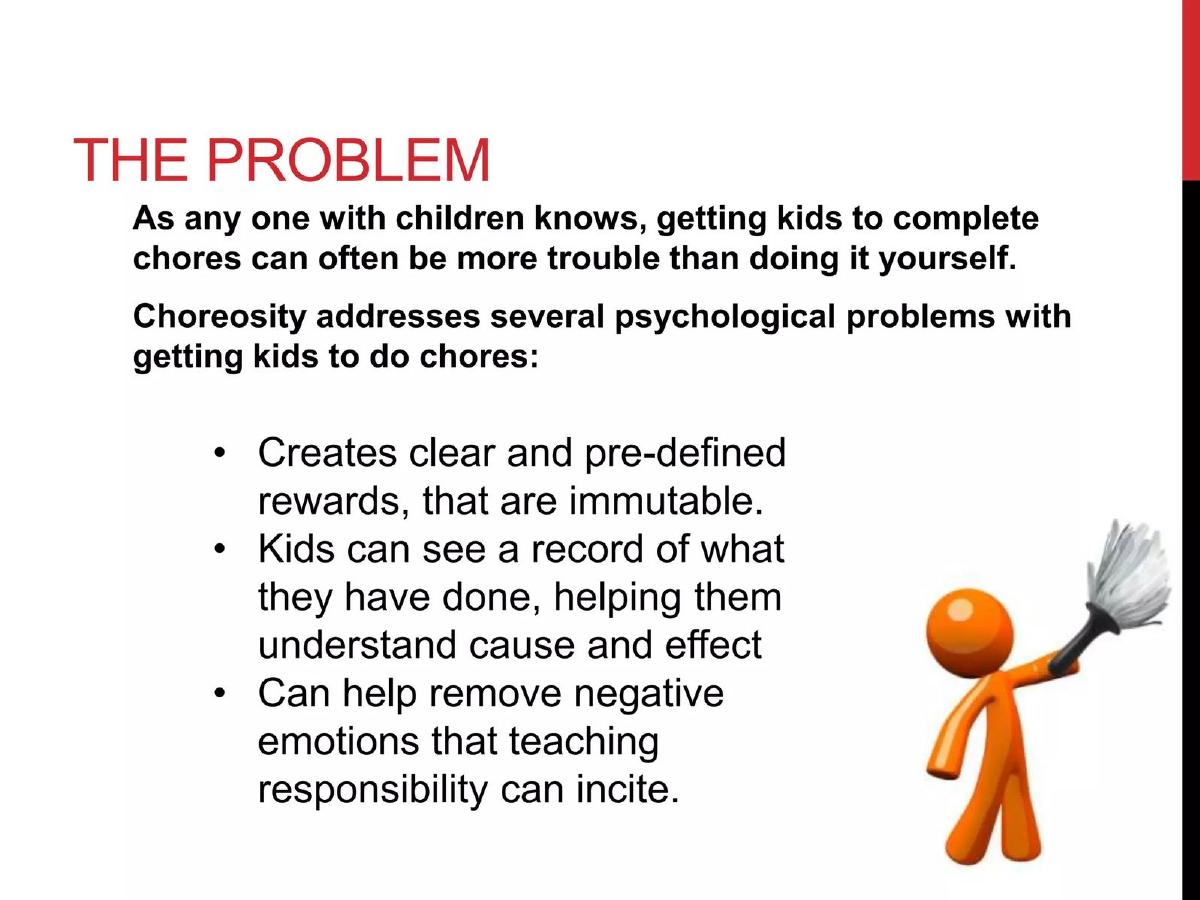
The problem is framed through the lens of parental frustration. It notes that getting kids to do chores is often more work than doing them oneself. The slide lists three psychological benefits of the app: creating immutable rewards, helping kids understand cause and effect through records, and removing negative emotions associated with teaching responsibility.
Slides 5-12: The Solution (Product Walkthrough)
These eight slides function as a product demo using low-fidelity wireframes.
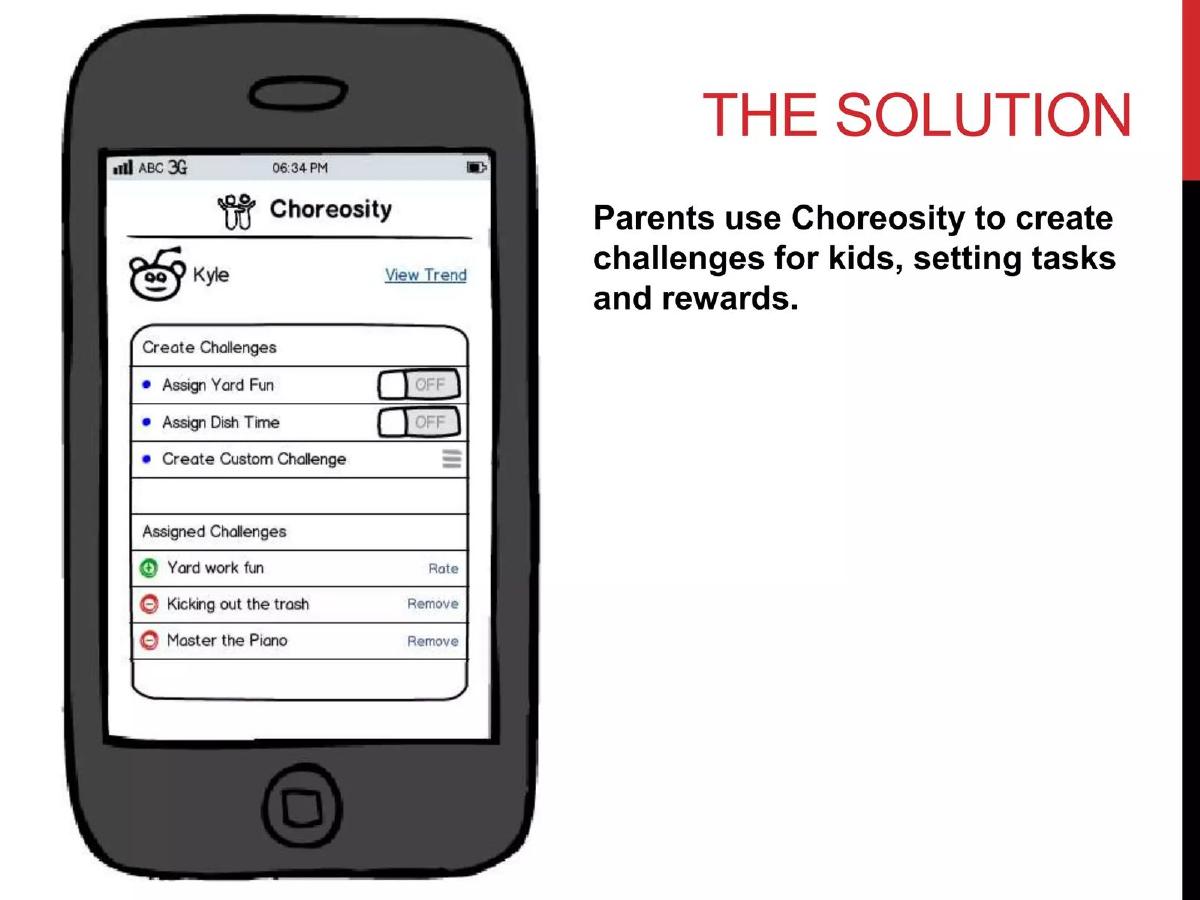
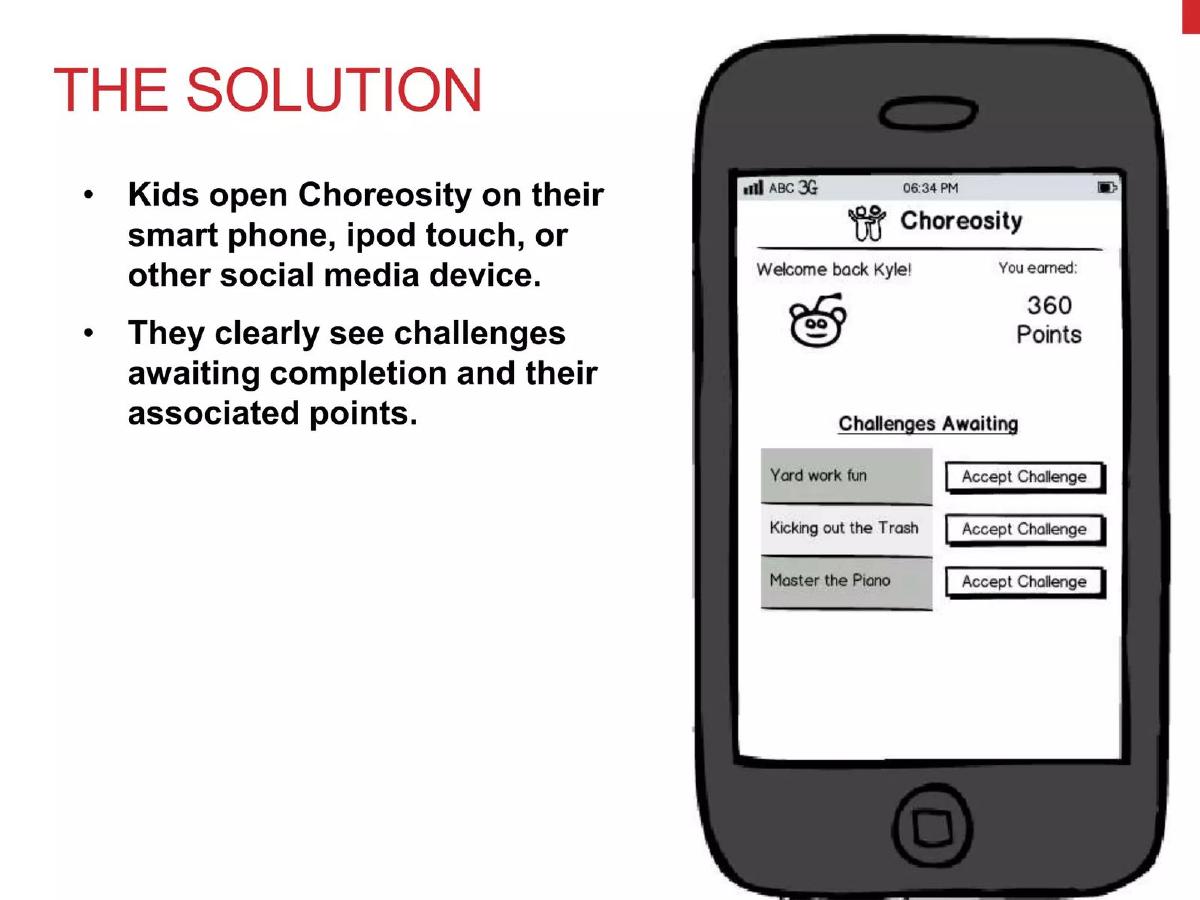
Slide 5: Shows the parent interface for creating challenges like "Yard work fun" or "Master the piano." · Slide 6: Shows the kid interface where they see "Challenges Awaiting" and their current point balance (e.g., 360 points). · Slide 7: Details the verification process where kids must "Include Photo" or "Include Video" to wrap up a challenge. · Slide 8: Shows the parent's approval screen where they can see thumbnails for multiple children (Kyle, Lynn, Tya). · Slide 9: Demonstrates the "Redo!!" vs "Good Job" feedback loop for parents. · Slide 10: Introduces a "Private Community" for parents to share ideas and read articles on parenting. · Slide 11: Shows data visualization for "Kyle's Challenge Trend," providing a record of help around the house. · Slide 12: Summarizes the value propositions, including making chores fun, acting as a "commitment mechanism," and improving parent-child relationships.
Slide 13: Customer Segments
Parents with children aged 8 to 16. · Tweens / Teens. · Caregivers (nannies, babysitters). · Educators (coaches, music teachers).
Slide 14: Revenue Streams
The monetization strategy is diverse. It proposes a freemium model with in-app advertising, a premium ad-free version, and a markup on in-app rewards. It also suggests selling aggregated data to researchers and charging professionals for access to the parent community. Note: Selling data of minors is a highly regulated area that would require significant legal scrutiny, which is not addressed here.
Slide 15: Lean Business Canvas
This slide presents a full Lean Business Canvas. It lists key partners (parent groups, game partners), key activities (market research, software dev), and cost structures (salaries, cloud infrastructure). This is the most detailed business-oriented slide in the deck, though the text is small and difficult to read in a presentation setting.
Slides 16-19: Testing Value Propositions and Key Findings
These slides cover the results of a small-scale survey. Slide 16 states they interviewed 10 people and surveyed 55 others. Slide 17 provides data on current habits: 84% of parents communicate chores verbally, and 62% do not use rewards. Slide 18 lists general tech trends, such as "100% of parents have smartphone" and "77% of children like video games." Slide 19 shows a pie chart where 36% of parents said a mobile app would help, while 33% said no and 31% were unsure.
Slide 20: Conclusion
The deck concludes that based on "limited field testing," the app is "worthy of continued pursuit." This phrasing suggests the project is in the very early ideation or pre-seed phase.
What Choreosity Does Well
The deck excels at defining the user journey. By using eight slides to walk through the interface, the founders make it very clear how the app functions for both the parent and the child. The inclusion of the verification step (photo/video) addresses a common friction point in chore apps: the "did they actually do it?" question. Furthermore, the use of a Lean Business Canvas shows that the founders have thought through the operational requirements of the business beyond just the app interface.
What is Missing from the Choreosity Deck
The most glaring omission is a Team Slide . Investors invest in people, especially at the pre-seed stage, and there is no information about who is building this or why they are qualified to do so. Additionally, there is no Ask . The deck does not state how much money is being raised, what the valuation is, or what milestones the funding will achieve. There is also a lack of Competitive Analysis . The market for chore and allowance apps (like Greenlight or RoosterMoney) is crowded, and the deck fails to explain how Choreosity will compete with established players. Finally, the Financials are non-existent; there are no projections for user growth, customer acquisition costs (CAC), or lifetime value (LTV).
What Founders Should Copy
Founders should emulate the way Choreosity uses Hypothesis Testing . Rather than just asserting that parents want this, they conducted a survey and presented the data—even the data that wasn't overwhelmingly positive (like the 31% of parents who were unsure). This shows a level of intellectual honesty and a data-driven approach. The dual-interface walkthrough is also a strong point; for any two-sided marketplace or multi-user app, showing how both parties interact with the product is essential for clarity.
Frequently asked questions
- What is the core problem Choreosity aims to solve?
- According to Slide 4, Choreosity addresses the psychological friction of getting children to do chores, which 'can often be more trouble than doing it yourself.' It aims to remove negative emotions and 'nagging' by creating a system of clear, immutable rewards and a record of responsibility that helps children understand cause and effect.
- How does the app verify that a chore has actually been completed?
- The solution relies on visual proof. Slide 7 and Slide 8 demonstrate that children must take a photo or video of their completed challenge. This media is then sent to the parent's device, where they can either approve the task as 'satisfactory' or request a redo if the work is insufficient.
- What are the primary revenue streams for the business?
- Slide 14 outlines a multi-pronged monetization strategy: a freemium model with targeted advertising, a premium ad-free version, markups on in-app rewards purchased by parents, the sale of aggregated unidentifiable data, and fees from professionals providing premium content to the parent community.
- What evidence of market demand does the deck provide?
- The deck cites 'Initial Hypothesis Testing' on Slide 16, involving 65 total participants. Slide 19 shows that 36% of surveyed parents said 'Yes' a mobile app would help with chores, while 31% were 'unsure.' It also notes that 80% of parents are open to technology assisting in chore completion.
- Is there a clear competitive analysis in the deck?
- No. Slide 3 mentions that there are 'surprisingly few high-quality mobile apps that have successfully captured this market,' but it does not list any specific competitors, nor does it provide a feature-comparison matrix to show how Choreosity differs from existing chore-tracking or allowance apps.