How consumer startups present the solution in a pitch deck: show what the person does, answer the problem slide point by point, and say what changes for them.
Consumer Solution Slide: Real Pitch Deck Examples
Eight solution slides from consumer startups, shown in full, compare how each shows what a person actually does with the product, whether it answers the problem slide before it, and what changes for the customer afterwards.
TL;DR
A consumer solution slide should show the person using the product, answer each point on the problem slide, and say what is better for them afterwards. Choreosity puts the parent's screen on the slide: "Parents use Choreosity to create challenges for kids, setting tasks and rewards." HousePouch answers overwhelming furniture choice with three steps, ending in adding products to a "virtual room" before buying. Bauz Razors names the change for the user: no more "tapping the blade in the sink." Lifestyler says its app helps "the worlds population reach their desired goals", which describes no user and no moment of use.
Consumer solution slides from real pitch decks
Each example shows the exact stored slide above its analysis and links to the full teardown. Claims are as shown on the slides; we have not verified them.
Choreosity solution slide — slide 5
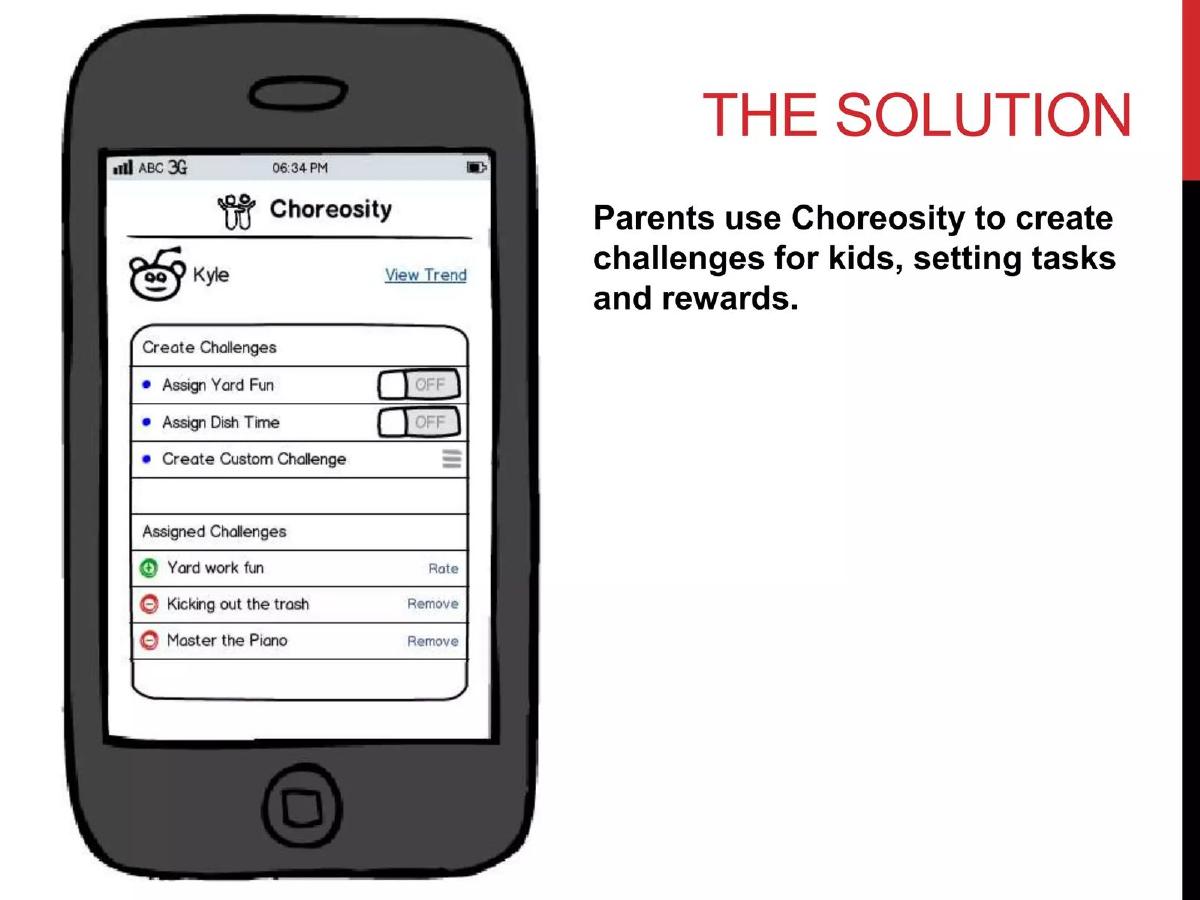
A chore-reward app for families. A sketched phone screen and one sentence.
Choreosity deck, slide 5. Exact stored slide matched to this analysis.
Our analysis: One user, one action, one screen. The investor sees exactly what a parent does.
Evidence and limitation: A product mock-up; no usage figures.
What a founder can adapt: Show one screen and one sentence of the form "[person] uses [product] to [action]."
Supporting analysis
What the deck claims: "Parents use Choreosity to create challenges for kids, setting tasks and rewards." The screen shows "Create Challenges" ("Assign Yard Fun", "Assign Dish Time", "Create Custom Challenge") and "Assigned Challenges" ("Yard work fun", "Kicking out the trash", "Master the Piano"). The next slide shows the child's side.
Presentation choice: It answers the problem slide's "more trouble than doing it yourself" with a task a parent can set in seconds.
When it does not fit: Say what changes for the parent, such as fewer arguments or chores done without reminders.
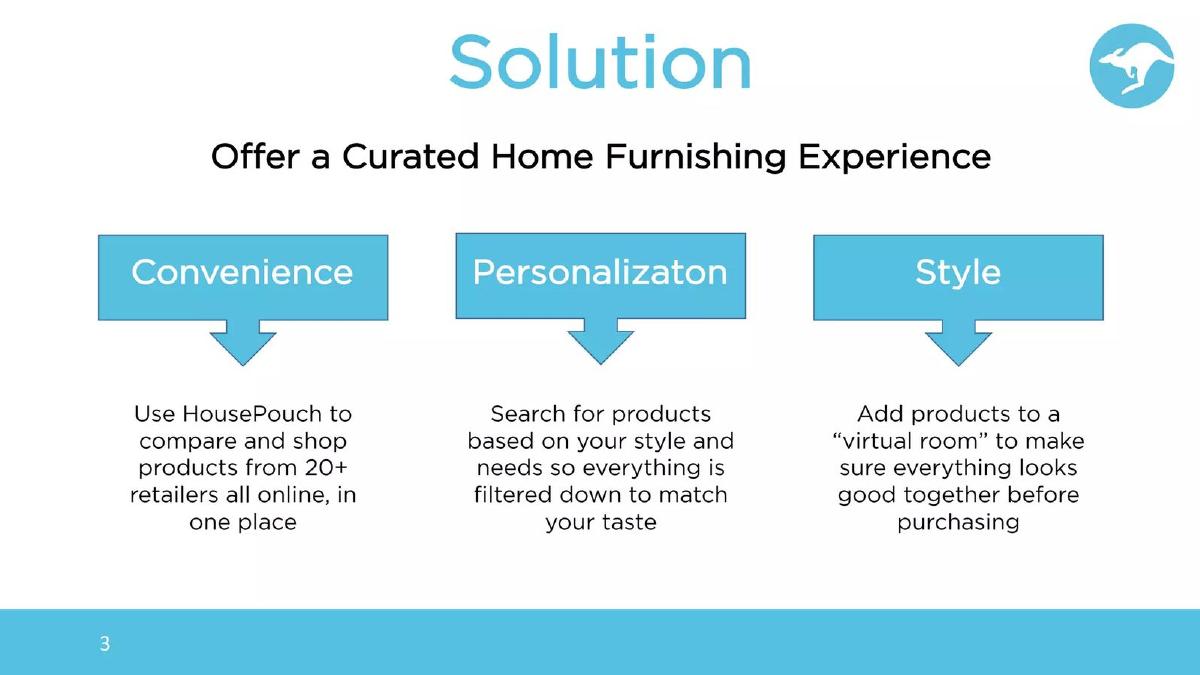
Online furniture shopping. Three boxes, each with one line.
HousePouch deck, slide 3. Exact stored slide matched to this analysis.
Our analysis: Each box is an action the shopper takes, and together they follow the order of a purchase.
Evidence and limitation: 20+ retailers; no usage figures.
What a founder can adapt: Write each benefit as something the customer does, in the order they would do it.
Supporting analysis
What the deck claims: "Offer a Curated Home Furnishing Experience." "Convenience: Use HousePouch to compare and shop products from 20+ retailers all online, in one place." "Personalizaton: Search for products based on your style and needs so everything is filtered down to match your taste." "Style: Add products to a 'virtual room' to make sure everything looks good together before purchasing."
Presentation choice: The "virtual room" line answers a worry every furniture buyer has: will it look right together?
When it does not fit: Replace the headline adjectives ("Convenience", "Style") with the problem each step removes, and fix the typo in "Personalizaton".
A razor that can be cleaned without tapping it on the sink. One long paragraph.
Bauz Razors deck, slide 4. Exact stored slide matched to this analysis.
Our analysis: It names a habit the user will drop (tapping the blade) and three results: easier, faster, cheaper.
Evidence and limitation: A description of the mechanism; no test results or photos.
What a founder can adapt: Name the habit your product removes.
Supporting analysis
What the deck claims: "A razor blade that allows water to easily flow and rinse without compromising effectiveness of the shave. I have invented a function that allows the user to temporarily adjust the position of the blade to allow effective cleaning." "There will not be a need for tapping the blade in the sink, this also contributes to a cleaner shave since the blade is not in contact with bacteria from the sink. My product will make the ritual of shaving easier, faster, and save the consumer money."
Presentation choice: "Tapping the blade in the sink" is a moment almost every shaver recognises.
When it does not fit: Show the razor or a diagram instead of a paragraph, and put a number on "save the consumer money".
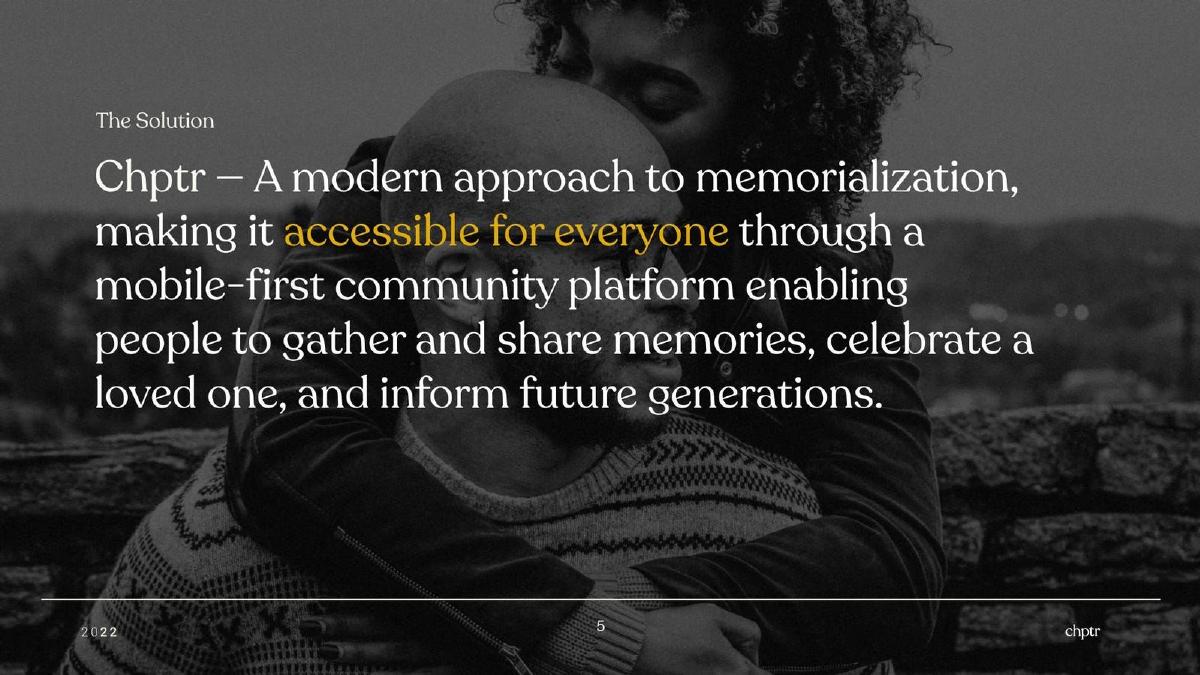
Chptr deck, slide 6. Exact stored slide matched to this analysis.
Our analysis: It answers two of the problem slide's four failings: "Rigid" (people can share memories) and "Expensive" (accessible for everyone).
Evidence and limitation: No figures.
What a founder can adapt: Reply to each failing on your problem slide in the same order.
Supporting analysis
What the deck claims: "Chptr — A modern approach to memorialization, making it accessible for everyone through a mobile-first community platform enabling people to gather and share memories, celebrate a loved one, and inform future generations."
Presentation choice: The verbs (gather, share, celebrate) describe what a grieving family would do.
When it does not fit: Answer "Temporary" and "$300–$500 per obituary" directly: how long a memorial lasts and what it costs. "Modern" and "platform" add nothing a family would notice.
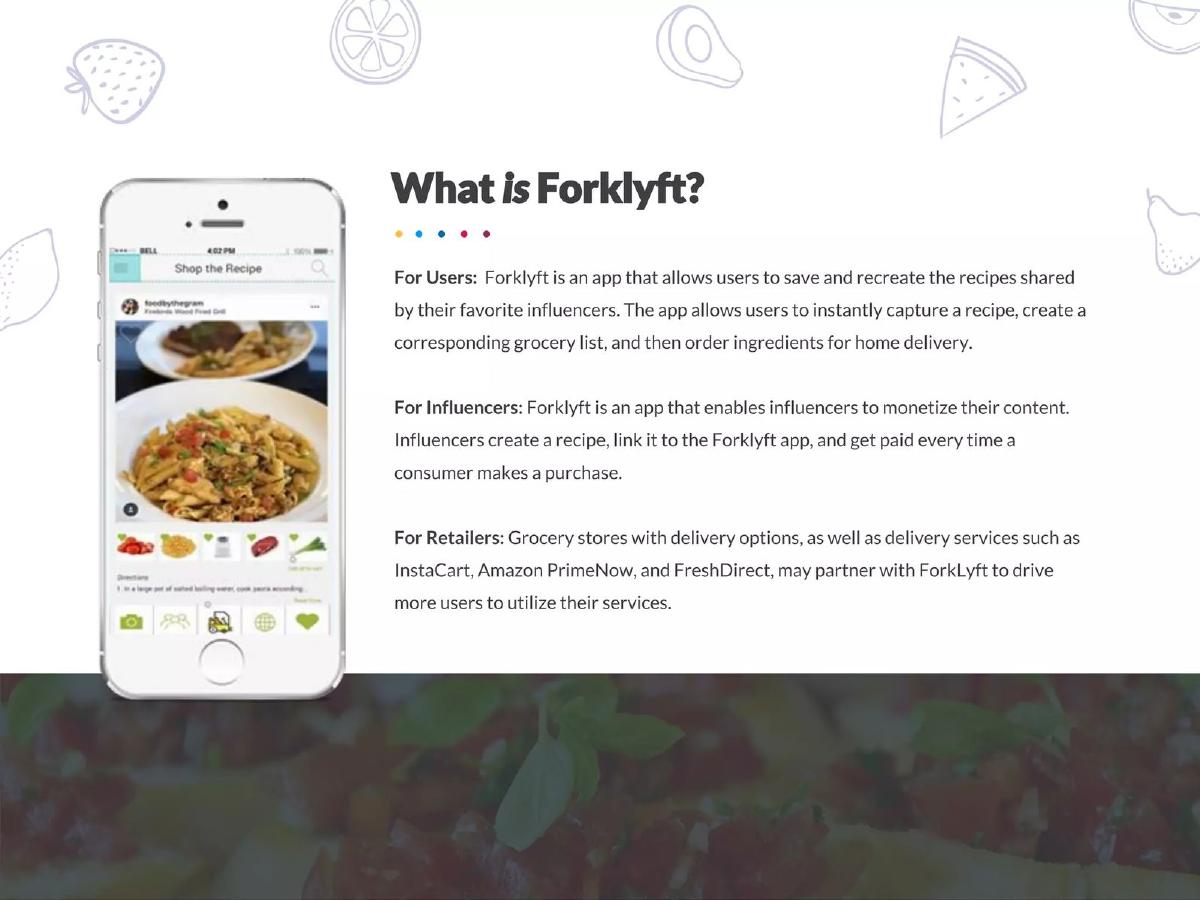
Shoppable recipes from food bloggers. A phone screen and three paragraphs, one per side.
Forklyft deck, slide 5. Exact stored slide matched to this analysis.
Our analysis: The user paragraph is a clear sequence: capture, list, order. It answers the problem slide's gap between saving a recipe and cooking it.
Evidence and limitation: No figures. Retailer partnerships are described as possible ("may partner").
What a founder can adapt: Describe the consumer's path as three verbs.
Supporting analysis
What the deck claims: "For Users: Forklyft is an app that allows users to save and recreate the recipes shared by their favorite influencers. The app allows users to instantly capture a recipe, create a corresponding grocery list, and then order ingredients for home delivery." "For Influencers: Forklyft is an app that enables influencers to monetize their content… and get paid every time a consumer makes a purchase." "For Retailers: Grocery stores with delivery options, as well as delivery services such as InstaCart, Amazon PrimeNow, and FreshDirect, may partner with Forklyft."
Presentation choice: The screen shows a recipe with its ingredients, the step the problem slide said was missing.
When it does not fit: Keep influencers and retailers for the business model slide; three audiences on one slide dilute the consumer story.
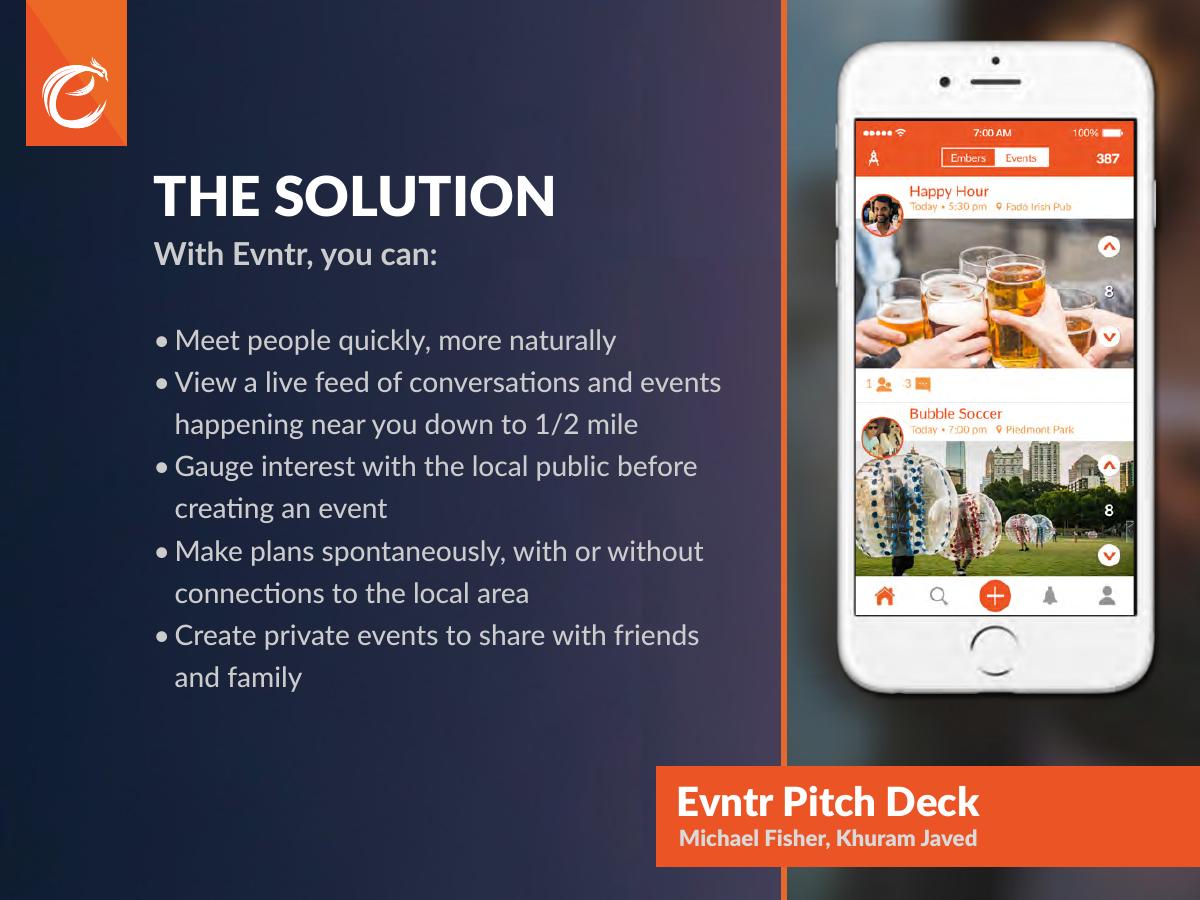
A local events app. Five things you can do, beside a phone showing nearby events.
Evntr deck, slide 5. Exact stored slide matched to this analysis.
Our analysis: Each line starts from what the user can do, and "down to 1/2 mile" makes the idea concrete.
Evidence and limitation: A product screen; no usage figures.
What a founder can adapt: Write benefits as "you can…" lines and add one specific detail such as distance or time.
Supporting analysis
What the deck claims: "With Evntr, you can: Meet people quickly, more naturally; View a live feed of conversations and events happening near you down to 1/2 mile; Gauge interest with the local public before creating an event; Make plans spontaneously, with or without connections to the local area; Create private events to share with friends and family."
Presentation choice: The screen ("Happy Hour", "Bubble Soccer") shows real-looking events rather than a logo.
When it does not fit: Five lines is too many; keep the two that answer the problem slide (loneliness and awkward alternatives).
Plant-based baked goods. A product photo and five labelled benefits.
Sun Flour Baking deck, slide 6. Exact stored slide matched to this analysis.
Our analysis: For a physical product, the photo is the solution; the labels answer what a buyer checks on a packet.
Evidence and limitation: Ingredient claims; the sugar is described as patented without a patent reference.
What a founder can adapt: Show the product and list the attributes buyers compare on the shelf.
Supporting analysis
What the deck claims: "Healthier and delicious plant-based products: cookies, cakes, muffins, brownies, truffles, macaroons, and more." "Vegan and gluten-free: an alternative for a wide range of customers: the curious, the vegans, or requiring a specific diet for medical reasons." "No contaminants: free of cholesterol, hormones, pesticides, and antibiotics." "Healthy sugar: use a patented sugar made from grape juice and brown rice syrup." "A longer shelf life: use all-natural ingredients, no eggs, dairy, or GMOs."
Presentation choice: A consumer product slide that shows the product and its label claims is read in seconds.
When it does not fit: Pick one buyer (people on medical diets, for example) rather than "a wide range of customers", and show one number against today's products.
Fitness planning software. A weaker example, included on purpose: a numbered feature list with no user or screen.
Lifestyler deck, slide 3. Exact stored slide matched to this analysis.
Our analysis: Point 4 (software makes trainer-quality plans affordable) is the real answer to the problem slide, but it comes last.
Evidence and limitation: No figures, prices or screens.
What a founder can adapt: Lead with point 4 and a price against a personal trainer.
Supporting analysis
What the deck claims: "To solve the aforementioned issues we have created the Lifestyler app. Our app has several features that help the worlds population reach their desired goals." "1. Personal trainer and nutritionist quality plans. Highly individual. Highly detailed. 2. Wide range of goals. From fat loss to muscular size… 3. Various levels of use available, from logs to fully generated plans. 4. All aspects of the plan are generated with software, making them affordable to everyone."
Presentation choice: It shows how a feature list written for "the worlds population" leaves the investor unable to picture a user.
When it does not fit: Show one plan on a screen for one named user instead of four abstract features.
Whether each slide shows the product in use, answers its own problem slide, and states what changes for the customer.
Example
Product in use
Answers the problem slide
What changes for the person
Choreosity
Yes (parent's screen)
Yes (setting chores)
No
HousePouch
Partly (three steps, no screen)
Yes (choice, taste, fit)
Partly (looks right before buying)
Bauz Razors
No (text only)
Yes (tapping the blade)
Yes (easier, faster, cheaper)
Chptr
No (photo)
Partly (two of four failings)
Partly (share memories)
Forklyft
Yes (recipe screen)
Yes (save to cook)
Partly (ingredients delivered)
Evntr
Yes (events feed)
Partly (five lines)
Partly (meet people)
Sun Flour Baking
Yes (product photo)
Yes (label claims)
No
Lifestyler
No
Buried (point 4)
No
Key Takeaways
Show the product in the customer's hands: a screen, a step or the object itself.
Answer the problem slide point by point, in the same words.
State what changes for the person afterwards: time saved, money saved, a worry gone.
If there are several sides (users, creators, retailers), lead with the consumer and move the rest to the business model slide.
Replace adjectives such as "modern" and "seamless" with what the person does.
Build your consumer solution slide
One line per part, answering your own problem slide.
Person and action. Who uses it, and what do they do with it? One sentence.
Show it. Which screen, photo or step shows that action best?
Answer. For each point on your problem slide, what is the reply?
Change. What is better for the person afterwards, in time, money or worry?
Copyable framework: [Person] uses [product] to [action]. Instead of [today's workaround], they [new behaviour], which [what changes, with a number].
Illustrative example 1 — written by us
Before: An innovative all-in-one platform that revolutionises pet care for everyone.
After: City dog owners book a vetted walker in two taps. Instead of asking around in neighbourhood chat groups, they see reviews and a fixed price, saving about 3 hours a month.
What improved: Our illustrative rewrite; figures are invented for the example. It names a person, an action, today's workaround and what changes.
What this guide adds
The general solution slide guide covers presenting a product in any business. Consumers don't evaluate a product through a pilot or a procurement review; they judge it in seconds from what they would do with it. This guide compares how consumer decks show that.
It pairs with the consumer problem slide guide. Three companies appear in both, so you can read each problem slide next to the solution slide that follows it: Chptr, Forklyft and Choreosity.
Three parts of a consumer solution
Use: what the person does, ideally shown (Choreosity, Evntr, HousePouch).
Answer: each point from the problem slide gets a reply (HousePouch, Bauz Razors, Sun Flour Baking).
Change: what is better for the person afterwards (Bauz Razors, Chptr).
Strong slides cover all three. Most real slides cover one or two.
Common mistakes
Adjectives instead of actions. "Modern", "seamless" and "curated" don't show what the person does.
Too many audiences. Lead with the consumer; creators and retailers belong on the business model slide.
Problem left unanswered. Each point on the problem slide should get a reply.
No picture of the product. Show a screen, the object or a step.
No change stated. Say what is better for the person afterwards.
Diagnostic checklist
One sentence says who uses the product and what they do.
A screen, photo or diagram shows the product in use.
Each point on the problem slide gets a reply.
It says what changes for the person, with a number if possible.
Other audiences are moved to later slides.
Frequently asked questions
How we chose these examples
Corpus: published pitch deck teardowns on StartupFundraising.com. Founder-uploaded private decks are excluded.
Selection (2026-09-25): we searched extracted text of slides 2–6 for slides beginning with "solution" in decks whose recorded sector is consumer, food and beverage, fashion, beauty, pets, travel, fitness, social or e-commerce, and read the slides following each problem slide in the consumer problem guide. About forty candidates were read; business-facing, marketplace and image-only slides were set aside. One strong candidate was set aside because the slide is marked confidential. Lifestyler is kept as a weaker contrast.
Overlap check: none of these eight slides appears in another guide. Chptr, Forklyft, Choreosity and Lifestyler appear in the consumer problem guide with their problem slides (different slide numbers). HomeHub and HelloBello, already used in the general solution guide, were not reused.
Review: all eight stored slide images were inspected on 2026-09-25 and matched to company, deck and slide number (editorial model review). No person has yet completed an editorial review of this page.
Claims are as shown on the slides; we have not verified them. We make no claim that any slide caused a fundraising outcome.