How to show customer surveys and discovery research in a pitch deck: your own research vs borrowed statistics, sample size, and willingness to pay vs interest.
Customer Survey Slide: Real Pitch Deck Examples
Eleven real slides that use surveys and customer research, shown in full, compare how founders present what customers told them, and which versions investors can rely on.
TL;DR
Survey results persuade investors when they come from your own target customers, state how many people answered, and measure willingness to pay or behaviour rather than general interest. In the examples below, Brightbox gives a sample (2,000+ shoppers) and pairs it with a named customer quote; Hampr turns a survey into a price ("$50 a week") and cites the research firm. Industry surveys (Empion's BCG figure, Vaayu's 6,000-consumer study) set context but say nothing about your product. The weakest show a chart with no sample size or question (Blossom Protein) or a small sample stated as a problem (Job Well Done, 85 people). State who you asked, how many, what you asked, and what they did next.
Customer survey slides from real pitch decks
Each example shows the exact stored slide above its analysis and links to the full teardown. Survey figures are as shown on the slides; we have not seen the underlying surveys or verified the results. Stage and year are given only where the slide or deck states them.
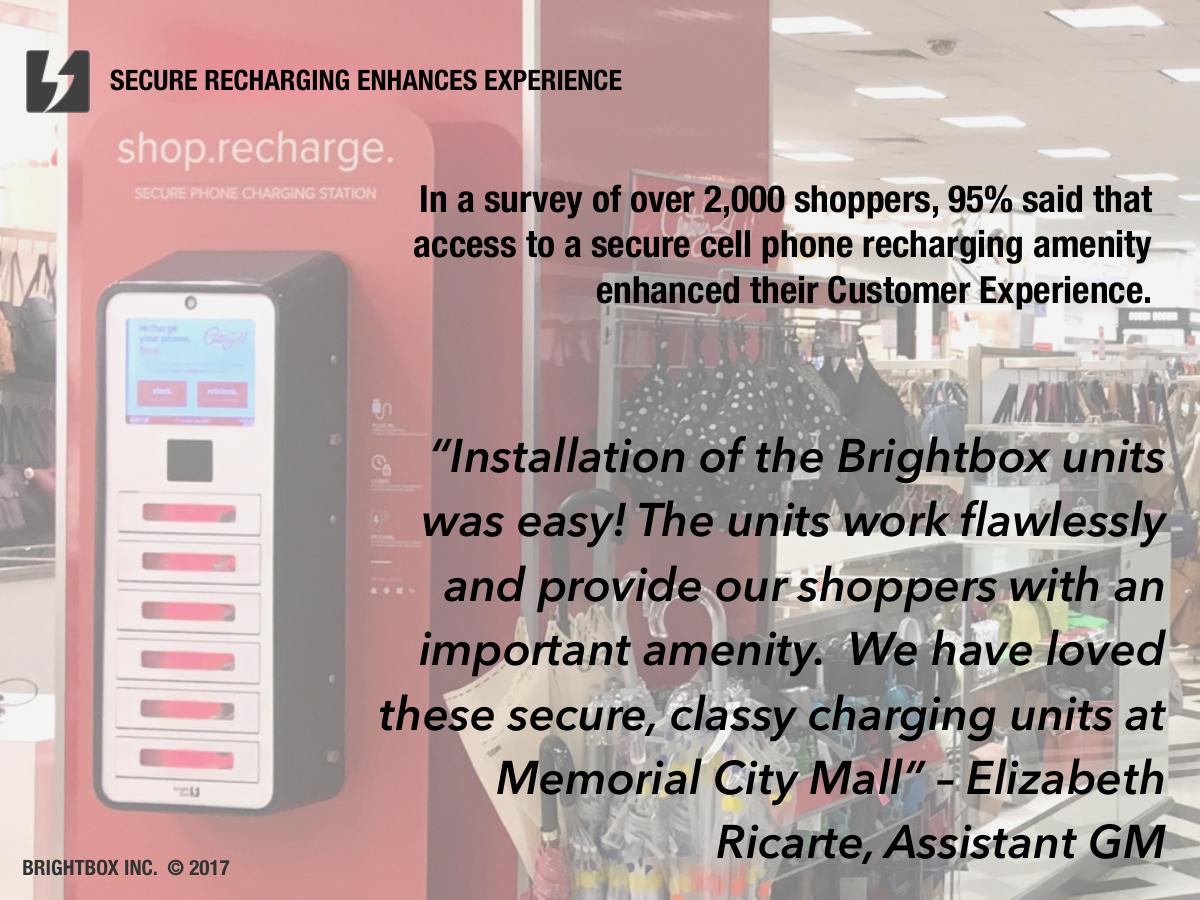
Brightbox customer research slide — slide 4
Phone charging stations for shopping venues. The slide carries a 2017 copyright; stage is not stated.
Brightbox deck, slide 4. Exact stored slide matched to this analysis.
Our analysis: The sample size is stated and the respondents are the end users; the quote comes from the buyer (a mall), so the slide covers both people who matter.
Evidence and limitation: The slide doesn't say who ran the survey or where, and "enhanced their experience" is a soft measure. Add whether shoppers stayed longer or spent more.
What a founder can adapt: Show one survey result from end users next to a named quote from the paying customer.
Supporting analysis
What the deck claims: "Secure recharging enhances experience": "In a survey of over 2,000 shoppers, 95% said that access to a secure cell phone recharging amenity enhanced their Customer Experience." A quote: "Installation of the Brightbox units was easy! The units work flawlessly and provide our shoppers with an important amenity. We have loved these secure, classy charging units at Memorial City Mall" – Elizabeth Ricarte, Assistant GM. A photo of a unit in a store.
Presentation choice: The sample size is stated and the respondents are the end users; the quote comes from the buyer (a mall), so the slide covers both people who matter.
When it does not fit: The slide doesn't say who ran the survey or where, and "enhanced their experience" is a soft measure. Add whether shoppers stayed longer or spent more.
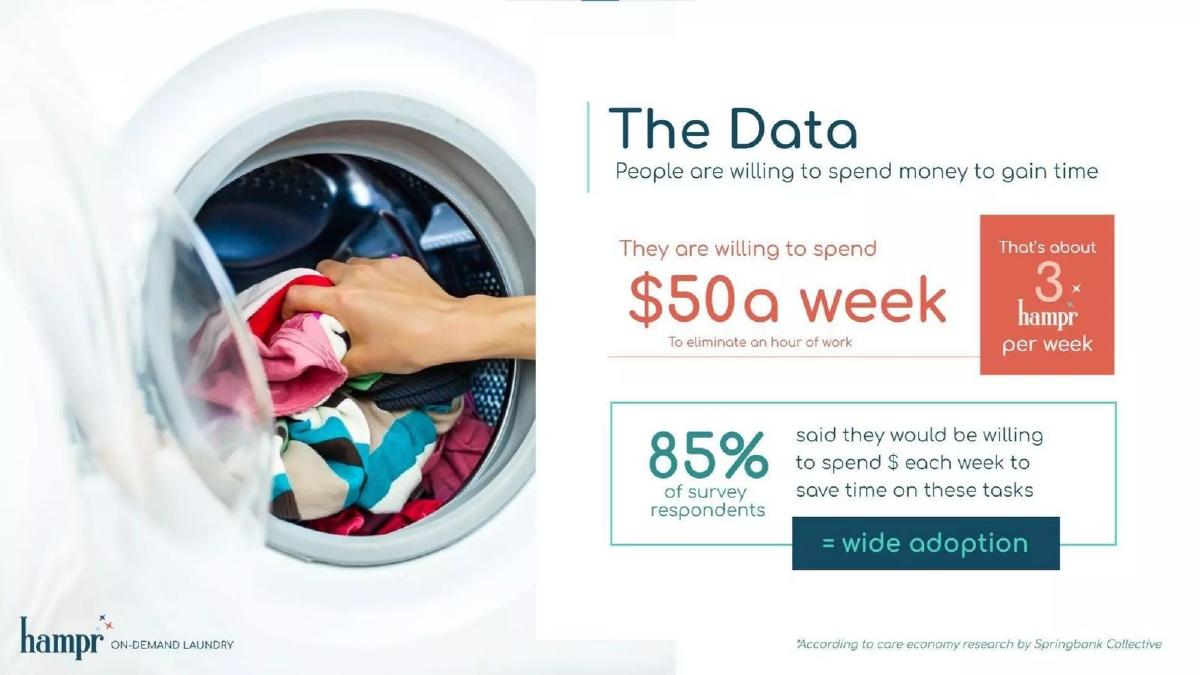
On-demand laundry service. Stage and year are not stated on the slide.
Hampr deck, slide 4. Exact stored slide matched to this analysis.
Our analysis: It asks about money, not interest, and converts the answer into the company's own unit (three Hampr orders a week). The source is named.
Evidence and limitation: The survey is third-party research about time-saving in general, not Hampr's customers, and "= wide adoption" overstates what a stated intention shows. Add your own conversion from a first order.
What a founder can adapt: Translate a willingness-to-pay finding into how many of your orders or subscriptions it equals.
Supporting analysis
What the deck claims: "The Data — People are willing to spend money to gain time." "They are willing to spend $50 a week to eliminate an hour of work"; "That's about 3x hampr per week". "85% of survey respondents said they would be willing to spend $ each week to save time on these tasks = wide adoption". Footnote: "According to core economy research by Springbank Collective".
Presentation choice: It asks about money, not interest, and converts the answer into the company's own unit (three Hampr orders a week). The source is named.
When it does not fit: The survey is third-party research about time-saving in general, not Hampr's customers, and "= wide adoption" overstates what a stated intention shows. Add your own conversion from a first order.
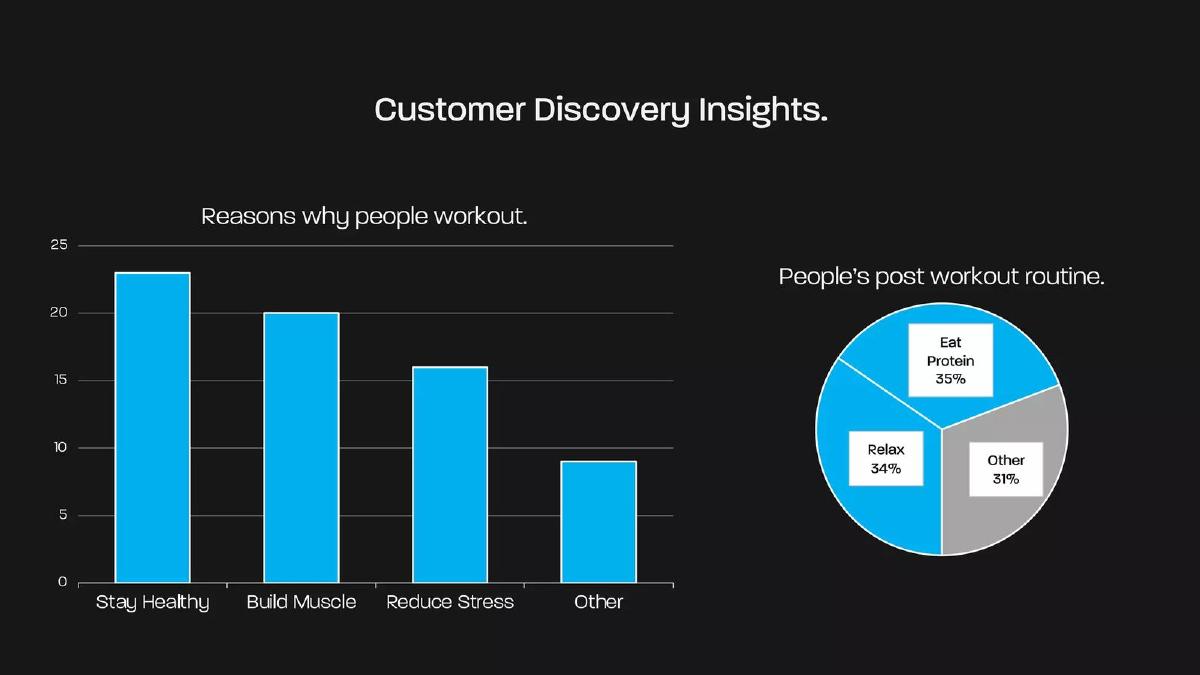
Protein product for people who exercise. Stage and year are not stated on the slide.
Blossom Protein deck, slide 3. Exact stored slide matched to this analysis.
Our analysis: Doing customer discovery early and showing it is a good habit, and "eat protein" as a top post-workout behaviour is relevant to the product.
Evidence and limitation: No sample size, question wording or respondent type is given, and the bar chart has no axis label. Add "n = …, [who], [date]" and drop the chart that doesn't lead to a purchase decision.
What a founder can adapt: Treat this as a slide to improve on. Keep one chart that ties directly to what you sell.
Supporting analysis
What the deck claims: "Customer Discovery Insights." A bar chart, "Reasons why people workout" (stay healthy, build muscle, reduce stress, other), and a pie chart, "People's post workout routine" (eat protein 35%, relax 34%, other 31%).
Presentation choice: Doing customer discovery early and showing it is a good habit, and "eat protein" as a top post-workout behaviour is relevant to the product.
When it does not fit: No sample size, question wording or respondent type is given, and the bar chart has no axis label. Add "n = …, [who], [date]" and drop the chart that doesn't lead to a purchase decision.
Game that helps parents get children to do household tasks. Stage and year are not stated on the slide.
Job Well Done deck, slide 2. Exact stored slide matched to this analysis.
Our analysis: It states the sample size plainly, which lets investors weigh the result.
Evidence and limitation: The question confirms a problem most parents would agree with. Ask what they have tried, what they pay for today, or whether they'd join a waitlist, and report that.
What a founder can adapt: Treat this as a slide to improve on. Keep the stated sample size.
Supporting analysis
What the deck claims: "The problem": "85 people…" "68% of respondents said getting kids to do household tasks is a problem." A pie chart of the split.
Presentation choice: It states the sample size plainly, which lets investors weigh the result.
When it does not fit: The question confirms a problem most parents would agree with. Ask what they have tried, what they pay for today, or whether they'd join a waitlist, and report that.
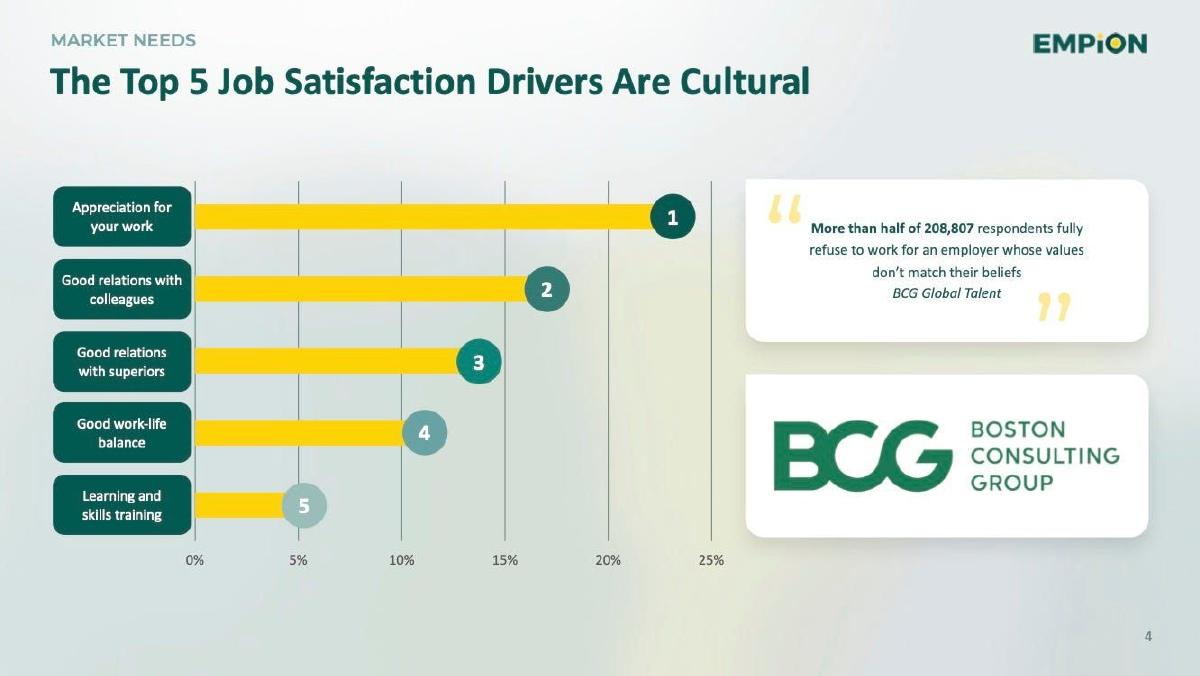
Culture-based hiring platform in Germany. Stage and year are not stated on the slide.
Empion deck, slide 4. Exact stored slide matched to this analysis.
Our analysis: A very large, named third-party survey makes a credible case that culture matters to job seekers, which is Empion's premise.
Evidence and limitation: It says nothing about whether employers will pay Empion to act on it. Follow with your own evidence from employers.
What a founder can adapt: Use a named industry survey to establish the need, and cite it precisely.
Supporting analysis
What the deck claims: "Market Needs — The Top 5 Job Satisfaction Drivers Are Cultural": a ranked bar chart (appreciation for your work, good relations with colleagues, good relations with superiors, work-life balance, learning and skills training). A quote: "More than half of 208,807 respondents fully refuse to work for an employer whose values don't match their beliefs", attributed to BCG Global Talent, with the BCG logo.
Presentation choice: A very large, named third-party survey makes a credible case that culture matters to job seekers, which is Empion's premise.
When it does not fit: It says nothing about whether employers will pay Empion to act on it. Follow with your own evidence from employers.
Carbon tracking software for retailers. Stage and year are not stated on the slide.
Vaayu deck, slide 4. Exact stored slide matched to this analysis.
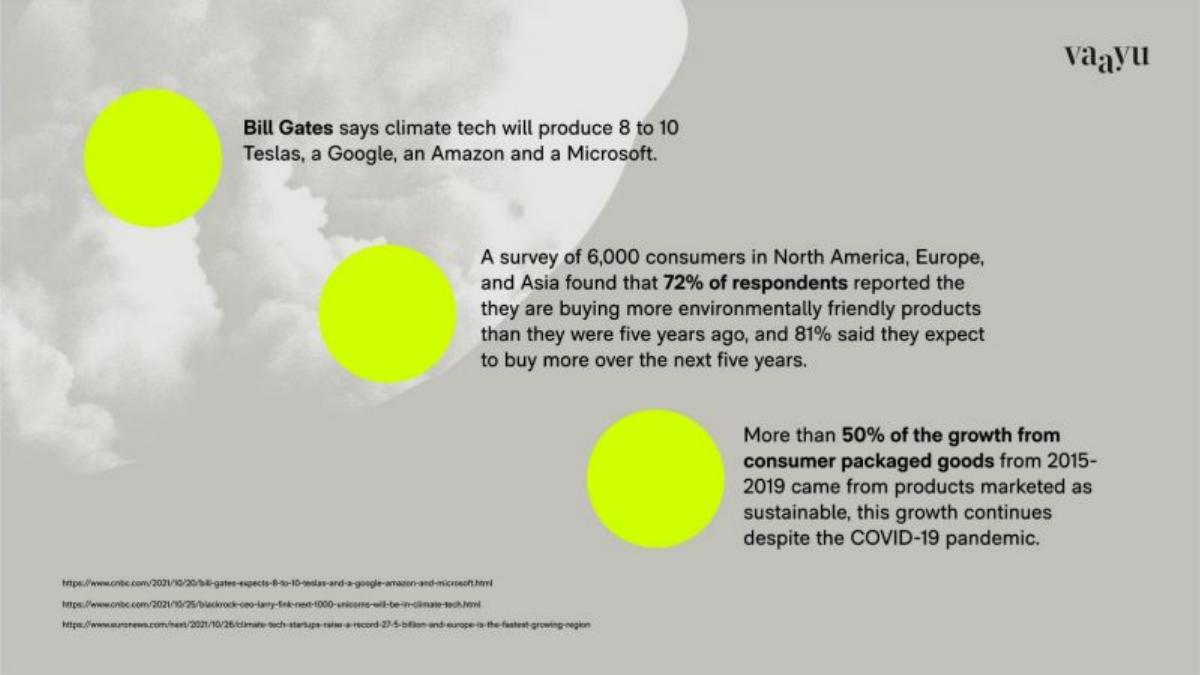
Our analysis: The sources are printed on the slide, and the consumer survey gives sample size and regions.
Evidence and limitation: The survey is about consumers, but Vaayu sells to retailers; the Bill Gates quote is an opinion, not evidence. Replace it with research from retailers about measuring emissions.
What a founder can adapt: Print sources on the slide when you use third-party figures.
Supporting analysis
What the deck claims: Three points: "Bill Gates says climate tech will produce 8 to 10 Teslas, a Google, an Amazon and a Microsoft." "A survey of 6,000 consumers in North America, Europe, and Asia found that 72% of respondents reported that they are buying more environmentally friendly products than they were five years ago, and 81% said they expect to buy more over the next five years." "More than 50% of the growth from consumer packaged goods from 2015–2019 came from products marketed as sustainable." Source links at the foot of the slide.
Presentation choice: The sources are printed on the slide, and the consumer survey gives sample size and regions.
When it does not fit: The survey is about consumers, but Vaayu sells to retailers; the Bill Gates quote is an opinion, not evidence. Replace it with research from retailers about measuring emissions.
Indonesian news content start-up. Stage and year are not stated on the slide.
Bicara Berita deck, slide 5. Exact stored slide matched to this analysis.
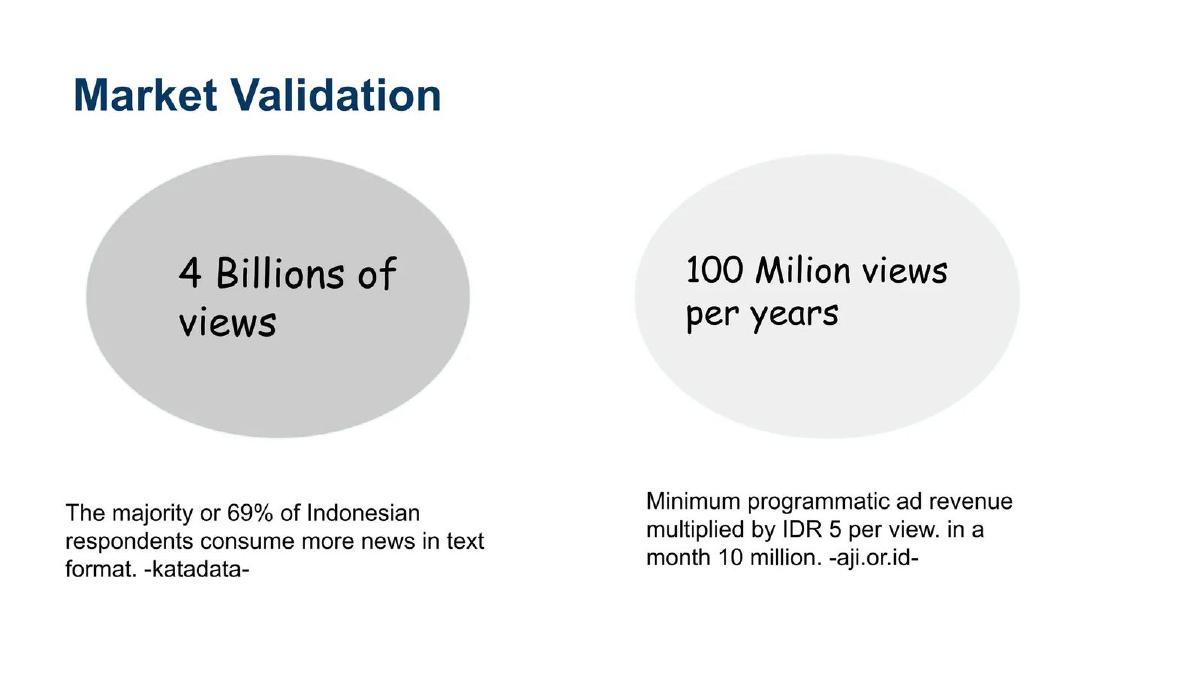
Our analysis: The sources are named for each figure.
Evidence and limitation: "Market validation" here is a third-party statistic and view counts that aren't clearly the company's own. Say whose views they are, and add research with your own readers.
What a founder can adapt: Treat this as a slide to improve on. Keep the source next to each number.
Supporting analysis
What the deck claims: "Market Validation": "4 Billions of views" and "100 Milion views per years". "The majority or 69% of Indonesian respondents consume more news in text format. -katadata-" "Minimum programmatic ad revenue multiplied by IDR 5 per view. in a month 10 million. -aji.or.id-"
Presentation choice: The sources are named for each figure.
When it does not fit: "Market validation" here is a third-party statistic and view counts that aren't clearly the company's own. Say whose views they are, and add research with your own readers.
Platform where gamers stake money on their own matches. Stage and year are not stated on the slide.
Stakester deck, slide 8. Exact stored slide matched to this analysis.
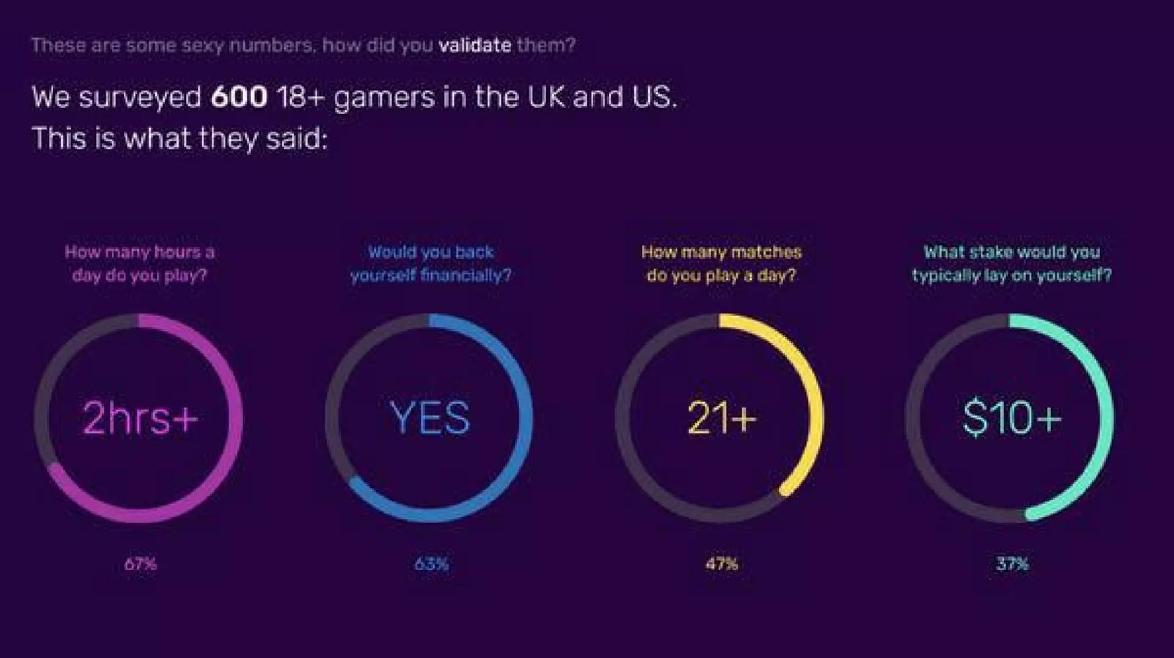
Our analysis: It anticipates the investor's question, states sample, age and countries, prints every question word for word, and one question asks for a money amount, which is the closest a survey gets to a purchase.
Evidence and limitation: The answer bands (2hrs+, 21+, $10+) were chosen by the company and the other answers aren't shown, so investors can't see the full spread. How respondents were recruited isn't stated. Show the full distribution, as K-Zen does below.
What a founder can adapt: Print the exact question above each result and include at least one question that asks for a price or stake.
Supporting analysis
What the deck claims: Header: "These are some sexy numbers, how did you validate them?" Then: "We surveyed 600 18+ gamers in the UK and US. This is what they said:" Four questions, each printed above a ring chart: "How many hours a day do you play?" (2hrs+, 67%); "Would you back yourself financially?" (YES, 63%); "How many matches do you play a day?" (21+, 47%); "What stake would you typically lay on yourself?" ($10+, 37%).
Presentation choice: It anticipates the investor's question, states sample, age and countries, prints every question word for word, and one question asks for a money amount, which is the closest a survey gets to a purchase.
When it does not fit: The answer bands (2hrs+, 21+, $10+) were chosen by the company and the other answers aren't shown, so investors can't see the full spread. How respondents were recruited isn't stated. Show the full distribution, as K-Zen does below.
Cannabis-infused drinks. The slide footer reads "K-Zen Beverages | Overview | Oct 2018" (printed page 14); the company was a private, venture-backed startup.
K-Zen deck, slide 15. Exact stored slide matched to this analysis.
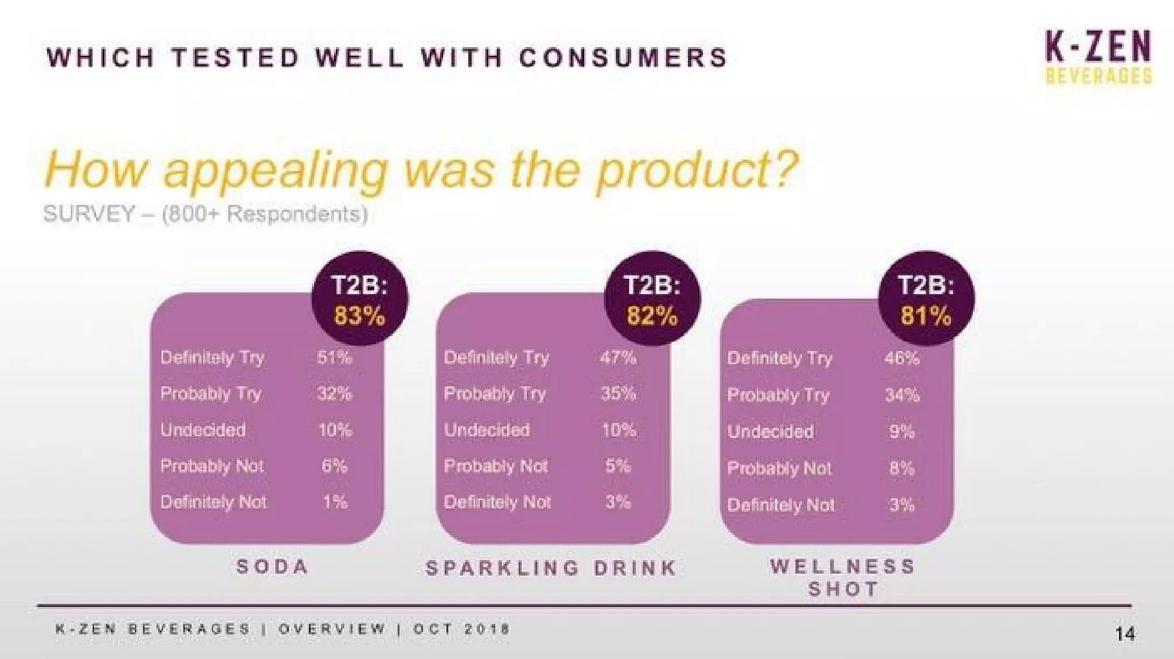
Our analysis: It shows the whole answer scale, not just the flattering share, and uses a standard concept-test measure (top two box) investors from consumer goods recognise. Testing three formats side by side turns the survey into a product decision.
Evidence and limitation: "Would try" is still stated intent, and who the 800+ respondents were (age, state, current cannabis users or not) isn't given. The three scores are within two points, so the slide doesn't say which format the company picked or why.
What a founder can adapt: Show the full answer scale and use the survey to choose between options, not just to prove interest.
Supporting analysis
What the deck claims: "Which tested well with consumers. How appealing was the product? Survey – (800+ Respondents)". Three product formats, each with a full five-point answer scale and a top-two-box (T2B) score: Soda – Definitely try 51%, Probably try 32%, Undecided 10%, Probably not 6%, Definitely not 1% (T2B 83%); Sparkling drink – 47/35/10/5/3 (T2B 82%); Wellness shot – 46/34/9/8/3 (T2B 81%).
Presentation choice: It shows the whole answer scale, not just the flattering share, and uses a standard concept-test measure (top two box) investors from consumer goods recognise. Testing three formats side by side turns the survey into a product decision.
When it does not fit: "Would try" is still stated intent, and who the 800+ respondents were (age, state, current cannabis users or not) isn't given. The three scores are within two points, so the slide doesn't say which format the company picked or why.
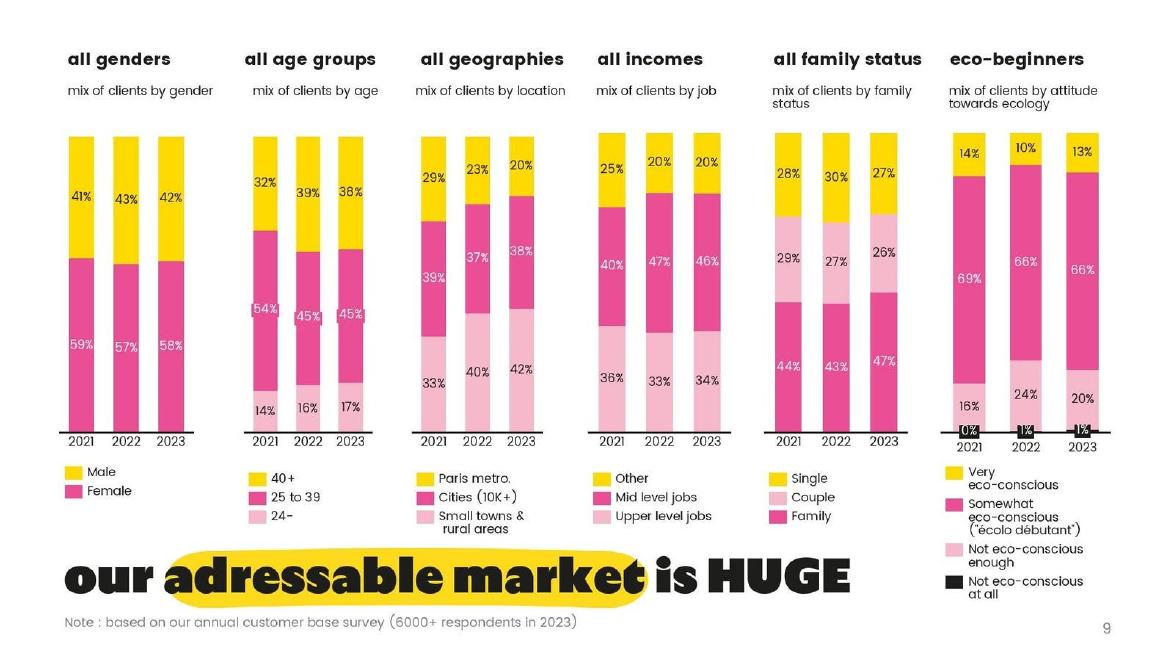
Refillable personal-care products in France. Survey data covers 2021–2023.
900 Care deck, slide 9. Exact stored slide matched to this analysis.
Our analysis: This is the company's own research with its own buyers, the sample is large and stated, and repeating it every year shows the customer base shifting (small towns and rural areas rise from 33% to 42%).
Evidence and limitation: A profile of existing customers shows who already buys, not how big the market is, so the headline claims more than the charts show. Pair it with a market-size calculation built from these segments.
What a founder can adapt: If you survey customers regularly, show the same questions across years so investors see the trend.
Supporting analysis
What the deck claims: Six stacked bar charts of the client mix for 2021, 2022 and 2023: gender (female 59%, 57%, 58%), age, location (Paris metro, cities 10K+, small towns and rural areas), job level, family status and attitude to ecology ("somewhat eco-conscious ('écolo débutant')" 69%, 66%, 66%). Headline: "our adressable market is HUGE". Note: "based on our annual customer base survey (6000+ respondents in 2023)".
Presentation choice: This is the company's own research with its own buyers, the sample is large and stated, and repeating it every year shows the customer base shifting (small towns and rural areas rise from 33% to 42%).
When it does not fit: A profile of existing customers shows who already buys, not how big the market is, so the headline claims more than the charts show. Pair it with a market-size calculation built from these segments.
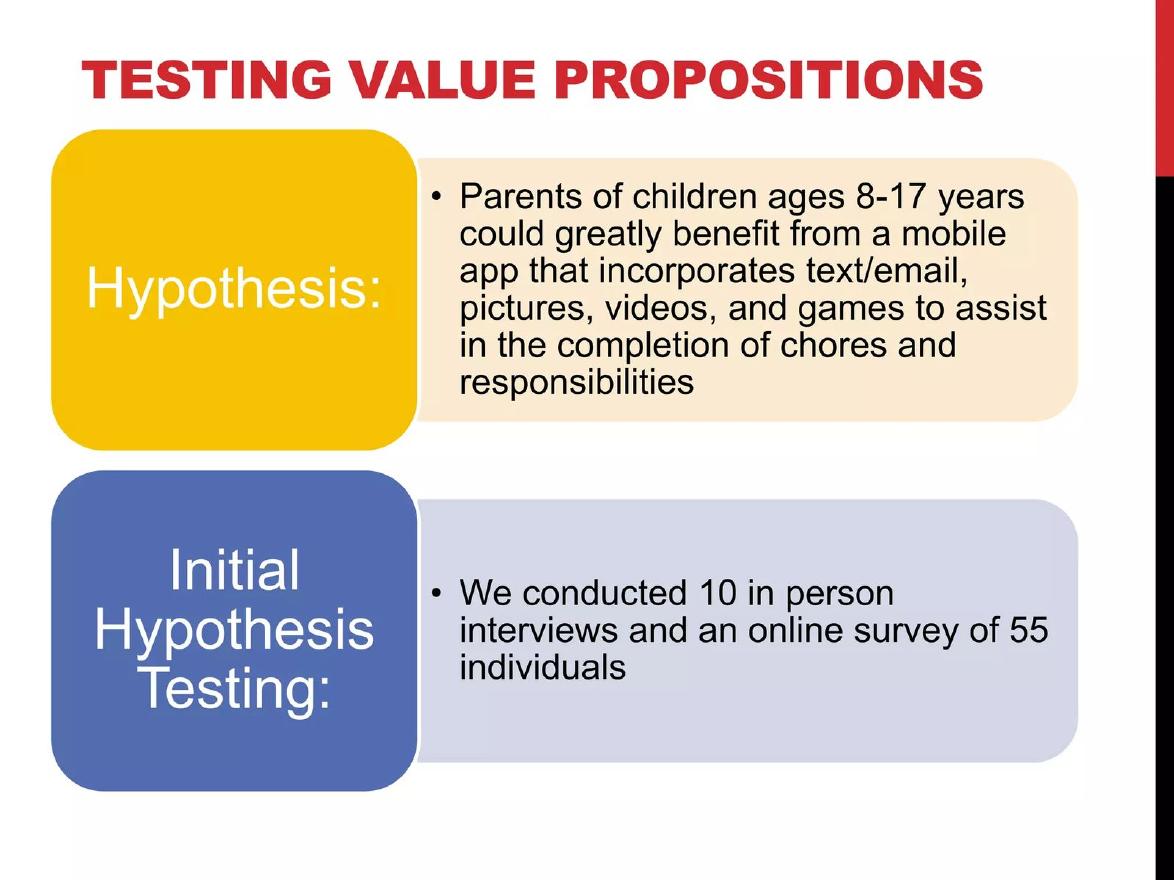
Mobile app to help parents get children to do chores. Stage and year are not stated on the slide.
Choreosity deck, slide 16. Exact stored slide matched to this analysis.
Our analysis: It writes the hypothesis down before the evidence and states both research methods and their sizes, which is the honest starting point for early discovery.
Evidence and limitation: No results appear on this page, so the slide shows that research happened but not what it found. Add the one finding that confirmed or changed the hypothesis, ideally a price or sign-up answer.
What a founder can adapt: Treat this as a slide to improve on. Keep the stated hypothesis and method.
Supporting analysis
What the deck claims: "Testing value propositions." "Hypothesis: Parents of children ages 8-17 years could greatly benefit from a mobile app that incorporates text/email, pictures, videos, and games to assist in the completion of chores and responsibilities." "Initial hypothesis testing: We conducted 10 in person interviews and an online survey of 55 individuals."
Presentation choice: It writes the hypothesis down before the evidence and states both research methods and their sizes, which is the honest starting point for early discovery.
When it does not fit: No results appear on this page, so the slide shows that research happened but not what it found. Add the one finding that confirmed or changed the hypothesis, ideally a price or sign-up answer.
The more columns you can fill with "yes", the more an investor can rely on the result.
Example
Own research?
Sample stated
Asks about paying or behaviour
Source named
Brightbox
Appears so
2,000+
No (experience)
No
Hampr
No (third-party)
No
Yes ($50/week)
Yes
Blossom Protein
Yes
No
Behaviour
Not needed
Job Well Done
Yes
85
No (problem)
Not needed
Empion
No (BCG)
208,807
No (attitude)
Yes
Vaayu
No
6,000
Behaviour (self-reported)
Yes, links
Bicara Berita
No
No
Behaviour
Yes
Stakester
Yes
600
Yes ($10+ stake)
Not needed
K-Zen
Yes
800+
Intent (would try)
Not needed
900 Care
Yes
6,000+
No (profile)
Not needed
Choreosity
Yes
10 + 55
No results shown
Not needed
Key Takeaways
Say how many people you asked. Brightbox's "over 2,000 shoppers" can be judged; Blossom Protein's chart can't.
Ask about paying, not liking. Hampr reports a spending figure and the share willing to pay, not just interest in laundry help.
Separate your research from other people's. Empion and Vaayu cite large third-party surveys; they support the market, not the product.
Pair numbers with a named voice. Brightbox adds a quote from a named mall manager next to its survey result.
Small samples are fine early if you're honest about them. Job Well Done states 85 respondents; the next step is showing what they did after answering.
Build your customer survey slide
Fill in each line before putting a survey number on a slide.
Who. Who answered: target buyers, users, or the general public?
How many. How many answered, and how did you find them?
Question. What exactly did you ask? Does it involve a price or commitment?
Result. What share said yes, and what did they do next (sign up, pay, join a waitlist)?
Source. If it's third-party research, who ran it and when?
Copyable framework: We asked [n] [target customers] recruited via [channel] in [month/year]: "[question]". [X]% said [answer]; [Y] of them then [signed up / paid / joined a waitlist]. Industry context: [third-party figure] ([source, year]).
Illustrative example 1 — written by us
Before: 68% of respondents said this is a problem.
After: We asked 85 parents of 6–12-year-olds via school groups (March): "Would you pay £4/month for an app that gets chores done?" 41% said yes; 22 joined the waitlist.
What improved: Our illustrative rewrite, not any company's text; the figures are invented for the example. It states who, how many, a price question and a follow-up action.
Where survey evidence fits in a deck
Customer research usually appears on the problem slide (proving the pain), a dedicated validation slide before traction exists, or the market slide (proving demand). The problem slide guide covers how to frame the pain; the pre-revenue traction guide covers pilots, waitlists and letters of intent. This guide covers only how to present survey and interview evidence so investors can judge it.
Investors discount survey results because saying yes costs nothing. The more a question resembles a purchase decision (a price, a commitment, a sign-up), the more weight it carries.
Common mistakes
No sample size. Always state n.
Asking whether it's a problem. Ask about paying or switching.
Borrowed research as validation. Label third-party data as market context.
Wrong respondents. Survey the people who will pay.
Stopping at stated intent. Show what respondents did next.
Diagnostic checklist
Sample size and respondent type are stated.
The question wording is shown or summarised.
At least one question involves a price or commitment.
Third-party figures are labelled with source and year.
A follow-up action (sign-up, payment) is reported if available.
Frequently asked questions
How we chose these examples
Corpus: published pitch deck teardowns on StartupFundraising.com. Founder-uploaded private decks are excluded.
Selection (2026-09-24): we searched extracted text of slides 2–6 for survey and interview language ("we surveyed", "survey of", "respondents", "customer interviews", "customer discovery") and found about 25 slides. We excluded clinical case data (Aridis), passing mentions (Intercom, Merge, Localize and others), a slide mainly about the solution (Digitzs, which also appears in the roadmap guide) and slides where the survey was a minor element. Seven remain.
Overlap check: the problem slide guide covers framing the pain; the pre-revenue traction guide covers pilots, waitlists and letters of intent; the testimonial guide covers named customer quotes. This guide covers only how survey and interview evidence is presented.
Review: all seven stored slide images were inspected on 2026-09-24 and matched to company, deck and slide number (editorial model review). No person has yet completed an editorial review of this page.
Update (2026-10-01): we searched the full extracted corpus for survey language beyond slides 2–6 and added four slides (Stakester p8, K-Zen p15, 900 Care p9, Choreosity p16), each checked against the original deck page image (AI editorial model review, not human). K-Zen Beverages was a private venture-backed company (seed round May 2019; never publicly listed), so its October 2018 deck is eligible. Plantt and ChangeForCause were not used because their deck files are not in the library.
Survey results are as reported on the slides; we have not seen the underlying surveys. We make no claim that any slide caused a fundraising outcome.