Blossom Protein presents a 14-slide deck (7 provided for review) centered on the 'Melo Shake,' a CBD-infused protein beverage designed to aid muscle building and stress reduction. The deck relies heavily on third-party market data from Statista to validate a $10 billion combined market opportunity, yet it sets a conservative market capture goal of just 0.01%. Financially, the company projects a path to profitability by Year 2, reaching $875,000 in revenue by Year 3. While the deck outlines a clear D2C marketing strategy and specific pricing tiers, it suffers from significant omissions: there…
Key takeaways
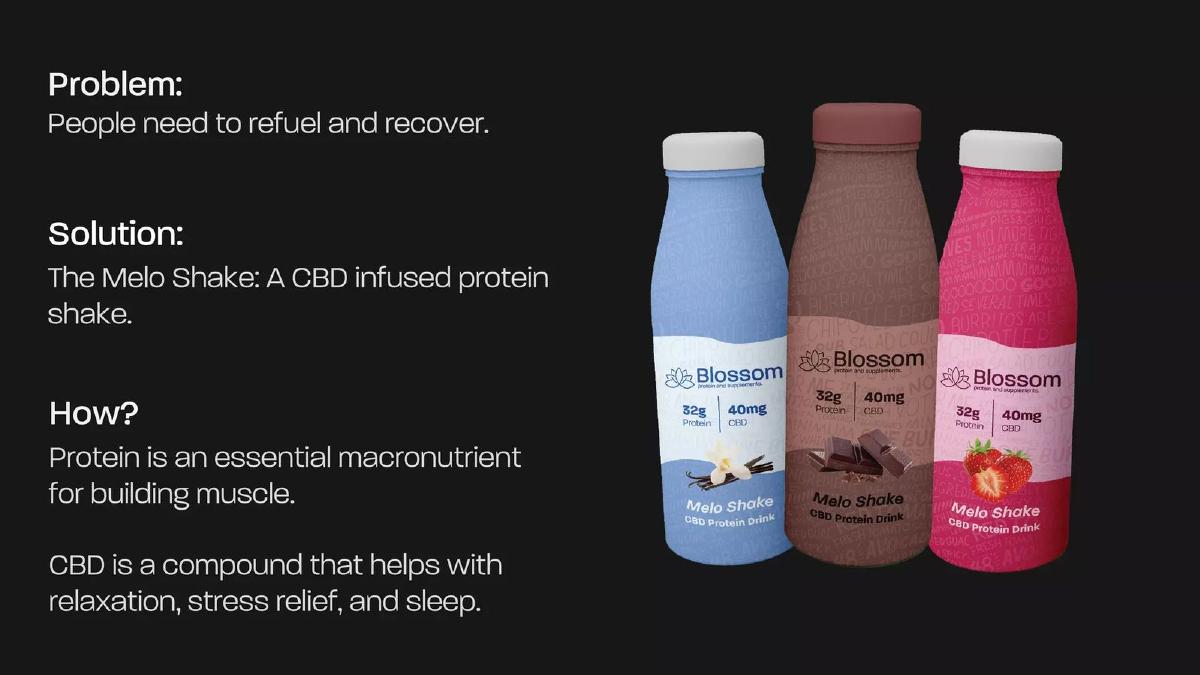
- The company identifies a dual-purpose product benefit: muscle building and stress reduction through CBD infusion (Slide 7).
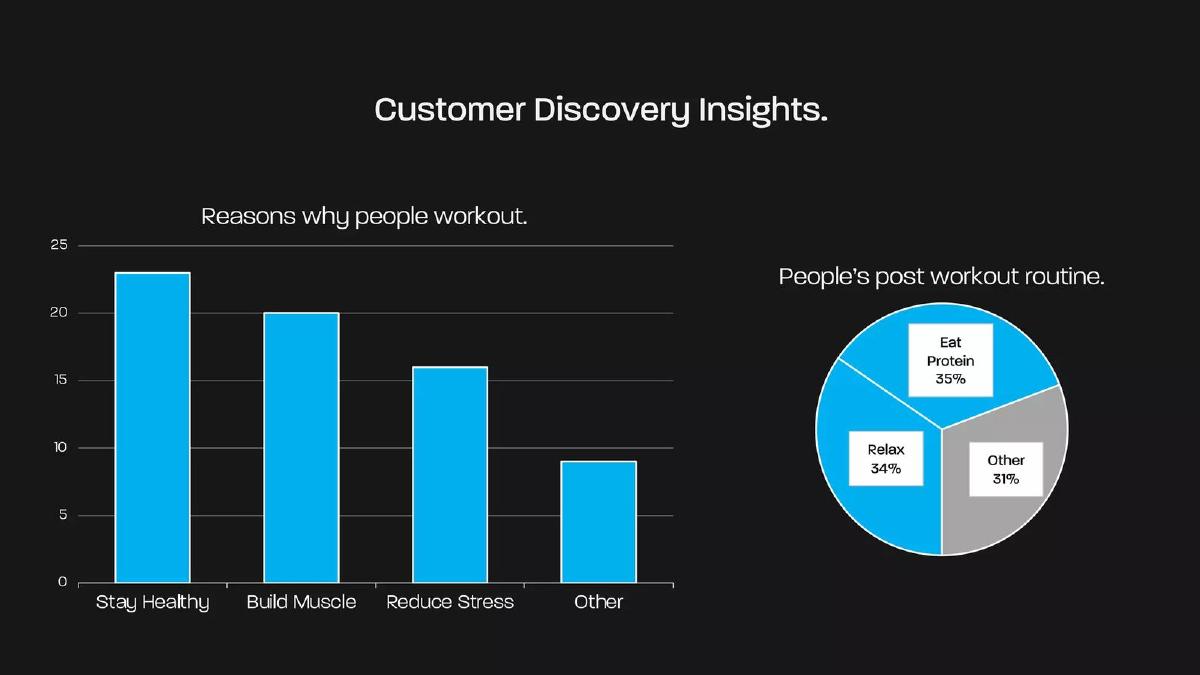
- Customer discovery data indicates that 35% of surveyed individuals eat protein post-workout, while 34% prioritize relaxation (Slide 2).
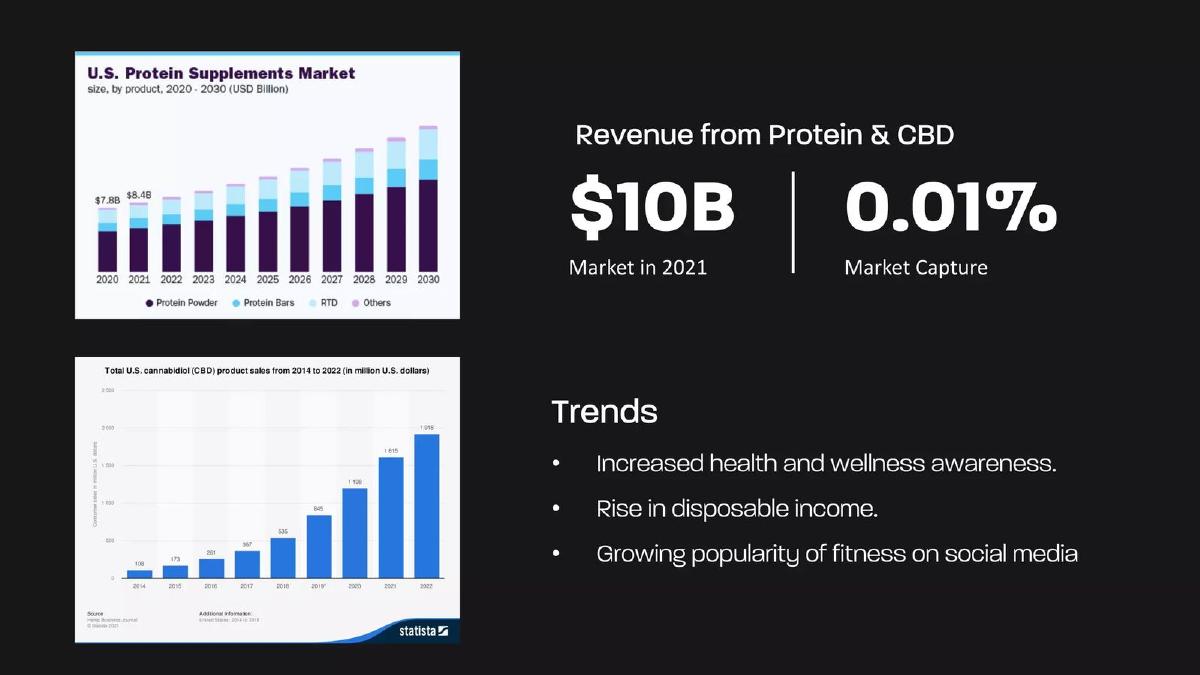
- Blossom targets a combined Protein and CBD market valued at $10 billion as of 2021, aiming for a 0.01% market capture (Slide 3).
- The business model is strictly Direct-to-Consumer (D2C), utilizing bundles and subscriptions with a top-tier price of $49.99/month for 8 units (Slide 4).
- Financial projections estimate Year 1 revenue at $175,000 with a -36% profit margin, shifting to a 13% margin in Year 2 (Slide 6).
- Breakeven is projected to occur at 52,000 units sold in Q1 of Year 2 (Slide 6).
- Marketing expenses are the primary cost driver, scaling from $50,000 in Year 1 to $250,000 in Year 3 (Slide 5).
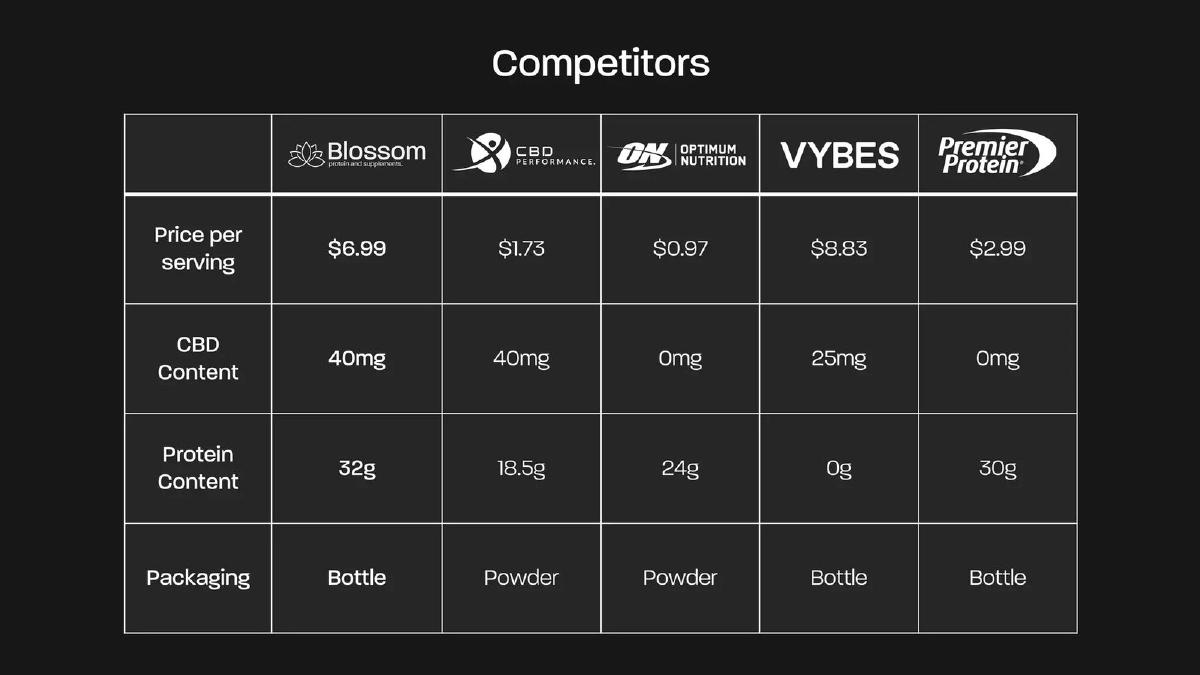
- The deck lacks a team slide, a competitive matrix, and a specific investment 'ask' or valuation (Slides 1-7).
Executive Summary: The Intersection of Recovery and Relaxation
Blossom Protein enters the highly competitive supplement space with a specific value proposition: the 'Melo Shake.' By combining 32g of protein with 40mg of CBD, the company attempts to solve two post-workout needs—physical recovery and mental relaxation—within a single SKU. The deck is structured as a standard early-stage pitch, though it leans heavily on external market validation rather than proprietary technology or unique distribution advantages.
Slide 1: Title and Brand Identity
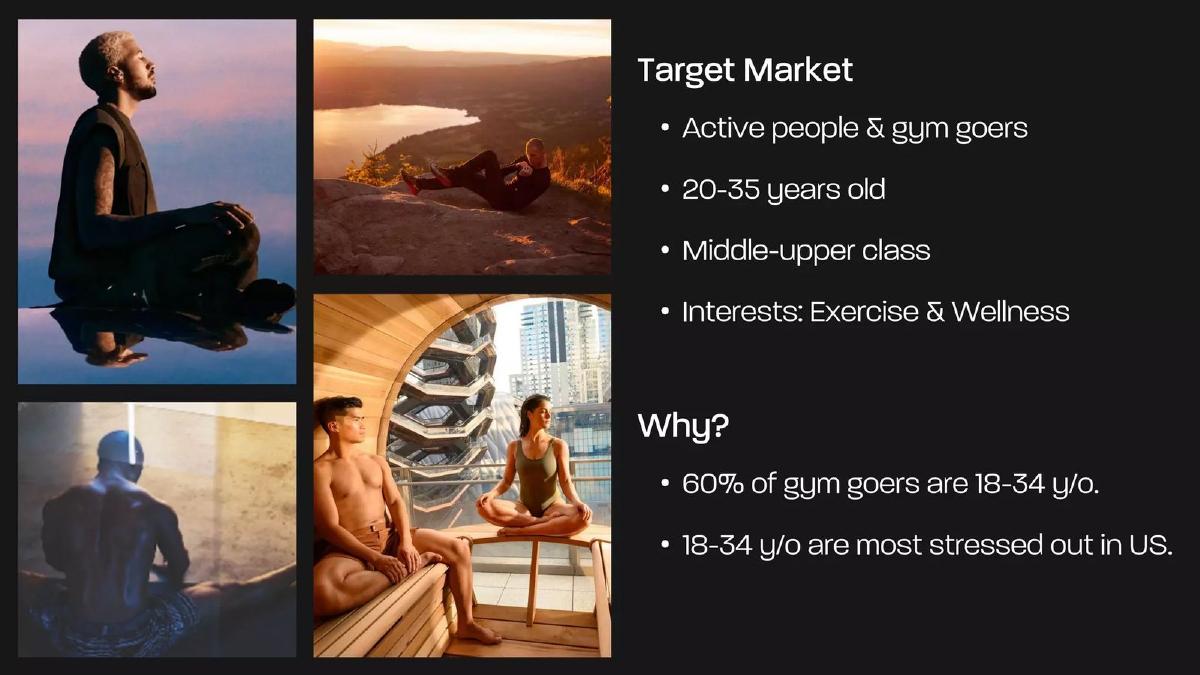
The cover slide establishes a lifestyle-oriented brand identity. It uses a triptych of images featuring yoga, meditation, and weightlifting, signaling that the product is intended for a broad spectrum of fitness enthusiasts, not just bodybuilders. The logo, a stylized lotus flower, reinforces the 'Blossom' name and the themes of wellness and growth. The sub-headline 'protein and supplements' suggests a broader product roadmap beyond their initial shake.
Slide 2: Customer Discovery Insights
This slide attempts to ground the product in consumer behavior. A bar chart titled 'Reasons why people workout' shows 'Stay Healthy' as the primary motivator (scoring above 20 on an unlabeled Y-axis), followed by 'Build Muscle' and 'Reduce Stress.' A corresponding pie chart for 'People's post workout routine' shows a near-even split between 'Eat Protein' (35%), 'Relax' (34%), and 'Other' (31%). The strategic intent here is to show that Blossom’s dual-benefit product addresses 69% of the post-workout market's primary desires.
Slide 3: Market Size and Trends
Blossom uses third-party data from Statista to frame the opportunity. They cite a $10 billion market in 2021 for Protein and CBD combined. The slide includes a chart showing the U.S. Protein Supplements Market growing toward $8.4 billion by 2030 and a CBD sales chart showing growth to $1.9 billion by 2022. Notably, the company sets a very conservative 'Market Capture' goal of 0.01%. While this appears realistic, it may lack the 'venture scale' ambition typically sought by high-growth investors. The trends listed—wellness awareness, disposable income, and social media fitness—are generic and lack specific company-specific insights.
Slide 4: Business Model and Pricing
The business model is a standard D2C (Direct-to-Consumer) flow. The 'Marketing' column lists five channels: Podcasts, Social Media, Paid Social, Influencers, and Branding. The 'Website' column focuses on Bundles, Subscriptions, SEO, and Email/SMS marketing. The 'Pricing' column provides specific tiers: $6.99 for a single unit, $39.99 for a 6-pack (approximately $6.66 per unit), and a subscription of $49.99/month for 8 units (approximately $6.25 per unit). This pricing structure incentivizes the subscription model, which is critical for predictable revenue in the CPG (Consumer Packaged Goods) space.
Slide 5: Detailed Expense Projections
This slide provides a granular look at the company's expected burn. Total expenses are projected to grow from $238,596.57 in Year 1 to $778,947.07 in Year 3. Marketing is the largest line item, starting at $50,000 and quintupling to $250,000 by Year 3. Interestingly, 'Product Development' and 'Brand Development' have no budget allocated in Year 2, suggesting a focus on scaling the existing 'Melo' line before reinvesting in R&D in Year 3. The inclusion of 'Warehousing' costs ($24k-$36k) indicates a physical inventory model rather than a dropshipping or third-party logistics (3PL) variable cost model.
Slide 6: 3-Year Financial Breakdown
The financial summary projects a classic 'J-curve' for revenue, starting at $175,000 and ending at $875,000. The company projects a loss of $63,596.57 in Year 1 (-36% margin) but claims they will reach breakeven at 52,000 units in Q1 of Year 2. By Year 3, they project a net profit of $96,052.93. While the revenue growth is steady, the absolute dollar amounts are relatively small for a venture-backed startup, suggesting this might be a lifestyle business or a seed-stage pitch for angel investors rather than institutional VCs.
Slide 7: The Melo Shake Recap
The final slide in the provided set serves as a product summary. It defines the 'Melo Shake' as a CBD-infused protein shake designed to 'Build muscle, relax, and reduce stress.' It features mockups of three flavors (Vanilla, Chocolate, Strawberry) and a 'Melo Powder' tub. The slide includes an image of a celebrity (Dwayne 'The Rock' Johnson) holding the product; however, there is no text indicating an official partnership or endorsement, which could be a placeholder for a 'target influencer' rather than a current reality. The slide concludes with a vague 'What's next?' section mentioning product line expansion.
What Blossom Protein Does Well
The deck is visually clean and follows a logical progression from problem (customer needs) to solution (product) to execution (business model and financials). The use of specific pricing tiers and unit-based breakeven points (52,000 units) shows that the founders have done the basic math required for a CPG business. By focusing on a 'dual-action' product, they successfully differentiate themselves from generic protein powders that only focus on muscle recovery.
Missing Elements in the Blossom Protein Deck
The most glaring omission is the Team Slide . In early-stage fundraising, the 'who' is often more important than the 'what.' There is no information regarding the founders' backgrounds in food science, supply chain, or digital marketing. Additionally, the deck lacks a Competitive Landscape . The protein market is dominated by giants like Optimum Nutrition and MusclePharm, while the CBD beverage space is increasingly crowded. Blossom fails to explain why a consumer would choose them over buying a standard protein shake and a separate CBD tincture.
Furthermore, there is no Investment Ask . A pitch deck is a functional document intended to solicit capital. Without a slide stating the amount being raised, the valuation (or cap), and the specific milestones that the funding will enable, the deck feels more like a business plan summary than a fundraising tool.
Lessons for Founders
Be Specific About Market Capture: While 0.01% market capture sounds 'safe,' investors often want to see a path to a much larger share or a clear explanation of why that small slice is worth millions in revenue. · Validate Celebrity Imagery: Using images of celebrities like The Rock without a stated partnership is a red flag. If it is a 'dream' partner, label it as such; otherwise, it can appear misleading. · Include Unit Economics: Blossom mentions COGS (Cost of Goods Sold) in their expense table, but a dedicated slide on the margin per bottle would be more persuasive for a CPG brand. · Don't Skip the Team: Even if you don't have a 'big name' background, highlight your specific hustle, your domain expertise, or your advisors. Investors invest in people first.
Frequently asked questions
- What is the core product offering of Blossom Protein?
- According to Slide 7, the core product is the 'Melo Shake,' which is a CBD-infused protein drink. The slide also shows a 'Melo Powder' variant. The product is marketed as a way to simultaneously build muscle and reduce stress, featuring 32g of protein and 40mg of CBD per serving as shown in the product mockups.
- How does Blossom Protein plan to acquire customers?
- Slide 4 outlines a multi-channel marketing strategy focused on digital presence. This includes podcasts, social media, paid social media, influencer marketing, and branding. The conversion funnel leads to a D2C website that utilizes SEO articles and Email/SMS marketing to drive bundles and subscription sales.
- What are the projected financials for the first three years?
- Slide 6 details a growth trajectory starting at $175,000 in revenue for Year 1, growing to $420,000 in Year 2, and reaching $875,000 in Year 3. The company expects to be profitable by Year 2 with a $55,785.41 profit, maintaining an 11% to 13% margin in the subsequent years.
- What market trends is the company betting on?
- Slide 3 cites three primary trends: increased health and wellness awareness, a rise in disposable income, and the growing popularity of fitness on social media. They support this with Statista charts showing the U.S. protein supplement market reaching nearly $8.4 billion and CBD sales nearing $2 billion.
- What critical information is missing from this pitch deck?
- The deck is missing several standard venture components. There is no 'Team' slide to establish founder credibility, no 'Competition' slide to show how they differentiate from existing protein brands, and no 'Ask' slide detailing how much money they are raising or how the funds will be allocated.