This 14-slide deck (7 slides provided) functions less as a traditional fundraising pitch and more as a 'lessons learned' retrospective for the Athens startup community. Blueground identifies a specific market gap: the shortage of high-quality furnished apartments for 1-12 month stays, noting that only 10% of current inventory meets this criteria. Having already raised €6.9M from investors like VentureFriends and Jabbar Internet Group, the deck focuses on the transition from operational efficiency to aggressive market expansion. It lacks traditional pitch elements like deep unit economics or a…
Key takeaways
- The company identifies a 'BIG shortage' of quality furnished apartments for mid-term rentals of 1-12 months on slide 2.
- Blueground notes that only 10% of existing apartment inventory is furnished, creating a supply-side opportunity (slide 2).
- The business model addresses landlord preferences for 1+ year contracts by acting as a professional intermediary (slide 2).
- The 'Why Now' slide attributes market readiness to minimalism trends and the shift toward online booking to avoid offline processes (slide 4).
- The deck confirms a total of €6.9M raised across Seed and Series A rounds prior to this presentation (slide 5).
- Institutional backers listed include VentureFriends (EU), Jabbar Internet Group (UAE), and Endeavor Catalyst (USA) on slide 5.
- Future strategy is explicitly tied to 'Series B Funding' and 'Expansion to other markets' on slide 6.
- The presentation concludes with operational advice, specifically warning that the 'Series A round can be tough' (slide 7).
Blueground: A Retrospective on Scaling PropTech
The Blueground presentation delivered at Open Coffee Athens XC is a unique artifact in the world of startup decks. Unlike a cold-outreach deck designed to secure a first meeting, this presentation serves as a victory lap and a roadmap. It was created after the company had already secured €6.9M in funding, positioning it as a case study for the local ecosystem. The deck focuses heavily on the 'why' and the 'what next,' providing a high-level overview of how Blueground transformed from a local Greek startup into a venture-backed international player in the furnished rental space.
Slide 1: The Value Proposition
The title slide establishes a clear, concise identity. Blueground defines itself as 'beautifully furnished apartments, enabled by technology, for 1+ month stays.' This one-sentence pitch is effective because it defines the product (apartments), the quality (beautifully furnished), the moat (technology), and the specific market niche (1+ month stays). By avoiding buzzwords like 'disrupting' or 'revolutionary,' the company grounds the viewer in a tangible service immediately.
Slide 2: The Supply-Demand Gap
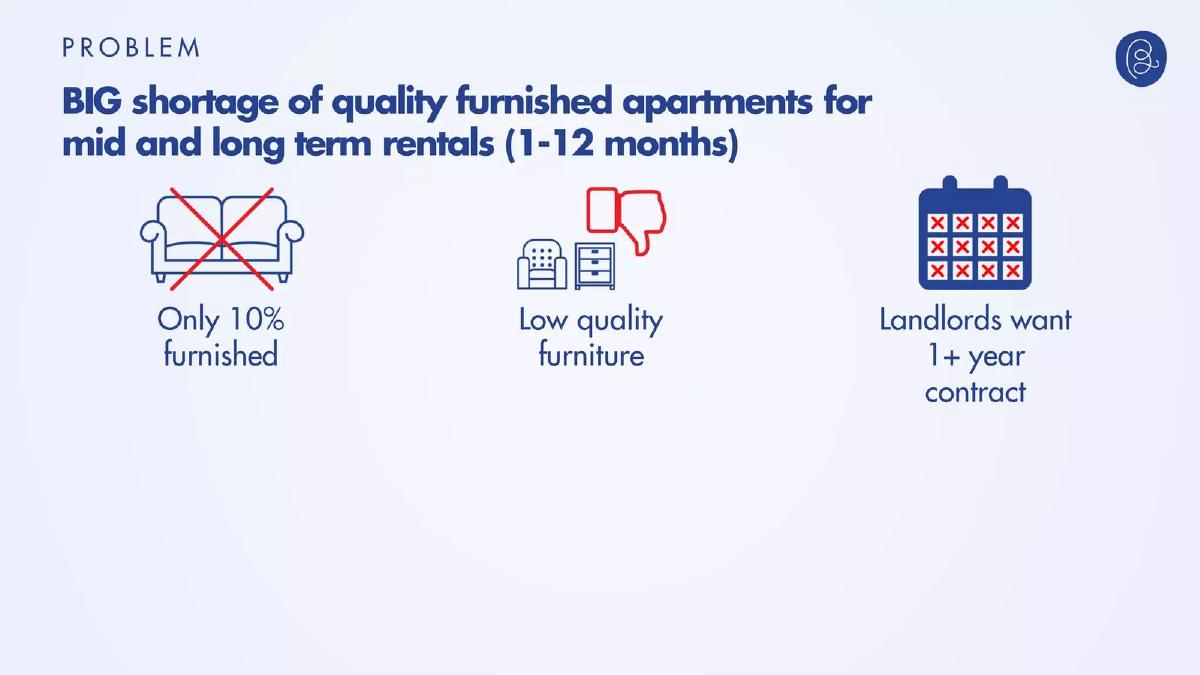
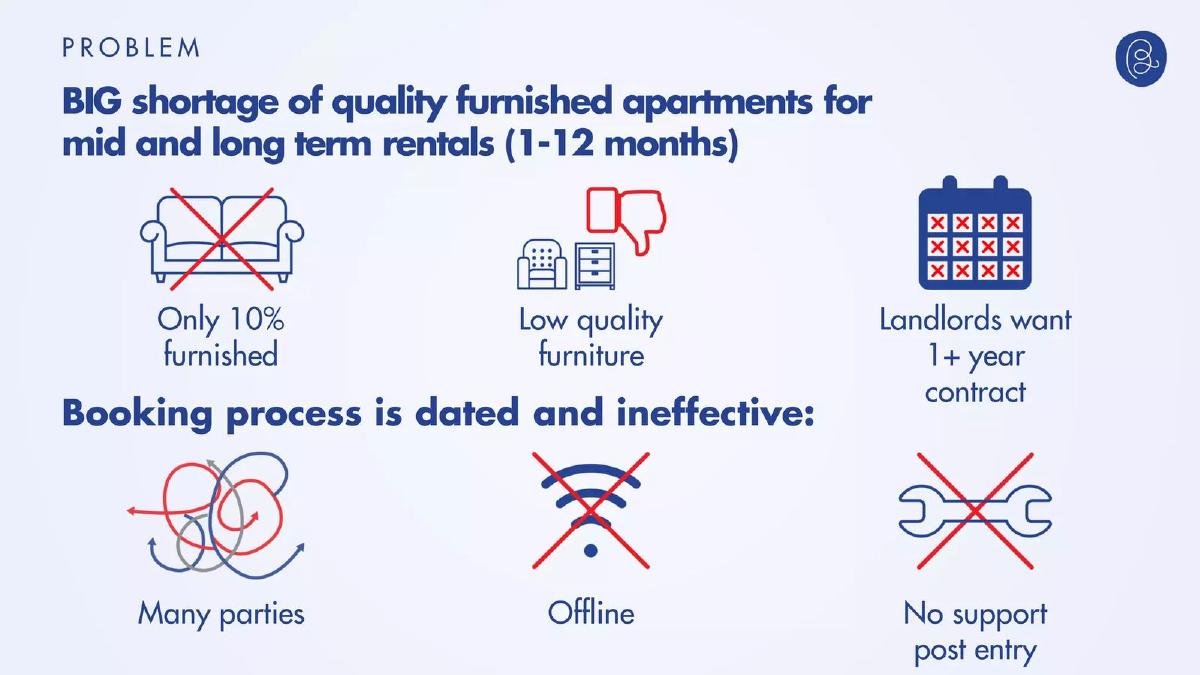
Slide 2, titled 'PROBLEM,' uses simple iconography to illustrate a complex real estate issue. The headline identifies a 'BIG shortage' in the 1-12 month rental market. The three pillars of this problem are quantified and qualified: only 10% of inventory is furnished, the quality of that furniture is generally low, and there is a mismatch between tenant needs and landlord desires (landlords wanting 1+ year contracts). This slide is crucial because it justifies Blueground's existence as a bridge between the flexible needs of modern workers and the rigid requirements of property owners.
Slide 3: The Visual Solution
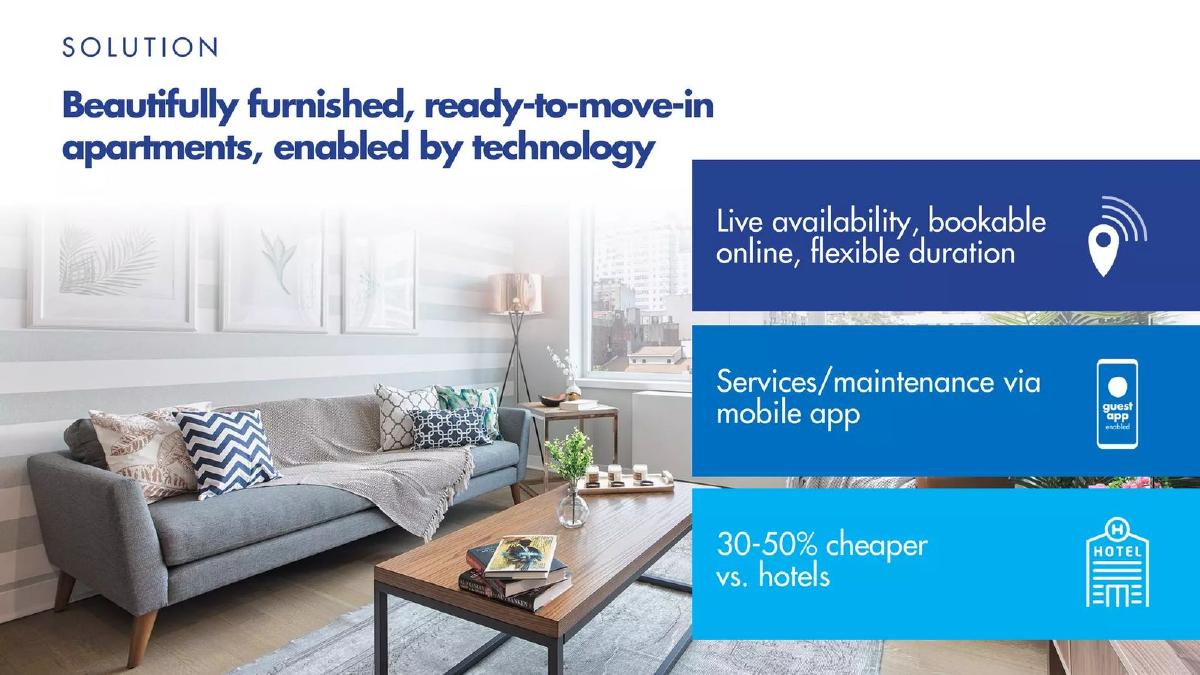
The 'SOLUTION' slide is primarily visual, featuring a high-quality photograph of a modern, well-lit living room. The text reiterates the 'ready-to-move-in' nature of the product. In PropTech, aesthetics are a core part of the product, not just the marketing. By showing rather than just telling, Blueground validates its claim of providing 'beautifully furnished' spaces. This slide serves to set a standard for the brand's physical output.
Slide 4: Market Timing and Cultural Shifts
The 'Why now?' slide (Slide 4) addresses the macro trends supporting the business. It cites 'Minimalism trends'—specifically that owning furniture is no longer desirable for a mobile workforce—and the ubiquity of 'Online booking.' This slide explains why a business that might have failed twenty years ago is viable today. It highlights the removal of 'middle men' and 'offline processes,' suggesting that Blueground is not just a real estate company, but a software-driven logistics company.
Slide 5: Traction and Validation
Slide 5, 'FUND RAISING & AWARDS,' provides the hard data necessary to prove the model's success. It explicitly states the company has 'RAISED SO FAR € 6.9M in Seed & Series A rounds.' The inclusion of logos for VentureFriends, Jabbar, and Endeavor Catalyst provides institutional social proof. Furthermore, the mention of the 'Hellenic Entrepreneurship Award' and 'European Commission' support suggests a high level of regulatory and community backing, which is vital for a company operating in the highly regulated housing sector.
Slide 6: The Road to Series B
The 'Going Forward' slide (Slide 6) is a transition from the past to the future. It uses a large graphic of a money bag labeled 'SERIES B FUNDING' and a circular array of arrows pointing toward 'Expansion to other markets.' This is a clear signal to the audience (and potential future investors) that the company has moved past the experimentation phase and is now focused on the 'blitzscaling' phase of its lifecycle.
Slide 7: Founder Lessons
The final slide in this set, 'LESSONS,' moves away from the business model to share executive insights. The bullet points—'Invest time in operations,' 'Be present when you expand,' and 'Series A round can be tough!'—add a human element to the deck. It acknowledges the operational 'waste' that can plague PropTech companies and warns other founders about the difficulty of the Series A milestone. This slide reinforces Blueground's position as a leader in the Athens startup scene, offering mentorship through transparency.
What Works in This Deck
The deck's greatest strength is its clarity of purpose. It doesn't try to solve every problem in real estate; it focuses exclusively on the mid-term furnished rental gap. The use of simple, bold text and high-quality imagery makes the deck easy to digest in a presentation setting. By the time the viewer reaches the 'Raised So Far' slide, the logic of the business feels inevitable. The deck also does an excellent job of balancing the 'soft' side of the business (interior design and minimalism) with the 'hard' side (VC funding and operational efficiency).
What Is Missing
Because this was a public presentation rather than a private pitch, several critical data points are omitted. There is no mention of unit economics—specifically, the cost to furnish an apartment versus the rental premium achieved. There is also no slide detailing the technology stack, despite the title slide claiming the business is 'enabled by technology.' A competitive landscape slide is also absent; while Blueground identifies the problem, it doesn't explicitly state how it differs from competitors like Sonder or traditional corporate housing providers. Finally, the team slide is missing from this selection, which is usually the most important slide for early-to-mid-stage investors.
Lessons for Other Founders
Founders should take note of how Blueground uses the 'Why Now' slide to frame their business within larger cultural shifts. Connecting a business to a trend like 'minimalism' makes the company feel like a part of a movement rather than just a service provider. Additionally, the transparency regarding the difficulty of the Series A round is a good reminder to be realistic in one's timeline. Finally, the deck demonstrates that once a company has achieved significant traction (like a €6.9M raise), the narrative should shift from 'can this work?' to 'how fast can we scale this?'
Frequently asked questions
- What is the core problem Blueground is solving?
- According to slide 2, the core problem is a significant shortage of quality furnished apartments for mid-term (1-12 month) rentals. They identify three specific pain points: only 10% of apartments are currently furnished, existing furniture is often low quality, and landlords typically demand long-term contracts of one year or more, which doesn't suit mobile professionals.
- How much capital had Blueground raised at the time of this deck?
- Slide 5 states that Blueground had raised a total of €6.9M across its Seed and Series A rounds. The slide also lists their key venture capital partners, which include VentureFriends, Jabbar Internet Group, and Endeavor Catalyst, representing a mix of European, Middle Eastern, and American capital.
- What are the key market drivers for Blueground's growth?
- Slide 4 identifies two primary drivers under the 'Why now?' heading. First, a cultural shift toward minimalism where owning furniture is no longer considered desirable. Second, a technological shift where online booking has become ubiquitous, allowing the company to bypass traditional 'middle men' and inefficient offline rental processes.
- What is the primary goal for Blueground's next phase of growth?
- Slide 6, titled 'Going Forward,' indicates that the company's next major milestones are securing Series B funding and using that capital for 'Expansion to other markets.' This suggests the company had validated its model in its initial cities and was moving into a global scaling phase.
- What operational lessons does the company share with other founders?
- On slide 7, Blueground emphasizes four lessons: investing time in operations to reduce waste, the importance of being physically present during market expansion, getting comfortable with uncertainty/risk, and the reality that raising a Series A round is a difficult process.