Blossom Berkeley's 2015 presentation is a pedagogical look at the customer discovery process within the EdTech sector. Rather than leading with aggressive financial projections or a massive TAM, the deck prioritizes the 'Collective Learning' gained from 130 interviews with parents, teachers, and directors. The narrative follows two distinct pivots: first, from a fragmented toolset to a unified school communication app, and second, to a parent-centric engagement platform. While the deck excels at demonstrating founder humility and methodical research, it is notably absent of business fundament…
Key takeaways
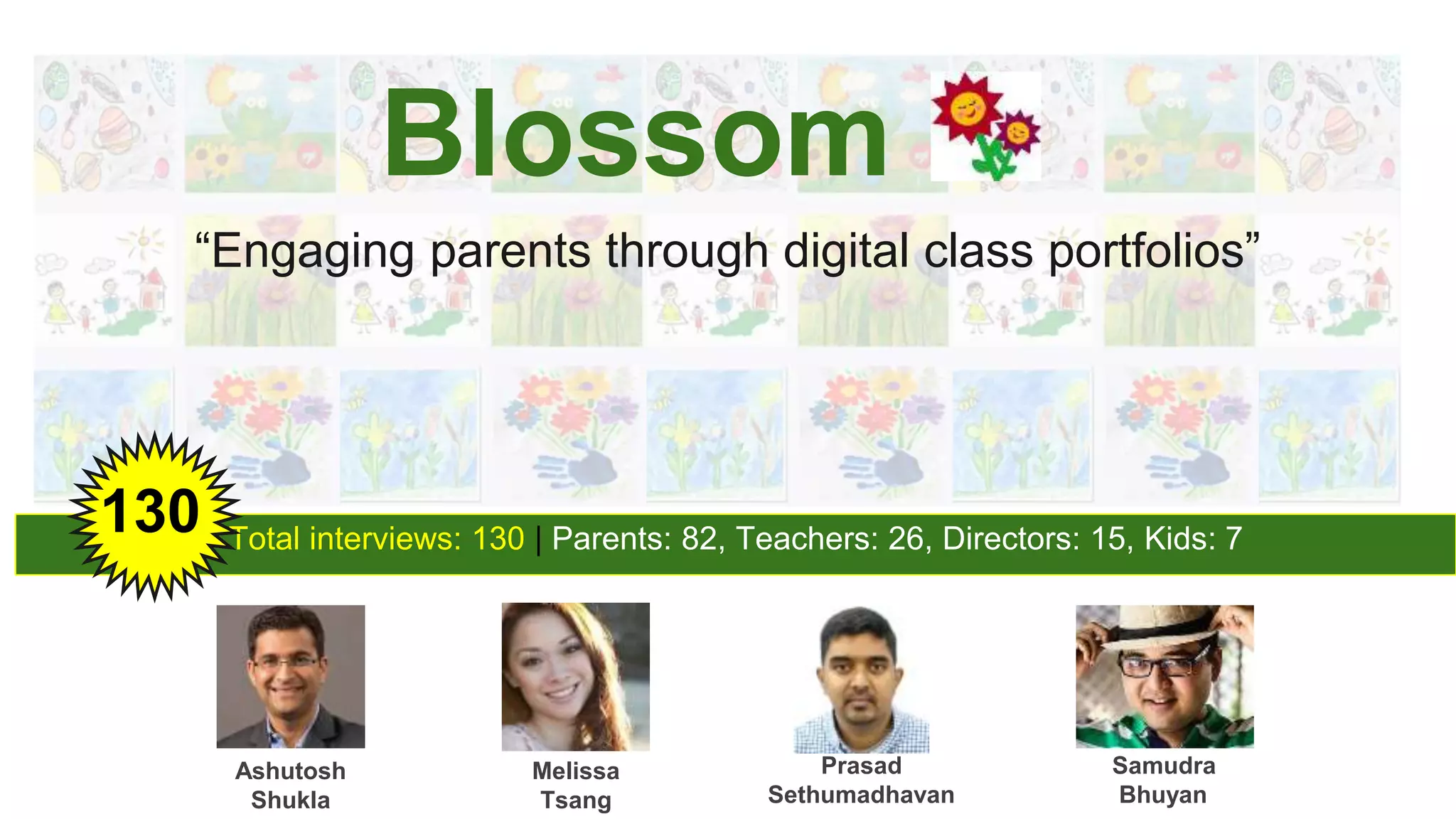
- The founders conducted 130 total interviews, including 82 parents and 26 teachers, to validate their problem set (Slide 1).
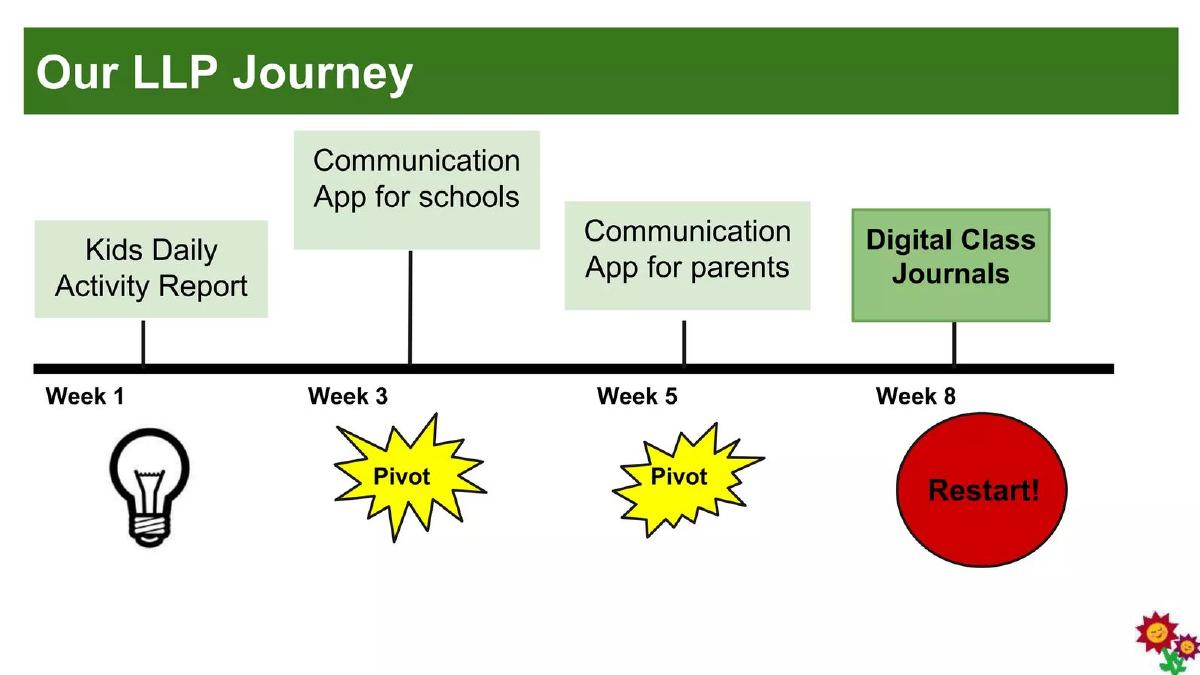
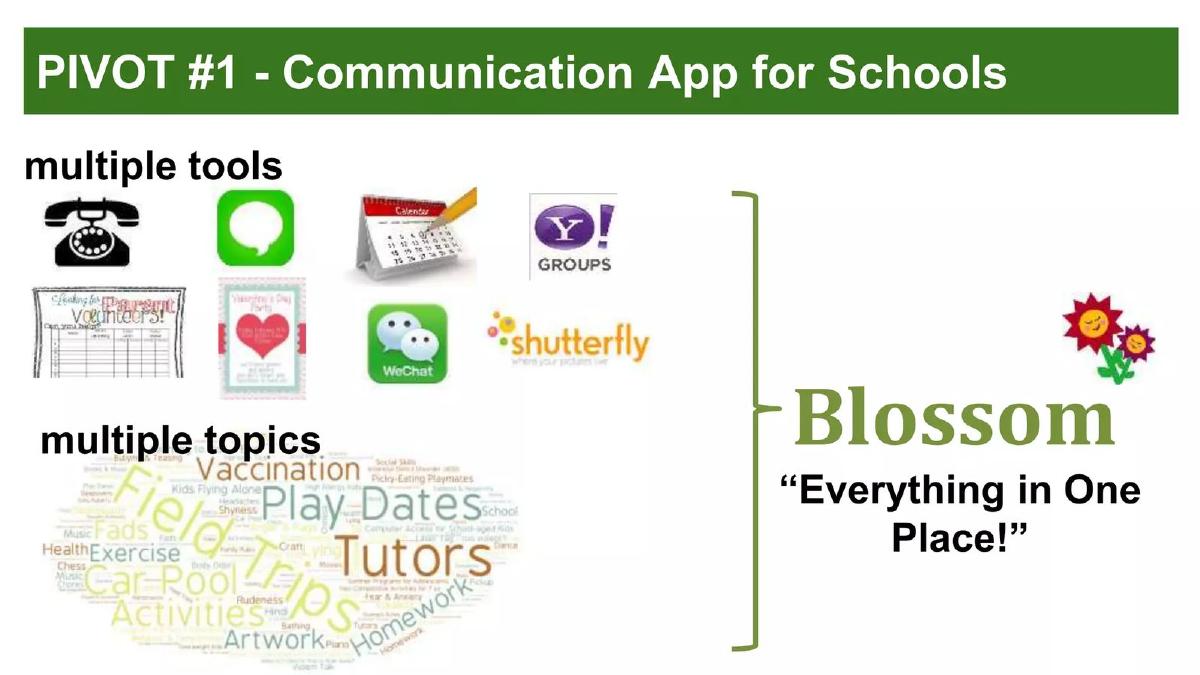
- The first pivot addressed the fragmentation of tools like Yahoo Groups, WeChat, and Shutterfly into a single platform (Slide 2).
- Product mockups for 'Pivot #2' show specific features for carpooling, health, and play dates within a parent-focused menu (Slide 3).
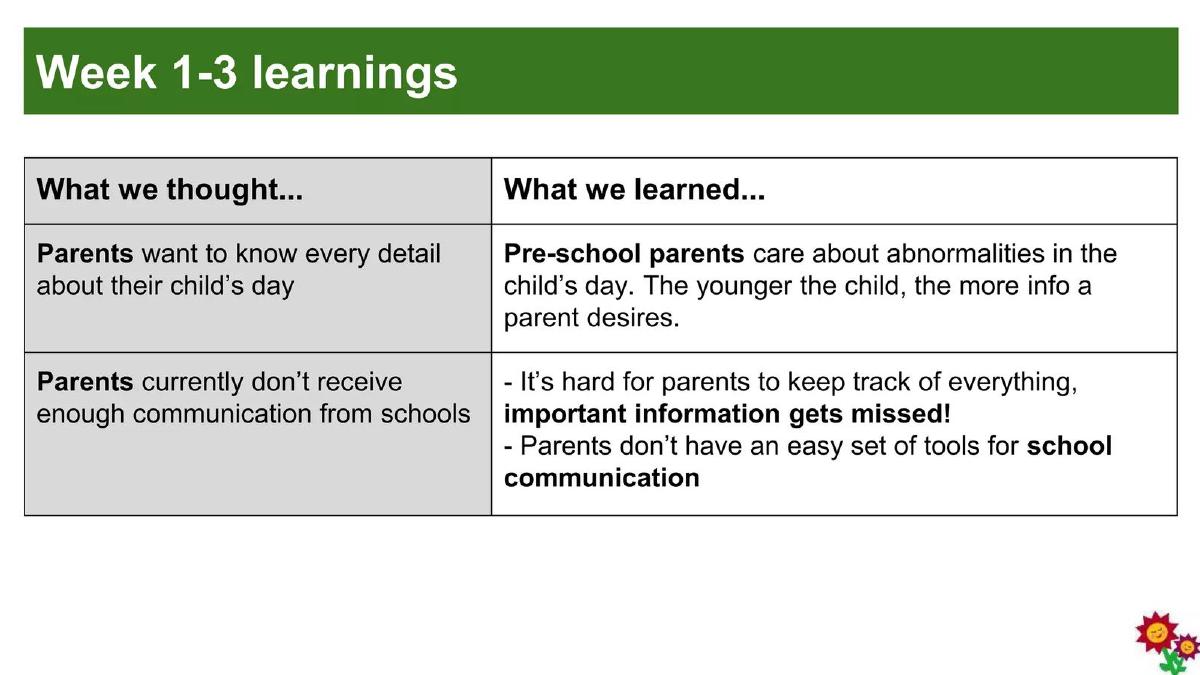
- The team explicitly acknowledges that '5 nice to have != 1 must have,' highlighting a struggle to find essential value (Slide 5).
- A Value Proposition Canvas for teachers identifies 'documenting kids progress' and 'engaging parents' as primary pains (Slide 7).
- Customer archetypes are narrowly defined as private school directors and teachers in urban centers who already utilize iPads (Slide 8).
- The deck completely omits financial data, including burn rate, revenue, and the specific amount of funding sought.
- There is no competitive analysis slide, despite Slide 2 listing several indirect competitors like Shutterfly and Yahoo Groups.
Executive Summary: The Lean Startup Methodology in Action
The Blossom Berkeley deck from 2015 is a fascinating artifact of the 'Lean Startup' era. Unlike modern decks that lead with explosive growth charts, Blossom leads with research. The deck is structured as a narrative of discovery, documenting how the team moved from a broad idea to specific customer archetypes through rigorous interviewing. While it lacks the 'greed triggers' typical of a Series A pitch, it provides a masterclass in how to present customer discovery data to stakeholders who value methodical validation over raw speculation.
Slide 1: Title and Team Validation
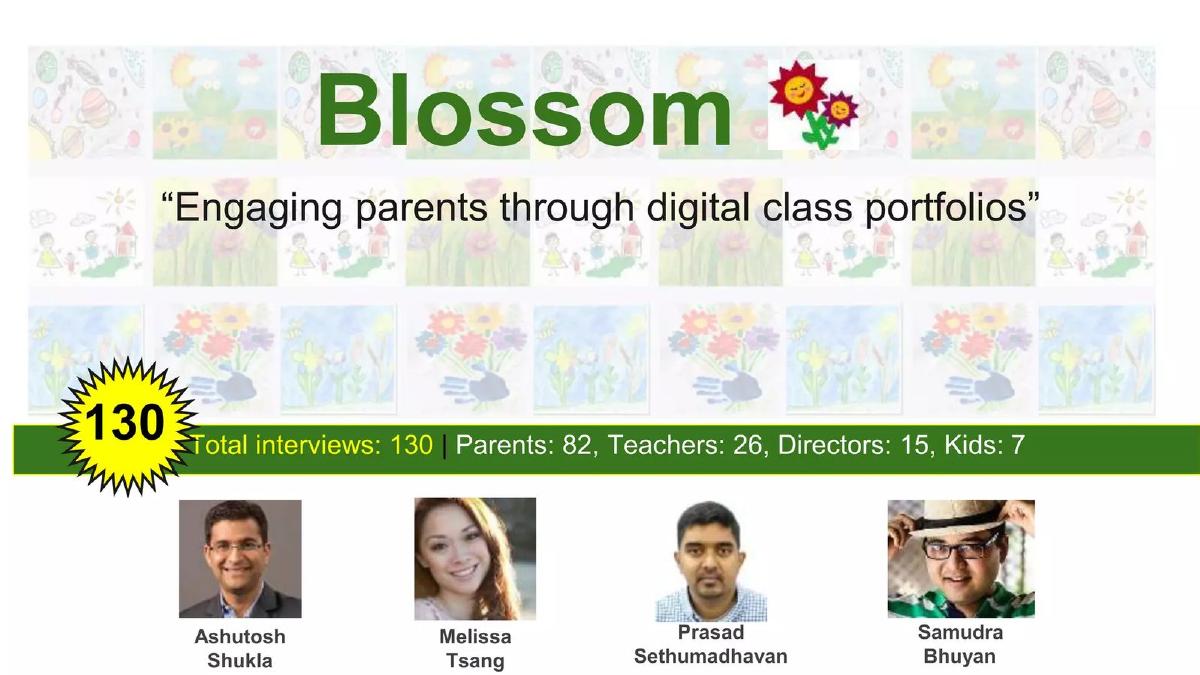
The cover slide establishes the company's mission: "Engaging parents through digital class portfolios." However, the most striking element of this slide is the immediate inclusion of raw data. A large, jagged badge announces "130" total interviews. The breakdown is specific: 82 Parents, 26 Teachers, 15 Directors, and 7 Kids. By putting these figures on the title page, the founders—Ashutosh Shukla, Melissa Tsang, Prasad Sethumadhavan, and Samudra Bhuyan—are signaling that their insights are backed by significant qualitative labor. This builds immediate credibility for the pivots that follow.
Slide 2: Pivot #1 - Solving Fragmentation
Slide 2 addresses the 'Problem' by visualizing the chaos of current school communications. It lists "multiple tools" including old-fashioned telephones, WeChat, Shutterfly, Yahoo Groups, and paper calendars. Below this, a word cloud of "multiple topics" (Field Trips, Play Dates, Vaccination, Tutors) illustrates the noise parents deal with. The solution is presented as Blossom: "Everything in One Place!" This is a classic 'unbundler' or 'aggregator' play, common in early-stage EdTech, where the value proposition is the reduction of app fatigue.
Slide 3: Pivot #2 - The Parent-Centric Interface
By Slide 3, the team introduces a second pivot, shifting the focus specifically toward a "Communication App for Parents." The slide features three high-fidelity mobile mockups. The "Blossom Menu" shows categories like Carpool, Health, Play dates, Birthday parties, and Weekend activities. A "New Volunteer Signup" screen shows a specific date (March 3, 2015) and a request for blankets. The third screen shows a "Class Calendar" with specific educational milestones like "Learning about fossils" and "Learning about Matter." This slide demonstrates that the team has moved beyond theory into feature-level product design.
Slide 4: The Philosophical North Star
Slide 4, titled "Rediscovering our Profound Belief," serves as the emotional heart of the deck. It states: "When teachers, parents, and kids are all actively engaged in their school community, an ideal village will emerge where education can thrive." In a fundraising context, this slide attempts to answer the 'Why' behind the product. It suggests that the founders are not just building a utility, but are trying to facilitate a specific social outcome (the 'village' model of education).
Slide 5: Collective Learning and Brutal Honesty
This is perhaps the most unique slide in the deck. Titled "Collective Learning from LLP," it uses a two-column table to compare "What we thought..." with "What we learned..." The honesty here is notable. They admit that "5 'nice to have' != 1 'must have'" and warn to "Be wary of what customers say, sometimes they lie!" They also include a metaphorical warning: "don't build a glass bridge when a dirty underpass is 'good enough'." This slide tells an investor that the team is coachable, analytical, and aware of the 'false positive' trap in customer interviews.
Slide 6: The Appendix Transition
Slide 6 is a simple transition slide for the Appendix. In a 32-slide deck, having an appendix this early (after only 5 content slides in this selection) suggests that the core narrative was kept intentionally brief, with the heavy data relegated to the back for deeper due diligence.
Slide 7: Value Proposition Canvas for Teachers
Slide 7 utilizes a standard strategic framework: The Value Proposition Canvas. It breaks down the "Jobs" of a teacher (documenting progress, ensuring development) against the "Pains" (parent communication, engaging parents). The "Pain Relievers" offered by Blossom include "kids help save time by documenting their own work" and "data to support parent-teacher conversations." This slide is critical because it identifies the 'User' (the teacher) as distinct from the 'Customer' (the parent or director), showing an understanding of the complex EdTech ecosystem.
Slide 8: Customer Archetypes
The final slide in this selection defines the target market through two personas: Rebecca (Private School Director) and Amy (Private Elementary School Teacher). Both are located in "urban centers" and are already "eager to pilot new solutions." By narrowing their focus to private schools and tech-forward individuals, the team avoids the 'boiling the ocean' fallacy. They are looking for early adopters who already have the hardware (iPads) and the budget to stay competitive.
What Works in This Deck
Methodological Rigor: The emphasis on 130 interviews is the deck's strongest asset. It proves the founders have 'gotten out of the building' and are not building in a vacuum. For a seed-stage investor, this reduces the risk of the team building something nobody wants.
Clarity of Pivot: Many founders are afraid to admit they changed their minds. This deck embraces the pivot as a sign of intelligence and responsiveness to data. By labeling slides "Pivot #1" and "Pivot #2," they show a clear evolutionary path for the product.
Visualizing the Mess: Slide 2 does an excellent job of making the 'Problem' feel visceral. Anyone who has been a parent or teacher recognizes the frustration of checking five different apps for one field trip update. The 'Everything in One Place' value prop is clear and immediate.
What Is Missing from This Deck
The Business Model: There is zero mention of how Blossom Berkeley intends to make money. Is it a SaaS fee per school? A freemium model for parents? A lead-gen tool for tutors? Without a revenue slide, this looks more like a research project than a business.
Market Size (TAM): While they identify archetypes, they don't quantify the opportunity. How many private schools fit this profile in the US? What is the total addressable spend for school communication software? Investors need to know if this can become a $100M+ company.
Competitive Landscape: Slide 2 mentions Shutterfly and WeChat as tools parents use, but it doesn't address direct EdTech competitors like ClassDojo, Remind, or Seesaw, which were already gaining significant traction by 2015. A competitive matrix is a glaring omission.
The Ask: The most critical omission for a pitch deck is the 'Ask.' There is no slide stating how much capital is being raised, what the milestones for that capital are, or the current runway of the team.
Founder Takeaways
If you are a founder in the pre-seed stage, copy the Customer Discovery Slide (Slide 1) and the Learning Table (Slide 5) . These slides demonstrate a level of intellectual honesty that is rare in the 'fake it till you make it' culture of Silicon Valley. Showing that you know the difference between a 'nice to have' and a 'must have' is a powerful way to build trust with sophisticated investors. However, ensure you supplement this qualitative data with the quantitative business fundamentals (TAM, Revenue, Competition) that this deck lacks. A pitch deck should prove both that the problem is real and that the solution is a viable, scalable business.
Frequently asked questions
- What stage of development is Blossom Berkeley in based on this deck?
- The company appears to be in the pre-seed or early seed stage, specifically within the 'customer discovery' phase of the Lean Startup methodology. The deck focuses heavily on interviews (130 total) and pivots rather than growth metrics or revenue. The presence of high-fidelity mockups for 'Pivot #2' suggests they have moved past initial wireframing but are still refining the core value proposition.
- How does the team define their target market?
- According to Slide 8, the team targets a very specific niche: private schools in urban centers. Their archetypes, 'Rebecca' and 'Amy,' are individuals who are already tech-literate and 'support technology & iPads in classrooms.' This suggests a bottom-up adoption strategy focusing on affluent or well-resourced private institutions rather than broad public school districts.
- What is the primary problem Blossom is trying to solve?
- The deck identifies 'fragmentation' as the core problem. Slide 2 illustrates that parents and teachers are currently forced to use 'multiple tools' (calendars, phone calls, Shutterfly, WeChat) to discuss 'multiple topics' (vaccinations, carpools, homework). Blossom aims to be the 'Everything in One Place' solution to reduce this cognitive and administrative load.
- What are the most significant omissions in this pitch deck?
- This deck lacks almost all standard financial and strategic slides required for a professional fundraise. There is no 'Ask' slide (how much money they need), no 'Market Size' (TAM/SAM/SOM), no 'Business Model' (how they make money), and no 'Competition' slide. It reads more like a progress report for an incubator program than a venture capital pitch.
- What is the 'Profound Belief' mentioned in the deck?
- Slide 4 defines their 'Profound Belief' as the idea that an 'ideal village' for education emerges only when teachers, parents, and kids are all actively engaged. This indicates a shift from a purely functional utility (a communication tool) to a mission-driven platform focused on community building and student development.