Blue Wire’s pitch deck is a masterclass in brevity, utilizing only 9 slides to articulate a thesis on the shifting landscape of sports media. Founded in 2018, the company positioned itself as the digital successor to the 'Old Guard' of radio, leveraging a decentralized network of over 50 podcasts. The deck highlights a significant traction milestone of 2.5 million listens within its first 11 months and a growth rate that doubled every quarter. While the deck lacks traditional financial projections, unit economics, or a detailed team slide beyond the founder, it successfully captures the marke…
Key takeaways
- The deck claims a total of 2.5 million listens were achieved within the first 11 months of operation as shown on slide 7.
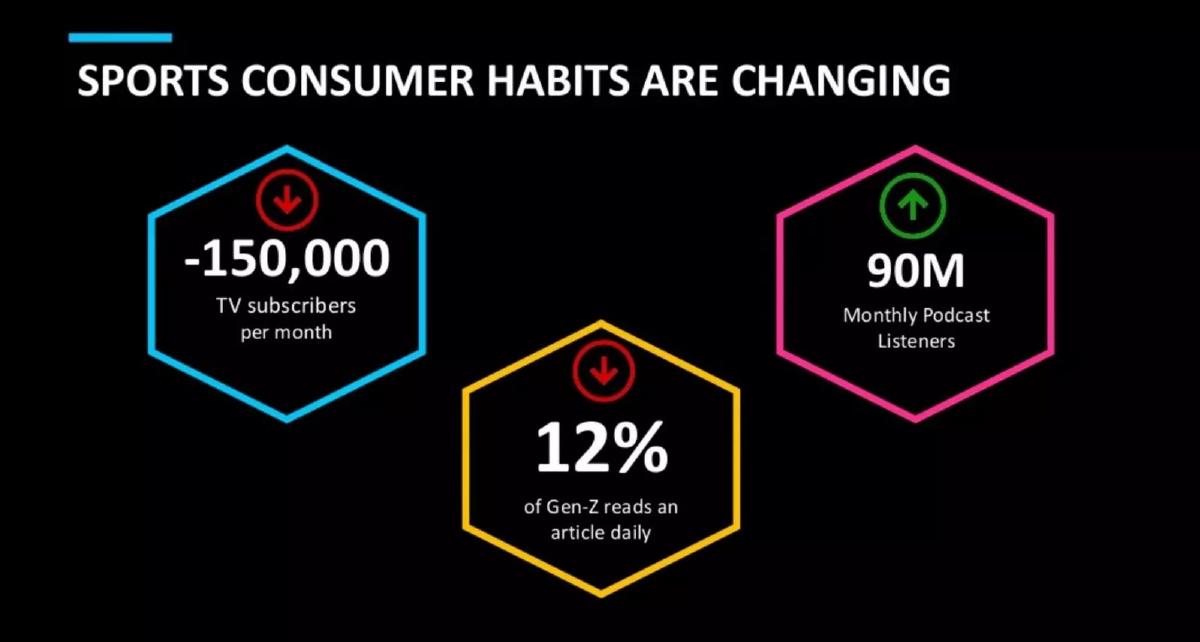
- Blue Wire identifies a market shift where 150,000 TV subscribers are lost per month while monthly podcast listeners reached 90 million on slide 4.
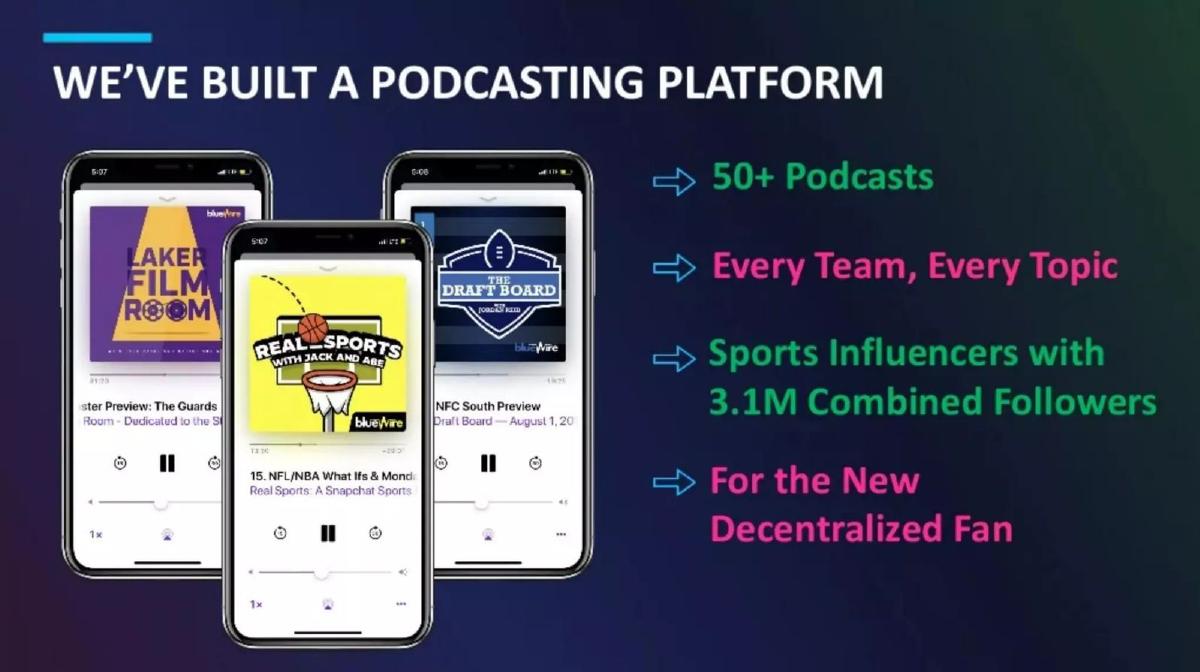
- The platform launched with over 50 podcasts covering 'Every Team, Every Topic' according to slide 5.
- Traction is illustrated by a growth curve showing listens doubling every quarter on slide 7.
- The company targets a $78 billion sports media market, projecting podcasting to take a significant share from the $17 billion radio market by 2030 on slide 8.
- The deck highlights a combined social following of 3.1 million across its sports influencers on slide 5.
- Only 12% of Gen-Z reads a daily article, a metric used on slide 4 to justify the pivot to audio-centric media.
- The deck entirely omits a business model slide, failing to explain how the company generates revenue from its 50+ podcasts.
The 9-Slide Strategy for a $12.5M Round
Blue Wire’s pitch deck is an exercise in minimalism. In an era where decks often stretch to 20 or 30 slides filled with complex data, Blue Wire managed to communicate its core value proposition and traction in just nine slides. Founded in 2018, the company entered a crowded sports media market by focusing on the 'decentralized fan'—the individual who cares more about their specific team than national sports talk radio. This teardown examines how they used simple visuals and aggressive growth metrics to validate their model.
Slide 1: Title and Thesis
The deck opens with the Blue Wire logo and the tagline: "The Future of Sports Is Podcasting." This is a bold, declarative statement that sets the stage for the entire presentation. It doesn't just describe what the company does; it makes a claim about the direction of the entire industry. The branding is clean, using a pulse-line integrated into the 'W' of Wire, subtly nodding to audio waves or a heartbeat.
Slide 2: The Founder's Origin
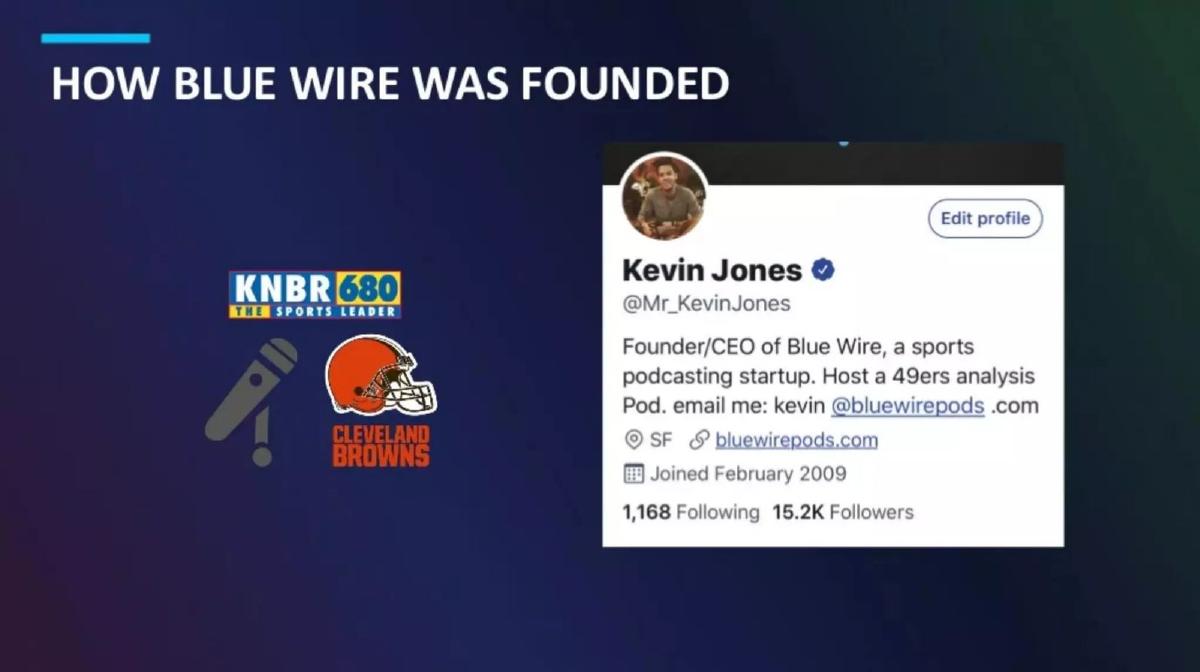
Slide 2, titled "HOW BLUE WIRE WAS FOUNDED," uses a screenshot of CEO Kevin Jones’s Twitter profile. This is an unconventional way to present a founder's background, but it serves a dual purpose. First, it establishes his credibility as a verified media professional (@MrKevinJones). Second, it shows the logos of KNBR 680 and the Cleveland Browns, implying a background in traditional sports media. The slide notes he hosts a 49ers analysis pod, grounding the company in actual content creation rather than just abstract management.
Slide 3: The Media Shift
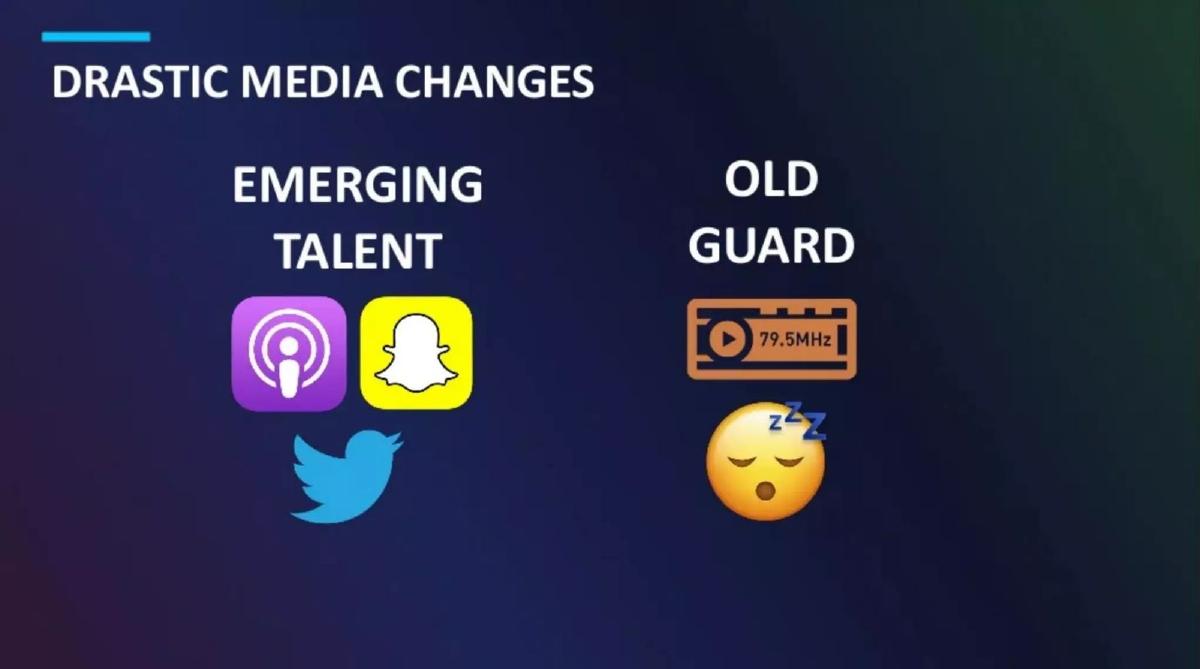
Titled "DRASTIC MEDIA CHANGES," this slide sets up the 'Enemy.' On one side is "EMERGING TALENT" represented by icons for Apple Podcasts, Snapchat, and Twitter. On the other is the "OLD GUARD," represented by a traditional radio icon and a 'sleeping' emoji. This is a classic storytelling technique in fundraising: identifying a stagnant incumbent and positioning the startup as the modern, energetic alternative. It frames the investment not just as a company, but as a bet on a cultural shift.
Slide 4: Changing Consumer Habits
Blue Wire provides the data to back up the previous slide's claims. Slide 4, "SPORTS CONSUMER HABITS ARE CHANGING," presents three key figures: "-150,000 TV subscribers per month," "12% of Gen-Z reads an article daily," and "90M Monthly Podcast Listeners." By contrasting the decline of traditional media (TV and print) with the rise of audio, the deck creates a sense of urgency. The use of hexagonal frames and simple up/down arrows makes the data digestible at a glance.
Slide 5: The Platform Solution
Slide 5 introduces the product: "WE’VE BUILT A PODCASTING PLATFORM." It lists four key value propositions: "50+ Podcasts," "Every Team, Every Topic," "Sports Influencers with 3.1M Combined Followers," and "For the New Decentralized Fan." The visual includes mockups of three podcasts on iPhones (Laker Film Room, Real Sports, and The Draft Board), proving that the platform is already live and populated with diverse content.
Slide 6: Content Breadth
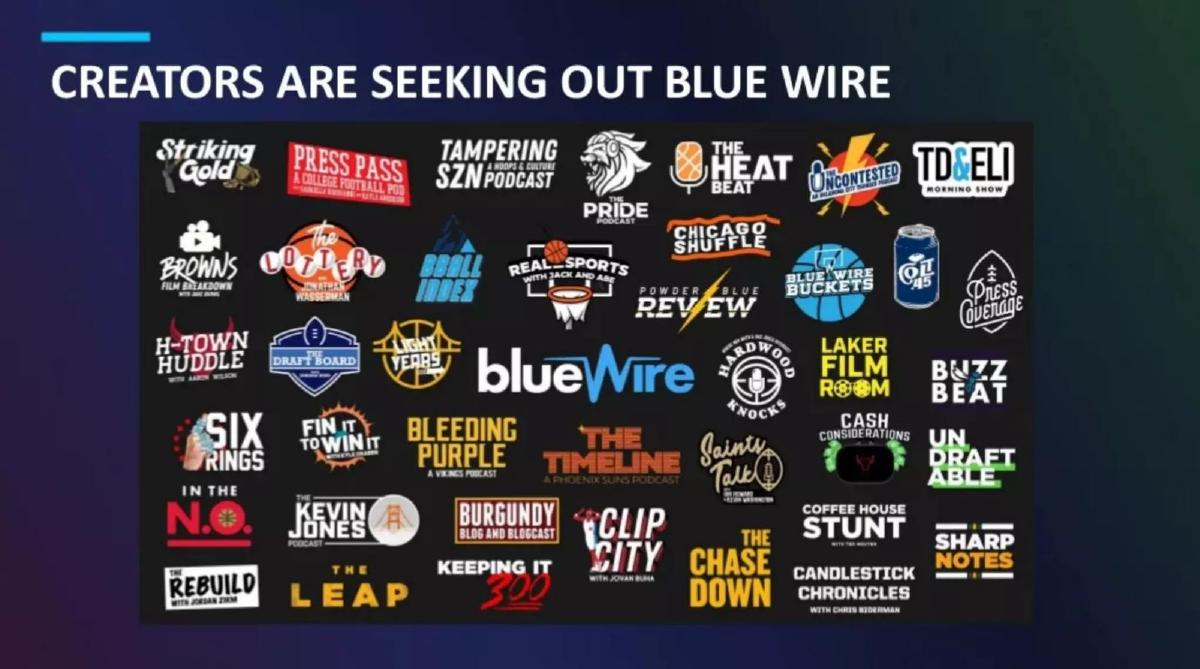
This slide is a 'logo wall' for the company’s own content. Titled "CREATORS ARE SEEKING OUT BLUE WIRE," it displays dozens of podcast covers. This visual density is intentional; it demonstrates the scale of the network without requiring the reader to look at a spreadsheet. It reinforces the 'Every Team, Every Topic' claim from the previous slide, showing coverage for the Browns, Lakers, Suns, and more.
Slide 7: Traction and Growth
Slide 7 is the most critical slide in the deck. Titled "TRACTION," it features a line graph showing "Listens" from August to June. The headline claim is that listens are "Doubling every quarter." Below the graph, it states "2.5 Million listens in 11 months." To add further credibility, it includes the New York Times logo and a screenshot showing one of their shows as the "#1 Sports Podcast on Apple." This slide answers the investor's most important question: 'Is it working?'
Slide 8: Market Validation
Slide 8 addresses the 'Total Addressable Market' (TAM). It compares the "2019 $17B" radio market to a "2030 $24B" market where podcasting (in green) has taken over the majority of the share. At the bottom, a large blue box highlights the "$78B Sports Media" industry. This suggests that while they are starting with podcasts, the ultimate prize is a piece of the much larger sports media pie.
Slide 9: The Vision
The final slide provides the CEO’s email address and three pillars: "Experience," "Traction," and "Global Vision." The 'Experience' section features a logo for 'The Kevin Jones Podcast,' and the 'Global Vision' is represented by a world map. This slide serves as a summary and a call to action, though it notably lacks a specific dollar amount for the fundraise.
What Works in This Deck
The Blue Wire deck excels at narrative momentum . It moves quickly from the problem (dying traditional media) to the solution (a decentralized podcast network) to the proof (2.5M listens). By using a 'logo wall' of their own shows, they visually demonstrate a 'moat' of content that would be difficult for a competitor to replicate quickly. The focus on 'Listens' as a North Star metric provides a clear indicator of product-market fit.
What Is Missing
The most glaring omission is the Business Model . The deck never explains how Blue Wire makes money. Are they taking a cut of ad revenue? Are they selling sponsorships? Is there a subscription component? For a 'Later' stage deck (as categorized), investors usually expect to see unit economics and revenue growth alongside listener growth. Additionally, there is no Team Slide beyond the founder. A network of 50+ podcasts requires a significant support staff, and the deck fails to highlight the talent behind the scenes. Finally, the lack of an Ask Slide means the deck feels more like a general company overview than a specific fundraising tool.
What a Founder Should Copy
Founders should emulate Blue Wire’s visual simplicity . Each slide has one clear message. The use of screenshots (Twitter profiles, Apple Podcast charts) provides 'authentic' proof that feels more trustworthy than a self-made chart. The 'Old Guard vs. Emerging Talent' framing is also a highly effective way to position a startup in a legacy industry. If you have a platform with many sub-brands, the 'logo wall' approach on Slide 6 is a powerful way to communicate scale instantly.
Final Analysis
Blue Wire’s deck is a high-conviction document. It relies on the strength of its traction curve and the undeniable trend of audio consumption. While it leaves many operational questions unanswered, it succeeds in its primary goal: creating enough excitement about the growth and the market shift to secure a follow-up meeting. It is a reminder that sometimes, less is more, provided the few metrics you do show are moving in the right direction.
Frequently asked questions
- How does Blue Wire define its competitive advantage?
- Blue Wire positions itself as the home for 'Emerging Talent' on slide 3, contrasting its digital-first approach with the 'Old Guard' of traditional radio. By aggregating over 50 niche podcasts, they offer a decentralized alternative to traditional sports broadcasting, capturing specific fan bases for every professional team rather than relying on a single national broadcast.
- What specific traction metrics did Blue Wire use to secure funding?
- The primary traction metric presented on slide 7 is 'Listens,' which the company claims doubled every quarter, reaching a total of 2.5 million in 11 months. They also cite social proof through mentions in The New York Times and a combined influencer following of 3.1 million people across their creator network.
- What is missing from the Blue Wire pitch deck?
- The deck is notably missing several standard components: a business model slide (explaining revenue streams like advertising or subscriptions), a detailed team slide (only the CEO is mentioned), a competitive landscape analysis, and a formal 'Ask' slide. It functions more as a high-level vision and traction summary than a comprehensive business plan.
- How does the deck address the market opportunity?
- Slide 8 uses a 'Market Validation' approach, showing a $17 billion radio market in 2019 and projecting a shift where podcasting captures a massive portion of a $24 billion combined audio market by 2030. It places this within the context of a broader $78 billion sports media industry.
- Who is the intended audience for this deck?
- Given the brevity and focus on high-level trends (Gen-Z habits, TV cord-cutting), this deck appears designed for venture capital investors who are already familiar with the 'creator economy' or 'digital media' thesis and need proof of execution (traction) rather than an education on the sector.