Fynd positions itself as an O2O (Online-to-Offline) information arbitrage platform targeting a USD 20BN fashion retail market in India. The deck emphasizes a highly leveraged model with zero inventory costs and no field force operational costs, claiming a 20% transaction commission and 15% gross margin. While the provided slides redact specific traction metrics, they highlight a robust logistics network capable of servicing over 6,000 pincodes with delivery times as fast as two hours. The product strategy centers on a habit-forming app featuring gamified elements like 'Gravity View' and an AI…
Key takeaways
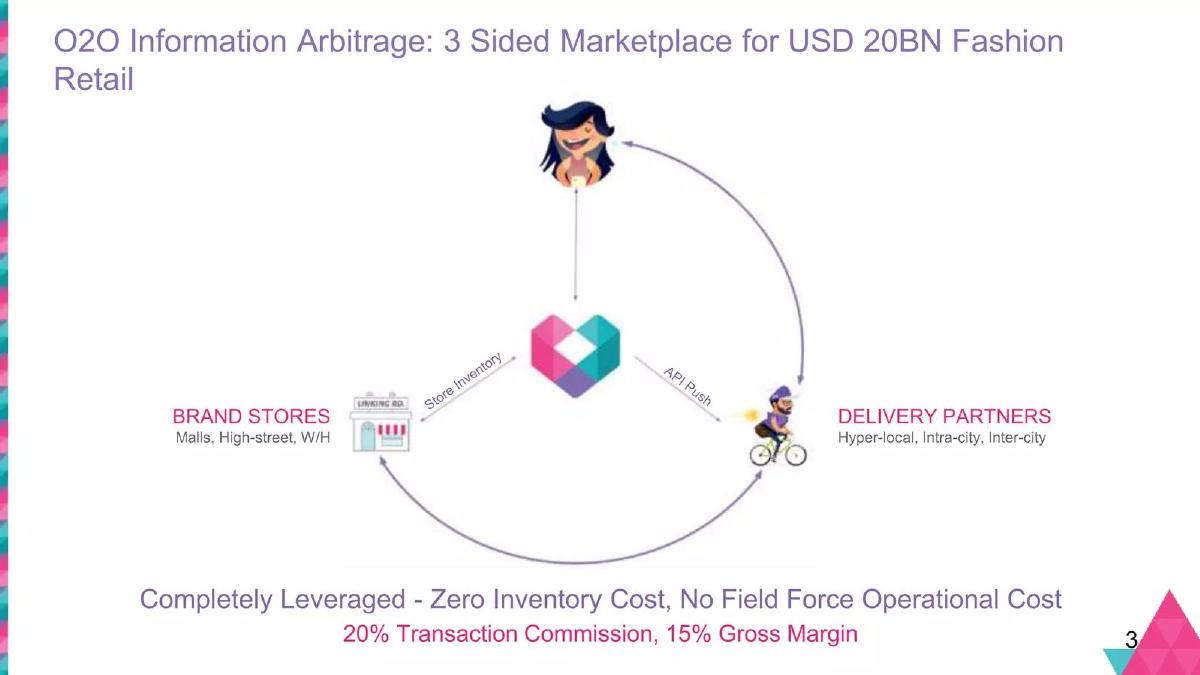
- The business model relies on O2O information arbitrage, connecting brand stores, delivery partners, and customers without holding inventory (Slide 3).
- Fynd claims a 20% transaction commission and a 15% gross margin on its marketplace activities (Slide 3).
- Logistics infrastructure is a core competitive advantage, with 8+ delivery partners and 6,000+ pincodes serviced (Slide 9).
- The platform utilizes a 'Greedy Order Fulfilment' algorithm to optimize store-delivery partner assignment for time and cost (Slide 9).
- Product differentiation includes 'Gravity View,' which allows users to view products by tilting their mobile device (Slide 13).
- The company employs a multi-channel acquisition strategy involving SEO, content commerce, and conversational AI via a bot named Fify (Slide 7, 15).
- Future monetization plans involve evolving into a 'Retail Information Exchange' beyond simple transactions (Slide 19).
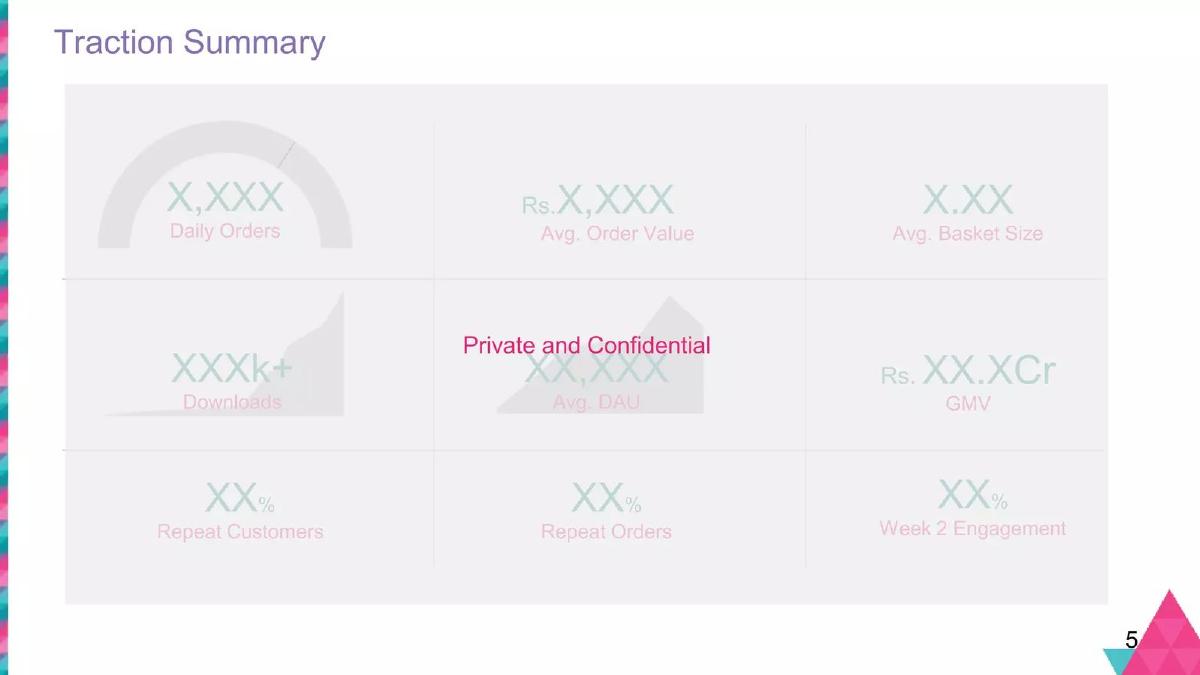
- The deck omits specific financial figures and user growth data in the public version, marking them as 'Private and Confidential' (Slide 5).
Fynd Pre-Series-A Deck Analysis
Fynd’s pitch deck presents a technology-first approach to solving the inefficiencies of the Indian fashion retail market. By positioning themselves as an 'Information Arbitrage' layer rather than a traditional retailer, they emphasize scalability and high margins. The deck is structured to showcase their technical moats—specifically in logistics algorithms and mobile user experience—while keeping their specific traction data confidential in this version.
Slide 1: Title Slide
The deck opens with the company logo and the ambitious mission statement: "Building India’s Largest Fashion Retailer." The footer indicates the document was "Proprietary & Confidential © 2016," providing a clear timeframe for the company's stage and market context.
Slide 3: The O2O Marketplace Model
This slide defines the core business logic. Fynd describes itself as an "O2O Information Arbitrage: 3 Sided Marketplace for USD 20BN Fashion Retail." The diagram shows a circular flow between three entities: BRAND STORES (Malls, High-street, W/H), DELIVERY PARTNERS (Hyper-local, Intra-city, Inter-city), and the consumer. Key financial highlights include a "20% Transaction Commission" and a "15% Gross Margin." The most significant claim here is that the model is "Completely Leveraged - Zero Inventory Cost, No Field Force Operational Cost," which appeals to investors looking for high-efficiency software models.
Slide 5: Traction Summary
Slide 5 is a placeholder for metrics, though the specific numbers are obscured with "X,XXX" or marked "Private and Confidential." The categories tracked are telling of their KPIs: Daily Orders, Avg. Order Value, Avg. Basket Size, Downloads, Avg. DAU, GMV (in Rs. XX.XCr), Repeat Customers, Repeat Orders, and Week 2 Engagement. By including 'Week 2 Engagement,' Fynd signals that they are focused on retention rather than just top-of-funnel acquisition.
Slide 7: Close Looped Digital Habit Strategy
This slide illustrates the ecosystem Fynd has built to acquire and retain users. It includes a "Habit-Forming App" as the primary transaction channel, an "SEO-First Website," and "Content Commerce" via a platform called THE CLOSET . They also mention "Conv. Commerce" (Conversational Commerce) as an activation channel and "Catalog Retargeting" to bring users back. The visual center of the slide highlights their presence across Mobile, Desktop/Search, Messaging, and Social Media (Facebook, Instagram, WhatsApp).
Slide 9: India-Scale Delivery Infrastructure
Logistics is presented as a solved problem. Fynd claims to be "India-Scale Ready" with "6k+ Pincodes Serviceable" and "8+ Delivery Partners." They boast a "2hrs Fastest Delivery Time." The slide introduces their "Greedy Order Fulfilment" algorithm, which is "optimized for both time and cost" when assigning stores to delivery partners. A bar chart shows the distribution of pincodes: 846 for Same Day Delivery, 2,124 for Next Day Delivery, and 3,121 for Two Day Delivery.
Slide 11: Product & Engineering
This slide serves as a transition, featuring a photograph of a whiteboard covered in complex UI/UX sketches and logic flows. It points to blog.gofynd.com , suggesting that the company prides itself on its engineering culture and transparency regarding its technical builds.
Slide 13: Habit-Forming App Features
Fynd highlights five specific features designed to differentiate the user experience:
Mix & Match: India’s only algorithmic look-based shopping app. · For You: Personalized products and collections. · Gravity View: A unique feature to "View products by tilting" the phone. · Universal Size Guide: Normalizing sizes across different brands to reduce returns. · Flashpay: Described as the "industry’s fastest 2-step checkout flow."
Slide 15: Conversational Commerce with Fify
The deck introduces Fify , the "World’s First Fashion Shopping AI Botfriend." At the time of the deck, it was a "Beta v0.1 Weak AI Bot" with a "Clear roadmap to become Strong AI Bot." It is positioned as a "Customer Activation Channel," and the slide mentions a "Long form working paper available on request," indicating a deep technical investment in NLP (Natural Language Processing).
Slide 17: Growth Targets and Recognition
This slide shows a screenshot of the Apple App Store, noting that Fynd was "Featured by the App Store on the homescreen." This serves as third-party validation of their product quality and user appeal.
Slide 19: Future of Fynd
The final content slide outlines the long-term vision. It reiterates that the "Model is exponential scale ready" and aims to be the "First port of call for fashion discovery and transaction." It explicitly mentions "Global Expansion" into "mall friendly geographies - MEA, SEA." Finally, it suggests a pivot or expansion into becoming the "Largest Retail Information Exchange," creating "New avenues for monetization" by selling data or insights derived from their O2O network.
What Works in the Fynd Deck
The deck excels at defining a clear, asset-light business model in a sector (fashion retail) that is traditionally capital-intensive. By labeling their model 'Information Arbitrage,' they immediately signal to investors that they are a technology company, not a logistics company. The emphasis on 'Greedy Order Fulfilment' and 'Gravity View' provides tangible examples of their technical moat. Furthermore, the focus on O2O (Online-to-Offline) addresses a specific market gap in India where physical inventory in malls was often disconnected from digital shoppers.
What is Missing from the Fynd Deck
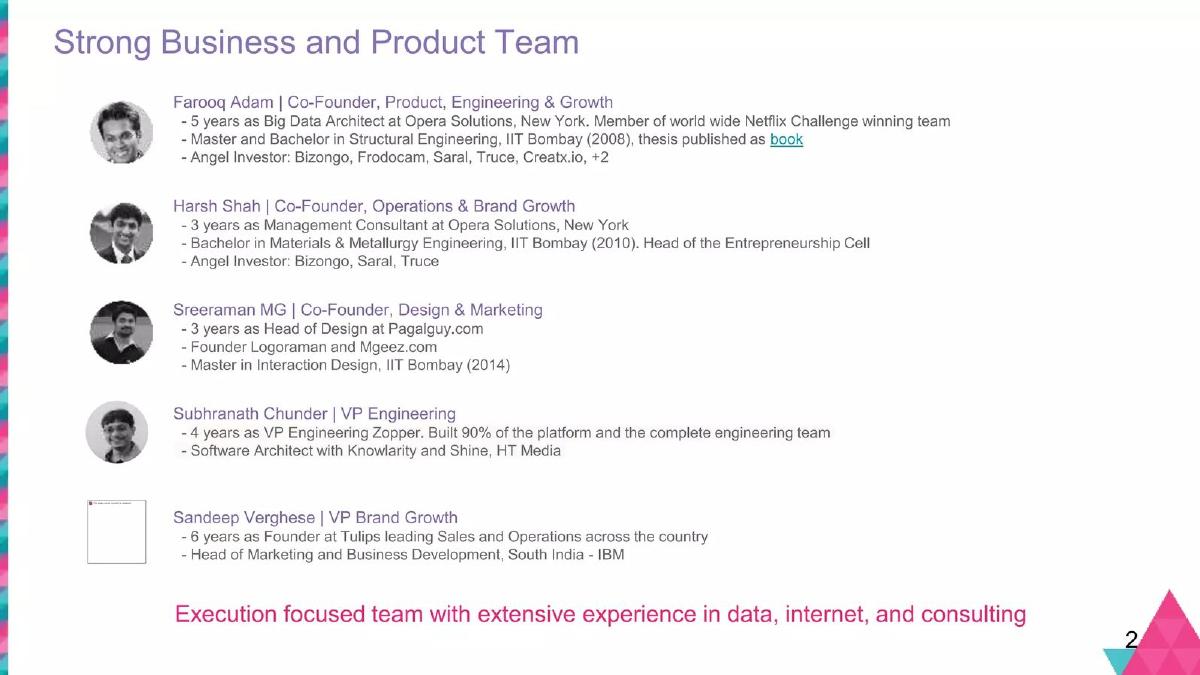
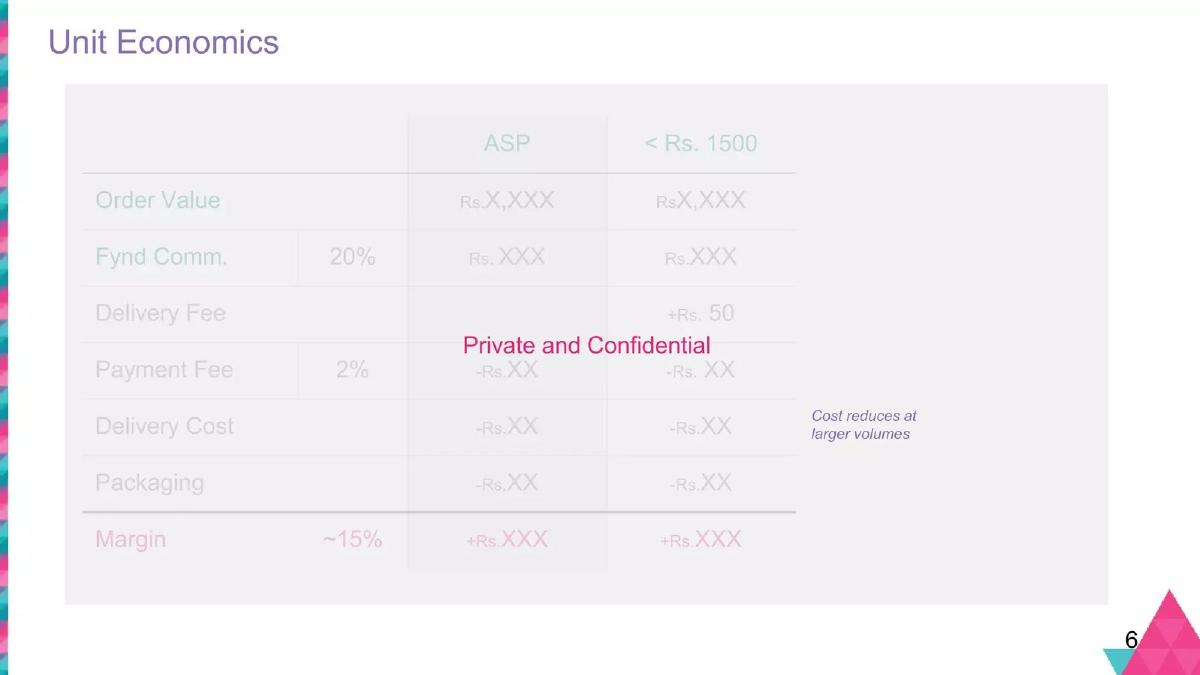
The most glaring omission is the actual traction data. While the categories are listed on Slide 5, the redaction makes it impossible to evaluate their growth rate or unit economics from these slides alone. Additionally, there is no Team Slide in the provided selection, which is critical for a Pre-Series-A round where the founders' pedigree is a major factor. There is also no Competition Slide ; while they mention being the 'only' algorithmic look-based app, they do not address how they defend against major incumbents like Myntra or Ajio. Finally, the Fundraising Ask and Use of Funds are absent from this set of slides.
Founder's Guide: What to Copy
Founders should emulate Fynd's ability to turn operational processes into proprietary technology. Instead of just saying "we have fast delivery," they branded their logic as "Greedy Order Fulfilment." This transforms a standard business function into an intellectual property asset. The use of a 'habit-forming' framework (Slide 7) is also a strong way to communicate a marketing strategy; it shows the investor that the company isn't just buying ads, but building a self-sustaining ecosystem of SEO, content, and retargeting.
Frequently asked questions
- What is Fynd's core business model?
- Fynd operates as a three-sided O2O (Online-to-Offline) marketplace. It connects physical brand stores (malls, high-street, and warehouses) with customers through a digital platform, utilizing third-party delivery partners for fulfillment. The model is asset-light, meaning Fynd does not own inventory or a delivery fleet, instead earning a 20% commission on transactions.
- How does Fynd handle logistics and delivery?
- Fynd uses an algorithmic 'Greedy Order Fulfilment' system to assign orders to one of its 8+ delivery partners. This system is optimized for both speed and cost. According to the deck, they can deliver in as little as two hours and have the infrastructure to service over 6,000 pincodes across India.
- What are the unique features of the Fynd mobile app?
- The app includes several 'habit-forming' and gamified features. Notable among these is 'Gravity View,' which uses device sensors to let users see different angles of a product by tilting their phone. It also features an algorithmic 'Mix & Match' shopping tool and a 'Universal Size Guide' to normalize sizing across different brands.
- What is 'Fify' and how does it fit into the strategy?
- Fify is described as the 'World's First Fashion Shopping AI Botfriend.' It serves as a conversational commerce and customer activation channel. While the deck notes it was in Beta (v0.1) at the time of the pitch, the goal was to move from a 'Weak AI Bot' to a 'Strong AI Bot' to drive engagement and sales.
- What are Fynd's plans for future growth?
- Beyond scaling within India, Fynd aims for global expansion into regions with high mall density, specifically the Middle East and Africa (MEA) and Southeast Asia (SEA). Long-term, they intend to leverage their data to become a 'Retail Information Exchange,' creating new avenues for monetization beyond direct sales commissions.