FútbolFitClub, a Latin American company selling indoor soccer training sessions for adults, exported an eight-slide Apple Keynote deck on 1 June 2017 whose PDF metadata carries the single title 'FFC Deck'. It is a demo-day deck rather than a fundraising deck, and it is unusual in this series because the traction is real: over 2,000 sessions delivered, over 3,000 people trained and over $100,000 in revenue. Everything an investor would need to act on that is missing. There is no price, package or margin anywhere in the file; no time period on any traction figure, so no growth rate can be deriv…
Key takeaways
- FútbolFitClub's 2017 deck is eight slides exported from Apple Keynote on 1 June 2017, titled only 'FFC Deck' in its metadata, pitching indoor soccer training sessions for adults in Latin America.
- The deck reports real traction — over 2,000 training sessions, over 3,000 people trained and over $100,000 in revenue — but attaches no time period to any of the three figures, so no growth rate can be calculated.
- $100,000 of revenue across 3,000 people is roughly $33 per customer lifetime, a trial-level figure for a recurring fitness service, and the deck contains no retention or repeat-attendance metric anywhere.
- There is no business model slide: across eight slides about a physical services company, no price, membership tier, session cost, venue cost or gross margin is ever stated.
- The competition slide is a five-row checkbox grid on which FFC scores 5/5 and the nearest competitor scores 2/5, and two of its winning rows — 'TECH' and 'MEASURABLE' — are supported by no screenshot or measured outcome in the file.
- The founders slide shows three portraits labelled CEO, CTO and COO with no names, no backgrounds and no contact details, alongside TechCrunch, Wayra, Web Summit and YLAI logos with no stated relationship to any of them.
- The deck's strongest asset is its tagline, 'Taking work out of workout', which compresses the entire product thesis into six words, and its sharpest slide is the three-word 'GYM = BORING' that should have carried a sourced gym-attrition figure.
- The deck ends on the team slide with no funding ask, no use of funds and no contact information, meaning a company with six figures of revenue never actually asks an investor for anything.
What this deck actually is
Eight slides, 1024 x 768 points — 4:3 , built in Apple Keynote and exported through Quartz on Mac OS X 10.10.4 on 1 June 2017 at 21:23 UTC . The PDF metadata carries a title and nothing else: "FFC Deck" . No author, no company field, no subject. The file is 11 MB — enormous for eight slides — because almost every page is a full-bleed photograph of people playing indoor football with a red brand bar laid over the top.
FútbolFitClub is a Latin American fitness company that sells indoor soccer training sessions for adults . The deck is the short, visual, conference-stage kind: one idea per slide, no paragraphs, no appendix, no financial model. Read it end to end and you get a problem, a cultural observation, a product sentence, two market numbers, a checkbox competition grid, three traction circles and three unnamed faces. That is the entire file.
Classify it honestly: this is a demo-day or pitch-competition deck , not a fundraising deck an investor could diligence. The distinction matters because it changes what counts as a flaw. On a stage, with a founder speaking over it, eight slides in this order is close to ideal — the deck is a backdrop and the founder is the argument. Emailed to an investor with no voiceover, the same eight slides are missing the four things that decide a cheque: a business model, unit economics, a funding ask and the founders' names .
And here is what makes this deck genuinely interesting rather than just thin. FútbolFitClub is one of the few decks in this series that arrives with real money already collected . Slide 7 says +$100K in revenue , +2K training sessions and +3K people trained . That is not a projection, not a pilot, not a letter of intent. It is a business that has taken cash from thousands of customers. Almost every deck we tear down would kill for that slide — and this deck spends one page on it, adds no time period, no repeat rate and no price, and then closes on three photographs with no names under them.
Slide-by-slide walkthrough
Slide 1 — Cover
The FútbolFitClub wordmark and hexagonal ball logo over a photograph, with one line: "Taking 'work' out of workout" .
This is the best line in the deck and one of the better taglines in this entire teardown series. It is six words, it is a pun that actually carries meaning rather than decorating it, and it states the whole product thesis : the company's claim is not that its training is more effective than a gym, it is that the training does not feel like training. Everything downstream — the boring-gym slide, the fun column in the competition grid, the retention argument that the deck never quite makes — is contained in those six words.
What the cover lacks is the standard email-attachment furniture: no date, no round, no location, no descriptor . A reader who has never heard of FútbolFitClub does not learn from this page what country it operates in, and for a company whose entire market slide is about LATAM, that is a real omission. The scare quotes around "work" also do the joke a small disservice — the line is strong enough to land without punctuation pointing at it.
Slide 2 — Problem
One statistic: "1.9 billion people are overweight" , attributed to the WHO .
The sourcing instinct is right — naming the World Health Organization in-line costs nothing and buys credibility, and most decks in this series do not bother. But the number is doing the wrong job. 1.9 billion is not this company's problem; it is the problem of every fitness company that has ever existed , plus the pharmaceutical industry, plus public health ministries. A problem slide that would apply verbatim to Peloton, WeightWatchers, Zumba and a municipal swimming pool has not told the investor anything about FútbolFitClub.
The specific problem is one slide away and the deck knows it — slide 3 is the real problem. The strongest version of this page merges the two: people who need to exercise do not fail because they do not know they should; they fail because they quit. Gym attrition is roughly half of joiners within six months. That is a problem statement with a business in it, and the fix is a sourced retention figure rather than a sourced obesity figure.
Slide 3 — Context
This is the deck's real insight and it is delivered with more confidence than anything else in the file. Three words, one equals sign, no bullets. Standing on a stage, this slide works perfectly — the audience laughs in recognition and the founder has bought thirty seconds of goodwill.
On paper, the same three words are an assertion where the deck's most defensible number should be . Gym churn and attendance decay are among the most studied and most quoted statistics in the fitness industry; the drop-off after January, the percentage of members who never attend, the median months-to-cancellation are all figures a founder in this business would already have on hand. One of them, placed under "GYM = BORING", converts the deck's central claim from an opinion into evidence — and, crucially, converts it into a market failure with money attached : every cancelled membership is revenue a more engaging format could have kept. Labelling the slide "Context" rather than "Problem" also undersells it. This is the problem. The obesity slide is the context.
Slide 4 — Solution
One sentence in capitals: "INDOOR SOCCER TRAINING SESSIONS FOR ADULTS" .
Clear, concrete, unpretentious — and the two qualifiers are the ones that matter. "Indoor" means the product is a scheduled, weather-independent, venue-based session rather than a pickup game, which is what makes it sellable as a recurring service. "For adults" is the sharper of the two: youth football academies are a crowded, low-margin, parent-funded category, and the deck is explicitly not in it. The target is the thirty-something who played as a teenager, has not touched a ball in a decade, and will show up for football when they will not show up for a treadmill.
What the slide does not say is how any of this is bought . Is it a membership, a class pack, a per-session drop-in, a corporate contract? Where does it happen — owned venues, rented pitch time, partner clubs? Who runs the session, and are they employees or contracted coaches? The deck's own traction slide implies the answer exists (2,000 sessions have already happened somewhere, run by someone), and the solution slide is where a reader expects to find it. This is the single biggest structural gap in the file: an eight-slide deck about a services business with no slide describing how the service is delivered or sold .
Slide 5 — Opportunity
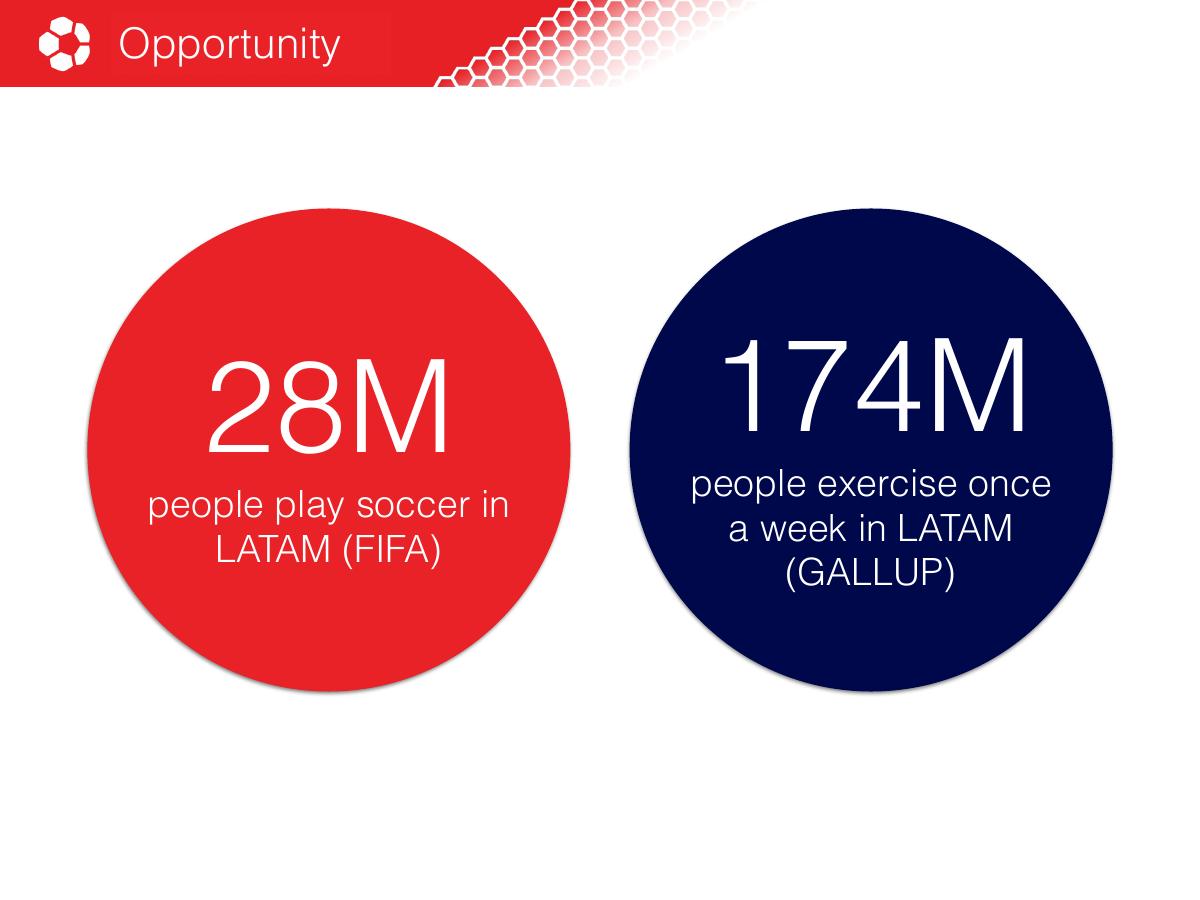
Two figures, each sourced: 28M people play soccer in LATAM (FIFA) and 174M people exercise once a week in LATAM (GALLUP) .
Two named sources on one slide is more rigour than most decks manage anywhere, and the choice of a two-number frame is smart in principle: one number for the sport, one for the habit. The intersection of "plays football" and "exercises weekly" is a much better description of this company's customer than either number alone.
But the slide leaves the intersection to the reader and, worse, never converts either figure into money . Neither 28 million nor 174 million is a market size — they are population counts. A market size requires a price, and the deck never states one. This is the arithmetic that was sitting right there and was not done: the deck already knows its revenue ( $100K ) and its customers ( 3,000 people trained ). That is roughly $33 of revenue per person to date . Multiply an honest annual value per active member by a defensible slice of the 28 million and you have a bottom-up market number built entirely from the company's own data, on a slide that currently contains none of it.
The second omission is geographic honesty . "LATAM" is not a market a single indoor-football operator addresses; it is nineteen countries, nineteen regulatory regimes and nineteen real estate markets. The deck never names the city or country it operates in. A reader cannot tell whether this is one venue in one city or a regional chain, which makes the LATAM-wide figures read as ambition rather than plan. Naming the home market and showing the number of venues would have made the same slide far stronger, not weaker.
Slide 6 — Competition
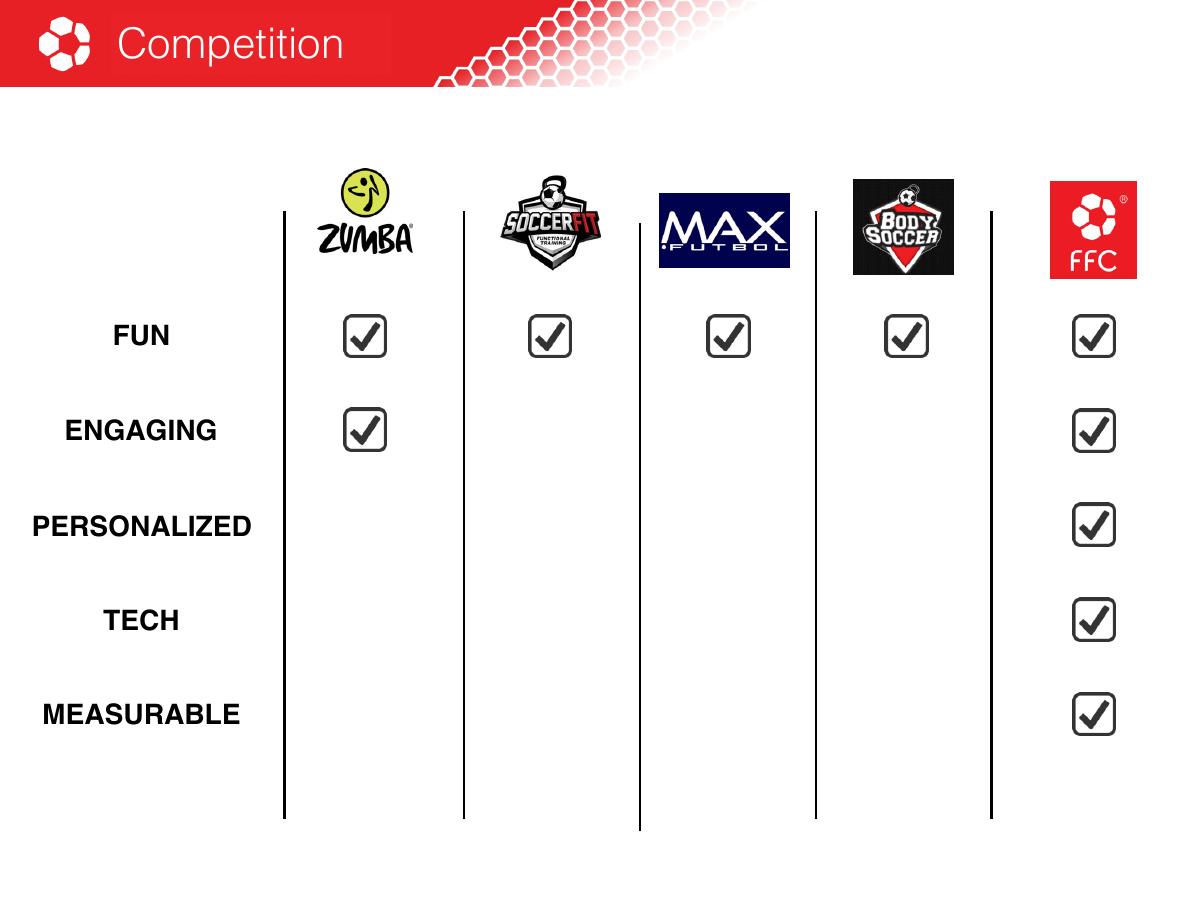
A five-column checkbox grid. Competitors: Zumba, SoccerFit Functional Training, MAX Fútbol, Body Soccer , and FFC . Rows: FUN, ENGAGING, PERSONALIZED, TECH, MEASURABLE . Every competitor gets a tick on FUN. Zumba additionally gets ENGAGING. FFC gets all five.
This is the most common self-inflicted wound in startup pitching, and FFC has the textbook version: a grid where the company scores 5/5 and the nearest competitor scores 2/5 . Every experienced investor has seen several hundred of these and discounts them automatically, because the axes were chosen after the winner was known. The tell is that the row set is unfalsifiable — no competitor would concede it is not "fun" or not "engaging", and none of the five rows is a fact anyone could check.
The choice of competitors is genuinely good, though, and deserves credit. Naming Zumba is the sophisticated move in the file: it says the company understands it competes in group fitness formats , not in football, and Zumba is the proof that a fun format can scale globally through licensed instructors. Listing three direct football-fitness operators alongside it also quietly rebuts the "no competition" fantasy — this founder knows the field.
Two rows are unsupported by anything else in the deck. TECH is claimed as a differentiator, and there is not a single product screenshot, app image or interface anywhere in these eight slides . MEASURABLE is claimed, and no measurement of any customer appears either — no fitness outcome, no attendance data, no progress metric. The deck ticks two boxes it never opens. If FFC really has an app tracking player performance, that is arguably the most investable thing about the company and it deserves its own slide; if it does not, those two ticks are the fastest way to lose a reader who does the checking.
Slide 7 — Traction
Three coloured circles: +2K training sessions , +3K people trained , +$100K in revenue .
Real numbers, real money, and the visual treatment is clean. After six slides of assertion, this page changes the conversation entirely — this is an operating business, not a concept. Any investor reading the deck starts here on the second pass.
And then the slide answers none of the questions it raises. Over what period? $100K in twelve months and $100K in four years are different companies, and the deck does not say which one this is. Without a time axis, three impressive-looking circles cannot be turned into a growth rate, and a growth rate is the only thing an early-stage investor is actually buying.
The internal ratios are also left unexamined, and they are the most interesting numbers in the deck. 3,000 people across 2,000 sessions — for a group format, that implies a small average group size and, read the other way, a customer base that is much wider than it is deep. $100,000 across 3,000 people is about $33 each, lifetime . For a recurring fitness service, $33 of lifetime revenue per customer is a trial number, not a membership number, and it points straight at the thing the deck never mentions: retention . A company whose entire thesis is "gyms are boring, so people quit them" has published no evidence that its own customers do not also quit. The one metric that would prove the pitch — repeat attendance, or monthly retention versus a gym benchmark — is the metric missing from the traction slide.
Slide 8 — Founders
Three black-and-white portraits labelled CEO , CTO and COO , above a row of four logos: TechCrunch , Wayra , Web Summit and YLAI (Young Leaders of the Americas Initiative) .
Three co-founders with clearly divided roles is a good structure to show, and the age mix visible in the photographs — two apparently younger founders and one visibly senior — usually signals exactly the operator-plus-experience combination investors like. The logo row is doing real work too: Wayra is Telefónica's accelerator and a meaningful LATAM signal, and YLAI is a US State Department fellowship that is genuinely competitive.
Then the slide throws all of it away. There are no names. Not one of the three founders is identified — no name, no prior company, no years of experience, no LinkedIn, no email. An investor who wants to look this team up cannot, and an investor who cannot look a team up cannot invest. This is the most expensive single omission in the deck, because the team slide is the one page a seed investor reads hardest.
The logo row has the same problem in milder form: the relationship is never stated . Was FFC in the Wayra portfolio, or did it pitch at a Wayra event? Was it covered by TechCrunch, or did a founder attend Disrupt? Did it exhibit at Web Summit, or win something? Unlabelled logos are read by experienced investors as the weakest true version of the claim, which is a shame when at least one of these is probably a strong one. One line under each logo — "Wayra Colombia, 2016 cohort" — is the difference between decoration and evidence.
And the deck ends here. No ask slide, no use of funds, no contact details. A company with $100K of revenue and no stated need for money has, functionally, not asked for anything — so the most likely outcome of sending this deck is a polite reply and no meeting.
What this deck does better than most startup pitch decks
The tagline actually contains the thesis. "Taking 'work' out of workout" is not decoration — it is the product argument, compressed to six words, and everything else in the deck is downstream of it. · It is eight slides long. Ruthless compression is rare and valuable. There is no filler slide, no roadmap fantasy, no "why us" page of adjectives. · Two market figures, two named sources. FIFA and Gallup, cited in-line. Most decks in this series assert their market numbers with no attribution at all. · It shows real revenue. $100K collected from 3,000 real customers puts FFC ahead of the overwhelming majority of decks that reach a seed investor's inbox. · The competitive set is chosen intelligently. Putting Zumba beside three football-fitness operators shows the founder understands they are selling a group-fitness format , not a sport. · "For adults" is a real positioning decision. Explicitly excluding the youth academy market is a sharper act of targeting than most decks perform anywhere. · The visual system is consistent. One red brand bar, one logo, full-bleed photography of the actual product being used by actual customers. The deck looks like a company.
Where this deck would fail in an investor meeting
No business model. Eight slides about a services company and not one price, package, membership tier or revenue line. · No unit economics. No cost per session, no venue cost, no coach cost, no contribution margin. A physical-format business lives or dies on these. · No time period on the traction. Three good numbers with no denominator cannot produce a growth rate. · No retention data — in a deck whose entire premise is that competitors fail at retention. · No founder names. Three portraits and three job titles. The team cannot be verified, contacted or looked up. · No funding ask and no use of funds. The deck never says what it wants or what the money buys. · No contact details anywhere , including on the final slide. · No home market named. "LATAM" is nineteen countries; the deck never says which one it operates in, or how many venues it runs. · A self-scored competition grid where FFC wins 5/5 on five unfalsifiable rows. · Two claimed differentiators with zero evidence. "TECH" and "MEASURABLE" are ticked, and no product interface or measured outcome appears in the file. · Unlabelled credibility logos. TechCrunch, Wayra, Web Summit and YLAI with no stated relationship to any of them. · An obesity statistic in the problem slot , which describes the entire fitness industry rather than this company's wedge.
Stage deck versus investor deck: what changes
Element FFC's deck (stage format) What an investor deck needs
Problem 1.9bn overweight (WHO) Gym attrition rate, sourced — the churn the product prevents
Insight "GYM = BORING" Same line, with the drop-off statistic underneath it
Solution Indoor soccer sessions for adults Same, plus delivery model: venues, coaches, session format
Market 28M players, 174M weekly exercisers Bottom-up: target members x annual value, in the home market first
Business model Absent Price per member or pack, gross margin per session, venue payback
Competition 5-row checkbox grid, FFC wins all Two verifiable axes, with FFC losing at least one of them
Traction +2K sessions, +3K people, +$100K The same three, by month, plus repeat rate and active members
Team CEO / CTO / COO photos, no names Names, one credential line each, and what each has previously operated
Ask Absent Amount, runway, and the three things the money buys
How you would rebuild this deck in an afternoon
Swap the problem slide. Replace the obesity figure with a sourced gym-attrition figure. The obesity number becomes a footnote on the same page. · Promote "GYM = BORING" to the problem slot and put the churn number under it. Same three words, now evidenced. · Add a business-model slide between solution and market. Price, package, where sessions happen, who coaches them, gross margin per session. This is the missing page, and the company already knows every number on it. · Rebuild the market slide bottom-up. Keep FIFA and Gallup at the top, then: target members in the home city x annual revenue per member = a real, defensible number. Name the country. · Put a time axis on traction. Turn the three circles into a monthly chart of sessions and revenue. If the trend is good it does more work than every other slide combined; if it is flat, the founder needs to know that before an investor tells them. · Add the retention metric. Repeat attendance, or monthly member retention against a gym benchmark. This single number is the proof of the entire thesis, and it is the one an investor will ask for in the first five minutes. · Cut the competition grid to two axes that can be checked — for example, price per session versus 90-day retention — and let FFC lose one of them. A grid you can lose is a grid an investor believes. · Show the product if "TECH" stays. One screenshot of whatever tracks the sessions. If there is no interface, delete the TECH and MEASURABLE rows. · Put names on the founders. Name, one credential line, one previous operating role. Label the logos with the relationship and the year. · Add slide 9: the ask. Amount, months of runway, and the specific milestones — venues opened, members added, retention target — the round is meant to reach. Add contact details on the same page.
The transferable lesson
FútbolFitClub's deck is the opposite of most decks in this series, and that is what makes it useful. The usual failure is a company with nothing pretending to have something: forty slides, a hockey-stick projection, a TAM the size of a continent and no customers. FFC has the reverse problem. It has thousands of real customers, thousands of delivered sessions and six figures of collected revenue — and it has built a deck that makes those facts look like three coloured circles on page seven, sandwiched between a self-scored grid and three anonymous portraits.
The deck never states a price, never names a city, never names a founder and never asks for money. Every one of those is a fact the company already possesses. Nothing on the fix list requires new traction, a new product or a better business — it requires writing down what is already true .
That is the lesson worth carrying into your own deck. The most common reason a good company reads as a weak one is not exaggeration; it is omission . Investors do not fill gaps generously. A missing price is read as "no pricing power". A missing time period on a revenue number is read as "the number took a long time". A missing founder name is read as "there is nothing to look up". A missing ask is read as "not really raising". FFC's deck is eight slides of good instincts with the evidence left out — and the version of it that gets funded is the same eight slides, with the numbers the founders already know written on them.
Frequently asked questions
- What is FútbolFitClub (FFC)?
- FútbolFitClub is a Latin American fitness company that sells indoor soccer training sessions for adults, positioned as an alternative to the gym under the tagline 'Taking work out of workout'. Its 2017 deck reports more than 2,000 sessions delivered, more than 3,000 people trained and more than $100,000 in revenue, with no time period attached to those figures.
- Is the FútbolFitClub deck a good pitch deck for investors?
- It works as a stage or demo-day deck and fails as an investor deck. Eight slides deliver a strong tagline, two sourced market figures and real revenue, but there is no business model, no unit economics, no retention data, no founder names, no funding ask and no contact details, so an investor has nothing to diligence and no way to reach the team.
- Which slides from the FFC deck should founders copy?
- The cover and the context slide. 'Taking work out of workout' states the product thesis in six words rather than decorating it, and 'GYM = BORING' delivers the company's central insight in three words with no bullets. Also copy the competitive set: naming Zumba alongside three football-fitness operators shows the founder understands they sell a group-fitness format, not a sport.
- What is the biggest mistake in the FútbolFitClub pitch deck?
- Showing real revenue with no time period and no retention figure. Over $100,000 collected from over 3,000 customers is roughly $33 each lifetime, which reads as trial behaviour rather than membership behaviour — and a company whose whole thesis is that gyms lose people to boredom has published no evidence that its own customers come back.
- Why is a checkbox competition grid a problem in a pitch deck?
- Because the axes are chosen after the winner is known. FFC scores 5/5 on fun, engaging, personalized, tech and measurable while the nearest competitor scores 2/5, and no competitor would concede any of those rows. Investors discount these grids automatically. Two verifiable axes — such as price per session versus 90-day retention — where the company loses one are far more persuasive.
- What would make an investor reject the FFC deck?
- No price, no margin, no time period on the traction numbers, no retention metric, no home market named despite a LATAM-wide market slide, no founder names on the team slide, unlabelled credibility logos, and no funding ask or contact details anywhere in the file. The company appears real and fundable; the deck gives an investor nothing to act on.