FunkySwap is a conceptual bartering platform that positions itself as the 'Hyperloop of bartering.' The deck focuses on solving the friction of traditional classified ads by using a gamified interface where users 'sit' at a virtual table to 'grab' items. The startup presents validation through a flash survey of 400+ people in Hungary, claiming 95% of respondents would pay for extra features if the items were 'funky.' The financial ask is modest at $100,000, intended for early-stage development and hiring a 'hacker.' However, the deck lacks a formal team slide, specific unit economics, or a de…
Key takeaways
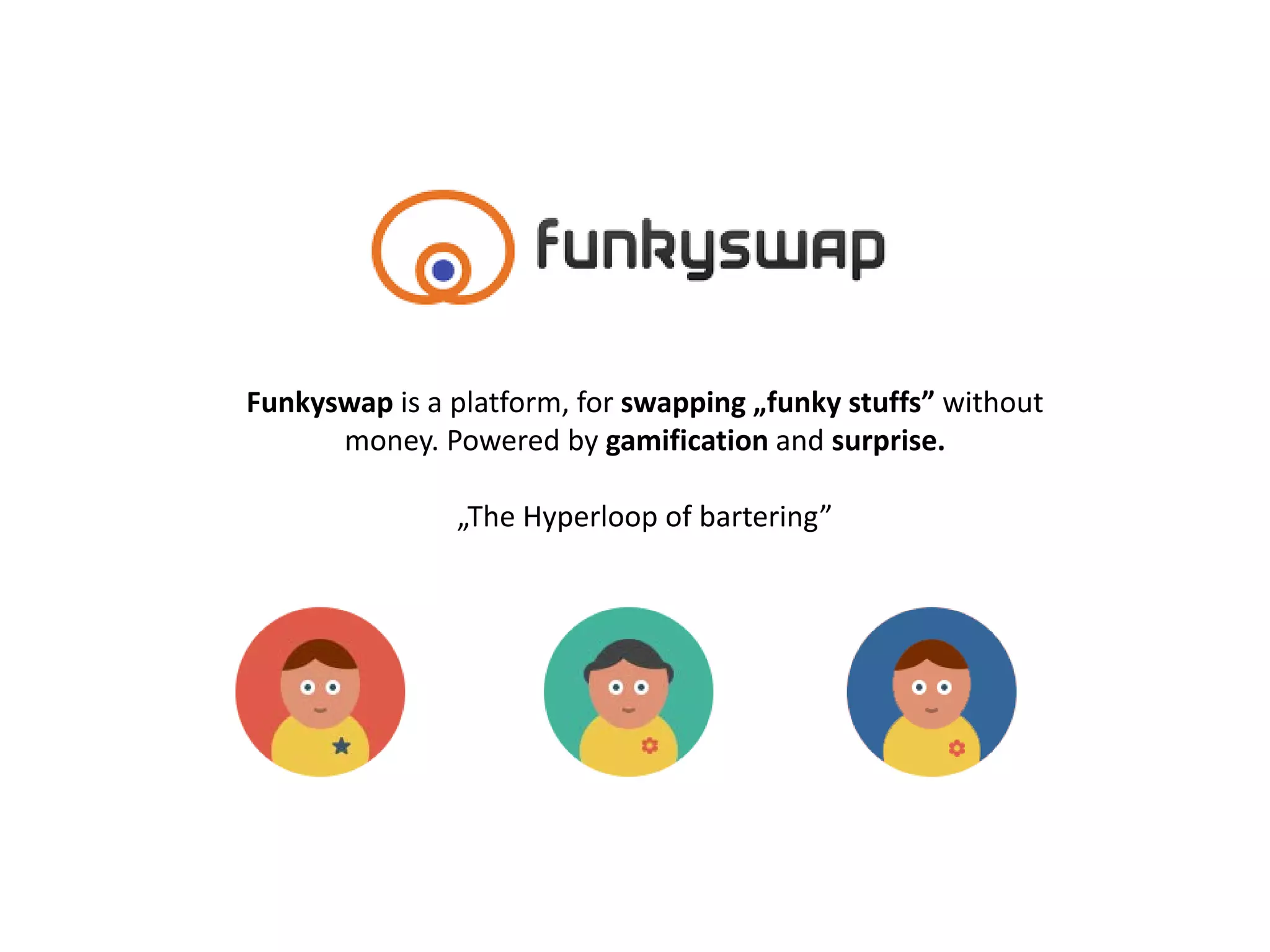
- The company describes itself as a platform for swapping 'funky stuffs' without money, utilizing gamification and surprise (Slide 1).
- Validation is based on a flash survey of 400+ people in Hungary, targeting the 18-49 age demographic (Slide 3).
- Survey data claims 74% of people possess needless goods, with 50% of those items valued between $100 and $500 (Slide 3).
- The product interface is modeled after a poker table where users 'Sit,' 'Mark,' and 'Grab' items within a 5-minute window (Slide 4).
- The target market is derived from eBay's user base, citing a TAM of 112.3 million active users (Slide 6).
- The startup aims for 10,000 early adopters and a Serviceable Obtainable Market (SOM) of 500,000 active users within two years (Slide 6).
- The immediate funding requirement is $100,000 USD for early-stage fundraising and hiring a 'hacker' (Slide 7).
- The deck omits a dedicated team slide, failing to list founder names, backgrounds, or previous experience (Slide 1-8).
Executive Summary: The Gamification of Barter
FunkySwap presents a conceptual pivot for the secondary goods market. By moving away from the 'cumbersome' nature of classified ads and auctions, the company proposes a high-speed, gamified bartering system. The deck, while visually simple, relies on the psychological triggers of 'surprise' and 'urgency' to differentiate itself from established players like eBay. However, the presentation is very early-stage, focusing more on user sentiment surveys than on technical architecture or a robust financial path to profitability.
Slide 1: Title and Vision
The opening slide introduces the brand 'FunkySwap' with a logo consisting of concentric orange circles. The tagline defines the service as a platform for swapping 'funky stuffs' without money, powered by 'gamification and surprise.' Most notably, it uses the analogy 'The Hyperloop of bartering,' suggesting a focus on speed and modern efficiency. The slide features three stylized avatars, which reappear throughout the deck, though no names are attached to them here.
Slide 2: The Problem Statement
Slide 2 outlines the friction in the current peer-to-peer commerce market. It notes that people possess 'useless goods' that are valuable to others but find current ad sites 'cumbersome' and prone to selling 'below cost.' The slide identifies four specific pain points: traditional barter sites are too local, valuations are unrealistic, supply and demand rarely meet (described as 'rare as a white crow'), and the browsing experience is 'sooo boring!!!' This sets the stage for a solution that prioritizes entertainment and global reach.
Slide 3: Market Validation
Validation is presented through three data points derived from a 'flash survey' of 400+ people in Hungary (Basis TG Hungary 18-49 ESOMAR ABC1). Slide 3 claims that 74% of people possess needless goods, with half of those items falling in the $100-$500 value range. 85% would swap with strangers for equal value, and 95% expressed a willingness to pay for 'extra features' if the items were 'funky.' This slide attempts to prove that a willingness to pay exists even in a 'moneyless' swapping environment.
Slide 4: The Painkiller - Product Mechanics
This slide illustrates the 'Gamify it!' solution. The interface is depicted as a green poker table. The user journey is broken into three steps: Sit (items appear based on interest), Mark (users select items they like), and Grab (users must take the item or release it within 5 minutes). The slide shows item cards for a guitar and headphones, each featuring a 'Funkymeter,' 'Pricemeter,' and 'Photometer.' This suggests a multi-dimensional rating system for goods beyond just a flat price.
Slide 5: Customer Acquisition Strategy
The growth strategy is presented as a four-quadrant map centered around 'WOM' (Word of Mouth). The four pillars are: 1. Social network activity, 2. Crowdfunding campaign, 3. Viral video, and 4. SEO and affiliate marketing. This is a standard, albeit generic, marketing mix for a B2C social platform. The inclusion of a crowdfunding campaign as a primary acquisition channel aligns with the 'Advice' requested later in the deck.
Slide 6: Target Market (TAM/SAM/SOM)
Slide 6 uses a nested circle diagram to quantify the opportunity. It uses eBay as the primary benchmark. TAM is cited as 112.3M active eBay users. SAM is 61.7M active non-corporate eBay users. The SOM is 500K active users within two years, with a starting goal of 10,000 early adopters. By anchoring to eBay's numbers, the founders are attempting to show a massive existing pool of users who are already comfortable with online secondary markets.
Slide 7: The Ask and Roadmap
Titled 'Needs AAAA+,' this slide uses a battery graphic to show progress and requirements. The company is seeking $100K USD for 'Early stage fundraising.' The roadmap is divided into four stages: Accelerate, Advice, Acquire, and Achieve. Specific needs listed include 'How to launch a successful crowdfunding campaign' and hiring 'A Hacker ASAP.' The final goal is reaching 'The round A and go further.'
Slide 8: Contact and Closing
The final slide repeats the avatars from the cover and provides contact information, including a website (www.funkyswap.com), a Hungarian phone number, and a Gmail address. The use of a Gmail address rather than a corporate domain email suggests the company is in the very earliest stages of formation.
What Works in This Deck
Clear Value Proposition: The 'Hyperloop of bartering' and the poker table analogy make the product's unique selling point immediately understandable. · Urgency Mechanics: The 5-minute 'grab or release' rule is a specific product feature that addresses the 'boring' browsing problem identified in the problem slide. · Specific Validation Data: Citing a survey of 400+ people with specific demographics (ESOMAR ABC1) provides more weight than generic market claims. · Modest Ask: A $100k ask is realistic for a concept-stage startup looking to build a Minimum Viable Product (MVP).
What is Missing from This Deck
Team Slide: This is the most critical omission. Investors fund people, not just ideas. There is no information on who the founders are or if they have the technical ability to build a gamified marketplace. · Business Model: While Slide 3 mentions that 95% would 'pay for extra features,' the deck never explains what those features are or how the company will actually generate revenue. · Competitive Landscape: The deck mentions eBay as a market size benchmark but doesn't explain how FunkySwap will compete with other swap sites or local marketplaces like Facebook Marketplace or Olx. · Unit Economics: There is no mention of Customer Acquisition Cost (CAC) or Lifetime Value (LTV), which are vital for a platform relying on 'viral' growth. · Technical Roadmap: The request for a 'Hacker ASAP' suggests no code has been written yet, but a slide detailing the tech stack or development milestones would add credibility.
Founder's Guide: What to Copy and What to Avoid
Copy the simplicity of the problem/solution fit. FunkySwap does a good job of identifying a specific emotional state (boredom/frustration with ads) and offering a specific emotional counter-measure (gamification/surprise). The use of a familiar mental model (the poker table) helps investors visualize the user experience without needing a live demo.
Avoid the lack of professional branding. Using a Gmail address on the final slide and omitting founder names creates an impression of an amateur project rather than a high-growth startup. Furthermore, 'viral video' is rarely a reliable acquisition strategy to present to investors without a proven track record of creating viral content. Finally, always include a team slide; even if the team is small, their backgrounds are the most important validation of the project's potential success.
Frequently asked questions
- What is the core product hook for FunkySwap?
- The core hook is the gamification of bartering. Instead of a standard list-based marketplace, Slide 4 shows a 'poker table' interface. Users see items appearing at the table based on their interests. They have a 5-minute window to 'grab' a 'must-have' item or release it, creating a sense of urgency and play that traditional classified sites like eBay or Craigslist lack.
- How does FunkySwap validate the market demand?
- Validation is provided on Slide 3 through a 'flash survey' of over 400 individuals in Hungary. The data suggests a high propensity for bartering, with 85% of respondents willing to give items to 'unknown fellows' in exchange for something of equal value. Most notably, it claims 95% would pay for premium features, though these features are not defined in the slides.
- What is the specific fundraising ask and use of funds?
- On Slide 7, the company identifies a need for $100,000 USD in early-stage fundraising. The 'battery' graphic indicates this capital is for the 'Accelerate' phase. Specific needs mentioned include hiring a 'hacker' (developer) immediately and seeking advice on how to launch a successful crowdfunding campaign to further the project's reach.
- Who is the intended target audience for this platform?
- Slide 6 defines the target market as active eBay users. The Total Addressable Market (TAM) is listed as 112.3 million users, while the Serviceable Addressable Market (SAM) is 61.7 million 'non-corporate' eBay users. The company sets a short-term goal of 10,000 early adopters, scaling to 500,000 active users within a two-year timeframe.
- What critical information is missing from the FunkySwap deck?
- The deck is missing a Team slide, which is a significant red flag for investors who need to know the founders' technical and business capabilities. It also lacks a clear Business Model slide explaining how the company generates profit beyond 'extra features,' and there is no mention of unit economics, burn rate, or a detailed roadmap for technical development.