Marketplace Team Slides: 6 Real Pitch Deck Examples
How marketplace founders show they can build the platform and bring both sides to it: named employers, prior companies, sales and network experience.
Marketplace Team Slide: Show Who Builds the Platform and Who Brings Both Sides
A marketplace needs a working platform and people on both sides of it: sellers or providers, and buyers. Investors read the team slide to see who can build the product and who can bring in each side. This guide compares six real team slides from decks tagged marketplace in our library, from a slide with dated roles at named companies for every person to one that lists names with no background.
TL;DR
Name who builds the platform and who brings in supply and demand, with an employer or result for each. Fynd gives every person years, a named employer and a result, such as a VP Engineering who "Built 90% of the platform" at Zopper. Tip and Trip names prior roles and a mentor who co-founded Actimize. FunkySwap shows each founder ran a company with stated turnover, but buries it in jokes. MatchConnect is honest that it is one founder "Currently seeking a cofounder". Jomla and Nepsify are weaker: names and titles, or names only.
Marketplace team slides from real pitch decks
Each example shows the exact stored slide above its analysis and links to the full teardown. The clearest slides come first; weaker ones follow for contrast. Claims are as shown on the slides; comments are ours.
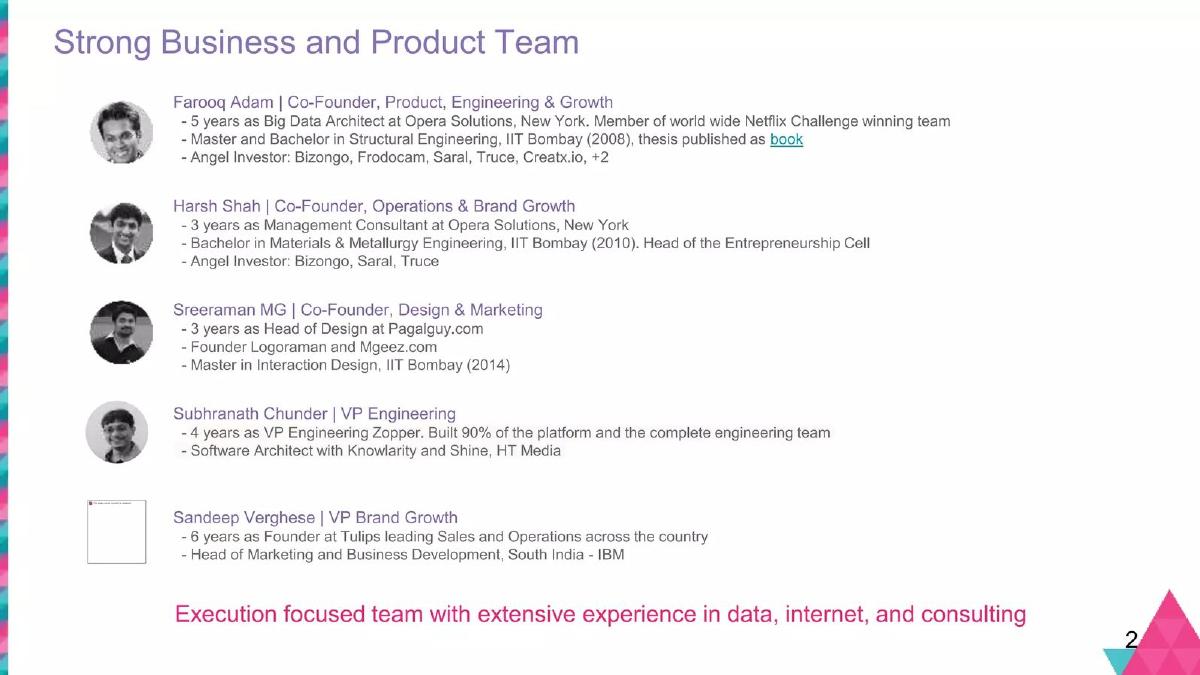
Fynd team slide — slide 2
Fashion retail; pre-Series A deck, cover line "Building India's Largest Fashion Retailer". Slide titled "Strong Business and Product Team".
Fynd deck, slide 2. Exact stored slide matched to this analysis.
Our analysis: The roles cover product, operations, design, engineering and "Brand Growth", which for a fashion marketplace is the supply side: the brands it sells.
Evidence and limitation: Years, named employers and one result or credential for each of five people; each role label names an area of the business.
What a founder can adapt: Say which side each commercial person brings; "Brand Growth" could state how many brands the team has signed.
Supporting analysis
What the deck claims: Farooq Adam, "Co-Founder, Product, Engineering & Growth": "5 years as Big Data Architect at Opera Solutions, New York", "Member of world wide Netflix Challenge winning team", "Angel Investor: Bizongo, Frodocam, Saral, Truce, Creatx.io, +2". Harsh Shah, "Co-Founder, Operations & Brand Growth": "3 years as Management Consultant at Opera Solutions". Sreeraman MG, "Co-Founder, Design & Marketing": "3 years as Head of Design at Pagalguy.com", "Founder Logoraman and Mgeez.com". Subhranath Chunder, "VP Engineering": "4 years as VP Engineering Zopper. Built 90% of the platform". Sandeep Verghese, "VP Brand Growth": "6 years as Founder at Tulips leading Sales and Operations across the country", "Head of Marketing and Business Development, South India - IBM". Footer: "Execution focused team with extensive experience in data, internet, and consulting".
Presentation choice: Investors can check every line, and they can see an owner for both the platform and the brand relationships.
When it does not fit: The small type; the strongest results are hard to read at a glance.
Marketplace-tagged deck. Slide titled "Who are we?".
Tip and Trip deck, slide 2. Exact stored slide matched to this analysis.
Our analysis: The technical founder's data experience is specific; the CEO's line shows leadership but not marketplace or sales experience. The mentor is clearly labelled as a mentor, not staff.
Evidence and limitation: Named projects and organisations for both founders; a mentor with three named companies; how the founders met.
What a founder can adapt: Add who will bring travellers and providers to the platform, and any early result.
Supporting analysis
What the deck claims: Arnon Benshahar (CTO): "Honorary bachelor's degree in Computer Science and MA student of Computer Sciences. Part of the BGU-EMC WWH project development team. Dealing and solving big data problems with a big data oriented ecosystem Hadoop." Yaron Been (CEO): "VP of 'The Cat' Non-profit Organization serving veterans of the Elite IDF Airborne Rescue Unit (669). Student of Industrial Engineering and Management." Guy Greenberg, "Our Mentor": "Co-founder and currently president of CoolaData. Guy was also the CEO and co-founder of Gilon business Insight and co-founder of Actimize." Footer: "We are a couple of friends and entrepreneurs, who met during our joint service in the elite IDF Airborne Rescue Unit (669)."
Presentation choice: Labelling advisors apart from the team is honest, and saying how founders met answers a common investor question.
When it does not fit: Letting a mentor's record stand in for the team's own commercial experience.
Barter platform for "swapping 'funky stuffs' without money". Slide titled "Who we are?".
FunkySwap deck, slide 2. Exact stored slide matched to this analysis.
Our analysis: Running a network retail business and a media buying firm is relevant to growing a community marketplace, but the jokes take more space than the facts.
Evidence and limitation: Three founders who each ran a company, two with stated turnover.
What a founder can adapt: Keep the nicknames, cut the jokes to a few words, and add who builds the product.
Supporting analysis
What the deck claims: Ildikó Bóna, "The babysitter": "Co-Founder and former CEO of FM Group Austria". Ferenc Faddi, "The network evangelist": "Founder and former CEO of FM Group Hungary (parfume and households retail avg turnover: 4M$)". Ádám Vajdics, "The hustler": "Founder and former CEO of USP Media (media planning and buying avg turnover: 3M$)". Each bio also has jokes, such as "She dances like Ginger Rogers" and "He's able to sell sand in the desert."
Presentation choice: Personality can help a slide be remembered; here it hides the strongest evidence.
When it does not fit: No technical owner is shown for a platform business.
MatchConnect deck, slide 3. Exact stored slide matched to this analysis.
Our analysis: The founder shows access to one side of the market, students, through a magazine he built. The missing co-founder is disclosed rather than hidden.
Evidence and limitation: Named press coverage and a prior audience result (six universities); an open co-founder role stated plainly.
What a founder can adapt: Say what skills the co-founder must bring, such as building the platform.
Supporting analysis
What the deck claims: Dominic Soh, "Founder": "Featured on News.com.au, The Herald Sun and other media outlets about his careers advice. Created a careers magazine from scratch to having a presence in 6 Victorian universities, reaching thousands of students." "A business & management trainer by day and careers coach by night." Second box: "Currently seeking a cofounder. Presently talking to 2 students from The University of Melbourne to explore how one of them can come onboard."
Presentation choice: Investors will notice a gap anyway; naming it and the plan to fill it is more credible.
When it does not fit: "Thousands of students"; give the number.
Jomla deck, slide 2. Exact stored slide matched to this analysis.
Our analysis: Included for contrast: the roles split sensibly between building and selling, but nothing shows anyone has done it before.
Evidence and limitation: Five names, photos and titles; no employers, years or results.
What a founder can adapt: Add one line each: a previous employer or a result.
Supporting analysis
What the deck claims: ZiKang Tai, "Director"; Vans Tam, "Marketing & Sales"; Justice Sia, "System Programmer"; Melvin Lee, "System Architecture"; Cindy Tam, "Online Marketing". Photos with icons for each area.
Presentation choice: Covering roles is the start; investors also need a reason to believe each person can deliver.
When it does not fit: Icons in place of backgrounds.
Whether an investor can see who builds the platform, who brings in each side, and something checkable about each person.
Example
Business
Platform owner
Supply or demand owner
Checkable facts
Fynd
Fashion retail
Yes (built 90% of a platform)
Brand Growth roles
Years, employers, results
Tip and Trip
Marketplace
Yes (data background)
Not shown
Named projects, mentor companies
FunkySwap
Barter platform
Not shown
Network and sales founders
Companies, turnover
MatchConnect
Marketplace
Sought (co-founder)
Founder reached students
Press, 6 universities
Jomla
Marketplace
Titles only
Titles only
None
Nepsify
Classifieds
Developer titles
Not shown
None
Key Takeaways
Show who builds the platform and who grows each side of the marketplace.
Give one named employer and one result per person.
Say which side each commercial person brings: suppliers, buyers or both.
Keep personality lines short; they should not push out the evidence.
If a key role is missing, say so and say how you will fill it.
Build your marketplace team slide
Cover the platform and both sides, then add a fact for each person.
Platform. Who builds the product, and what have they built before?
Supply. Who brings sellers or providers, and what relationships or results do they have?
Demand. Who brings buyers, and how have they grown an audience before?
Fact. One named employer and one result per person.
Gaps. Which role is missing, and how will you fill it?
Copyable framework: Headline: [the areas your team covers]. [Name], [role]: [employer], [result]. Supply: [name] brought [N] [sellers] at [company]. Open role: [role], [plan].
Illustrative example 1 — written by us
Before: Vans Tam, Marketing & Sales. Cindy Tam, Online Marketing.
After: Vans Tam, Marketing & Sales: signed [N] [sellers] at [company]. Cindy Tam, Online Marketing: grew [channel] to [N] users at [company].
What improved: Our illustrative rewrite; the bracketed details are placeholders, not Jomla's facts. It ties each person to one side of the marketplace.
What this guide adds
The general team slide guide covers any company. A marketplace has a particular question: can this team get both sides onto the platform, not just build it? This guide looks at how real marketplace team slides answer it.
Our library's marketplace tag is broad; it includes fashion retail, barter, classifieds, travel and matching services. We note each company's business where the deck shows it.
How we read each slide
We quote the text on the stored slide images. We have not checked any employer, turnover, investment or result claim.
Common mistakes
No supply owner. Say who brings sellers or providers onto the platform.
No platform owner. A marketplace is software; name who builds it.
Jokes over facts. Keep personality short so the evidence stays visible.
Founders without roles. Give every founder a job on the slide.
Hidden gaps. State a missing role and the plan to fill it.
Diagnostic checklist
A platform owner with a named track record.
An owner for supply and for demand.
One employer and one result per person.
Advisors and mentors labelled apart from staff.
Any open role stated with a plan.
Frequently asked questions
What should a marketplace startup's team slide show?
Who builds the platform, who brings in each side of the market, and one checkable fact for each person. Fynd gives five people years, a named employer and a result.
Should I show a missing co-founder on my team slide?
Stating it plainly is more credible than hiding it. MatchConnect says it is "Currently seeking a cofounder" and names where it is looking.
Is a list of names and titles enough?
No. Jomla and Nepsify show names and roles, or names only, so an investor can't judge anyone's experience from the slide.
How we chose these examples
Corpus: published pitch deck teardowns on StartupFundraising.com. Founder-uploaded private decks are excluded.
Selection (2026-09-27): we reviewed unused slides from decks tagged marketplace that looked like team slides; eight had stored images and were reviewed as images.
Kept six. Left out: Exelarc p3 (a problem slide) and Get Groomed p2 (a company overview that names the founders without backgrounds). No uploads were requested.
Review: stored slide text and images were checked on 2026-09-27 and matched to company, deck and slide number (editorial model review). No person has yet completed an editorial review of this page.
Claims are as shown on the slides; we have not verified them. We make no claim that any slide caused a fundraising outcome.