Fuzzy.ai’s 2014 seed deck is a study in brevity, consisting of only seven slides. The presentation avoids traditional fundraising staples such as a business model, market size analysis, or a specific financial ask. Instead, it relies on three core pillars: an aggressive problem statement ('A.I. or DIE'), a high-pedigree founding team with experience at Google and Wikitravel, and early validation from 15+ beta customers including Intel Security. The deck positions the product as an accessible API for complex decision-making, targeting specific use cases like price optimization and lead scoring…
Key takeaways
- The deck uses a provocative opening slide with the phrase 'A.I. or DIE' to establish immediate urgency (Slide 1).
- Barriers to AI adoption are identified as a lack of data scientists, insufficient data, and high costs in time and money (Slide 2).
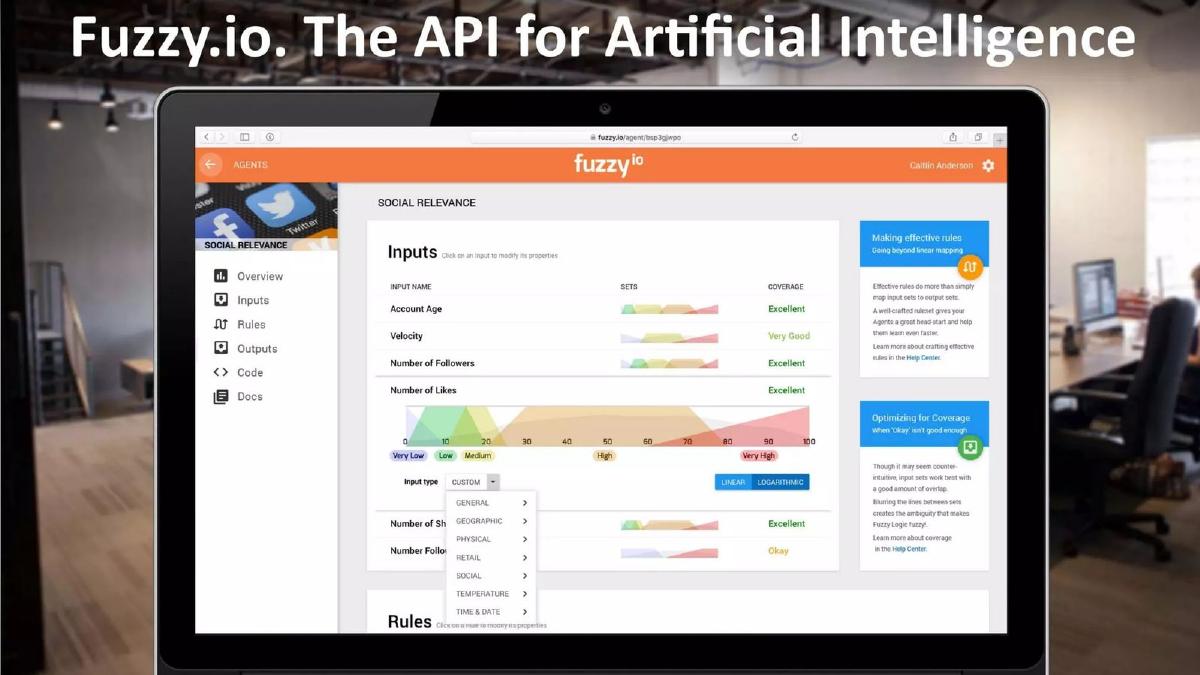
- The product is explicitly defined as 'The API for Artificial Intelligence,' emphasizing ease of integration (Slide 3).
- Three specific commercial use cases are highlighted: Price Optimization, Lead Scoring, and Marketplace Matching (Slide 4).
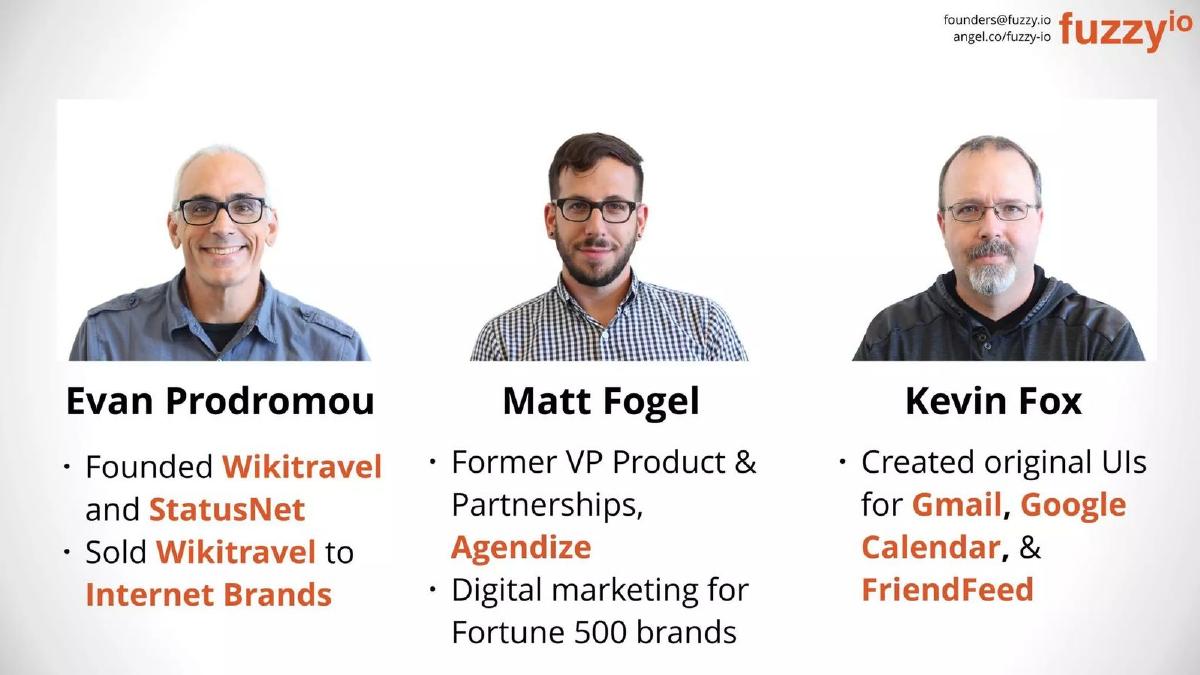
- The team slide features significant pedigree, noting Kevin Fox created the original UIs for Gmail and Google Calendar (Slide 5).
- Founder Evan Prodromou is credited with founding Wikitravel and StatusNet, adding serial entrepreneur credibility (Slide 6).
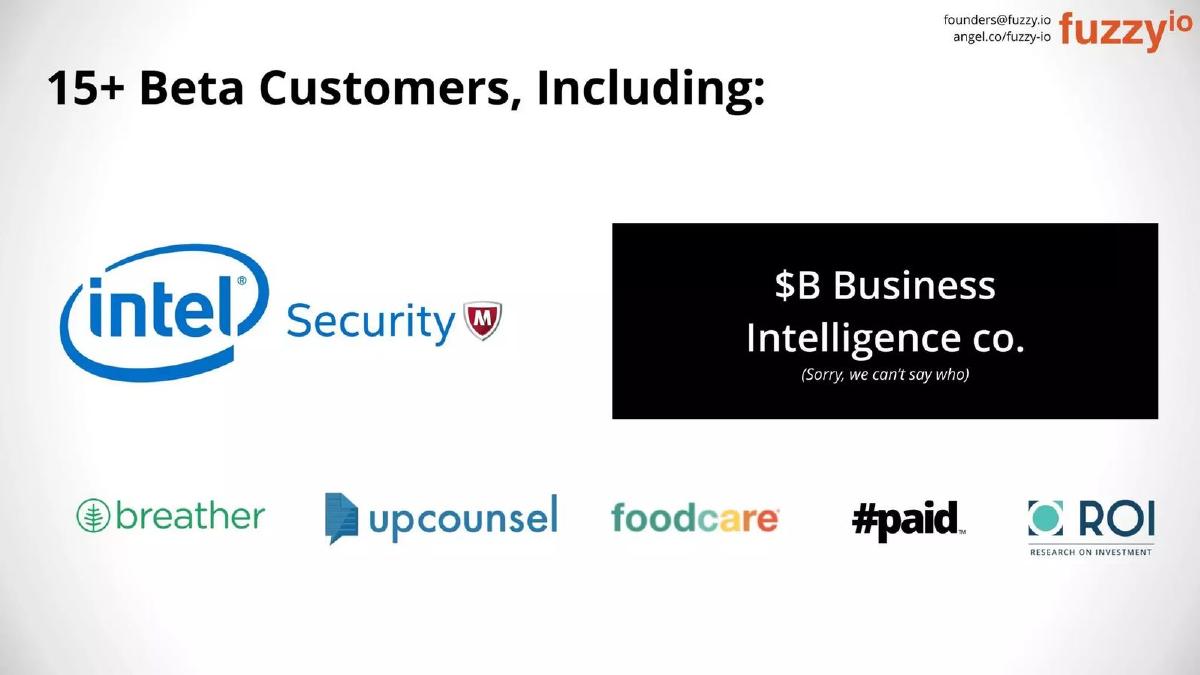
- Traction is demonstrated through 15+ beta customers, including a '$B Business Intelligence co.' that remains anonymous (Slide 6).
- The deck completely omits a business model, competition analysis, and a specific funding ask (Slides 1-7).
The Minimalist Approach to Seed Fundraising
The Fuzzy.ai pitch deck from 2014 is a relic of an era where AI was just beginning its second major wave of commercial interest. With only seven slides, it is one of the shortest successful seed decks in the public domain. It does not follow the standard Sequoia or Y Combinator templates. Instead, it functions as a high-level teaser designed to leverage the immense social capital of its founding team. The deck is less about a business plan and more about a technical promise: that AI can be made accessible via a simple API.
The Hook and the Problem (Slides 1-2)
Slide 1: Title The deck opens with a stark, high-contrast image of a circuit-board brain and the text 'A.I. or DIE'. This is a classic 'fear of missing out' (FOMO) opening. It suggests that AI is no longer optional for businesses. Notably, the slide includes contact information and an AngelList URL (angel.co/fuzzy-io) in the top right corner, signaling that this deck was likely used for online syndication as much as for in-person meetings.
Slide 2: The Barriers This slide identifies the 'enemy.' It uses three icons to represent what currently stops companies from using AI: the need for Data Scientists, the requirement for 'Tons of Data,' and the exhaustion of 'Time and Money.' By framing these as the problems, Fuzzy.ai sets itself up as the solution that requires none of these things. It is a bold claim, especially the implication that 'Tons of Data' are not needed, which directly contradicts the prevailing machine learning wisdom of the time.
Product and Use Cases (Slides 3-4)
Slide 3: The Solution Fuzzy.ai introduces its interface here, titled 'The API for Artificial Intelligence.' The slide shows a screenshot of a dashboard on a laptop. The UI appears to allow users to set 'Inputs' like 'Account Age,' 'Velocity,' and 'Number of Followers' with qualitative sliders ranging from 'Very Low' to 'Very High.' This visualizes the 'Fuzzy Logic' aspect of the company name—allowing for nuanced, non-binary decision-making without complex coding.
Slide 4: Use Cases To ground the abstract concept of an AI API, Slide 4 provides three concrete examples: Price Optimization, Lead Scoring, and Marketplace Matching. The use of stock photography here is somewhat generic, but the labels are critical. They tell the investor exactly which budgets the company plans to capture. These are all high-ROI activities for enterprise customers, which justifies a potentially high price point for the API later on.
The Team and Traction (Slides 5-6)
Slide 5: The Team This is the strongest slide in the deck. In early-stage investing, the team is often 80% of the decision. Evan Prodromou is listed as the founder of Wikitravel and StatusNet, with a successful exit to Internet Brands. Matt Fogel brings VP-level product and marketing experience. Kevin Fox is the 'star' hire for a product-led company, credited with creating the original UIs for Gmail and Google Calendar. This level of pedigree suggests that the team can actually build the simplified AI interface they promised on Slide 3.
Slide 6: Traction Traction is presented through logos rather than charts. The slide claims '15+ Beta Customers.' The inclusion of Intel Security provides enterprise validation. The most intriguing element is a black box representing a '$B Business Intelligence co.' with the note '(Sorry, we can’t say who).' While this is a common tactic to build intrigue, it also serves as a powerful signal that major players are looking at this technology.
The Conclusion (Slide 7)
Slide 7: Contact The deck ends as it began, with the circuit brain graphic and contact details. There is no summary of the market size, no competitive landscape, and no financial projections. It is a 'take it or leave it' presentation that relies entirely on the strength of the problem and the reputation of the people solving it.
What Works in the Fuzzy.ai Deck
Extreme Clarity of Mission: The deck does not get bogged down in the mathematics of fuzzy logic or neural networks. It stays at the level of 'We make AI easy for developers.' This is a message an investor can understand in five seconds.
Founder-Market Fit: The team slide perfectly aligns with the product. If you are building a tool to make complex technology easy to use, having the person who designed the Gmail UI (Kevin Fox) is the ultimate proof of capability. Slide 5 is the anchor that makes the rest of the deck believable.
Specific Use Cases: By highlighting Lead Scoring and Price Optimization on Slide 4 , the founders avoid the 'horizontal platform' trap where investors don't know who will actually buy the product. They show they have thought about the commercial application, not just the technical implementation.
What is Missing from the Fuzzy.ai Deck
Business Model: There is no mention of how Fuzzy.ai intends to make money. Is it per API call? A monthly subscription? A percentage of the 'optimization' value? Investors generally want to see a path to $100M in revenue, and this deck offers no clues on pricing strategy.
Market Size (TAM): The deck assumes the investor already believes AI is a massive market. While 'A.I. or DIE' is a strong sentiment, it doesn't quantify the opportunity. There are no figures regarding the number of developers or the total spend on data science that they are disrupting.
The Ask: The most glaring omission is the fundraising goal. The deck does not state how much money they are looking for or what they will do with the capital. This suggests the deck was used as a teaser to get a meeting, rather than a comprehensive document to close a deal.
Competition: In 2014, other 'AI as a service' companies were emerging. The deck makes no effort to differentiate Fuzzy.ai from IBM Watson or other burgeoning API providers. It relies on the 'ease of use' claim without proving why competitors can't simply copy their UI.
What a Founder Should Copy
The 'Problem' Framing: Use Slide 2 as a template for identifying the 'Tax' your customers are currently paying. By listing Data Scientists and Time as the costs, Fuzzy.ai makes their product feel like a cost-saving measure rather than a new expense.
Pedigree Highlighting: If you have a team with 'Big Tech' experience, don't just list the company names. List the specific, recognizable products they built, as seen on Slide 5 ('Created original UIs for Gmail'). This creates a much stronger mental image for the investor.
Beta Validation: If you don't have revenue, use a 'Beta Customers' slide like Slide 6 . Even if you have to keep some names anonymous, showing that large companies are willing to test your product is a significant de-risking factor for seed investors.
Final Analysis
The Fuzzy.ai deck is a high-conviction, low-information pitch. It works because the founders have already 'won' in previous ventures. For a first-time founder, this deck would likely be insufficient because it lacks the structural rigor of a market analysis and a financial plan. However, as a lesson in brevity and branding, it is excellent. It identifies a massive shift in the world (AI), points out why it is currently hard to adopt, and presents a team that is uniquely qualified to make it easy. In the world of seed funding, sometimes that is enough to get to the next meeting.
Frequently asked questions
- Why is the Fuzzy.ai deck so short at only 7 slides?
- At the seed stage in 2014, the founders likely relied on their significant professional reputations to do the heavy lifting. When a team includes the creator of the Gmail UI and a founder who sold a company to Internet Brands, investors often require less formal documentation on market size and more focus on the product vision and early technical validation.
- What is the primary value proposition of the product according to the deck?
- Fuzzy.ai positions itself as a way to bypass the traditional requirements of AI development. Slide 2 lists 'Data Scientists,' 'Tons of Data,' and 'Time and Money' as the current obstacles. The deck suggests that their API removes these barriers, allowing developers to implement decision-making logic without needing a specialized data science team.
- How does the deck handle the lack of revenue or growth metrics?
- Instead of revenue, the deck uses 'Beta Customers' as a proxy for traction. Slide 6 lists 15+ beta participants. By including recognizable names like Intel Security and hinting at a billion-dollar business intelligence firm, they signal that the product has enterprise-grade utility even if it is not yet generating significant recurring revenue.
- What specific industries or problems does Fuzzy.ai target?
- Slide 4 identifies three high-value niches: Price Optimization, Lead Scoring, and Marketplace Matching. This helps investors visualize the 'Jobs to be Done' and prevents the AI tool from feeling like a 'solution in search of a problem,' which is a common pitfall for horizontal API startups.
- Is the lack of a 'The Ask' slide a mistake?
- In a deck intended for a live presentation or a platform like AngelList (referenced on Slide 1), the 'Ask' is often handled in the accompanying text or conversation. However, for a standalone pitch, omitting the amount being raised and the planned use of funds is generally considered a weakness as it leaves the investor's primary question unanswered.