Fynd’s Series A deck is a masterclass in articulating a complex operational model with clarity. The company positions itself as an 'Information Arbitrage' play, connecting physical brand stores to digital consumers without the burden of warehousing or inventory risk. By leveraging a 20% transaction commission and a 15% gross margin, Fynd demonstrates a lean path to profitability in the competitive e-commerce landscape. The deck emphasizes technical moats, such as deep ERP and POS integrations with major brands like Nike and Levi's, and a multi-channel acquisition strategy including an AI 'bot…
Key takeaways
- The business operates as a 3-sided marketplace focusing on 'O2O Information Arbitrage' to eliminate inventory and field force costs (Slide 3).
- Fynd claims a 20% transaction commission and a 15% gross margin on its retail operations (Slide 3).
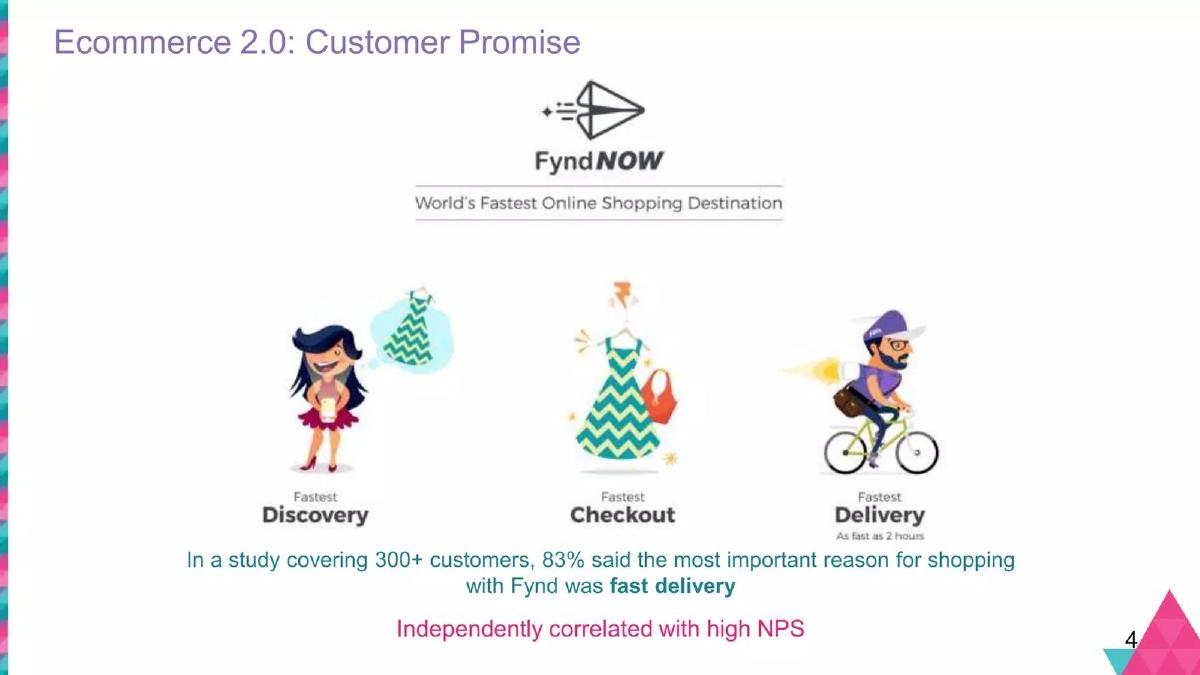
- Customer research involving 300+ participants identified 'fast delivery' as the primary value proposition for 83% of users (Slide 4).
- The platform features deep technical integration with ERP systems like SAP and Oracle, and POS systems like Ginesys and Navision (Slide 12).
- The inventory catalog includes 142 marquee brands and 8,000 real-time store inventories as of the deck's creation (Slide 8).
- Logistics are handled by 8+ delivery partners covering 6,000+ pincodes with a fastest delivery time of 2 hours (Slide 9).
- The acquisition strategy is diversified across a habit-forming app, SEO-optimized website, and conversational commerce via an AI bot named Fify (Slide 7).
- The team is heavily weighted toward engineering, with 26 staff members in that department out of a total headcount exceeding 70 (Slide 20).
Executive Summary and Team
Slide 1: Title Slide
The deck opens with a clean, minimalist title slide featuring the Fynd logo and the tagline "Building India’s Largest Fashion Retailer." The footer notes the document is "Proprietary & Confidential © 2016," which provides context for the vintage of the data presented.
Slide 2: Strong Business and Product Team
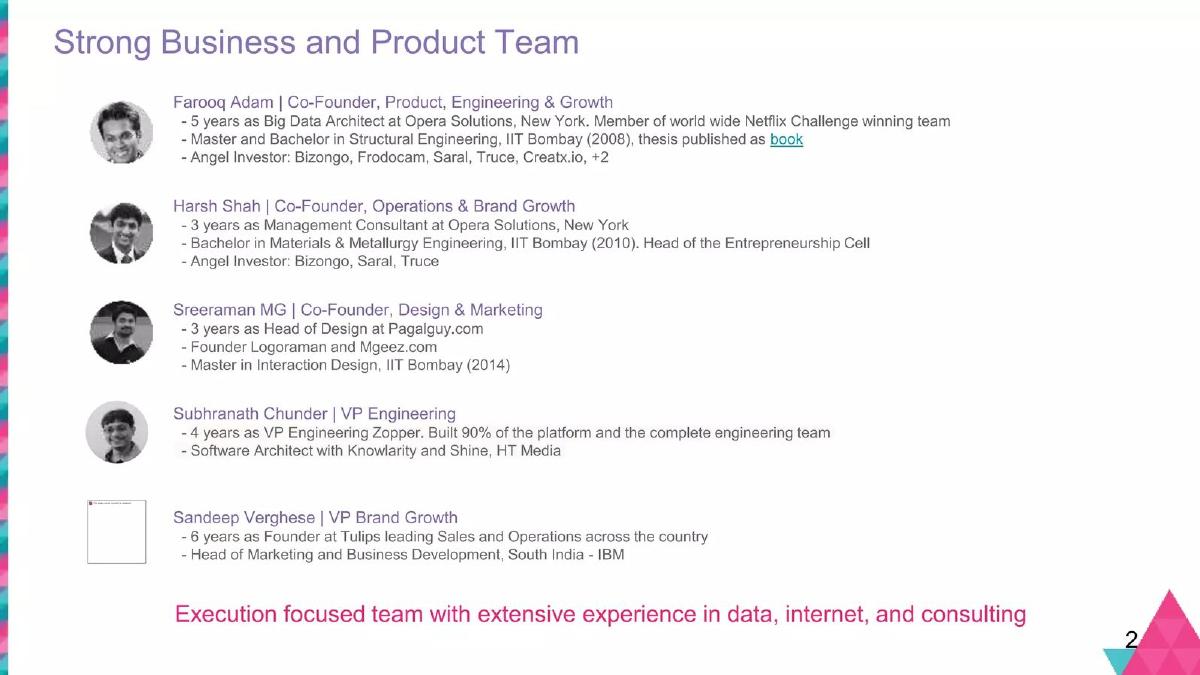
Fynd leads with its team, highlighting three co-founders and two VPs. Farooq Adam (Product, Engineering & Growth) and Harsh Shah (Operations & Brand Growth) both bring experience from Opera Solutions in New York. Sreeraman MG (Design & Marketing) is noted for his background at Pagalguy.com. The slide emphasizes their educational pedigree (IIT Bombay) and their history as angel investors in other startups like Bizongo and Saral. The summary at the bottom describes them as an "Execution focused team with extensive experience in data, internet, and consulting."
The Business Model: O2O Information Arbitrage
Slide 3: 3 Sided Marketplace
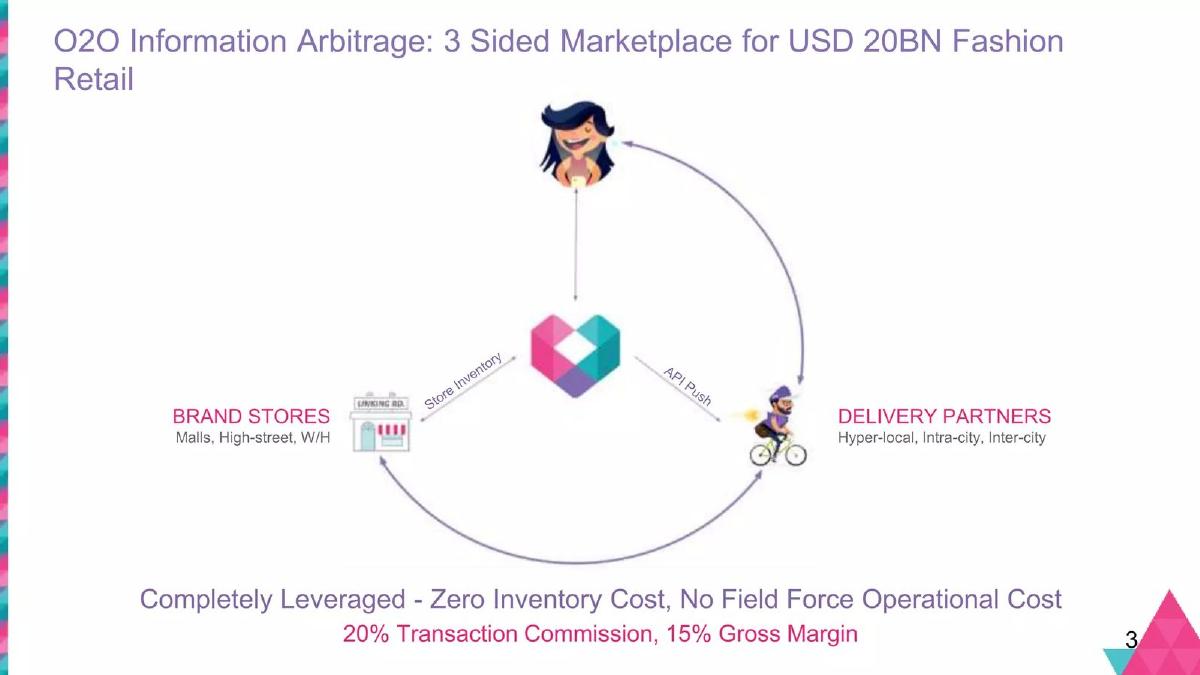
This is the core architectural slide of the deck. It defines Fynd as an "O2O Information Arbitrage" play. The marketplace connects Brand Stores (Malls, High-street), Customers , and Delivery Partners . The key value proposition is being "Completely Leveraged," meaning zero inventory costs and no field force operational costs. They state a 20% Transaction Commission and a 15% Gross Margin , which are strong figures for a retail intermediary.
Slide 4: Ecommerce 2.0: Customer Promise
Fynd positions itself as the "World’s Fastest Online Shopping Destination" under the sub-brand FyndNOW . They cite a study of 300+ customers where 83% identified "fast delivery" as the primary reason for shopping with Fynd. The slide links fast discovery, checkout, and delivery (as fast as 2 hours) to a high Net Promoter Score (NPS).
Traction and Unit Economics
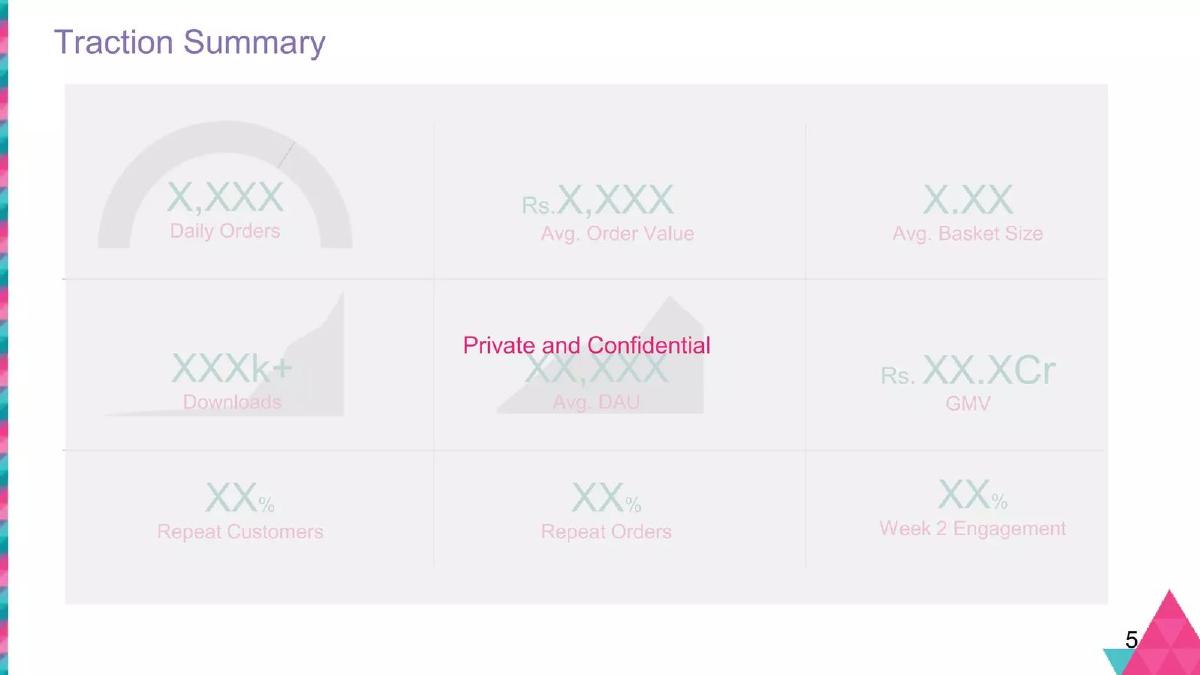
Slide 5: Traction Summary
This slide is largely redacted with "Private and Confidential" placeholders. However, the categories of measurement are visible: Daily Orders, Avg. Order Value, Avg. Basket Size, Downloads, Avg. DAU, GMV, Repeat Customers, Repeat Orders, and Week 2 Engagement. The presence of these metrics suggests a data-driven approach, even if the specific numbers are withheld in this version of the deck.
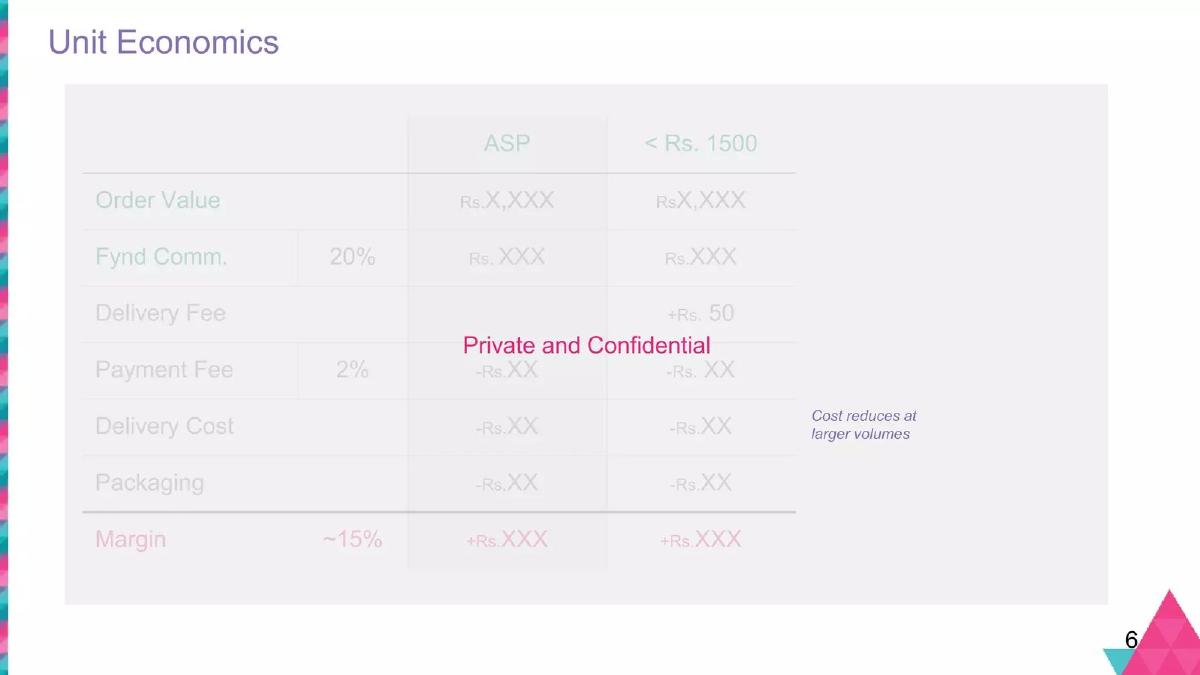
Slide 6: Unit Economics
Like the previous slide, the specific currency values are redacted, but the structure is informative. Fynd breaks down economics by Average Selling Price (ASP) and orders under Rs. 1500. They account for Fynd Commission (20%) , Payment Fee (2%) , Delivery Cost , and Packaging . They reiterate a ~15% Margin and note that costs reduce at larger volumes.
The Ecosystem and Technical Moat
Slide 7: Close Looped Digital Habit Strategy
This slide illustrates their multi-channel acquisition and retention strategy. It includes a "Habit-Forming App," an "SEO-First Website," "Content Commerce" via a blog called The Closet, "Catalog Retargeting," and "Conversational Commerce" via messaging apps. This suggests a sophisticated understanding of the digital marketing funnel beyond simple paid acquisition.
Slide 8: Strong Brand Traction
Fynd showcases its scale with 142 Marquee Brands (with a target of 220), 32k Products (target 50k), and 8k Real-time Store Inventories (target 12k). Logos displayed include Nike, Puma, Levi's, Clarks, and Steve Madden. This slide serves as social proof and validates their ability to integrate with major retailers.
Slide 9: Delivery India-Scale Ready
The logistics slide claims 6,000+ Pincodes Serviceable and 8+ Delivery Partners . A bar chart shows the distribution of delivery speeds: 846 pincodes for Same Day Delivery, 2,124 for Next Day, and 3,121 for Two Day Delivery. They mention a "Greedy Order Fulfilment" algorithm that optimizes for time and cost.
Product Deep Dive
Slide 10: Brand Transition
A simple interstitial slide featuring the Fynd logo and social media handles (@GoFynd).
Slide 11: Product & Engineering
This slide features a photo of a whiteboard covered in complex UI/UX sketches and logic flows. It serves to emphasize the "engineered" nature of their solution and points users to their engineering blog.
Slide 12: Deep Real-time Ecosystem Integration
This is a critical "moat" slide. It lists the specific enterprise software Fynd integrates with: ERP (SAP, Oracle, Microsoft Dynamics, etc.), POS (Ginesys, Navision, ETP), and Delivery (Delhivery, Ecom Express, Gojavas). This deep integration is what allows them to offer real-time inventory without owning the stock.
Slide 13: Habit-Forming App With Gamified Features
The app features are highlighted: Mix & Match (algorithmic look-based shopping), For You (personalization), Gravity View (tilting the phone to see products), Universal Size Guide , and Flashpay (2-step checkout). These features are designed to increase engagement and reduce friction.
Slide 14: SEO-First Engineered Website
Fynd details its web strategy, noting the site is brand keyword optimized, mobile-friendly, and ISP cached via Akamai for speed. A unique claim is that the site is "Non-Scrappable," which they argue ensures direct traffic and customer ownership.
Slide 15: Fify: World’s First Fashion Shopping AI Botfriend
This slide introduces Fify , their conversational commerce bot. It is described as a "Customer Activation Channel" currently in Beta v0.1. The roadmap aims to move from a "Weak AI Bot" to a "Strong AI Bot."
Slide 16: Product Centric and Extreme Automated Organization
Fynd highlights its internal tools: Fynd CC (suite for managing transactions/cataloging), Custom Growth Stack (SaaS and home-grown tools), Bot Alerts (Slack integration for inventory syncs and payment failures), and Fynd Vision (using neural networks for automated product classification).
Growth and Future
Slide 17: Growth Targets - App Store
A visual slide showing the Fynd app featured on the App Store home screen, validating their standing with platform providers.
Slide 18: Growth Targets: July 1 - Aug 15
This slide contains redacted targets for GMV, Deliveries, Peak Daily Orders, and Customer Satisfaction. It shows the company was focused on a specific high-growth window, likely a seasonal sale period ("The Grand Brand Sale").
Slide 19: Future of Fynd
The vision slide outlines four pillars: Exponential scale , becoming the first port of call for fashion discovery, Global Expansion (MEA, SEA), and becoming the Largest Retail Information Exchange to find new avenues of monetization.
Slide 20: Team and Key People
The final slide provides a detailed breakdown of the 70+ person team. Engineering is the largest department (26), followed by Catalog (15) and Operations (11). It lists key hires and their previous companies (Amazon, Disney, IBM, etc.), reinforcing the message of a high-caliber execution team.
What Works
Clear Business Logic: The "Information Arbitrage" and "O2O" concepts are explained simply, making the lack of inventory—a traditional e-commerce headache—look like a massive competitive advantage. · Technical Moat: Slide 12 explicitly lists the ERP and POS systems they integrate with. This demonstrates that their model isn't just a website; it's a deep technical integration that is hard for competitors to replicate. · Unit Economics Focus: Even with redacted numbers, the inclusion of a detailed unit economics slide (Slide 6) shows that the founders are thinking about profitability and contribution margin from the start. · Brand Validation: The list of 142 marquee brands on Slide 8 provides immediate credibility.
What is Missing
The Ask: There is no slide detailing how much money they are raising, the valuation, or the specific use of proceeds. · Competitive Landscape: The deck does not mention other fashion e-commerce giants in India (like Myntra or Jabong) or how Fynd specifically wins against them beyond delivery speed. · Historical Financials: While there is a traction summary, there is no multi-year or multi-quarter financial history showing the trajectory of growth. · Customer Acquisition Cost (CAC): While they mention a 15% margin, they do not explicitly state their CAC or Lifetime Value (LTV), which are critical for a Series A round.
What a Founder Should Copy
The Team Breakdown (Slide 20): Showing the exact headcount by department and the pedigree of mid-level management (not just founders) builds immense confidence in execution capability. · The Integration Slide (Slide 12): If your startup relies on being a layer on top of existing infrastructure, list the specific logos of the software you integrate with. It proves the "plumbing" is already built. · Value Proposition via Research (Slide 4): Don't just say your product is fast; cite a study (even a small one of 300 customers) to show that your users actually value that specific feature. · Visualizing the Marketplace (Slide 3): The 3-sided marketplace diagram is a perfect way to show how value and information flow through a platform.
Frequently asked questions
- What is Fynd's core business model?
- Fynd operates an Online-to-Offline (O2O) marketplace. Instead of holding inventory in warehouses, they integrate directly with the real-time inventory of physical brand stores. When a customer orders on the Fynd app, the product is picked up from the nearest local store and delivered. This allows them to maintain zero inventory costs and high gross margins of approximately 15%.
- How does Fynd handle logistics and delivery?
- The company uses a 'Greedy Order Fulfilment' algorithm that optimizes for time and cost by assigning orders to one of 8+ delivery partners. They service over 6,000 pincodes in India and offer delivery as fast as 2 hours, with a significant portion of orders delivered within the same day or next day.
- What brands are currently on the Fynd platform?
- According to slide 8, Fynd has 142 marquee brands, including global and domestic names like Nike, Puma, Levi's, Steve Madden, Superdry, Fabindia, and Biba. They provide access to 32,000 products from 8,000 real-time store inventories.
- What is 'Fify' and how does it fit into their strategy?
- Fify is described as the 'World's First Fashion Shopping AI Botfriend.' It represents Fynd's conversational commerce channel, acting as a customer activation tool. It allows users to discover and shop for fashion through a chat interface, which the deck identifies as a key part of their 'Close Looped Digital Habit Strategy.'
- Is there a clear exit or growth target in the deck?
- The deck outlines growth targets for a specific period (July 1 - Aug 15) and mentions global expansion into the Middle East and Southeast Asia. However, the specific GMV and delivery numbers are redacted as 'Private and Confidential.' There is no mention of a specific exit strategy or acquisition target.