Gable's $12M Series A deck is a masterclass in identifying a timely, high-friction problem: the logistical nightmare of managing a distributed workforce's physical space needs. The deck effectively contrasts the 'old way' (manual, fragmented, and wasteful) with a centralized platform that serves three distinct stakeholders: employees, HR managers, and workspace hosts. With 32 enterprise customers and 50% MoM growth in SaaS fees as of late 2022, the narrative is backed by significant early traction. While the deck lacks a specific financial 'Ask' slide or detailed unit economics, it compensate…
Key takeaways
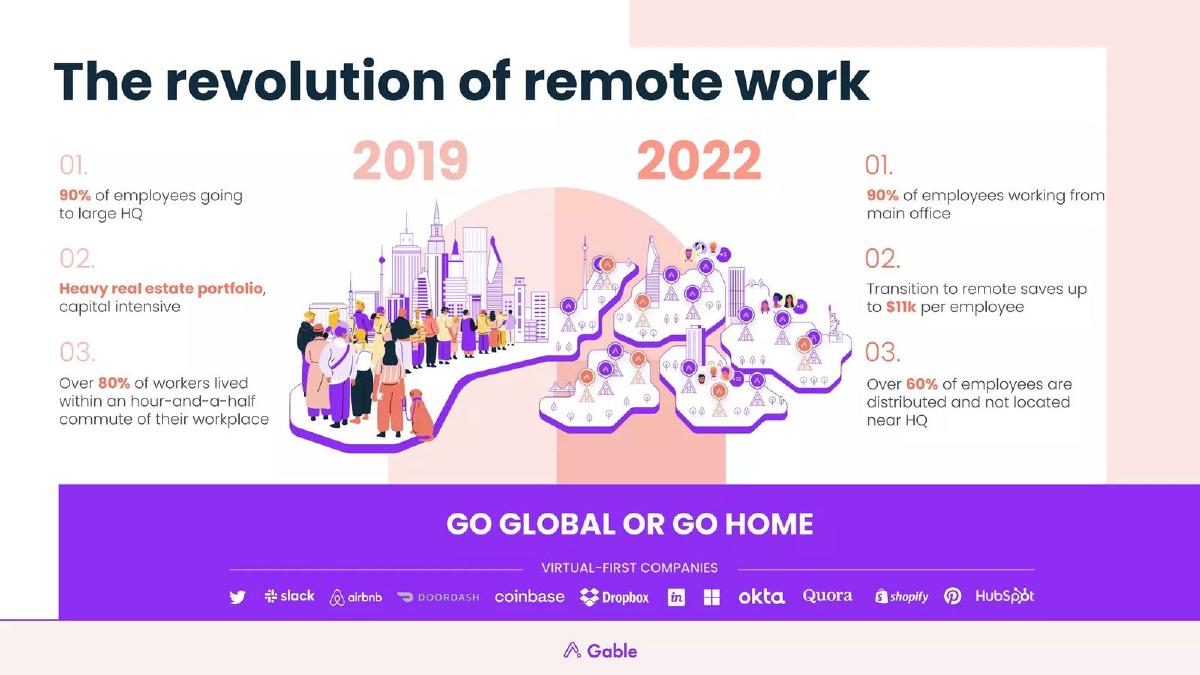
- The deck identifies a massive shift in worker distribution, noting that by 2022, over 60% of employees were distributed and not located near a main HQ (Slide 3).
- Gable solves for the '50% overspent' on real estate that companies face due to a lack of usage visibility (Slide 6).
- Traction is highlighted by 32 enterprise customers, including Docker and Medium, and 50% MoM growth in SaaS fees (Slide 8).
- The business model is a hybrid of SaaS fees ($6-$8 per employee/month) and a 20% commission on workspace utilization (Slide 17).
- The platform manages a network of over 800 spaces across 30 states and 10 countries (Slide 12).
- Gable targets a specific 'sweet spot' of companies with 100 to 5,000 employees, representing a $17.2B revenue opportunity (Slide 18).
- Sales efficiency is a core highlight, boasting a 42.8% conversion rate and a 100% conversion rate from pilot to customer (Slide 19).
- The product roadmap outlines a clear transition from basic booking to advanced enterprise features like budget forecasting and SOC2 compliance (Slide 21).
Executive Summary and Team
Slide 1: Title Slide
The deck opens with a clean, branded title slide dated September 2022. It features a map of the United States with employee clusters, immediately signaling that the company deals with distributed workforces and geographic location data.
Slide 2: Meet the Team
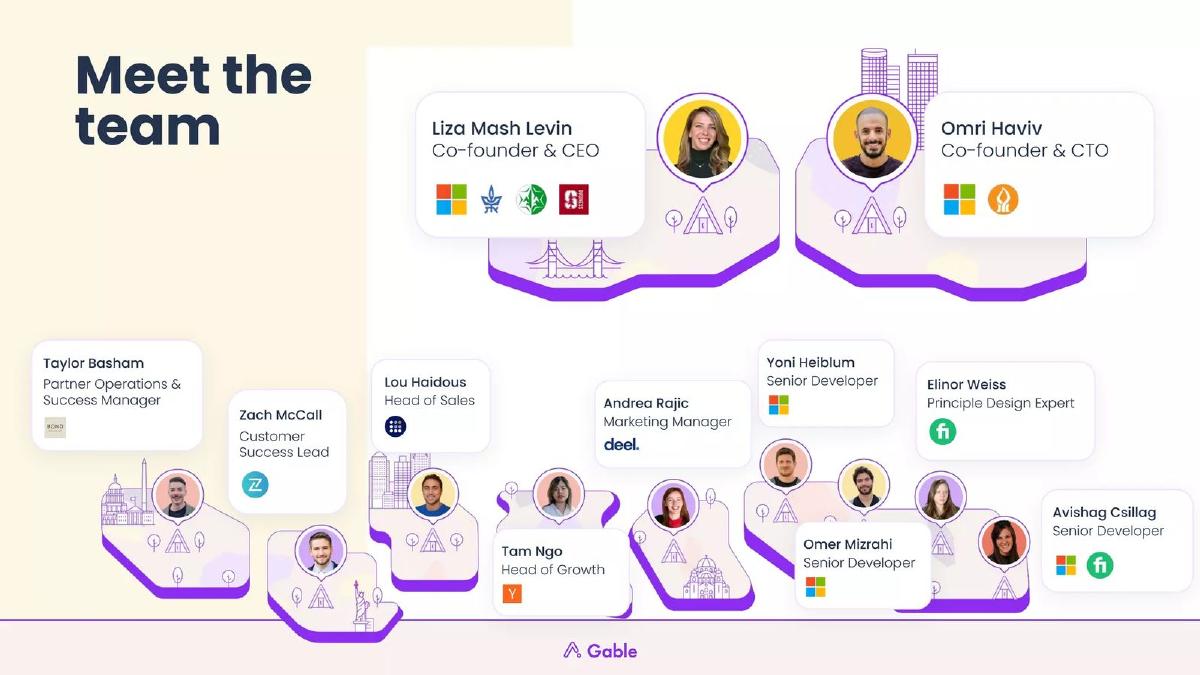
Gable leads with its team, a common strategy for Series A rounds where execution capability is paramount. Co-founders Liza Mash Levin (CEO) and Omri Haviv (CTO) highlight backgrounds at Microsoft and various startups. The slide also lists key hires in Sales, Growth, and Engineering, showcasing logos from companies like Deel, Fiverr, and Microsoft to establish professional pedigree. The team is lean but covers all essential functions for a scaling SaaS business.
The Problem and Market Shift
Slide 3: The Revolution of Remote Work
This slide sets the stage by comparing 2019 to 2022. It notes that in 2019, 90% of employees went to a large HQ. By 2022, over 60% of employees are distributed. Crucially, it cites a potential saving of $11k per employee for companies transitioning to remote work, providing a strong financial incentive for the product.
Slide 4: Going Remote-First is Hard
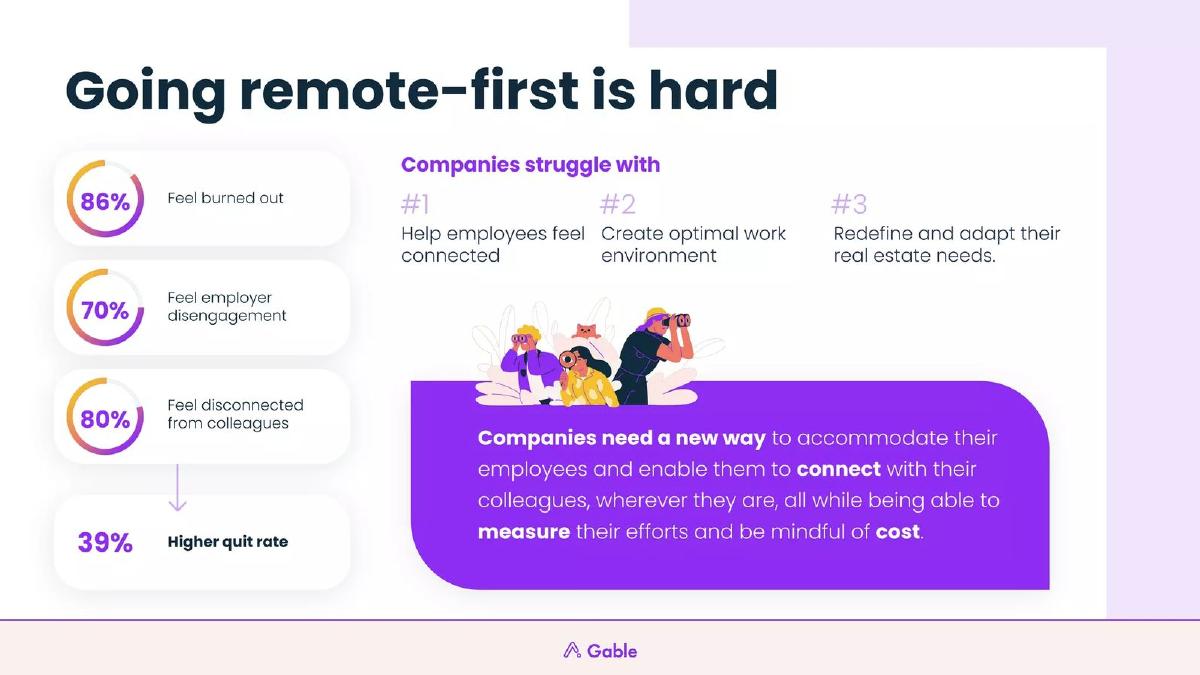
Gable identifies the friction points of this transition: 86% of employees feel burned out, and 80% feel disconnected. The slide argues that companies need a way to connect colleagues while being 'mindful of cost.' It links these emotional states to a 39% higher quit rate, framing Gable as a retention tool as much as a real estate tool.
Slide 5: How it's Done Today
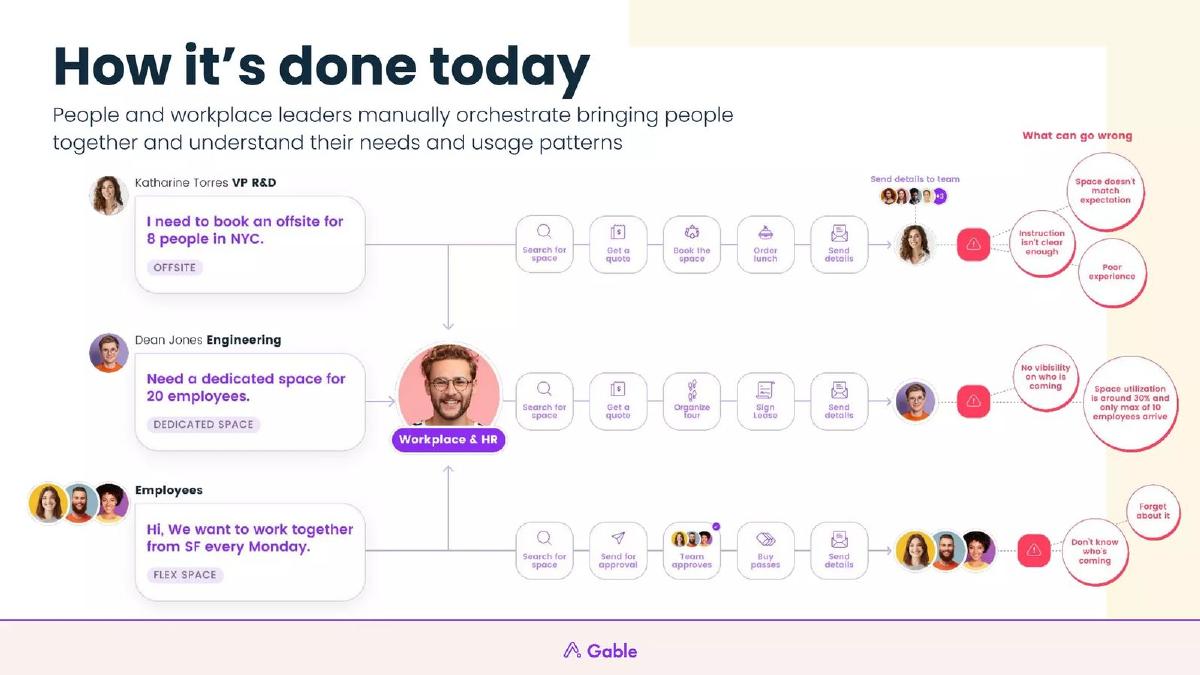
This is a 'status quo' slide. It illustrates the manual, fragmented process currently used by VP R&Ds and Engineering leads to book offsites or dedicated spaces. It highlights the 'Workplace & HR' persona as the one stuck in the middle of a chain of manual quotes, tours, and approvals. The 'What can go wrong' column lists issues like poor experience and low space utilization (30%).
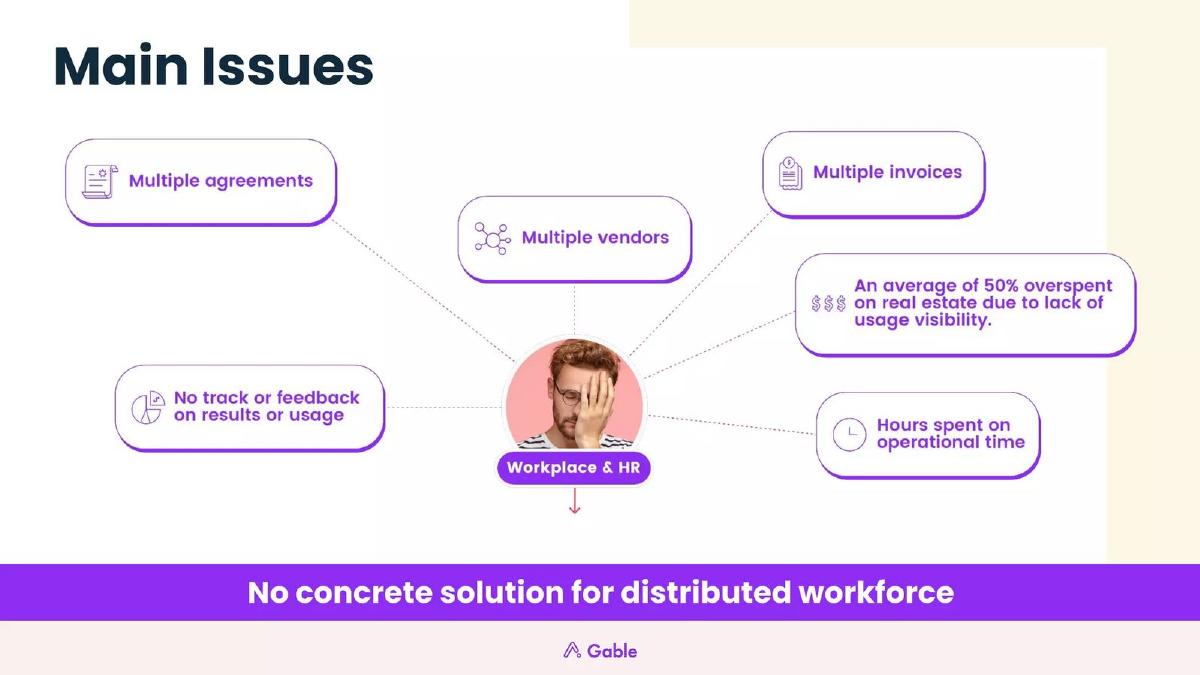
Slide 6: Main Issues
Building on the previous slide, this identifies the specific pain points for HR: multiple agreements, multiple vendors, multiple invoices, and a lack of feedback. The most compelling figure here is that companies overspend by an average of 50% on real estate due to a lack of usage visibility.
The Solution and Product
Slide 7: Gable Centralized Management Suite
The solution slide introduces Gable as the bridge between Workspaces, Workplace & HR, and Employees. It promises 'Management, control & insights' for the company and 'One app to book a space' for the employee. The visual shows a globe with Gable pins, reinforcing the global nature of the solution.
Slide 8: Where We Are (Traction)
This is the 'meat' of the deck. Gable reports 32 enterprise customers, including Docker, Medium, and Noom . Key growth metrics include 50% MoM growth in SaaS fees and 22% MoM increase in bookings. They also claim a network of 800 spaces across 30 states and 10 countries. This slide proves product-market fit and early scaling capability.
Slide 9: Employee View
A product walkthrough slide showing the mobile interface. It highlights features like 'Team view' to encourage collaboration, pre-reserved seats, and integrations with Slack and Google Calendar. The focus is on ease of use for the end-user.
Slide 10: Management and Insights
This slide shows the HR dashboard. It emphasizes control: budget management, role-based access, and visibility into employee satisfaction. The screenshot shows a 'Dashboard' with 1,453 total bookings and a 9.2 employee satisfaction score, illustrating the data-rich nature of the platform.
Slide 11: Host View
Gable addresses the supply side of their marketplace. The host dashboard allows workspace providers to manage listings, approve reservations, and track earnings. It mentions integrations with Stripe and Google Calendar, suggesting a frictionless experience for the vendors.
Slide 12: Partnership with Over 800 Spaces
A map-heavy slide showing the density of their network. It lists partners like Bond Collective, The Yard, and Galvanize . The 30% MoM growth in the space network suggests they are successfully aggregating supply to meet demand.
Value Proposition and Case Studies
Slide 13: Why They Choose Gable
A summary slide focusing on four pillars: Culture (collaboration), Cost (flexibility), Control (visibility), and Scalable (asset-light). It reinforces the 'pay-as-you-go' model as a key differentiator from traditional long-term leases.
Slide 14: Case Study - PostClick
Qualitative proof. PostClick, with 235 employees across 10 states, saw a 63% employee usage rate and an 82% booking increase MoM . The quote from the COO emphasizes that Gable helps them 'think about hybrid work differently.'
Slide 15: Case Study - Wheel
A second case study for Wheel (322 employees). It highlights that 60% of their employees are remote and new, and Gable helped transform their office-based culture. They saw a 22% booking increase MoM.
Business Model and Market Opportunity
Slide 16: Business Model
The pricing is transparent: A SaaS fee of $6-$8 per employee per month plus a 20% commission on the price of the space utilized. This dual-stream revenue model is attractive as it provides both predictable recurring revenue and upside from high usage.
Slide 17: TAM (Total Addressable Market)
Gable segments the market by company size. Their 'sweet spot' is the 100-5,000 employee range, which they value at $17.2B in revenue . They explicitly state their target initial customers are in the tech industry with a 'people-first culture.'
Slide 18: GTM - Scalable Process
The Go-To-Market slide shows a highly efficient sales funnel. They report a 42.8% conversion rate from first meeting to 'closed won' and, most impressively, a 100% conversion rate from pilot to customer. The average sales cycle is 20.3 days, which is remarkably fast for enterprise SaaS.
Slide 19: Massive Channel Opportunity
This slide lists potential integration partners across HR (Workday, BambooHR), Payroll (Deel, Remote), and Real Estate (Tishman Speyer). It suggests Gable sees itself as a layer in the broader HR tech stack rather than a standalone silo.
Slide 20: Product Roadmap
The roadmap looks ahead to Q2 2023. It includes enterprise features like budget forecasting, compliance (SOC2/GDPR), and monetization through partner integrations and space add-ons. It also mentions 'Gable for startups,' suggesting a move down-market to capture companies earlier in their lifecycle.
Slide 21: Thank You
The final slide provides contact information for the CEO and features the team avatars again, maintaining the 'people-centric' theme of the deck.
What Works and What is Missing
What Works
Strong Traction Metrics: The 50% MoM growth in SaaS fees and 100% pilot-to-customer conversion are powerful indicators of product-market fit. · Clear Persona Targeting: The deck clearly identifies who the buyer is (COO/CFO) and who the decision-maker is (Head of People), which gives investors confidence in the sales strategy. · Dual Revenue Stream: Combining SaaS with a marketplace commission creates a high-ceiling revenue model that benefits from both headcount growth and increased office usage. · Timely Problem: The deck leans heavily into the post-pandemic shift, using 2022 data to show that the 'remote revolution' is a permanent structural change, not a temporary trend.
What is Missing
The Ask: There is no slide stating how much money is being raised or how the $12M (mentioned in the source) will be spent. · Competitive Landscape: The deck ignores direct competitors (like WeWork's own software or other flex-space aggregators), choosing to only fight against the 'manual status quo.' · Unit Economics: While SaaS pricing is clear, there is no mention of Customer Acquisition Cost (CAC) or Lifetime Value (LTV), which are critical for a Series A teardown. · Financial Projections: The deck shows past growth but offers no forward-looking revenue projections or path to profitability.
Founder Takeaways
Design for Three Stakeholders: If your product is a marketplace or a platform, show the interface for every user type. Gable does this perfectly by showing the Employee, HR Manager, and Host views. This proves you have thought through the entire ecosystem.
Use Case Studies to Humanize Data: Hard metrics are great, but quotes from COOs at recognizable companies (like Wheel and PostClick) provide social proof that numbers alone cannot. It shows that the product is actually changing company culture.
Focus on Sales Efficiency: For a Series A, investors want to see that your sales process is repeatable. Stating a 20-day sales cycle and a 42% conversion rate is a very effective way to signal that the 'machine' is ready for more capital to be poured in.
Frequently asked questions
- What is Gable's primary value proposition?
- Gable positions itself as a centralized management suite for flexible workspaces. It aims to reduce the 'operational time' and 'multiple invoices' associated with managing distributed teams by providing a single app for employees to book space and a dashboard for HR to manage budgets and track usage visibility.
- How does Gable make money?
- The company employs a dual-revenue model. It charges a SaaS fee of $6 per employee per month (billed yearly) or $8 (billed monthly). Additionally, it takes a 20% cut of the price of the space utilized, including hot desks, meeting rooms, and private offices.
- Who are Gable's main customers and targets?
- As of the deck's publication, they had 32 enterprise customers including Noom, Docker, and Medium. Their primary target persona is the 'Decision Maker' (Head of People or Workspace Director) at tech companies with 100 to 5,000 employees.
- What growth metrics are shared in the deck?
- Gable reports 50% MoM growth in SaaS fees, 22% MoM increase in bookings, and 25% MoM growth in the number of companies served. They also note a 30% MoM growth in their partner space network.
- What is missing from this Series A deck?
- The deck notably lacks a specific 'Ask' slide detailing how much capital they are raising and how it will be allocated. It also omits detailed financial projections, burn rate, and a competitive landscape analysis beyond a general 'how it's done today' slide.