The GameOnBiz deck is a quintessential example of early 2010s 'gamification' fever. Spanning 11 slides, it identifies a lack of employee engagement and 'sucking' performance reviews as the core problem, proposing a mobile-plus-software solution. The deck is light on technical specifics and heavy on third-party validation, citing Gartner and M2 Research to justify a $2.8 billion market opportunity. While it names a four-person executive team, it lacks professional biographies or a track record of success. The ask is a flat $500,000 USD to reach a two-month milestone of starting sales. Ultimate…
Key takeaways
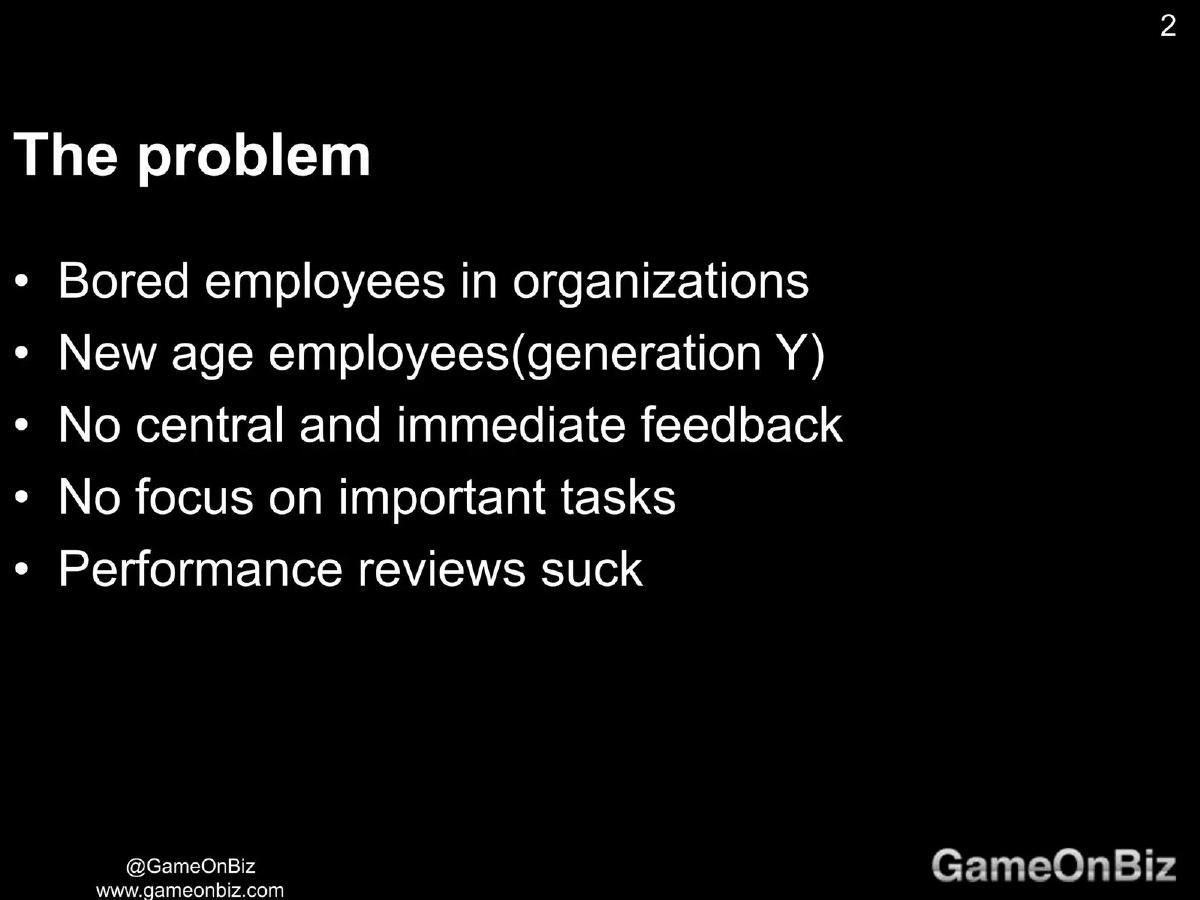
- The company identifies 'Generation Y' employees and boring performance reviews as the primary market pain points on slide 2.
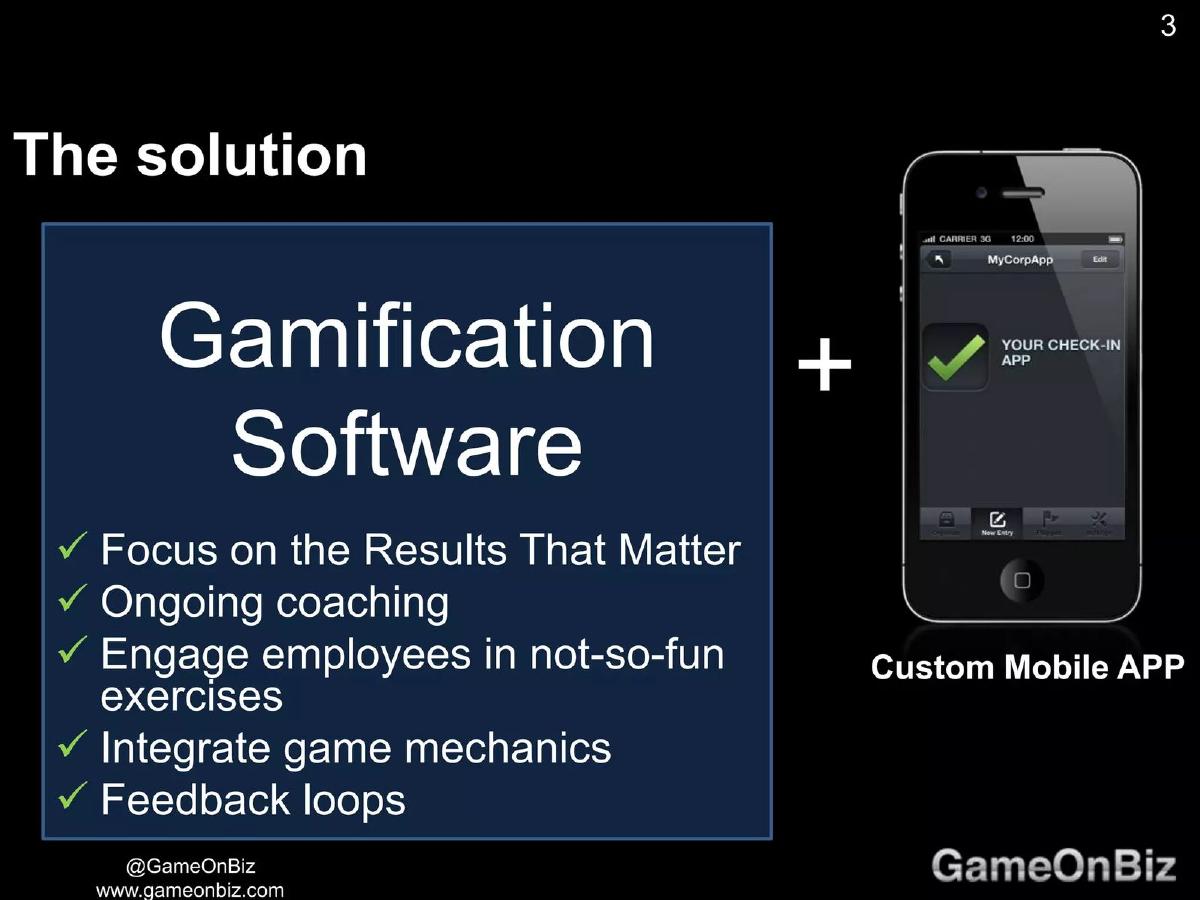
- The solution is presented as a combination of gamification software and a custom mobile application on slide 3.
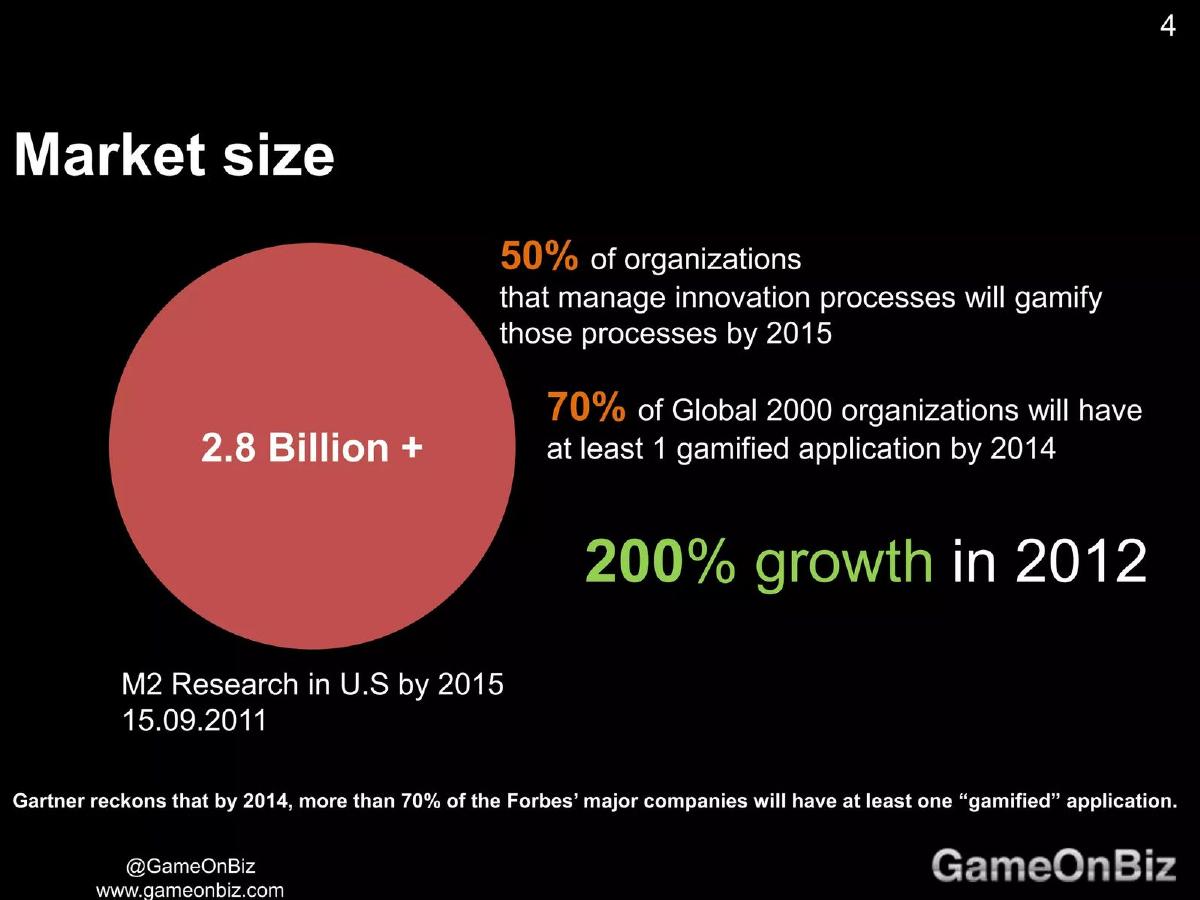
- Market size is estimated at $2.8 billion by 2015, citing M2 Research and a 200% growth rate in 2012 on slide 4.
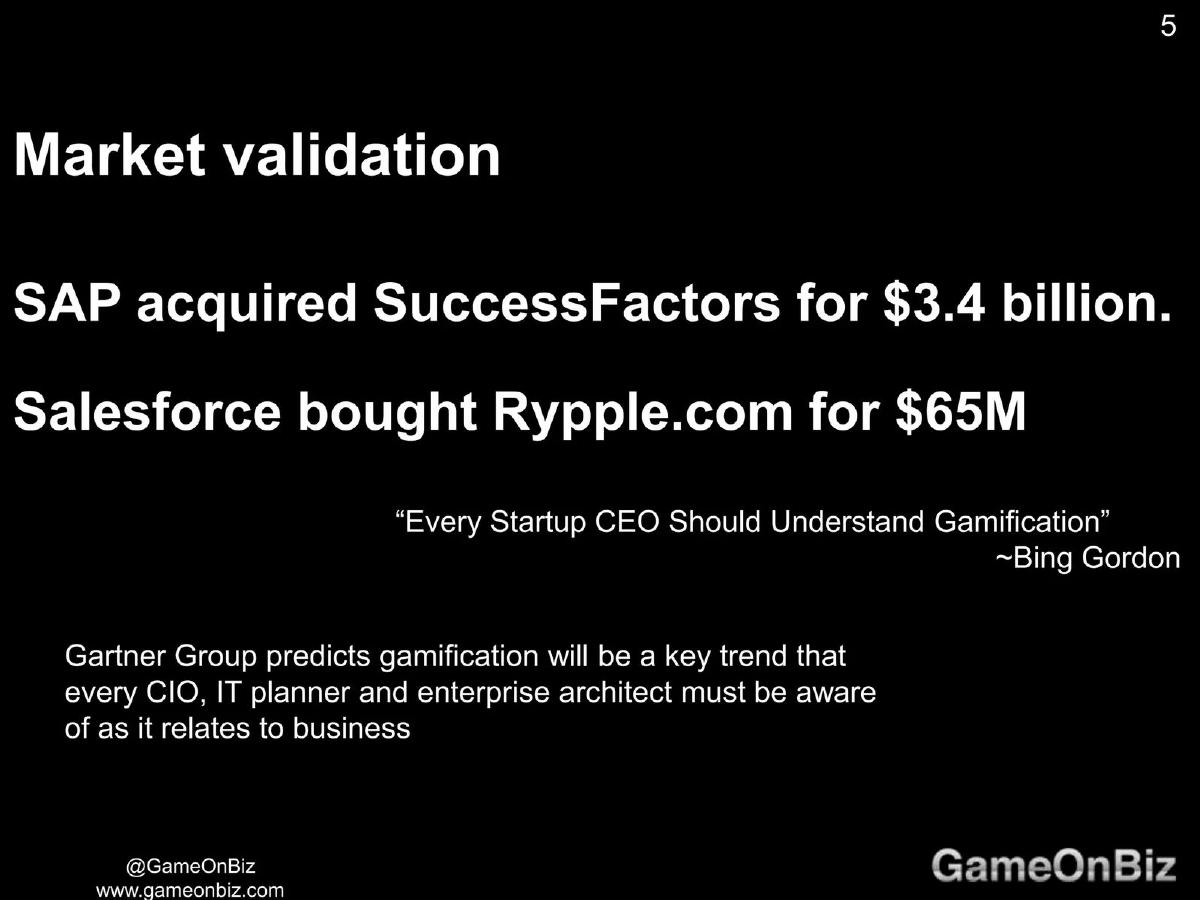
- The deck uses the $3.4 billion acquisition of SuccessFactors by SAP as market validation on slide 5.
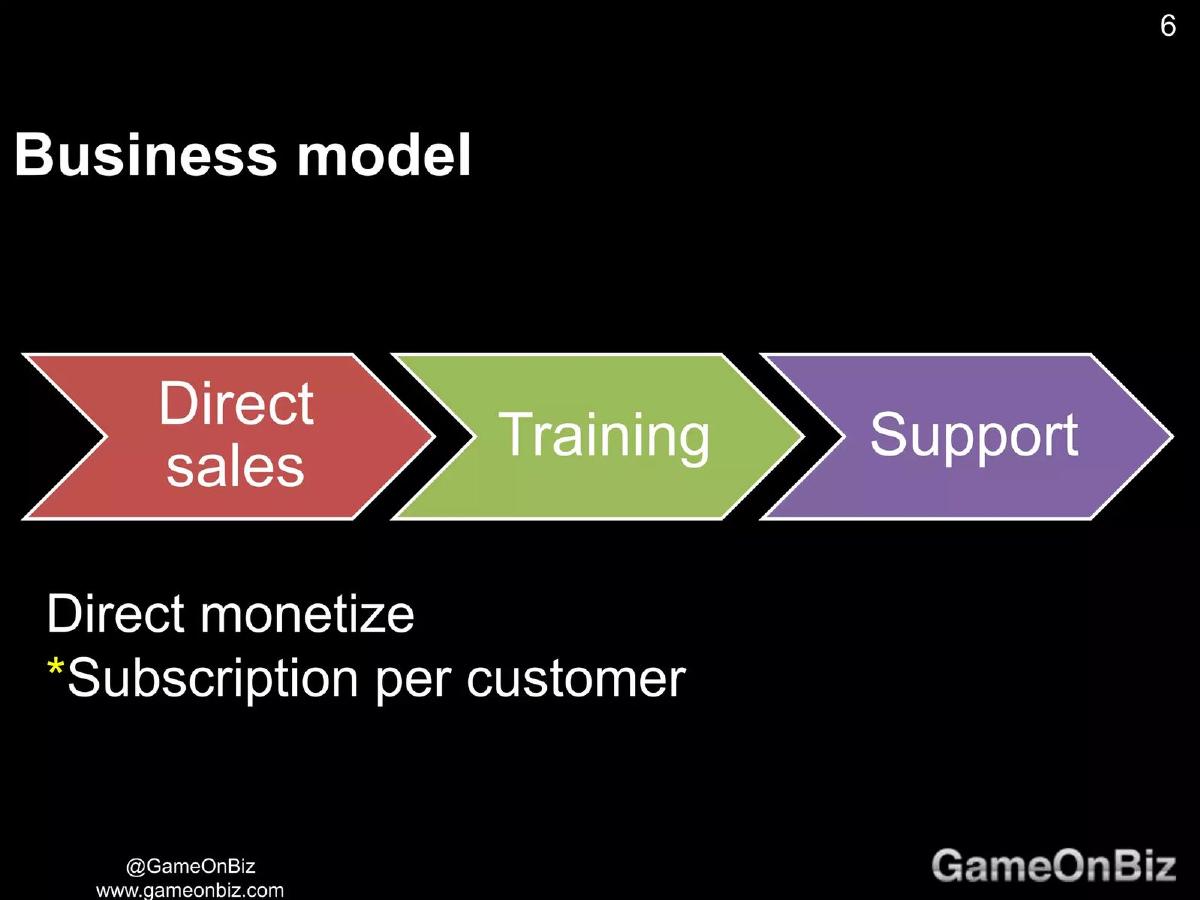
- The business model relies on direct sales and a subscription-per-customer revenue stream as shown on slide 6.
- GameOnBiz positions itself as the 'Affordable' alternative to Cisco, SAP, and Salesforce on the competition matrix on slide 7.
- The team consists of four named executives, though slide 10 notes that sales and HR experts are only 'ready to join' after the funding phase.
- The financing ask is $500,000 USD to fund a two-month milestone for product development and the start of sales on slide 11.
The Pitch Deck Breakdown
Slide 1: Title Slide
The deck opens with a high-contrast title slide featuring the GameOnBiz logo against a dark, abstract blue background. The tagline is straightforward: "GameOnBiz is easy way to motivate and reward your employees." It includes contact information for Jordan Katz Arow and a link to the company website. The branding is consistent with early 2010s corporate software aesthetics.
Slide 2: The Problem
Slide 2 lists five bullet points identifying the pain points in modern organizations. These include "Bored employees," the arrival of "Generation Y," a lack of "central and immediate feedback," and a lack of focus on important tasks. The final point, "Performance reviews suck," uses informal language to highlight a common corporate frustration. This slide sets up the need for a more engaging, real-time management tool.
Slide 3: The Solution
The solution is presented as a dual-threat offering: "Gamification Software" plus a "Custom Mobile APP." The slide lists five value propositions: focusing on results that matter, ongoing coaching, engaging employees in "not-so-fun exercises," integrating game mechanics, and creating feedback loops. A mockup of an iPhone running a "MyCorpApp" with a check-in feature is shown, though it appears to be a conceptual graphic rather than a functional UI screenshot.
Slide 4: Market Size
This slide relies heavily on external research to justify the opportunity. It cites a "2.8 Billion +" market size from M2 Research in the U.S. by 2015. It also quotes Gartner, predicting that 50% of organizations managing innovation will gamify processes by 2015, and 70% of Global 2000 organizations will have at least one gamified application by 2014. The slide highlights a "200% growth in 2012," positioning the company at the start of a massive trend.
Slide 5: Market Validation
To prove that large players are interested in this space, slide 5 lists two major acquisitions: SAP buying SuccessFactors for $3.4 billion and Salesforce buying Rypple.com for $65 million. It also includes a quote from Bing Gordon stating that every startup CEO should understand gamification. This slide is intended to show investors that there is a clear exit path via acquisition by enterprise giants.
Slide 6: Business Model
The business model is depicted as a linear flow from Direct Sales to Training to Support. The core monetization is listed as a "Subscription per customer." The slide is minimalist and lacks detail regarding price points, customer acquisition costs (CAC), or lifetime value (LTV) projections. It suggests a standard SaaS model but does not provide the unit economics to back it up.
Slide 7: Competition
The competition matrix uses "Affordable vs. Expensive" and "SMB vs. Enterprise" as its axes. GameOnBiz places itself in the top-center, claiming to be the most affordable option while serving both SMBs and Enterprises. Competitors listed include Cisco, Salesforce, Jive, and SAP, all of which are placed in the "Expensive/Enterprise" quadrant. This positioning suggests a disruption strategy based on price accessibility.
Slide 8: Competitive Advantages
This slide lists five boxes of advantages: a developed core product, being first in the European market, targeting both SMB and Enterprise sectors, having HR consultants on the team, and possessing enterprise sales experience. The claim of being "1st In European market" is a significant geographic differentiator, though no data is provided to support this status.
Slide 9: Marketing Plan
The marketing strategy is split into Online and Offline channels. Online tactics include partnerships, AdWords, SEO through HR groups/magazines, and industry articles. Offline tactics are limited to software distributors and event sponsorships. The plan is a standard B2B playbook but lacks specific targets or budget allocations for these channels.
Slide 10: Team
The team slide features four individuals: Jordan Katz Arow (CEO), Ike Anderson (COO), Matt Perlman (CFO), and Todor Iliev (CIO). While their titles are clear, the slide provides no information about their previous experience or qualifications. A note at the bottom states that "leading sales and HR experts" are ready to join only after the funding phase, which may signal to investors that the current team is incomplete for the scale they intend to reach.
Slide 11: Financing
The final slide presents the ask: "500,000 USD seeking." It ties this funding to "Milestone #1," which is defined as "Product development and sales start." The timeline for this milestone is stated as "2 months." This is an aggressive timeline for a seed round, suggesting the product is very close to launch or that the $500,000 is intended to bridge a very specific gap in the go-to-market strategy.
What GameOnBiz Does Well
The deck is highly focused on a single, trending theme: gamification. By leaning on heavyweights like Gartner and M2 Research, the founders successfully paint a picture of an inevitable market shift. The competitive positioning is also clear; they aren't trying to out-feature SAP or Salesforce, but rather out-price them. This "affordable alternative" narrative is a classic entry point for startups in crowded enterprise markets. Furthermore, the inclusion of major M&A activity (SuccessFactors and Rypple) provides a strong "why now" and a clear exit strategy for potential investors.
What Is Missing from the Deck
The most glaring omission is a lack of product depth. For a company selling "gamification," there is no evidence of the actual game mechanics, UI, or user experience. Investors generally want to see how the "fun" actually looks in a corporate setting. Additionally, the team slide is weak; names and photos without professional history make it impossible to judge execution capability. There is also a total absence of financial projections, unit economics, or a detailed breakdown of the $500,000 use of proceeds. Finally, the two-month timeline for "sales start" after funding is highly optimistic and lacks a supporting roadmap.
What a Founder Should Copy
Founders should emulate the way GameOnBiz uses market validation. Citing specific, high-value acquisitions in the same sector (Slide 5) is an excellent way to prove that the "big fish" are buying what you are building. The use of a simple 2x2 competition matrix (Slide 7) is also a best practice, as it allows investors to immediately grasp the company's intended market niche. The deck also does a good job of keeping text to a minimum, ensuring that the core message of each slide is not lost in a sea of bullet points.
Final Analysis
The GameOnBiz deck is a product of its time, capturing the peak of the gamification trend. While it identifies a real problem—employee disengagement—it relies too much on market hype and not enough on proprietary technology or team pedigree. To be successful today, a similar deck would need to include actual platform data, a much deeper dive into the "Generation Y" user psychology, and a team slide that proves the founders have the "enterprise sales experience" they claim to possess. The $500,000 ask is modest, but the lack of a detailed roadmap makes it a difficult sell for sophisticated investors.
Frequently asked questions
- What is the specific product offering of GameOnBiz?
- According to slide 3, the product is a combination of 'Gamification Software' and a 'Custom Mobile APP.' The software is intended to provide ongoing coaching, feedback loops, and integrate game mechanics into 'not-so-fun exercises.' However, the deck does not provide specific feature lists or actual screenshots of the software interface beyond a generic mobile mockup.
- How does GameOnBiz plan to generate revenue?
- Slide 6 outlines a three-stage business process: Direct Sales, Training, and Support. The primary monetization strategy is a 'Subscription per customer.' The deck does not specify pricing tiers, average contract values, or whether the training and support components are billed as additional professional services or included in the subscription.
- What is the company's competitive positioning?
- On slide 7, GameOnBiz uses a 2x2 matrix to position itself as highly 'Affordable' compared to 'Expensive' incumbents like SAP, Salesforce, and Cisco. It also places itself in the middle of the SMB and Enterprise axis, while slide 8 claims a competitive advantage by being the '1st In European market' and having 'Enterprise sales experience.'
- Who are the founders and what is their background?
- Slide 10 lists Jordan Katz Arow (CEO), Ike Anderson (COO), Matt Perlman (CFO), and Todor Iliev (CIO). The slide provides photos but omits any professional history, previous exits, or educational background. It also mentions that additional HR and sales experts will only join the team after the 'fund phase' is completed.
- What are the funding requirements and intended use of proceeds?
- Slide 11 states the company is seeking $500,000 USD. The stated goal for this capital is 'Milestone #1,' which includes 'Product development and sales start.' The timeline for this milestone is remarkably short, cited as '2 months.' The deck does not provide a breakdown of how the $500,000 will be allocated between engineering, sales, and operations.