GAPPbooks' 18-slide 'Overview' deck, exported from PowerPoint on 27 May 2015 and marked Confidential, pitched the AppBook: a book distributed as a standalone mobile app, with multimedia, gamification, direct author-reader messaging and - the genuinely prescient part - reader data owned by the author rather than by Amazon. The deck never turns that thesis into an investable proposition. There is no team slide, no traction, no revenue, no financial model, no product screenshot, no named customer, no roadmap and no funding ask; the only person named is in the PDF metadata. Slide 10 sells 'HIGHER…
Key takeaways
- GAPPbooks' 18-slide 'Overview' deck was exported from PowerPoint via Acrobat PDFMaker on 27 May 2015 and marked Confidential, though the circulating copy carries a November 2015 public upload stamp.
- The deck contains no team slide, no traction, no revenue, no financial model, no product screenshot, no named author or customer, no roadmap, no funding ask and no contact details - the only human name in the file is in the PDF metadata.
- Slide 10 promises authors 'HIGHER ROYALTIES'; slide 18 prints 40% (DIY tier) and 50% (custom tier) against the 70% Amazon KDP, Apple and Kobo all paid in 2015 - roughly $2 to $3 less per copy on a $9.99 title.
- Fixed costs make the gap worse, not better: $49 plus $9.99/month on the DIY tier, and a $2,500-$50,000+ development fee plus $299/month on the custom tier, meaning about $6,088 in year-one fees at the cheapest custom price.
- Slide 8 states the publishing industry 'can't be fixed'; slide 10 is titled 'THREE SIMPLE SOLUTIONS' - the two claims cannot both stand.
- Slide 13 claims 'NO ONE - YET' is doing this, in May 2015, when Apple iBooks Author, Inkling, Atavist, Book Creator, Kotobee, PubCoder and Aquafadas were all shipping interactive book creation.
- The same slide argues 'Steve Jobs was first to market with iTunes' - the iTunes Music Store launched in 2003, years after eMusic, Napster, Rhapsody, MusicNet and Pressplay.
- Slide 14's headline says 'There are no competitors on the AppBook market' while the diagram beneath it names six competitor categories, including white-label eReader apps and digital publishing platforms.
What this deck actually is
Eighteen slides, 4:3 landscape (720 x 540pt), built in PowerPoint and exported with Acrobat PDFMaker 10.0 on 27 May 2015 . The document properties name the author as Kyle Newton, and the cover is stamped Confidential — a marking the file outlived, since the copy that circulates carries a slide-sharing upload stamp from November 2015. It is titled "GAPPbooks Overview", and "overview" is the honest word for it. This is a story deck, not an investment document.
The concept is genuinely interesting. GAPPbooks argued that the ebook — a static text file rendered inside somebody else's reader — was a dead end, and that the real successor to the printed book was the AppBook : a book that ships as a standalone mobile application, with multimedia, gamification, direct messaging between author and reader, over-the-air content updates, and in-app upselling. Crucially, the author would own the reader relationship and the reader data instead of renting it from Amazon. In 2015 that was a defensible thesis with real intellectual weight behind it.
The deck never converts the thesis into a business anyone can underwrite. Across eighteen slides there is no team slide, no traction, no revenue, no financial model, no pipeline, no named customer or author, no product screenshot, no roadmap, no funding ask, no use of funds and no contact details . The only human name attached to the entire file is the one hidden in the PDF metadata. What is present instead is a manifesto, three market statistics that argue with each other, a competition slide that declares no competitors while drawing four categories of competitor around itself, and — on the final slide — a pricing table whose own numbers disprove the deck's central promise.
That last point is the reason this teardown is worth reading. GAPPbooks makes one core commercial claim: authors will earn higher royalties . Slide 18 prints the actual splits. They are lower. Not marginally — dramatically, and in both pricing tiers, before the monthly fees.
The royalty math, worked
Slide 18 is the only slide in the deck containing hard numbers, and it offers authors two paths.
Tier 1, "D.I.Y. AppBook Builder": a $49 publishing fee per platform, a $9.99 monthly maintenance fee, a 30% app-store listing fee to Google/Apple/Amazon, an average GAPPbook publishing fee of 30%, and an average author royalty of 40% .
Tier 2, "Custom AppBook Builder": a one-time development fee of $2,500 to $50,000+ , a $299 monthly marketing and maintenance fee, the same 30% store fee, a GAPPbook fee of 20%, and an average author royalty of 50% .
Both stacks total exactly 100%, which is at least internally consistent. The problem is the comparison the deck refuses to print. In May 2015, Amazon's Kindle Direct Publishing paid a 70% royalty on titles priced between $2.99 and $9.99, with no setup fee, no monthly fee and no development cost. Apple's iBooks Store paid 70%. Kobo Writing Life paid 70%. Those were the incumbent terms that "HIGHER ROYALTIES" on slide 10 was implicitly beating.
Run one book at $9.99. Under KDP the author nets roughly $6.99 per copy. Under the GAPPbooks DIY tier they net $4.00 . Under the custom tier, $5.00. Every single copy sold through GAPPbooks leaves the author between $1.99 and $2.99 worse off than the platform the deck is positioned against — and that is before the fixed costs. Year one on the DIY tier adds $49 plus twelve months at $9.99, roughly $169 , and if the $49 is genuinely charged "per platform" across the three stores named on the same slide, $147 plus maintenance. Year one on the custom tier adds a development fee starting at $2,500 and $299 a month — $6,088 in year one at the cheapest end , and over $53,000 at the top of the quoted range.
There is no volume at which the author catches up, because the per-copy gap runs the wrong way. The custom-tier author paying $6,088 in fees to earn $1.99 less per copy than they would have earned for free is not sliding towards break-even as they sell more — they are digging faster. That is the deck's core promise inverted by the deck's own pricing table, on a slide the reader reaches with no traction, no team and no ask to distract them.
An AppBook may well be worth more than an ebook. A richer product can carry a higher price, and a $24.99 AppBook at 40% beats a $9.99 ebook at 70%. But that argument requires a price comparison, a willingness-to-pay signal, or one real title's sales data — and the deck contains none of the three. It asserts higher royalties and then prints lower percentages, and leaves the reader to notice.
Slide-by-slide walkthrough
Slide 1 — Cover
"GAPPbooks Overview" and "Confidential", over the logo, with the footer tagline that will repeat on all eighteen pages: "Unleash Your Full Potential" .
No date, no round, no company descriptor, no name, no email. An investor who forwards this file to a partner cannot say what stage it is, when it was written or whom to reply to. The word "Overview" is doing quiet damage too: it lowers the reader's expectation of rigour before the first argument lands, and the deck spends eighteen slides confirming that expectation.
The tagline is the deeper problem. "Unleash Your Full Potential" appears 18 times and says nothing about books, authors, publishing or apps. It is footer real estate on every page that could have carried a one-line positioning statement the reader absorbs by repetition.
Slide 2 — "Will do for BOOKS what APPLE did for MUSIC"
The single most consequential slide, and it argues against the company. What Apple did to music was unbundle the album, collapse the price to $0.99 a track, and take a 30% cut of everything . Rights holders did not get better economics from iTunes; they got distribution and lost pricing power. Slide 18 then concedes the same 30% to the app stores and layers a second 20-30% GAPPbook fee on top. If GAPPbooks does for books what Apple did for music, the author outcome is precisely the outcome slide 10 promises to fix.
Comparisons to Apple, Uber and Netflix invite the reader to test the analogy. This one fails its own test on the deck's final slide.
Slide 3 — "Our Manifesto"
Ambition is not a flaw in a seed deck, and a company attacking an entrenched format needs a line like this. But a manifesto slide is a cheque the rest of the deck has to cash with evidence, and this deck never returns to the reader experience with a single screenshot, a demo link, or a description of what one finished AppBook actually looks like in a reader's hands.
Slide 4 — "Digital reading platforms have tipped"
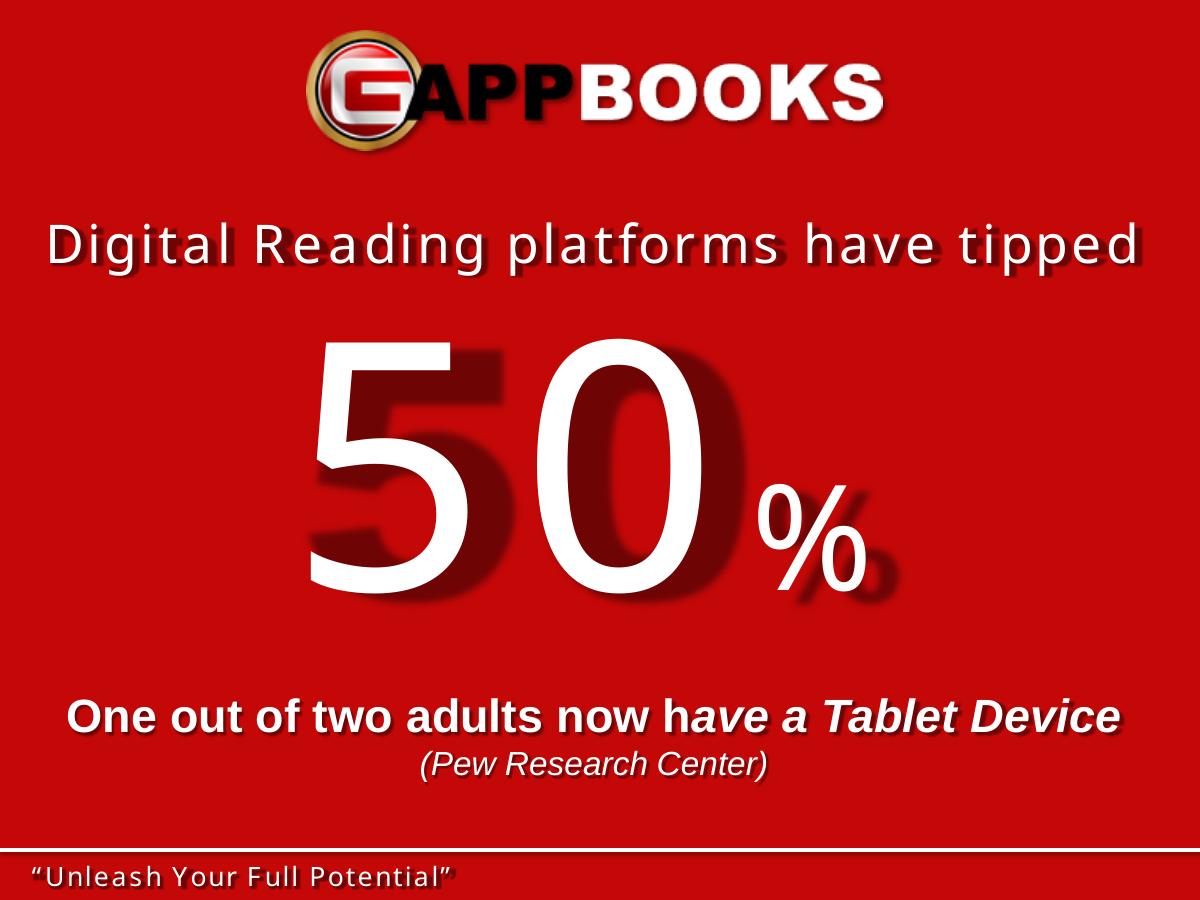
One number: 50% , "One out of two adults now have a Tablet Device", attributed to Pew Research Center.
The attribution is the right instinct and rarer than it should be — most decks in this series cite nothing. Two problems. First, the figure is rounded generously: Pew's tablet-ownership readings for US adults in this period sat in the mid-forties, not at half. Second, and more importantly, "adults" here means American adults, presented on a slide with no geography, in a deck that will claim a global market three slides later. Device penetration in the US is not a proxy for a worldwide publishing opportunity.
There is also a logical gap the slide does not close. Tablet ownership is not reading demand, and reading demand is not demand for a book that arrives as an app. The deck treats the three as the same fact.
Slide 5 — "AppBooks vs. eBooks"
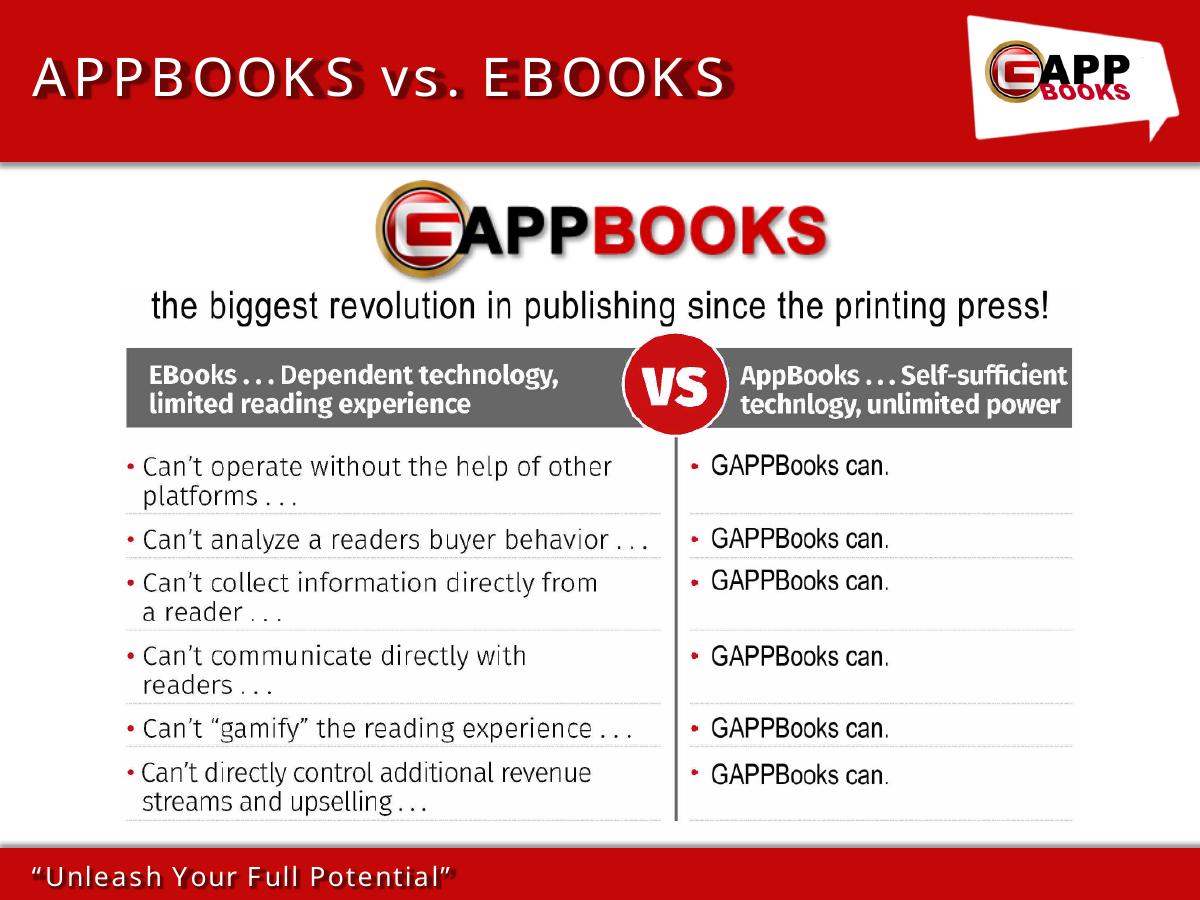
A two-column comparison. The left column lists what ebooks cannot do: operate without another platform, analyse reader buying behaviour, collect information directly from a reader, communicate with readers, gamify the reading experience, control additional revenue streams and upselling. The right column answers each with the identical phrase: "GAPPBooks can." Six times.
The framing is legitimate and the six capabilities are real differences between an app and an EPUB file. But repeating "GAPPBooks can" six times is assertion, not evidence, and it is deployed at exactly the moment a reader wants proof. One screenshot of a live analytics dashboard showing real reader behaviour on a real title would have converted the whole column from claim to fact.
The comparison also quietly picks the weaker opponent. The relevant competitor for a data-owning author in 2015 was not the EPUB format — it was Amazon, which owned the reader relationship and had the data. "Ebooks can't" is easy. "Amazon won't give it to you, and here's how we get around that" is the argument that mattered, and it is not made.
Slide 6 — The Gartner quote
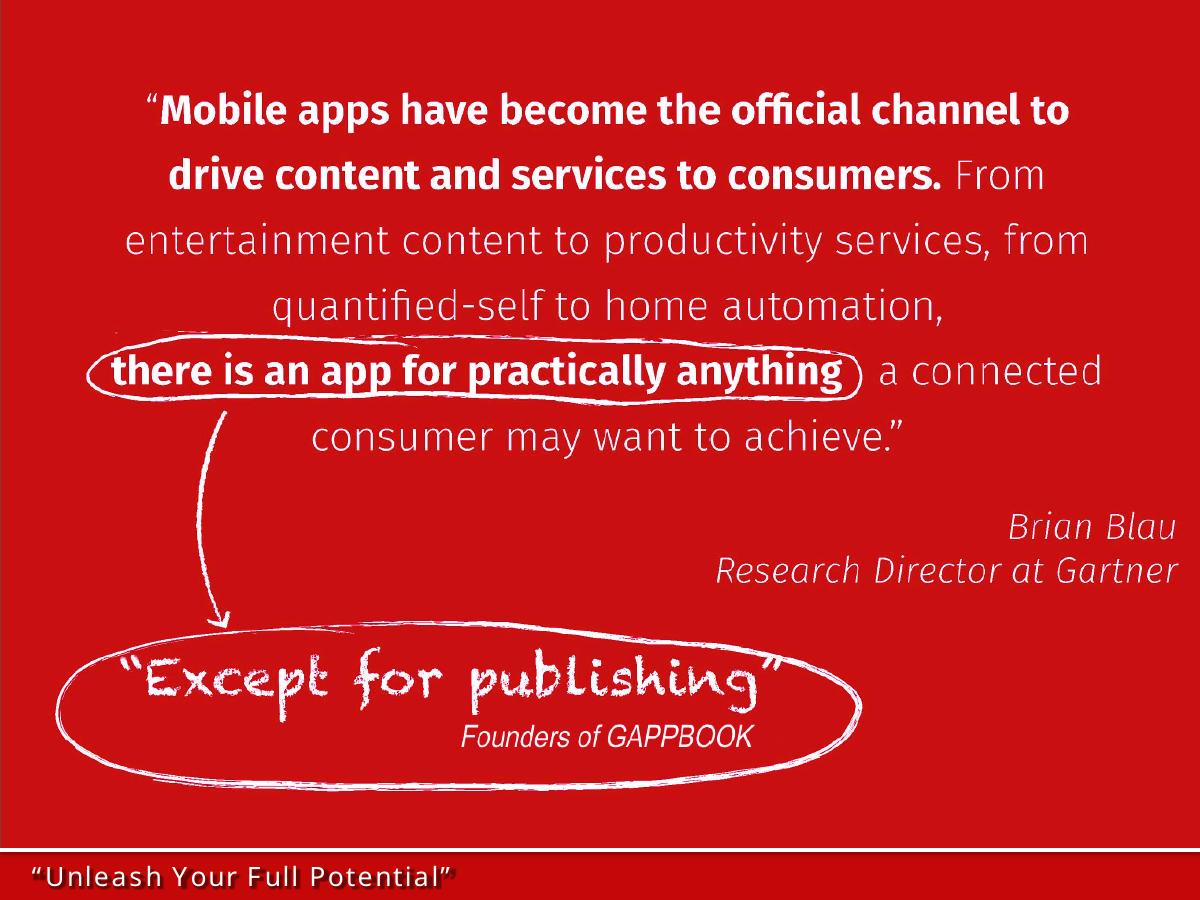
A long quote from Brian Blau, Research Director at Gartner, on mobile apps becoming the official channel for content and services — followed immediately by a second quote block, styled the same way, attributed to "Founders of GAPPBOOK" .
Borrowing an analyst's authority is standard practice. Placing your own words in a matching quote box directly beneath his is not: it uses the visual grammar of third-party validation to present a self-assertion. Readers notice the seam, and once they do, they start discounting the genuine citation above it too. The attribution also names "Founders" plural, in a deck that never tells the reader who those founders are.
Slide 7 — "What is an AppBook"
A seven-bullet capability list: unlimited multimedia, full eReading functionality, gaming and engagement, social interaction and direct messaging, datamining and behaviour tracking, instant content updates, direct upselling.
This should be the strongest slide in the deck and it is one of the weakest — because it is text. A product defined as "a book that is also an app" has to be shown . There is not a single device mockup, screen capture or example title anywhere in eighteen slides. The deck asks an investor to fund a new media format without ever displaying the format.
Bullet six deserves separate attention: "Ability to immediately update the content and do it as many times as needed." That is factually complicated. In 2015, updating a native app on the Apple App Store required a review cycle measured in days, not an instant push. The deck states a capability the platform constraints of its own distribution channel did not straightforwardly allow, and offers no architectural explanation of how it would.
Slide 8 — "The publishing industry is dying"
Three lines of centred text: the industry is dying, no one knows what to do about it, and — the line that matters — "The truth is it can't be fixed."
Two slides later, the deck presents "THREE SIMPLE SOLUTIONS". A reader cannot hold both. If the industry cannot be fixed, three simple solutions cannot fix it; if three simple solutions fix it, it was fixable. The rhetorical intent is obvious — the old model is beyond repair, so it must be replaced — but the words on the page contradict each other across a two-slide gap, and the contradiction is easy to remove and was not.
"The publishing industry is dying" was also, factually, a strained claim in 2015. US trade publishing revenue was broadly flat to growing that year, and print was in the middle of an unexpected stabilisation. Opening on a premise a well-read investor knows to be shaky costs credibility on the slides that follow.
Slide 9 — "The problem in publishing"
Three columns: publishers are stuck (sales cratered, margins shrunk, business model can't change), readers are disengaged (reading behaviour has changed, "Generation Y doesn't read print books", books aren't connecting), authors are struggling (authors are starving, publishers don't add value, authors don't know how to profit). Closing line: "How much is it worth to readers, publishers, authors and investors if the publishing industry could be rebooted?"
Structurally this is the best-built slide in the deck. Three stakeholders, three pains each, one question that converts pain into value — that is a template worth copying wholesale.
What it lacks is a single number. Nine assertions, zero citations, on the one slide where the deck has just told us it can cite sources (slide 4 named Pew). "Sales have cratered" invites the obvious question — by how much, over what period — and the deck leaves it open. "Generation Y doesn't read print books" was, in 2015, contradicted by Pew's own reading surveys, which repeatedly found younger adults reading print at rates at or above their elders. The deck cites Pew when it helps and contradicts Pew when it does not.
Slide 10 — "Three simple solutions"
Higher royalties with author-chosen cover price; authors own their reader database; ongoing direct engagement through the platform.
These are the right three. Ownership of the reader relationship in particular was the genuine strategic wedge against Amazon, and a version of this deck built entirely around solution two would have been stronger than the one that exists.
Solution one is the claim slide 18 disproves. Solution two — "authors own their reader database" — raises a question the deck never touches: reader data collected inside an app distributed through Apple and Google is governed by those platforms' privacy rules and by consumer data law, and "the author owns the database" is a promise with real legal texture behind it. Nothing here addresses consent, storage, or what happens to the database if the author leaves the platform. For the solution the deck should be proudest of, that is a conspicuous silence.
Slides 11 and 12 — "GAPPbooks: the solution"
Eight capability tiles across two slides under the banner "GAPPBOOK IS NOT JUST AN APP!": DIY AppBook Builder, Connection Ecosystem, Conversion Driver, Engagement Platform, Data Mining Engine, Revenue Multiplier, Viral Accelerator, Brand Equalizer.
Eight named capabilities is at least three too many for a seed-stage company with no product shown and no team named. Each tile is written at maximum abstraction — "AppBooks convert authors into celebrities", "authors can convert multimedia content into profit overnight", "just about any activity can be monetized" — and abstraction stacked eight deep reads as a wish list rather than a roadmap.
The DIY tile makes a specific and testable claim: building a multimedia AppBook is "as easy as building a Facebook page". That is the single best sentence in the deck, because it is concrete, memorable and falsifiable. It also has an obvious follow-up — show me — and the deck cannot. A four-screen sequence of the builder in action would have carried more weight than both slides combined.
Slide 13 — "Who else is doing this?"
The answer, in large type: "NO ONE – YET" , with the supporting line "Steve Jobs was first to market with iTunes and look what happened".
Both halves are wrong in ways an investor will catch instantly.
"No one" was not true in May 2015. Apple had shipped iBooks Author free in 2012, for building multimedia interactive books. Inkling had been building rich interactive titles since 2009 and had opened its Habitat authoring platform. Atavist was publishing multimedia long-form as apps and licensing its tooling. Book Creator , Kotobee , PubCoder and Aquafadas were all selling interactive book creation. Push Pop Press had famously done it in 2011 and been bought by Facebook. This is not obscure history; several of these were the most-cited names in digital publishing at the time.
And Steve Jobs was not first to market in digital music. The iTunes Music Store launched in 2003, years after eMusic, Napster, Rhapsody, MusicNet and Pressplay. The correct version of this argument — Apple was not first, Apple was best, and being second with better execution is how the category was won — is stronger, truer, and would have survived the first question from an investor who lived through it. Instead, the slide claims a monopoly that did not exist, using an example that disproves the point it is making.
Slide 14 — "Competitive landscape"
A Venn construction: a BOOKS circle containing traditional publishers, self-publishing and print-on-demand, and eBook converters; an APPS circle containing white-label eReader apps, app builders and digital publishing platforms; and in the intersection, a solid red circle reading "APPBOOKS ONLY — GAPPBOOK". Headline: "There are no competitors on the AppBook market. There are only books and apps."
The diagram is the strongest visual in the file and the positioning logic — we sit at an intersection nobody occupies — is exactly how a category-creation deck should be built.
It also contradicts its own headline. The slide says there are no competitors, then names six categories of competitor around the perimeter, two of which — white-label eReader apps and digital publishing platforms — are direct competitors doing substantially what GAPPbooks proposed to do. A reader who takes the diagram seriously has to conclude the sentence above it is false. Deleting one line ("There are no competitors...") and replacing it with an honest wedge statement would have kept the diagram's power and removed the contradiction.
Empty quadrants also carry a burden the deck never picks up. If nobody is in the middle after five years of tablets, an investor's first thought is not "opportunity" — it is "why not?". Perhaps discovery: an app-per-book has no shelf, no browse, no series page, and each title has to buy its own installs. That is the hardest question in the business, and the slide that raises it does not answer it.
Slide 15 — "Market opportunity"
Three statistic panels under the line "GAPPBOOK is positioned at the center fo the convergence: PUBLISHING. APPS. ENGAGEMENT." — the typo is on the slide.
Panel one: 391,000 ISBN-registered self-published titles in 2012, up 59% over 2011 and 422% over 2007. That is Bowker data, and it was three years stale by May 2015; the more recent figures were dramatically higher and would have made the point better. Citing 2012 in 2015 signals the deck was assembled from an older file and not refreshed.
Panel two contains the deck's clearest numerical failure. In one panel, two incompatible forecasts sit side by side: "By 2018, the Global Gamification Market will reach $5.5Bn" immediately followed by a quotation reading "The size of the gamification market, currently estimated at around $100mm, will grow to more than $2.8b by 2016." A market that is $100mm "currently" cannot also be on a path to $5.5Bn by 2018 in any sane model, and the $100mm figure was already years out of date when the slide was written. Two analyst numbers were pasted into one box without anyone checking whether they described the same world. Neither carries a named source or a date.
Panel three — 268 billion app downloads and $77 billion revenue by 2017, from Gartner — is correctly attributed and genuinely relevant. It is also a market GAPPbooks is not in: total app-store revenue is not addressable market for a book-publishing platform, and the slide does not attempt the arithmetic that would turn any of these three numbers into a revenue opportunity for this company. There is no TAM, no SAM, no bottom-up build, and no statement of how many AppBooks at what price equals what business.
Slide 16 — "Who is our customer?"
A cluster diagram: authors, publishers, associations, educators, coaches, professional speakers, trainers, spanning non-fiction, how-to, religious, fiction and children's.
The instinct is right — professional speakers, coaches and trainers were the correct beachhead, because they already sell high-priced content to an audience they own and would genuinely pay for engagement data. That insight is on the slide.
It is also buried among eleven other segments given equal visual weight. Naming everyone is the same as naming no one; the slide would be twice as strong if it picked professional speakers and said so, then listed the rest as expansion. And there is no segment sizing, no evidence any of these groups were asked, and no pilot with a single named coach or speaker.
Slide 17 — "Monetizing an AppBook"
A circular loop: the AppBook is purchased by a reader → it engages and interacts with the reader → big data is collected → upselling of additional products and services → advertising and promo opportunities → a "Trust Based Reader Ecosystem" at the centre.
Multiple revenue lines from a single sale is a real strength of the app format, and drawing them as a loop rather than a list is the right choice.
Every arrow in the loop is unquantified — no conversion rate, no average upsell value, no ad CPM, no share of revenue by line — so it describes a mechanism, not a model. The loop also contains an unexamined tension: it places advertising inside a product the reader has already paid for, and puts "Trust Based" at the centre of the same diagram. Serving ads in a purchased book, while mining that reader's behaviour, is not obviously a trust-building act, and the deck does not defend it.
Slide 18 — "Author options"
The pricing table analysed above — and the last slide in the file.
Ending on pricing is not a mistake in itself; ending there with no ask is. There is no funding amount, no instrument, no valuation, no use of funds, no milestones the money buys, no team, no email address and no next step. An investor who reaches slide 18 persuaded has no idea what they are being asked to do or whom to contact. The name Kyle Newton exists only in the PDF's document properties.
What to copy, and what to fix
Worth copying: the three-stakeholder problem structure on slide 9 and its value-converting closing question; the intersection Venn on slide 14; the "as easy as building a Facebook page" line, which is the only sentence in the deck a reader will repeat verbatim; citing a named research source on a market claim at all; and the decision to print real pricing rather than hide behind "flexible enterprise terms".
Worth fixing: the deck promises higher royalties and prints lower ones — either show the price premium that makes 40% beat 70%, or drop the claim. Never write "no competitors" above a diagram naming six categories of competitor. Never place two analyst forecasts that contradict each other in the same box. Do not say the industry "can't be fixed" two slides before offering three fixes. Check the historical analogy before betting a slide on it — Jobs was not first. Show the product at least once when the product is a new visual format. And add the four slides this deck is missing entirely: team, traction, the model, and the ask.
GAPPbooks was early to an idea — that the reader relationship, not the file format, was the thing authors needed to own — that the next decade proved out in newsletters, communities and creator platforms. The deck reads as though the founders believed the idea so completely that they never felt the need to evidence it. Eighteen slides of conviction, one page of numbers, and the numbers contradicted the conviction.
Frequently asked questions
- What was GAPPbooks?
- GAPPbooks was a publishing platform concept built around the 'AppBook' - a book distributed as a standalone mobile application rather than as an ebook file inside someone else's reader. The pitch was that an AppBook could carry unlimited multimedia, gamification, direct author-reader messaging, over-the-air content updates, in-app upselling and full reader analytics, letting authors and publishers own the reader relationship and the reader database instead of renting it from Amazon. The deck is dated May 2015.
- Is this a real GAPPbooks investor pitch deck?
- It is the company's own 18-slide 'GAPPbooks Overview' deck, 4:3 landscape at 720 x 540pt, built in PowerPoint and exported with Acrobat PDFMaker 10.0 on 27 May 2015, with the cover marked Confidential. It functions as a story or overview deck rather than a full investor deck: it has no team, traction, financials or funding ask, and the only person named anywhere in the file is in the PDF document properties.
- How much was GAPPbooks raising?
- The deck never says. There is no funding amount, no instrument, no valuation, no use of funds, no milestone plan and no closing date across all eighteen slides. The final slide is a pricing table for authors, after which the deck simply ends - with no ask, no team and no contact details for a persuaded reader to act on.
- What is the biggest problem with the GAPPbooks deck?
- Its central promise is contradicted by its own numbers. Slide 10 sells 'HIGHER ROYALTIES' as solution number one, but slide 18 shows author royalties of 40% on the DIY tier and 50% on the custom tier, against the 70% that Amazon KDP, Apple iBooks and Kobo all paid in 2015. On a $9.99 title that is roughly $4.00 or $5.00 to the author versus $6.99 elsewhere - before a $49 setup and $9.99 monthly fee on the cheap tier, or a $2,500-$50,000+ development fee and $299 a month on the expensive one. Higher royalties are lower royalties, and no sales volume closes the gap because the per-copy economics run the wrong way.
- Was GAPPbooks really the only company building interactive AppBooks in 2015?
- No. Slide 13 answers 'WHO ELSE IS DOING THIS?' with 'NO ONE - YET', but by May 2015 Apple had shipped iBooks Author free since 2012, Inkling had been producing interactive titles since 2009 and had opened its Habitat authoring platform, Atavist was publishing multimedia long-form as apps and licensing its tooling, and Book Creator, Kotobee, PubCoder and Aquafadas were all selling interactive book creation. Slide 14 then contradicts the claim itself by drawing 'white label eReader apps' and 'digital publishing platforms' as adjacent categories.
- What can founders learn from the GAPPbooks deck?
- Three things. First, never let a pricing slide contradict a promise slide - work your own numbers against the incumbent's before you claim to beat them. Second, 'we have no competitors' is almost never true and is instantly checkable; a wedge statement about where you sit is stronger and survives diligence. Third, if your product is a new visual format, show it - this deck describes an AppBook across eighteen slides without ever displaying one screen of it. What is worth copying is the three-stakeholder problem slide, the intersection Venn diagram, and the willingness to publish real prices.