Galvanize positions itself as a modern alternative to traditional media agencies, specifically targeting the SMB sector. The deck identifies a lack of know-how, time, and budget as the primary barriers for these companies in the digital space. By leveraging 'aspiring talents' and avoiding expensive office overhead, Galvanize proposes a cost-plus pricing model with a 50% profit margin. The deck highlights a significant jump in projected revenue from 280,000 SEK in 2018 (at 25% workload) to 4.5 million SEK in 2019 (full-time). While the deck provides clear market data and a basic financial fram…
Key takeaways
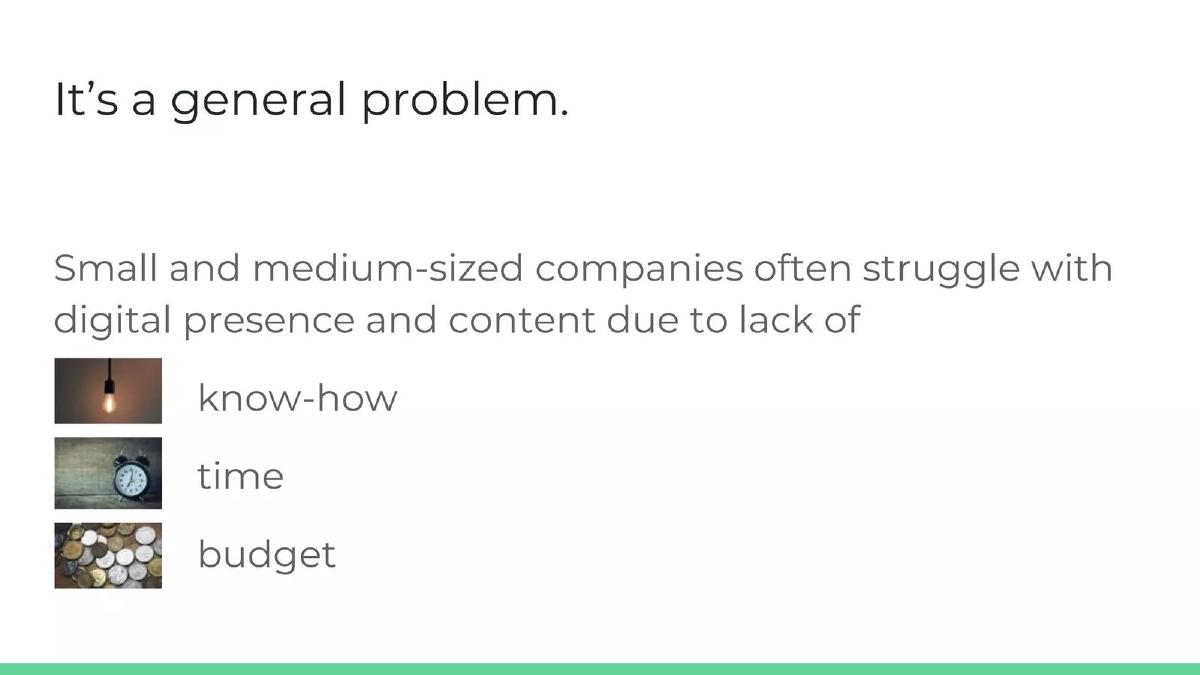
- The company targets small and medium-sized companies that lack the know-how, time, and budget for digital media (Slide 3).
- Galvanize defines its value proposition as a media agency that does not require big productions or expensive offices to produce content (Slide 5).
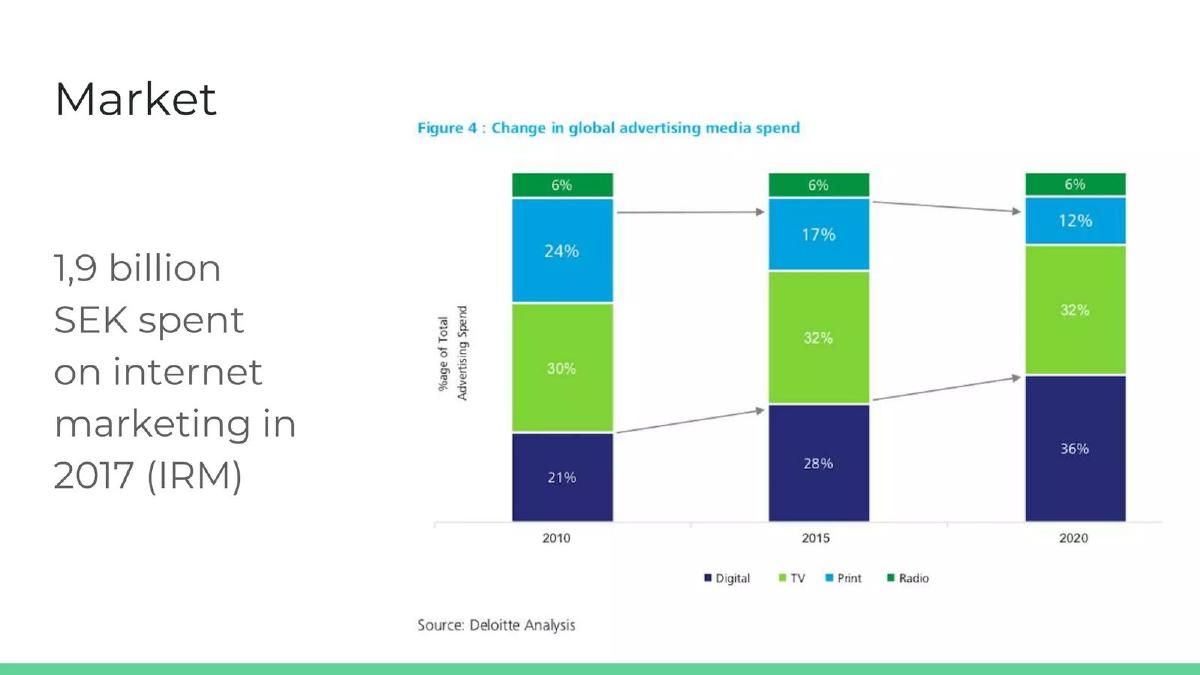
- Market data from 2017 shows 1.9 billion SEK spent on internet marketing, with digital spend projected to reach 36% of total advertising by 2020 (Slide 6).
- The business model relies on a 50% profit margin, with 30% of costs allocated to 'aspiring talents' and 20% to project expenses (Slide 10).
- Financials show a 2018 revenue of 280,000 SEK on a 25% workload, with a 2019 projection of 4.5 million SEK for full-time operations (Slide 11).
- The deck identifies traditional agencies, in-house teams, and freelancers as the primary competitive landscape (Slide 9).
- Marketing strategy is heavily reliant on word of mouth and personal sales meetings rather than automated lead generation (Slide 13).
- There is no information regarding the founding team, their backgrounds, or the specific capital amount being raised.
Galvanize Pitch Deck Analysis
The Galvanize pitch deck is a 13-slide presentation that outlines a service-based agency model designed to solve the digital content gap for small and medium-sized enterprises (SMEs). The deck focuses on the transition from traditional, high-overhead media production to a leaner, talent-driven approach. It relies heavily on market trends from 2017 and 2018 to justify its existence.
Slide 1: Title Slide
The deck opens with a minimalist title slide featuring the company name, Galvanize , and the tagline "AFFORDABLE CREATIVE MARKETING." The visual design is clean, using a dark background with a thin green accent line, setting a professional tone for a creative services company.
Slide 2: The Hook
Slide 2 introduces the premise of the business by asking, "Thought about your digital media presence?" It lists three foundational beliefs: "People will Google you first," "You need to go digital," and "Everyone has a story to tell." This slide serves to establish the necessity of the service in a modern economy where digital first impressions are paramount.
Slide 3: The Problem
The problem is defined as a "general problem" affecting small and medium-sized companies. Slide 3 explicitly lists three pain points: lack of know-how, time, and budget. These are standard hurdles for SMEs, and by identifying them early, Galvanize sets the stage for its value proposition as a solution that addresses all three simultaneously.
Slide 4: The Mission
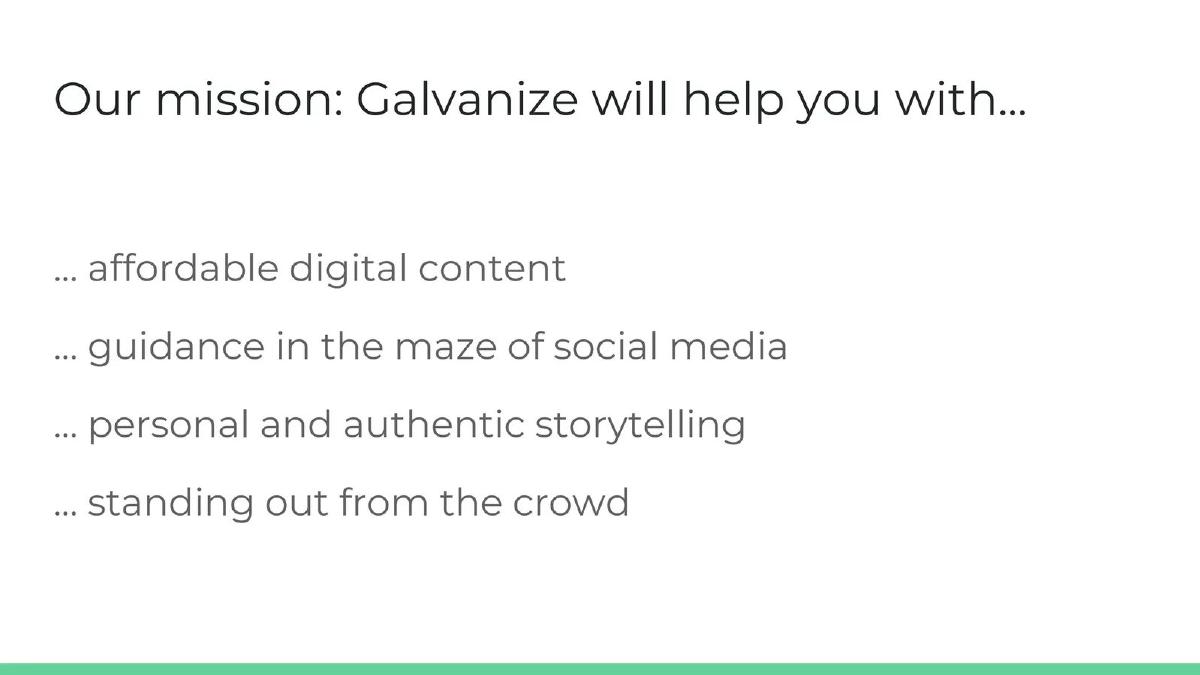
Slide 4 outlines the company's mission. Galvanize intends to help clients with "affordable digital content," "guidance in the maze of social media," "personal and authentic storytelling," and "standing out from the crowd." The focus here is on the qualitative aspects of their service—authenticity and guidance—rather than just technical execution.
Slide 5: Value Proposition
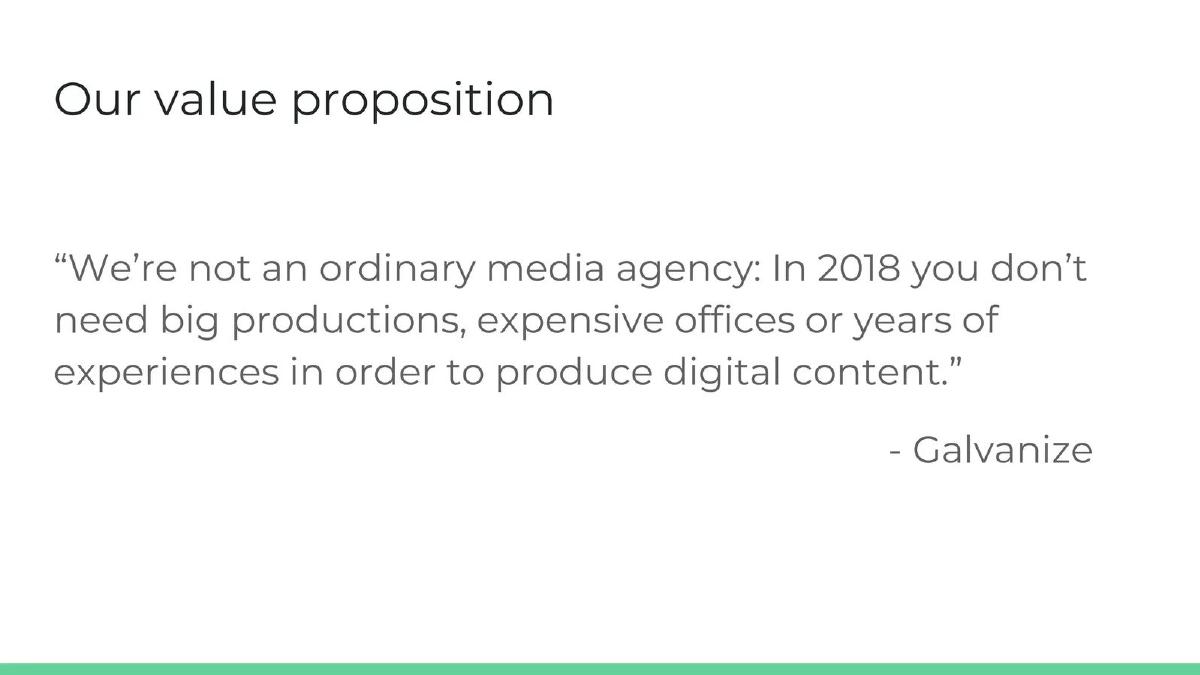
This slide contains a direct quote that defines the company's operational philosophy: "We’re not an ordinary media agency: In 2018 you don’t need big productions, expensive offices or years of experiences in order to produce digital content." This is a critical slide because it explains how they achieve the "affordability" mentioned on the title slide. By removing the overhead of traditional agencies, they position themselves as a high-margin, low-cost alternative.
Slide 6 & 7: Market Data
Galvanize uses two slides to validate the market. Slide 6 cites 1.9 billion SEK spent on internet marketing in 2017 and includes a Deloitte Analysis chart showing digital advertising spend growing from 21% in 2010 to a projected 36% in 2020. Slide 7 provides a more granular look at 2017 budget plans, highlighting that 56% of professionals planned to increase social media marketing spend and 55% planned to increase content marketing spend. These figures provide a macro-economic tailwind for the business model.
Slide 8: Competitors
Slide 8 identifies the competitive landscape. It lists traditional media agencies, in-house media agencies, and freelancers and consultants. The slide includes an image with the text "Not your traditional media agency," reinforcing the disruption of the status quo. However, it lacks a competitive matrix or a specific breakdown of how Galvanize wins against these three distinct groups.
Slide 9: Business Model
The business model is presented via a pie chart on Slide 10. The company uses a cost-plus pricing strategy: "Selling price = Cost + 50 % profit margin." The cost side is split between "Aspiring talents" (30%) and "Project expenses" (20%) , with the remaining 50% as Revenue (Profit) . This indicates a highly profitable service model if they can maintain a steady flow of projects and manage junior talent effectively.
Slide 10: Financials
Slide 11 provides the most concrete data in the deck. It shows 2018 revenue of 280,000 SEK based on a 25% workload . It then projects 4.5 million SEK in revenue for 2019 once the team moves to full-time operations. A bar chart titled "CASHFLOW IN (SEK)" shows specific project contributions, including 100,000 SEK from "ALMEDAL" and 80,000 SEK from "SB." The jump from 280k to 4.5m is significant and suggests an aggressive scaling plan.
Slide 11: Key Partners
Slide 12 lists the ecosystem Galvanize intends to leverage: Start-up platforms, Universities & media schools, Event bureaus, and Social media influencers. The mention of universities and media schools is particularly important, as it likely represents the source of the "aspiring talents" mentioned in the business model slide.
Slide 12: Marketing Strategy
The marketing strategy on Slide 13 is traditional for a service business. It relies on Word of mouth, Personal sales meetings, Website, and Social media channels. While these are standard, the reliance on personal sales meetings suggests that the 4.5 million SEK revenue target will require a significant amount of manual business development effort.
Slide 13: Closing Slide
The final slide repeats the branding from the title slide over an image of people using mobile devices. It reinforces the "AFFORDABLE CREATIVE MARKETING" tagline but does not provide contact information or a call to action.
What Works in This Deck
Clear Problem Identification: The deck does an excellent job of distilling the SME struggle into three simple words: know-how, time, and budget. · Transparent Business Model: The 50% profit margin target is bold and clearly communicated, giving investors a clear idea of the unit economics. · Market Timing: Using 2017/2018 data to show the shift from print/TV to digital provides a strong logical foundation for an agency launch in that era. · Scalability Logic: Showing that 280k SEK was earned at 25% capacity provides a mathematical (if simplified) basis for the 4.5m SEK full-time projection.
What Is Missing
The Team: This is the most glaring omission. In a service business powered by "aspiring talent," the leadership's ability to recruit, train, and manage that talent is the only thing that matters. There are no bios or names provided. · The Ask: The deck never mentions how much capital is needed or what that capital will be used for (e.g., hiring, marketing, or technology). · Service Specifics: While it mentions "digital content," it doesn't specify if this is video, copywriting, graphic design, or all of the above. · Retention Metrics: For an agency, recurring revenue is key. The deck focuses on one-off project revenue (like the Almedal event) rather than long-term retainer contracts.
Founder Takeaways
Lead with the Margin: If you have a service business with a 50% net margin, make that a central part of your pitch. Investors like high-margin service models that don't require heavy R&D. · Leverage Macro Trends: Using third-party data from Deloitte or Adobe (as seen on Slide 7) adds credibility to your claim that a market is growing. · Don't Forget the Team: Especially in an agency pitch, you are the product. Never omit a team slide that highlights your specific expertise in the niche you are targeting. · Define Your Talent Pipeline: If your model relies on "aspiring talent" (students/juniors), explain how you vet them to ensure quality control. Without this, the model looks risky to an outsider.
Frequently asked questions
- What is the core business model of Galvanize?
- Galvanize operates as a lean creative marketing agency. According to slide 10, they use a cost-plus pricing model where the selling price equals cost plus a 50% profit margin. Their cost structure is split between 'aspiring talents' (30%) and project expenses (20%). This suggests they act as a bridge between junior creative talent and SMBs, keeping overhead low by avoiding traditional agency expenses like high-end offices.
- How does Galvanize justify the market opportunity?
- The deck uses two slides to establish market demand. Slide 6 cites Deloitte and IRM data showing 1.9 billion SEK spent on internet marketing in 2017, with digital media spend trending upward. Slide 7 shows that over 50% of marketing professionals planned to increase budgets for social media, content marketing, and video advertising in 2017, which aligns with Galvanize's core service offerings.
- What are the projected financials for the company?
- Slide 11 outlines a significant growth trajectory. In 2018, the company recorded 280,000 SEK in revenue while operating at only a 25% workload. For 2019, they projected 4.5 million SEK in revenue upon transitioning to full-time operations. The slide also includes a bar chart showing various revenue streams like 'HACK', 'ALMEDAL', and 'SB', though these specific projects are not detailed elsewhere in the deck.
- Who are the competitors mentioned in the deck?
- Slide 9 categorizes competition into three groups: traditional media agencies, in-house media agencies, and freelancers/consultants. Galvanize attempts to differentiate itself by claiming it is 'not your traditional media agency,' implying that its affordability and focus on authentic storytelling (Slide 4) provide an edge over high-cost incumbents and fragmented freelancers.
- What critical information is missing from this pitch deck?
- The deck is missing several standard components required for an investment decision. Most notably, there is no team slide, leaving the founders' expertise unknown. There is also no 'Ask' slide detailing how much money is being raised or how it will be used. Additionally, the deck lacks a product roadmap or a description of the specific workflow/technology used to manage 'aspiring talents' at scale.