Giggles N' Hugs operates a niche hospitality model combining organic dining with supervised children's play areas. The April 2018 deck focuses heavily on validating the financial viability of their existing Southern California locations to justify a broader expansion. By highlighting a 20% EBITDA margin and a 2.5-year average payback period per store, the company attempts to frame a traditionally risky brick-and-mortar business as a repeatable, high-margin retail play. However, the deck relies heavily on third-party marketing partnerships and lacks a clear executive team slide or a detailed b…
Key takeaways
- The company claims a 20% EBITDA margin across its single-store economic model on slide 5.
- Glendale Galleria location reported a 12.3% sales increase in 1H17 and 30% positive cash flow on slide 4.
- The business model includes a unique child drop-off service, which they claim is the first of its kind in Los Angeles on slide 2.
- Expansion strategy targets high-traffic, upscale retail centers with a footprint of 4,500-5,000 sq. ft. as stated on slide 5.
- A recent Rights Offering raised $650,000 from approximately 200 investors according to slide 7.
- Total company cost to launch a new store is estimated at $600,000 after accounting for tenant improvement funds on slide 5.
- The deck highlights a partnership with dOMAIN for brand strategy, citing their work with brands like Chrysler and the LA Lakers on slide 6.
- The company asserts that breakeven is attainable with the addition of just two more locations on slide 5.
Executive Summary and Brand Positioning
Slide 1: Title and Mission
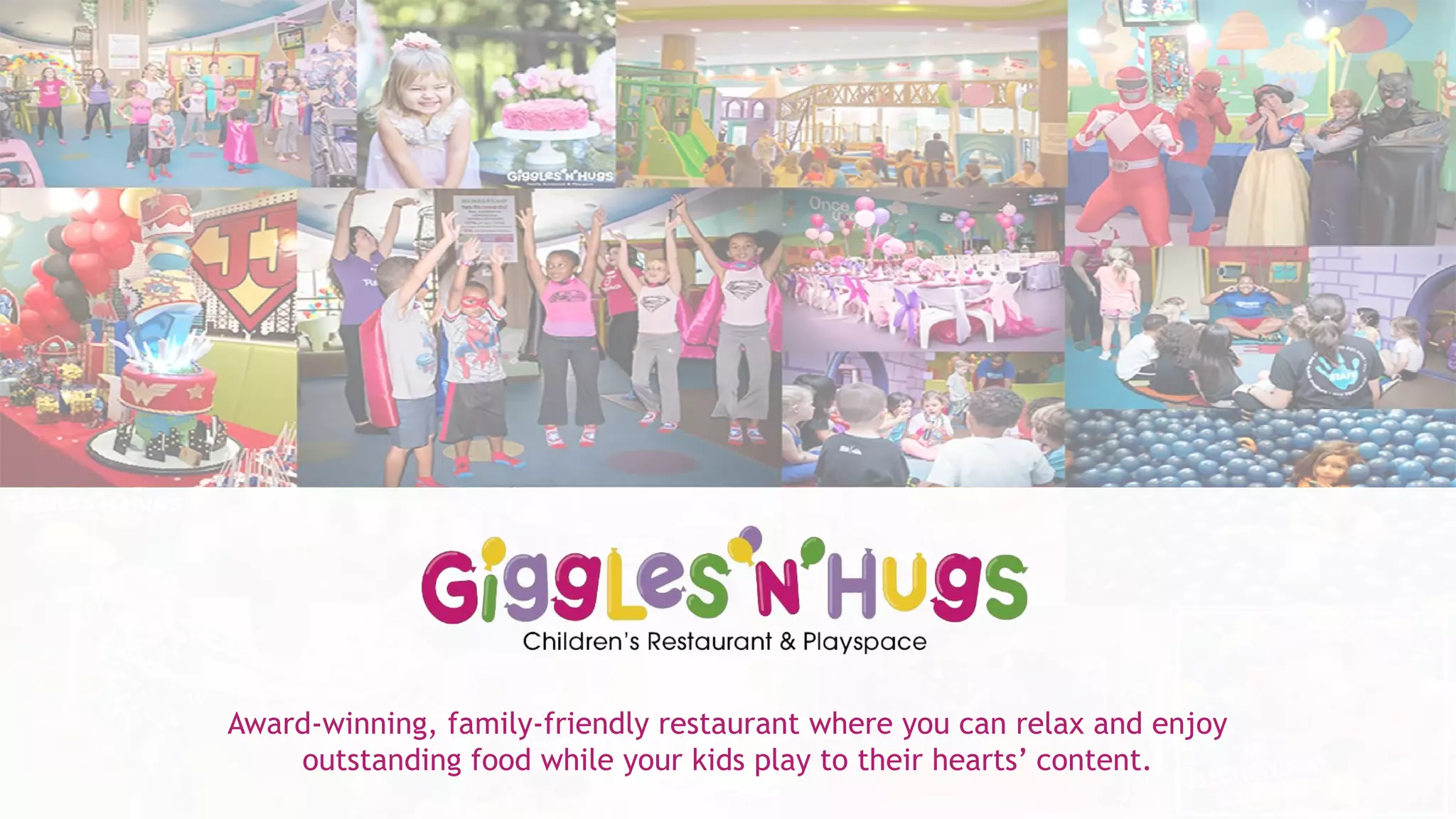
The opening slide establishes Giggles N' Hugs as a 'Children’s Restaurant & Playspace.' The visual collage emphasizes the 'fun' aspect of the business, showing birthday parties, costumed characters (Power Rangers, Batman), and children in ball pits. The sub-text defines the value proposition: a place where parents can 'relax and enjoy outstanding food' while kids play. This immediately identifies the dual-customer nature of the business—the child is the user, but the parent is the payer who seeks 'relaxation.'
Slide 2: Value Proposition and Services
Titled 'Who We Are,' this slide breaks down the operational model. Key features include a 'giant kid-friendly play area,' an organic menu for children aged 1-10, and activities scheduled every 30 minutes. A critical differentiator mentioned here is the 'Child drop-off service,' which allows parents to shop in the mall while their children are supervised. The slide claims they are the 'First and only restaurant to offer this service in LA,' which is a strong play for mall operators looking to increase adult foot traffic and dwell time.
Slide 3: Social Proof and Awards
The 'Award-Winning' slide serves as the primary credibility builder. It lists specific accolades: '#1 Family Restaurant' by Yelp, '#1 Birthday Party Place' and 'Best Pizza in Los Angeles' by Nickelodeon, and 'Best Indoor Play-space' by Red Tricycle. By citing these specific, recognizable brands, the company attempts to move away from the 'dirty playplace' stigma often associated with family entertainment centers.
Operational Performance and Unit Economics
Slide 4: Current Location Performance
This slide provides a side-by-side comparison of their two flagship locations: Glendale Galleria and Westfield Topanga. The data is granular, citing 10-year leases signed in 2012 and 2013. The Glendale location is the stronger performer, with sales up 12.3% in 1H17 and generating 'positive cashflow of 30%.' The Topanga location is described as 'Operating at breakeven.' The demographic data at the bottom (household income >$100k) justifies their 'upscale' positioning and explains why they target specific mall profiles.
Slide 5: Single-Store Economics
This is the most critical slide for an investor. It breaks down the 'Total Company Cost' to launch a new store at $600,000, which is the $1.2M initial investment minus $600k in 'Tenant Improvement Funds'—a common real estate incentive in high-end malls. The table projects a 20% EBITDA margin, with revenue growing from $1.4M to $1.6M over four years. The claim that 'Breakeven [is] attainable with two (2) additional locations' suggests the company is currently burdened by corporate overhead that requires a slightly larger footprint to offset.
Marketing and Capital Structure
Slide 6: Strategic Partnerships
The company highlights its partnership with dOMAIN Integrated for brand strategy. By showing logos for the Los Angeles Lakers, Chrysler, and House of Blues, Giggles N' Hugs is attempting to signal that they have 'big brand' support despite being a small footprint operation. The slide focuses on 'multi-platform programs' and 'A-list celebrities,' implying a lifestyle-brand approach to what is essentially a restaurant business.
Slide 7: The Rights Offering
This slide provides a snapshot of their recent capital activity. It notes that approximately 200 investors participated in a Rights Offering, raising $650,000. However, the slide feels unfinished; the 'Units Sold' is listed as 'x.x million' and the second item under 'Next Steps' is a question mark. This lack of polish on a financial slide is a significant red flag for professional investors, though it may reflect a 'work-in-progress' internal update.
Appendix and Visuals
Slide 8: Customer Testimonials
The appendix features three testimonials. One highlights the 'entire experience' from booking to food service, while another specifically calls out the quality of the food compared to 'dinosaur shaped chicken nuggets.' This reinforces the 'organic/nutritious' angle mentioned earlier in the deck. The dates on the testimonials (2016 and 2017) show the feedback was relatively current at the time of the April 2018 deck publication.
Slide 9: Product Photography
The final slide is a grid of food photography. It showcases salads, paninis, burgers, and cupcakes. The quality of the plating is intended to prove the 'restaurant' side of the business is legitimate and not just a secondary thought to the playground. It visually supports the claim that the menu is 'accommodative to parents.'
What Giggles N' Hugs Does Well
The deck excels at defining a very specific niche. They aren't just a restaurant, and they aren't just a gym; they are a 'supervised childcare and dining solution' for high-income mall shoppers. The use of real-world location data from Glendale and Topanga (Slide 4) provides a 'proof of concept' that many early-stage decks lack. Furthermore, the breakdown of 'Tenant Improvement Funds' on Slide 5 shows a sophisticated understanding of retail real estate, demonstrating how they can halve their effective CAPEX by negotiating with mall owners.
What is Missing from the Deck
The most glaring omission is a Team Slide. There is no mention of the founders, the management team, or the board of directors. In a hospitality business, the 'operator' is often more important than the 'concept,' and the absence of this information is a major gap. Additionally, there is no Competitor Analysis. While they list awards, they do not explain how they defend their market share against other entertainment options or high-end casual dining. Finally, the Exit Strategy is not addressed; there is no mention of whether they intend to be acquired by a larger restaurant group or a mall REIT.
Founder's Teardown: Lessons to Copy
Founders in the brick-and-mortar space should study Slide 5. The way Giggles N' Hugs separates 'Store Net Profit' from 'Corporate Op. Costs' is the correct way to show how a business scales. It allows investors to see the health of the individual units regardless of the current size of the headquarters. Another lesson is the 'Site Selection Strategy' on Slide 5—instead of saying 'we will open in malls,' they list four specific criteria (high-traffic, upscale, children under 10, less favorable weather). This level of specificity gives investors confidence that the expansion is based on a repeatable formula rather than intuition.
Frequently asked questions
- What is the core value proposition of Giggles N' Hugs?
- The company positions itself as a 'solution' to the friction of family dining. By combining an organic, nutritious menu with a supervised, high-end playspace, they allow parents to eat and relax while children are entertained. Slide 2 emphasizes that they offer activities every half hour, including karaoke and character appearances, alongside a unique child drop-off service for mall shoppers.
- How does the company select new locations?
- According to slide 5, the company uses an empirical site selection model. They specifically target high-traffic, upscale shopping malls and lifestyle centers in markets with less favorable weather (which drives indoor play). They also look for demographic clusters with children under 10 and high household incomes, specifically citing areas where 23-30% of households earn over $100k on slide 4.
- What are the specific unit economics for a single store?
- Slide 5 outlines a four-year projection for a typical store. It starts with $1.4 million in Year 1 revenue, growing to $1.62 million by Year 4. With store net profits around $330k-$374k and corporate operating costs held flat at $50k, they project a consistent 20% EBITDA. This results in an average payback period of 2.5 years on the initial $600k net investment.
- What is the status of their current fundraising efforts?
- Slide 7 details a 'Rights Offering' that raised $650,000. This involved approximately 200 investors. The slide is notably incomplete, featuring a placeholder '?' for the second item under 'Next Steps,' suggesting this version of the deck may have been a draft or used during an active transition period. The capital is intended to fund negotiations for new mall locations.
- How does the company handle competition and brand awareness?
- Rather than listing direct competitors like Chuck E. Cheese, the deck focuses on third-party validation and high-tier marketing. Slide 3 lists awards from Yelp, Nickelodeon, and Red Tricycle. Slide 6 highlights a partnership with dOMAIN Integrated, a PR and branding firm, to leverage 'A-list celebrity' connections and amplify the brand in new markets.