Ggw timebank (Good Good Wonderful) is a social enterprise project that emerged from the first Social Enterprise Startup Weekend in Wellington, 2013, where it secured second place. The pitch deck focuses heavily on the philosophical and design-centric approach to building a community-based time-banking platform. Rather than traditional market size or revenue projections, the slides showcase user interface mockups, a 'Skills Match' notification system, and a commitment to open data. The project aims to facilitate the exchange of services—such as gardening or piano lessons—using time as a curren…
Key takeaways
- The company placed second at the first Social Enterprise Startup Weekend in Wellington in 2013 (Slide 2).
- The platform features a social-media-style feed where users can post requests, such as gardening help or piano lessons (Slide 3).
- A 'Skills Match' notification system proactively alerts users when a request aligns with their registered abilities (Slide 4).
- The project emphasizes 'Open Data,' displaying a Google Analytics dashboard with 68,605 visits and a 12.70% new visit rate (Slide 5).
- The development philosophy is strictly 'Design Centric,' prioritizing empathy for real people and iterative simplification (Slide 7).
- The platform integrates existing local time banks, specifically mentioning Kapiti Time Bank and Lyttelton TimeBank (Slide 3).
- The deck includes a hand-drawn risk/reward matrix mapping features like 'social integration' and 'balance algorithm' (Slide 10).
- There is no mention of a business model, revenue streams, or a specific funding request in the provided slides.
Ggw timebank: A Social Enterprise Teardown
The Ggw timebank pitch deck is a product of the 2013 Social Enterprise Startup Weekend in Wellington. It represents a specific era of social entrepreneurship where the focus was on 'refactoring the crappy world economy' through community-led initiatives and digital gratitude platforms. The deck is less of a financial pitch and more of a product vision and values statement.
Slide 1: Title Slide
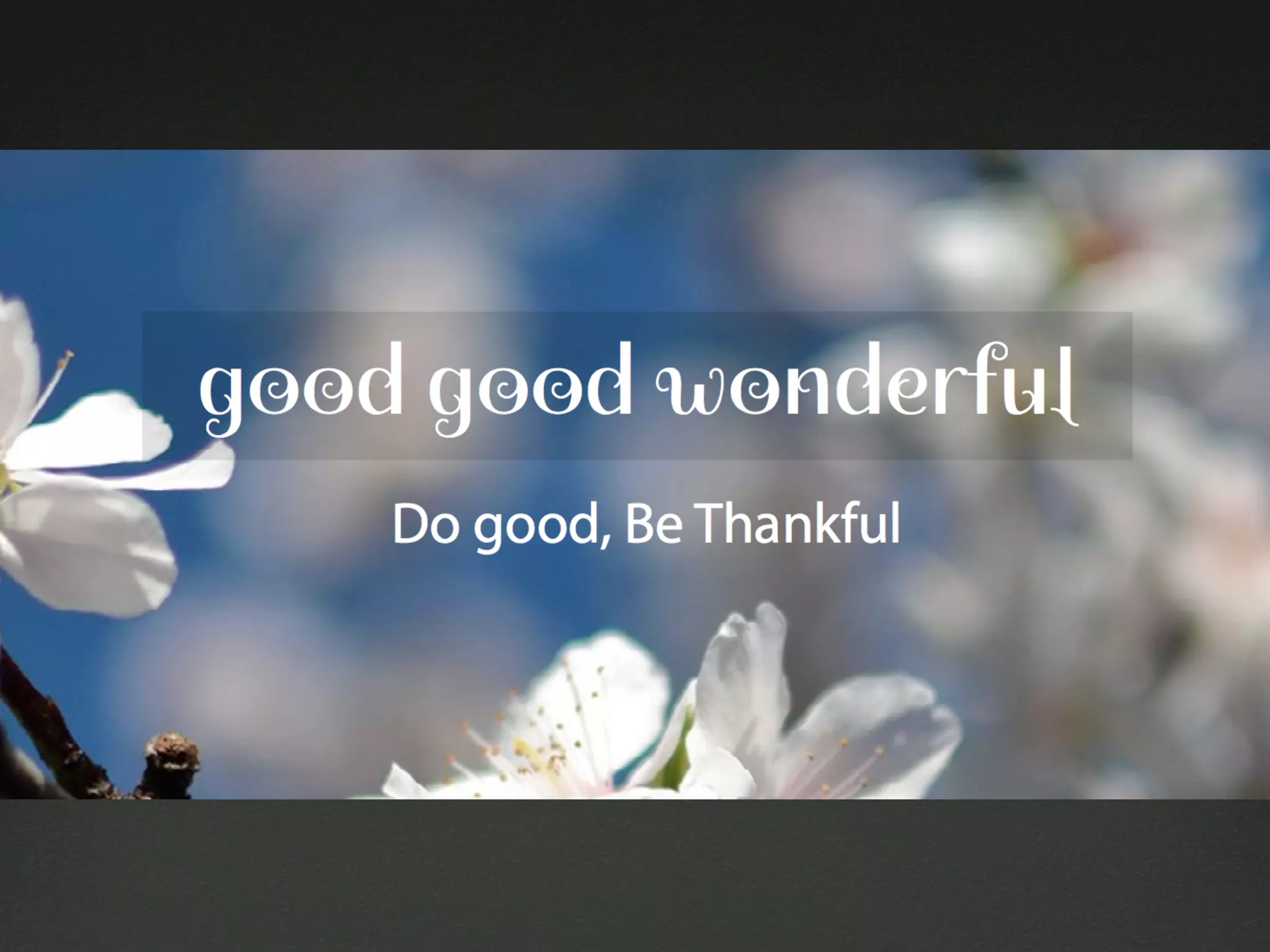
The opening slide features the branding 'good good wonderful' with the tagline 'Do good, Be Thankful.' The imagery is soft-focus floral, establishing a tone that is community-oriented and aspirational rather than corporate. It immediately signals that the project is a social enterprise.
Slide 2: About Us and Validation
This slide serves as the 'Social Proof' section. It features a quote from Dave Moskowitz, who praises the company as a 'total standout' with a shot at 'refactoring the crappy world economy.' Crucially, it notes that the project was the 'Second place winner' at the first Social Enterprise Startup Weekend in Wellington, 2013. A humorous note at the bottom, 'Hey we won a phone!', adds a personal, grassroots touch to the narrative.
Slide 3: Platform Interface Mockup
Slide 3 provides a comprehensive look at the proposed user interface. The design is clean and modular, featuring three columns:
Left Column: User profile ('Shelly'), skill badges, and a 'Balance' pie chart. It also shows 'Acknowledgments'—public thank-you notes that include hours to 'pay forward.' · Center Column: A social feed showing activity. Examples include Jack requesting help for a 'working bee' and Alex paying Mona 2 hours for 'helping with the car.' · Right Column: A 'Local Skills Map' showing the geographic distribution of skills in Titahi Bay and links to existing time banks like Kapiti and Lyttelton.
Slide 4: Notifications and Skills Match
This slide zooms in on the 'Skills Match' functionality. It shows a popup notification: 'Jack has posted a request that matches your skills.' This indicates that the platform isn't just a passive bulletin board but an active matching engine designed to reduce the friction of finding relevant tasks within a community.
Slide 5: Open Data and Traction
Labeled 'Open Data,' this slide displays a Google Analytics dashboard. It shows 68,605 total visits, 8,712 new visits, and a bounce rate of 33.31%. The average visit duration is listed at 6 minutes and 22 seconds. By sharing these metrics openly, the founders demonstrate a commitment to transparency, a core value in many social enterprises.
Slide 6: The Project Transition
A simple transition slide titled 'The project' with the subtitle 'The team and values.' It marks the shift from what the product does to how the team thinks and operates.
Slide 7: Design Centric Philosophy
This slide outlines the team's methodology. It emphasizes empathy for 'real people and real problems' as the first step. The fourth point, 'Take stuff away and keep iterating,' suggests a lean development approach focused on simplicity and user experience over feature bloat.
Slide 8: Contact Information
The contact slide lists Miles Thompson as the lead. It provides two domains (.org and .as), an email address, and social media handles. The inclusion of a phone number and Skype ID reflects the communication norms of the early 2010s.
Slide 9: Mobile Vision
This slide shows a hand-drawn mobile phone frame containing a photo of a tree with the prompt: 'Why are you thankful for today?' This suggests a mobile app component focused on daily gratitude, likely intended to drive daily active usage and reinforce the 'thankful' brand identity.
Slide 10: Risk and Feature Mapping
The final slide in this set is a hand-drawn matrix. The vertical axis ranges from 'low risk' to 'high risk,' and the horizontal axis appears to track 'known' vs 'unknown' (though the left side is cut off). Items like 'social integration' and 'community news feed' are marked as high risk, while 'reminders' are lower risk. Below the matrix, there is a flow chart connecting 'empowerment' to 'public acknowledgment' and 'image motivation' to 'celebration of good things.' This slide provides a raw look at the team's internal strategic planning.
What Works in This Deck
Clear Product Vision: The mockups on Slide 3 and 4 are excellent. They don't just tell the reader what a time bank is; they show exactly how a user would interact with it. The inclusion of specific names and tasks (gardening, piano lessons) makes the concept tangible.
Strong Values Alignment: For a social enterprise, the 'Design Centric' and 'Open Data' slides are highly effective. They signal to potential partners or impact investors that the team is principled and transparent.
Early Validation: Winning second place at a Startup Weekend is a significant milestone for a pre-seed project. It proves that the idea resonated with judges and mentors in a competitive environment.
What Is Missing from This Deck
Business Model: There is no mention of how the project sustains itself. While it is a social enterprise, even non-profits or B-Corps need a revenue model (grants, transaction fees, or subscriptions) to survive. The deck is silent on this.
The 'Ask': A standard pitch deck usually ends with a request for funding, partnerships, or talent. This deck ends with contact info but no specific call to action regarding what the team needs to move to the next stage.
Market Size and Competition: There is no analysis of the broader time-banking market or how Ggw timebank differs from existing platforms like TimeRepublik or local manual time banks. While it mentions Lyttelton and Kapiti, it treats them as partners rather than analyzing the competitive landscape.
Team Bios: While Miles Thompson is listed as a contact, there are no details on his background or the skills of the broader team. Investors typically want to know why this specific team is qualified to build this specific solution.
Founder's Takeaway: What to Copy
Use High-Fidelity Mockups: If your product is a platform, follow Ggw's lead on Slide 3. Showing a 'live' feed with realistic data helps the audience visualize the community you are trying to build.
Map Your Risks: The hand-drawn matrix on Slide 10 is a great exercise. Even if you clean it up for the final deck, showing that you have thought about which features are 'high risk' or 'unknown' demonstrates a level of strategic maturity that many early-stage founders lack.
Leverage Social Proof: If you have won an award or received a strong testimonial from a recognized industry figure, put it front and center. The quote from Dave Moskowitz on Slide 2 does a lot of heavy lifting in establishing the project's potential importance.
Frequently asked questions
- What is the core product of Ggw timebank?
- Ggw timebank is a digital platform designed to facilitate time-banking, where community members exchange services for time credits. The interface, shown on Slide 3, resembles a social network where users like 'Jack' or 'Rohana' post requests for help with gardening or music lessons. It includes a 'Local Skills Map' to visualize community resources and a gratitude system where users can publicly acknowledge and pay forward hours to others.
- What traction does the deck demonstrate?
- The deck highlights two primary forms of traction. First, it notes a second-place finish at the 2013 Social Enterprise Startup Weekend in Wellington (Slide 2). Second, Slide 5 displays an 'Open Data' dashboard showing 68,605 total visits and 8,712 new visits over a specific period, suggesting the platform or a related landing page had achieved significant early traffic.
- Who is the lead for the Ggw timebank project?
- The contact slide (Slide 8) identifies Miles Thompson as the primary point of contact. He is associated with the email miles@goodgoodwonderful.org and the social media handle @utunga. The slide also lists two URLs: goodgoodwonderful.org and thankful.as, indicating the project operates under the 'Good Good Wonderful' brand umbrella.
- How does the platform match users with tasks?
- Slide 4 illustrates a 'Skills Match' feature. The system generates automated notifications when a community member's request aligns with another user's pre-defined skills. For example, the mockup shows a notification for a user who can help with a 'garden mulcher' for a 'working bee on Saturday,' demonstrating a proactive approach to connecting supply and demand within the time bank.
- What is the design philosophy of the team?
- According to Slide 7, the team follows a four-step 'Design Centric' process: 1) Understand and empathize with real people and problems; 2) Design the experience around those motivations; 3) Design the interface and graphical presentation; and 4) Iterate by taking things away. This suggests a user-experience-first approach rather than a technology-led or profit-led development cycle.