4rented presents a classic peer-to-peer marketplace proposition: allowing owners to monetize underutilized assets while helping customers save time and money. The deck is extremely lean, consisting of only 11 slides, and indicates the company is in the earliest possible stage of development. The primary revenue driver is a 10% commission on every transaction, as stated on slide 4. However, the deck lacks critical data points required for professional fundraising, including market sizing, competitive analysis, team backgrounds, and a specific financial ask. With the product still in developmen…
Key takeaways
- The company operates on a 10% transaction fee model for all rentals facilitated through the platform (Slide 4).
- At the time of the deck's creation, the product was not yet functional, having only launched a landing page a few days prior (Slide 5).
- The value proposition for owners is the ability to earn money from rarely used items without needing a physical store (Slide 2).
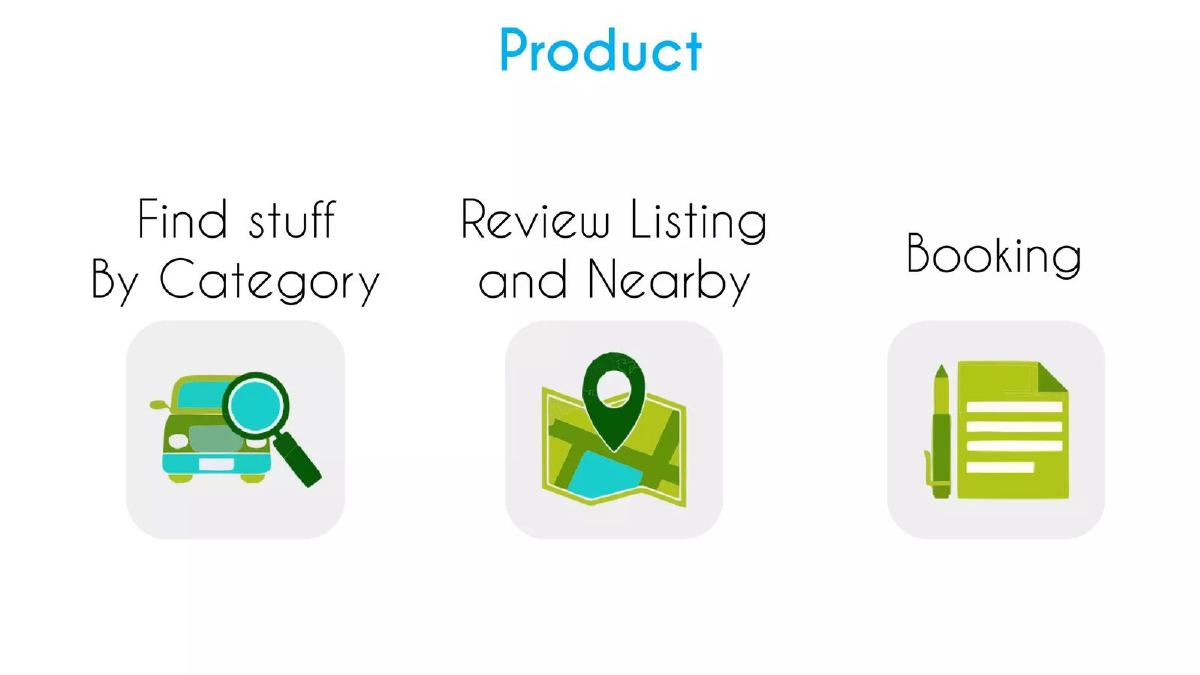
- The customer-facing product features include category-based searching, location-based listing reviews, and a booking system (Slide 3).
- The deck omits a team slide, providing only a single contact name, Rizqi Fajruni, on the final slide (Slide 6).
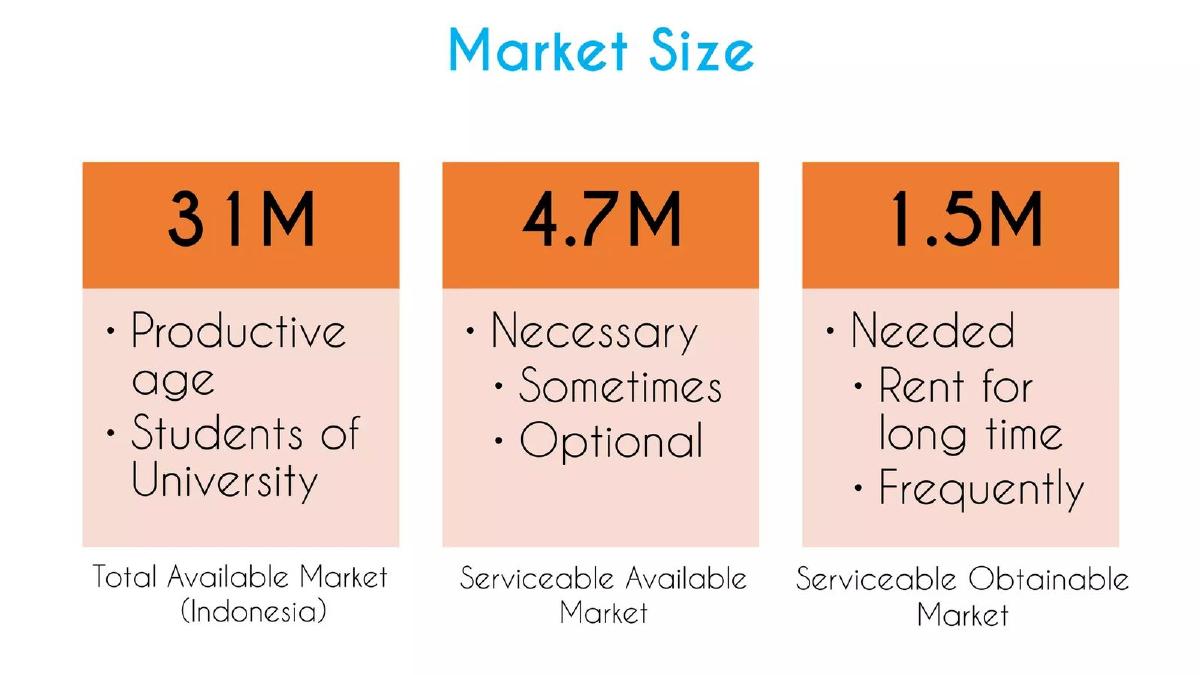
- There is no mention of target market size (TAM/SAM/SOM) or specific geographic focus beyond a +62 country code phone number (Slide 6).
- The deck lacks a 'The Ask' slide, meaning the amount of capital sought and its intended use are not disclosed.
- Competitive differentiation is not addressed, leaving it unclear how 4rented plans to compete with established rental platforms.
Executive Summary: The Minimalist Marketplace
4rented enters the crowded 'Airbnb for X' space with a pitch deck that is notable for its brevity and simplicity. The core premise—renting anything, anywhere—is a broad horizontal marketplace play. While the deck outlines a clear, albeit standard, business model, it leaves many of the most important questions for investors unanswered. With no team history, no market data, and no product screenshots beyond icons, the deck serves as a baseline template for a startup idea rather than a validated business case.
Slide 1: Title and Tagline
The cover slide introduces the brand 4Rented.com with the tagline 'Rent anything and wherever you are.' The logo incorporates a key icon, signaling a focus on access and unlocking value. The design is clean but generic, providing no immediate indication of geographic focus or specific niche within the rental market.
Slide 2: The Solution
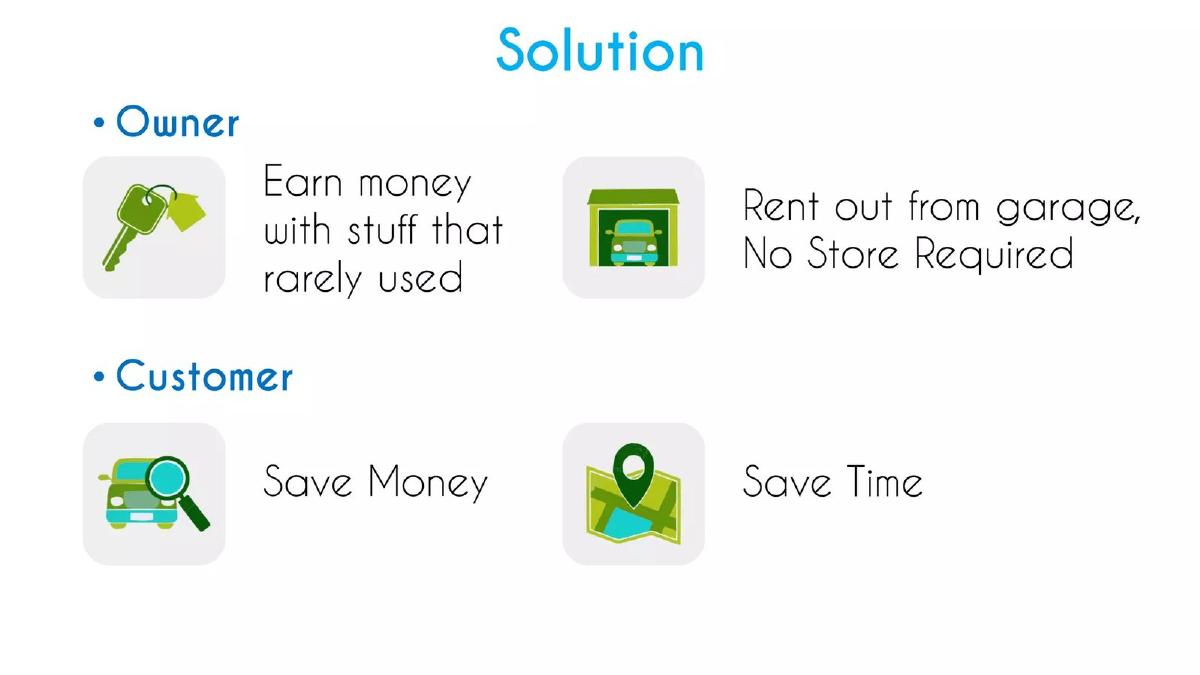
Slide 2 breaks down the value proposition for two distinct user groups: the Owner and the Customer . For the owner, the benefits are listed as 'Earn money with stuff that rarely used' and 'Rent out from garage, No Store Required.' This positions the platform as a low-friction way for individuals to enter the rental economy. For the customer, the benefits are simplified to 'Save Money' and 'Save Time.' The use of icons (keys, garage, magnifying glass, map) helps communicate these points quickly, though the slide lacks any specific data on how much money can be saved or earned.
Slide 3: Product Features
The 'Product' slide outlines three primary functions of the application: Find stuff By Category , Review Listing and Nearby , and Booking . These are the fundamental building blocks of any marketplace. However, the slide uses generic clip-art rather than actual UI/UX screenshots. This reinforces the statement made later in the deck that the product is still in the development phase. There is no mention of unique features like identity verification, insurance, or dispute resolution, which are typically critical for peer-to-peer rental platforms.
Slide 4: Business Model
This is the most concrete slide in the deck. It states: 'Every transaction, we take 10% from total price.' A 10% take rate is on the lower end for peer-to-peer marketplaces (which often range from 15% to 25% when combining host and guest fees), which could be a competitive advantage for attracting supply, but may pose challenges for long-term profitability given the high costs of customer acquisition and insurance in this sector.
Slide 5: Financials and Status
The 'Financials' slide is unexpectedly devoid of numbers. Instead, it serves as a status update. It features a graphic of a workspace with various coding languages (C++, Java, PHP, HTML) and the text: '4Rented still developping. We just launch a few days ago with landing page.' This is a critical admission for investors; it classifies the company as 'pre-product.' The misspelling of 'developing' and 'launch' suggests a lack of attention to detail in the deck's final review.
Slide 6: Contact Information
The final slide is a standard 'Thank You' page. It lists Rizqi Fajruni as the point of contact, providing a phone number with a +62 prefix (Indonesia) and a Gmail address. The use of a personal Gmail account rather than a company domain email (@4rented.com) further emphasizes the very early, informal stage of the venture.
What Works in This Deck
Clarity of Revenue: Many early-stage decks dance around how they will actually make money. 4rented is explicit: they take 10% of every transaction. This simplicity is helpful for initial conversations.
Dual-Sided Value Prop: The deck correctly identifies that a marketplace lives or dies by its ability to serve both supply (owners) and demand (customers). By listing specific benefits for both, the founders show they understand the basic mechanics of their business model.
Honesty Regarding Stage: By stating the product is still in development and only a landing page is live, the founders avoid over-promising. This sets the right expectations for a 'friends and family' or very early angel round.
What is Missing
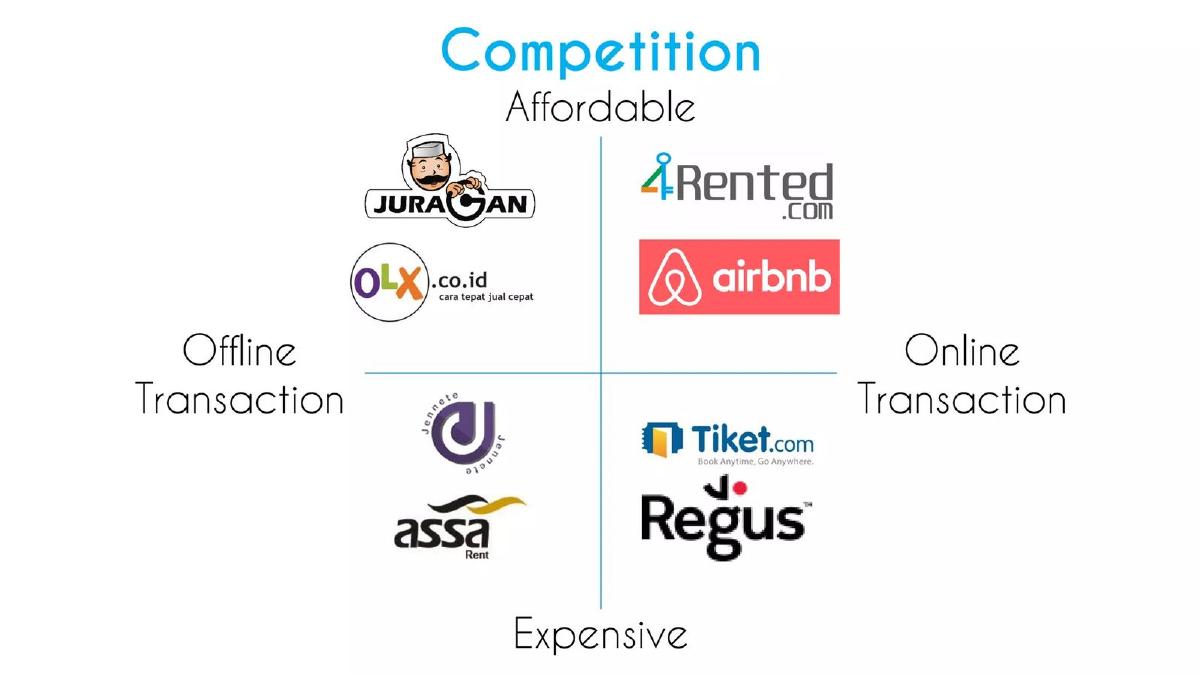
The Team: Investors invest in people, especially at the pre-product stage. This deck provides no information on who is building the company, their technical capabilities, or their experience in the rental or marketplace industry. · Market Size: There is no mention of the Total Addressable Market (TAM). Without knowing the size of the rental market in their target geography, it is impossible to judge the potential scale of a 10% commission model. · Competition: The rental space is highly competitive, with players ranging from Fat Llama to local classified sites like OLX or Facebook Marketplace. The deck does not explain how 4rented will win against these incumbents. · The Ask: A pitch deck is a tool to raise money. By omitting the amount of capital needed and the milestones that capital will fund, the deck fails to close the loop with the reader. · Unit Economics: While the 10% fee is clear, there is no mention of the cost to acquire a customer (CAC) or the expected lifetime value (LTV), which are the metrics that ultimately determine if a marketplace is viable.
Founder Recommendations
If you are using a similar minimalist approach, consider the following improvements to move from a 'project' to a 'startup':
1. Show, Don't Just Tell: Even if the product is in development, include high-fidelity wireframes or mockups. This proves that you have thought through the user journey beyond just 'Booking' and 'Categories.'
2. Define Your 'Why': Why are you building this now? Is there a specific trend in Indonesia (given the +62 area code) that makes this the right time? Adding a 'Market Opportunity' slide is essential.
3. Professionalize the Presentation: Ensure there are no spelling errors ('developping', 'launch'). Use a company email address to signal that the venture is a serious entity rather than a side project.
4. Detail the Supply Side: 'Rent anything' is often too broad for a startup to gain traction. Successful marketplaces usually start with a niche (e.g., high-end cameras, power tools, or camping gear). Specifying a starting category would make the go-to-market strategy more believable.
5. Add a Roadmap: Since the product is just a landing page, a slide showing the next 6-12 months of development and growth milestones would give investors a reason to believe in the project's momentum.
Frequently asked questions
- What is 4rented's primary business model?
- According to slide 4, 4rented utilizes a commission-based revenue model. They take a 10% cut of the total price of every transaction performed on the platform. This is a standard marketplace model, though the deck does not specify if there are additional fees for insurance, processing, or premium listings.
- What stage of development is the 4rented platform in?
- The platform is in the very early 'pre-seed' or conceptual stage. Slide 5 explicitly states that the product is 'still developping' (sic) and that they had only launched a landing page a few days prior to the deck being finalized. There is no evidence of a functional MVP or active user base in the provided slides.
- Who is behind 4rented?
- The deck is highly anonymous regarding the team. The only individual identified is Rizqi Fajruni, whose name and contact information appear on the 'Thank You' slide (Slide 6). There are no details regarding professional background, technical expertise, or other co-founders, which is a significant omission for an investment deck.
- What problem does 4rented aim to solve?
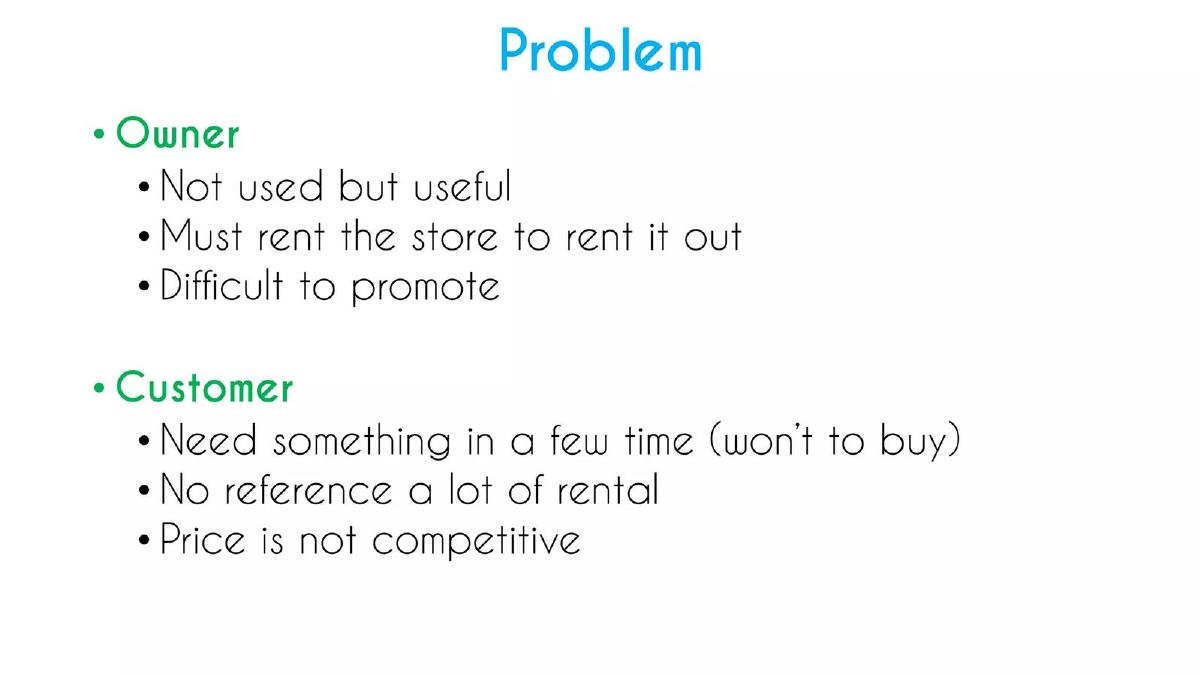
- Based on slide 2, the company targets two sides of the market. For owners, it solves the problem of underutilized assets ('stuff that rarely used') and the high barrier to entry for renting items (no store required). For customers, it aims to solve the problems of high costs and time inefficiency by providing a local rental alternative.
- Is there a specific investment ask in the deck?
- No. The 11-slide deck (of which 6 are analyzed here) does not include a slide detailing how much money the company is looking to raise, the valuation they are seeking, or a roadmap for how the funds will be deployed. This makes the deck function more as a project introduction than a formal pitch for capital.