forTiBi is a pre-launch social commerce platform aiming to replicate the success of group-buying models in the German market. The deck focuses heavily on the macroeconomic tailwinds of German e-commerce, which was valued at 65.1 billion euros in 2017, and the rising share of mobile commerce. The core value proposition is a viral loop where users receive steep discounts—such as a $240 shoe for $140—by inviting friends to purchase together. However, the deck is notably thin on execution details. It lacks a functional team beyond a single founder, provides no financial projections, and offers no…
Key takeaways
- The platform utilizes a group-buying model where users receive discounts by inviting friends to buy together, theoretically halving CAC (Slide 4).
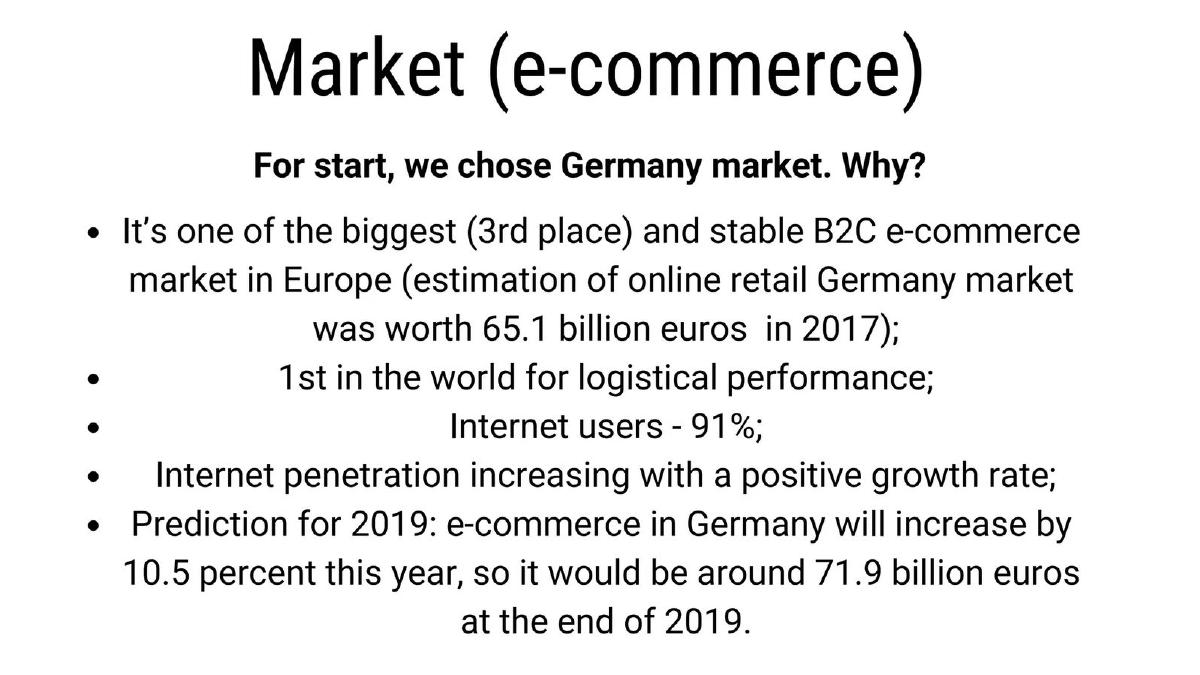
- Germany was selected as the target market due to its status as the 3rd largest B2C e-commerce market in Europe, worth 65.1 billion euros in 2017 (Slide 5).
- M-commerce is projected to make up almost 39 percent of all retail e-commerce sales in Germany by the end of 2019 (Slide 7).
- The competitive landscape is dominated by Amazon, which held a 51.2% market share in Germany in 2017 (Slide 9).
- The product UI demonstrates a 'Buy Alone' vs. 'Buy With Friend' pricing tier, showing a potential 41% discount for social purchases (Slide 11).
- The team slide lists only one individual, Vasyl Zelinskyi, as Founder and CEO, with no mention of technical or operational staff (Slide 12).
- The roadmap is extremely high-level, moving from 'Launch MVP' to 'Launch Marketplace' without specific dates or milestones (Slide 13).
- The deck contains no 'Ask' slide, omitting the funding amount sought, valuation, or use of proceeds.
Executive Summary: The Pinduoduo Model for Europe
forTiBi is a pitch deck for a social m-commerce platform that seeks to disrupt the German retail market using a group-buying model. The concept is heavily inspired by successful Chinese platforms like Pinduoduo, where viral sharing and collective purchasing power lead to lower prices for consumers and lower acquisition costs for the platform. The deck relies heavily on macroeconomic data to justify the market opportunity but lacks the granular operational detail required for a seed-stage investment.
Slide 1: Title Slide
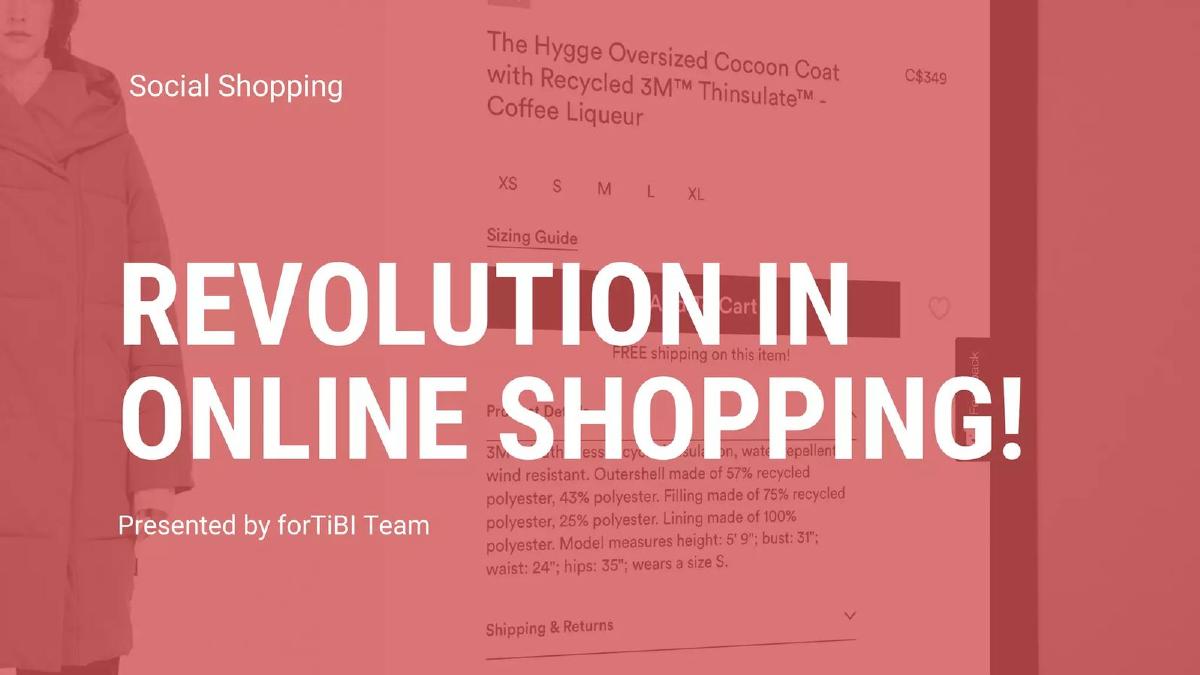
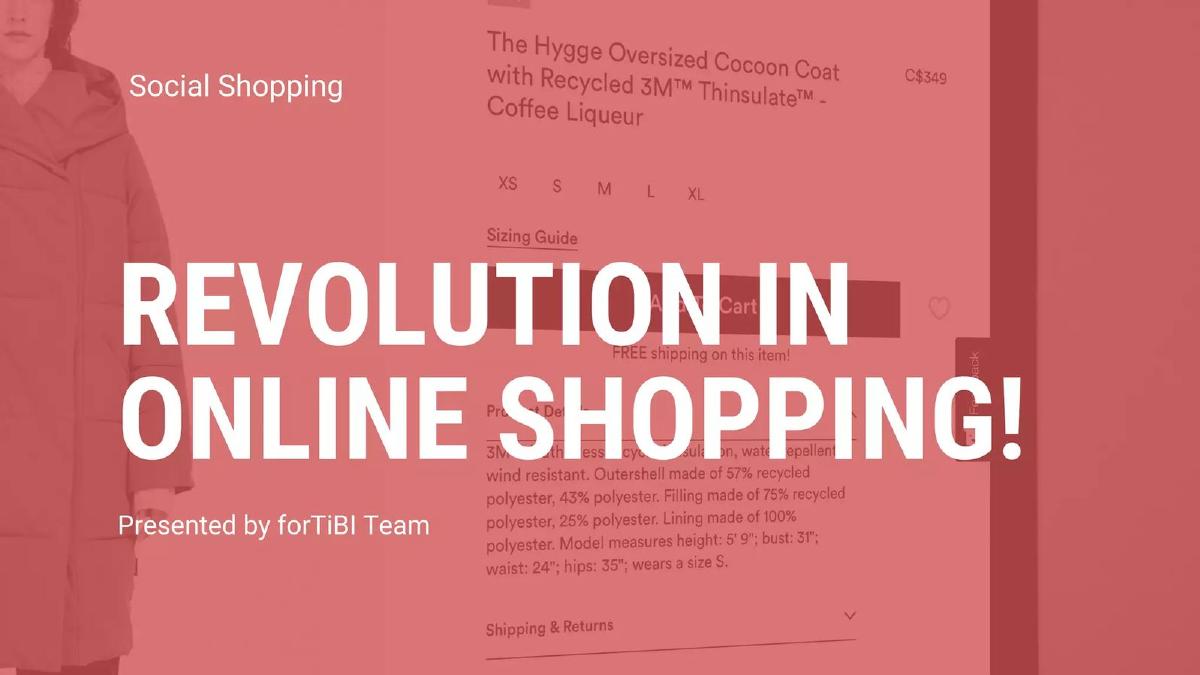
The deck opens with the headline "REVOLUTION IN ONLINE SHOPPING!" and identifies the sector as "Social Shopping." The presentation is attributed to the "forTiBi Team," though later slides suggest a very small organization. The background image shows a mobile shopping interface for a "Hygge Oversized Cocoon Coat" priced at C$349, establishing the fashion/apparel context immediately.
Slide 2: Agenda
A standard table of contents listing nine discussion points: Core of business, Business model, Market (e-commerce and m-commerce), Main players, Value proposition, Product mechanics, Team, and Vision. The imagery switches to a black-and-white cityscape, which feels generic and disconnected from the social shopping theme.
Slide 3: Core of Business
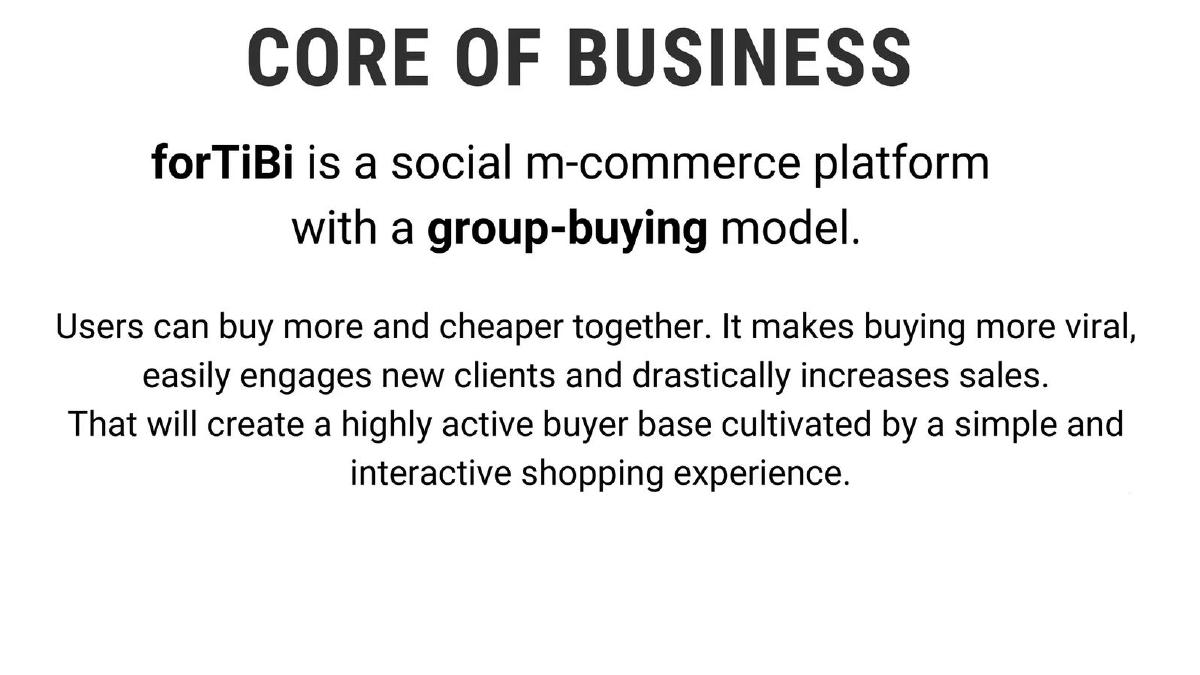
This slide defines forTiBi as a "social m-commerce platform with a group-buying model." The text emphasizes that buying together makes the experience "more viral" and "drastically increases sales." It promises a "highly active buyer base" through a "simple and interactive shopping experience." This is a high-level conceptual slide that establishes the 'what' without the 'how.'
Slide 4: Business Model
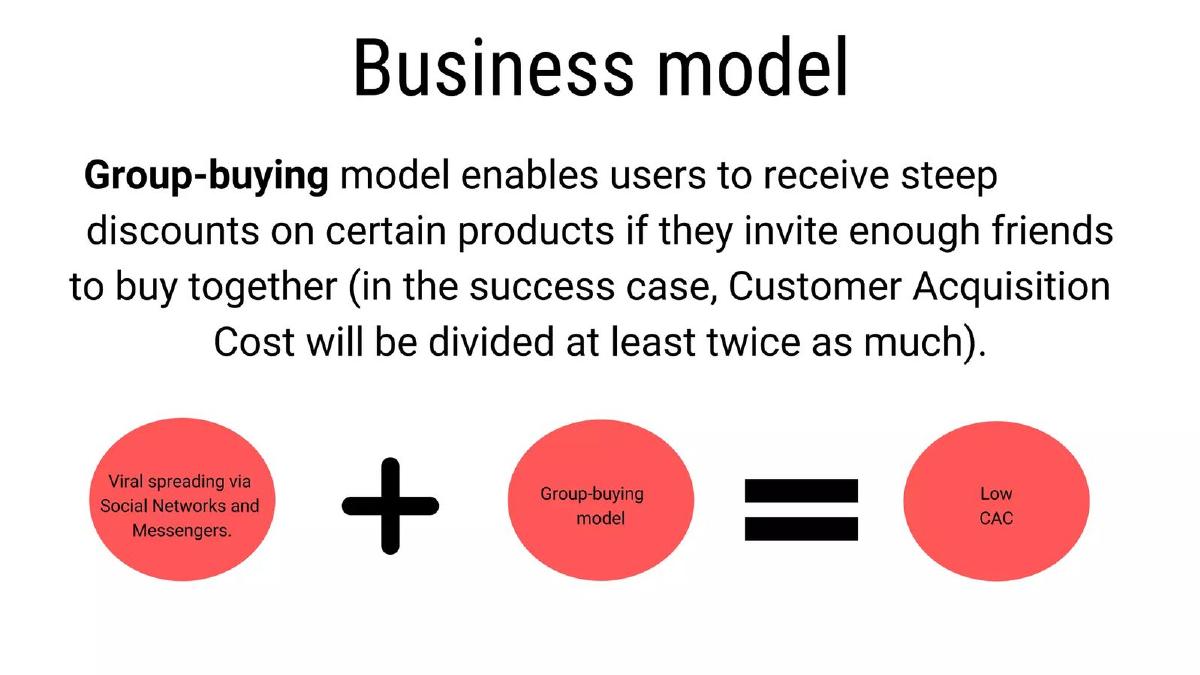
The business model is explained through a simple equation: Viral spreading + Group-buying model = Low CAC. The slide claims that in a success case, Customer Acquisition Cost will be "divided at least twice as much." This is the central thesis of the deck, suggesting that the user base acts as the primary marketing department by inviting friends to secure discounts.
Slide 5 & 6: Market (e-commerce)
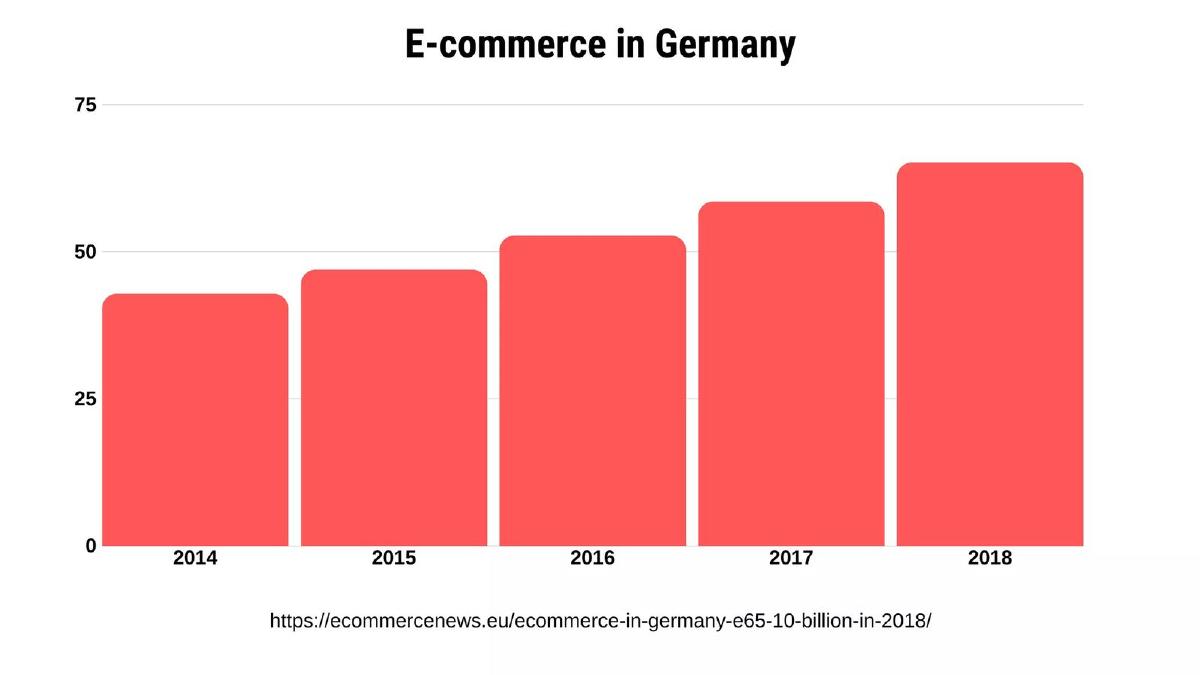
The founders focus exclusively on Germany. Slide 5 notes that the German online retail market was worth 65.1 billion euros in 2017 and was expected to grow to 71.9 billion euros by the end of 2019. It highlights Germany's #1 global ranking for logistical performance and 91% internet penetration. Slide 6 provides a bar chart showing steady growth from 2014 to 2018, sourced from ecommercenews.eu.
Slide 7 & 8: Market (m-commerce)
These slides narrow the focus to mobile commerce. Slide 7 quotes eMarketer, noting that m-commerce sales were expected to reach 39% of all retail e-commerce in Germany by the end of 2019. Slide 8 provides three charts: total retail m-commerce sales (billions), m-commerce as a percentage of e-commerce, and the percentage change year-over-year. The data shows a market growing from under $20B in 2016 to a projected $35B+ by 2021.
Slide 9: Main Players in Market
This slide acknowledges the competition. A bar chart and pie chart show that Amazon dominates the German market with a 51.2% share (based on 2017 data from EHI Retail Institute). Other players include Otto (17.2%), Zalando (7.4%), and Notebooksbilliger (4.4%). The sheer dominance of Amazon is presented as a fact, though the deck does not yet explain how forTiBi will carve out space from such a consolidated leader.
Slide 10: Value Proposition
The value proposition is mapped on a 2x2 matrix. The Y-axis is "Products target to customer needs" and the X-axis is "Channel to reach customers." forTiBi places itself in the top-right quadrant ("Social Shopping"), claiming to target the specific needs of all customers. It contrasts this with Amazon ("Horizontal E-commerce"), which it defines as search-based, and Zalando ("Vertical E-commerce"), which it defines by product category.
Slide 11: How it will work?
This slide provides the only look at the product UI. It shows a mobile app interface featuring Nike shoes. The key feature is a split CTA (Call to Action) at the bottom: "BUY ALONE $240" and "BUY WITH FRIEND $140." A caption explains that users must share a link via social media or messengers to unlock the lower price. This is a direct implementation of the Pinduoduo "team purchase" mechanic.
Slide 12: Team
The team slide is a significant weakness. It lists only one person: Vasyl Zelinskyi, Founder and CEO. There are no advisors, co-founders, or technical leads listed. For a platform that requires significant logistical integration, social graph API management, and high-scale e-commerce architecture, a single-person team is a major red flag for investors.
Slide 13: Our Vision (Further Steps)
A three-point timeline: 1. Launch MVP (group-buying model), 2. Launch Marketplace, 3. E-commerce ecosystem covering purchase, payment, and shipping. The roadmap lacks dates, specific KPIs, or geographic expansion plans beyond the initial German focus mentioned earlier.
Slide 14: Get In Touch
The final slide provides contact information. The location is listed as Lviv, Ukraine, despite the target market being Germany. It includes a phone number and a generic Gmail address (fortibi.team@gmail.com). The use of a Gmail address rather than a professional domain is a common indicator of a very early-stage or amateur project.
What forTiBi Does Well
The deck identifies a clear and proven business model (social group-buying) and applies it to a specific, high-value geography (Germany). By focusing on the "Low CAC" argument, the founders address the primary pain point of modern e-commerce: the rising cost of Facebook and Google ads. The use of a 2x2 matrix to differentiate from Amazon and Zalando is a smart way to show that they aren't competing on search or inventory depth, but on a different psychological trigger (social validation and discounts).
What is Missing from the Deck
The Ask: There is no mention of how much money is being raised, the valuation, or the specific milestones that the funding will enable. · Unit Economics: While they claim CAC will be lower, they provide no data on margins. If a shoe is discounted from $240 to $140, who absorbs that $100 loss? Is it the brand, or is forTiBi taking a loss to acquire users? · Supply Side: There is no mention of how they will acquire inventory. Will they hold stock, or is this a pure marketplace? How will they convince brands like Nike (shown in the mockups) to participate in deep-discount social selling? · Regulatory/Logistics: Operating in Germany from Ukraine presents significant VAT, shipping, and consumer protection law challenges (like the 14-day right of withdrawal) that are not addressed. · Technical Team: A social commerce platform is a complex technical undertaking. The absence of a CTO or engineering lead makes the "Vision" slide feel like wishful thinking.
Founder Takeaways
Macro data is not a strategy: forTiBi spends four slides (5-8) proving that the German e-commerce market is big. Investors already know this. Founders should spend less time on market size and more time on their unique "wedge" into that market. Address the 'Discount' math: If your model relies on 40% discounts (as shown on slide 11), you must explain the economics. Deep discounts often attract low-LTV (Life Time Value) customers who only shop when there is a deal, which can lead to a 'death spiral' of unprofitable growth. Professionalize the outreach: Using a Gmail address and omitting a funding ask makes a deck look like a school project rather than a business. Secure a domain and be explicit about what you need from investors.
Frequently asked questions
- What is the core mechanism of forTiBi's business model?
- The core mechanism is social group-buying. As shown on slide 4, the model encourages users to share product links via social networks and messengers. If enough friends join the purchase, the group receives a 'steep discount.' The company claims this will divide Customer Acquisition Costs (CAC) at least twice as much compared to traditional retail models.
- Why did the company choose Germany as its initial market?
- According to slide 5, Germany was chosen because it is the 3rd largest B2C e-commerce market in Europe and ranks 1st globally for logistical performance. The deck cites high internet penetration (91%) and a stable growth rate, predicting the market would reach 71.9 billion euros by the end of 2019.
- How does forTiBi plan to differentiate itself from Amazon and Zalando?
- Slide 10 uses a 2x2 matrix to position forTiBi in the 'Social Shopping' quadrant. It contrasts itself against 'Horizontal E-commerce' (Amazon), which is search-based, and 'Vertical E-commerce' (Zalando), which groups by category. forTiBi claims to focus on the 'personalized needs of a large amount of users' through social channels rather than search or category browsing.
- What is the current stage of the product and team?
- The company appears to be in the pre-MVP stage. Slide 13 lists 'Launch MVP' as the first step in their future vision. The team is also at a nascent stage; slide 12 only lists one person, Vasyl Zelinskyi, as the Founder and CEO, suggesting the startup has yet to build out its core engineering or marketing teams.
- What critical information is missing from this pitch deck?
- The deck lacks several standard fundraising components. There are no financial projections or unit economics beyond a theoretical reduction in CAC. There is no mention of how the company will handle logistics or supplier relationships. Most importantly, there is no 'Ask' slide detailing how much capital is being raised or how it will be spent.