Foursquare’s 2009 deck is a product-heavy presentation that successfully translated the abstract concept of 'location-based social networking' into tangible game mechanics. By defining the app as a mix of friend-finder, city-guide, and social-game (Slide 2), the founders focused on user engagement through points and badges (Slides 5, 10). Crucially, the deck identifies lead generation for local merchants as the primary revenue model (Slide 11), using 'mayorships' as a bridge between digital activity and physical rewards. While it lacks a formal 'Ask' slide or detailed financials, it compensat…
Key takeaways
- Foursquare defined itself as a three-part hybrid: friend-finder, social city-guide, and social-game (Slide 2).
- The product was built on the legacy of Dodgeball, using the simple premise: 'Tell us where you are and we'll tell you who and what's nearby' (Slide 3).
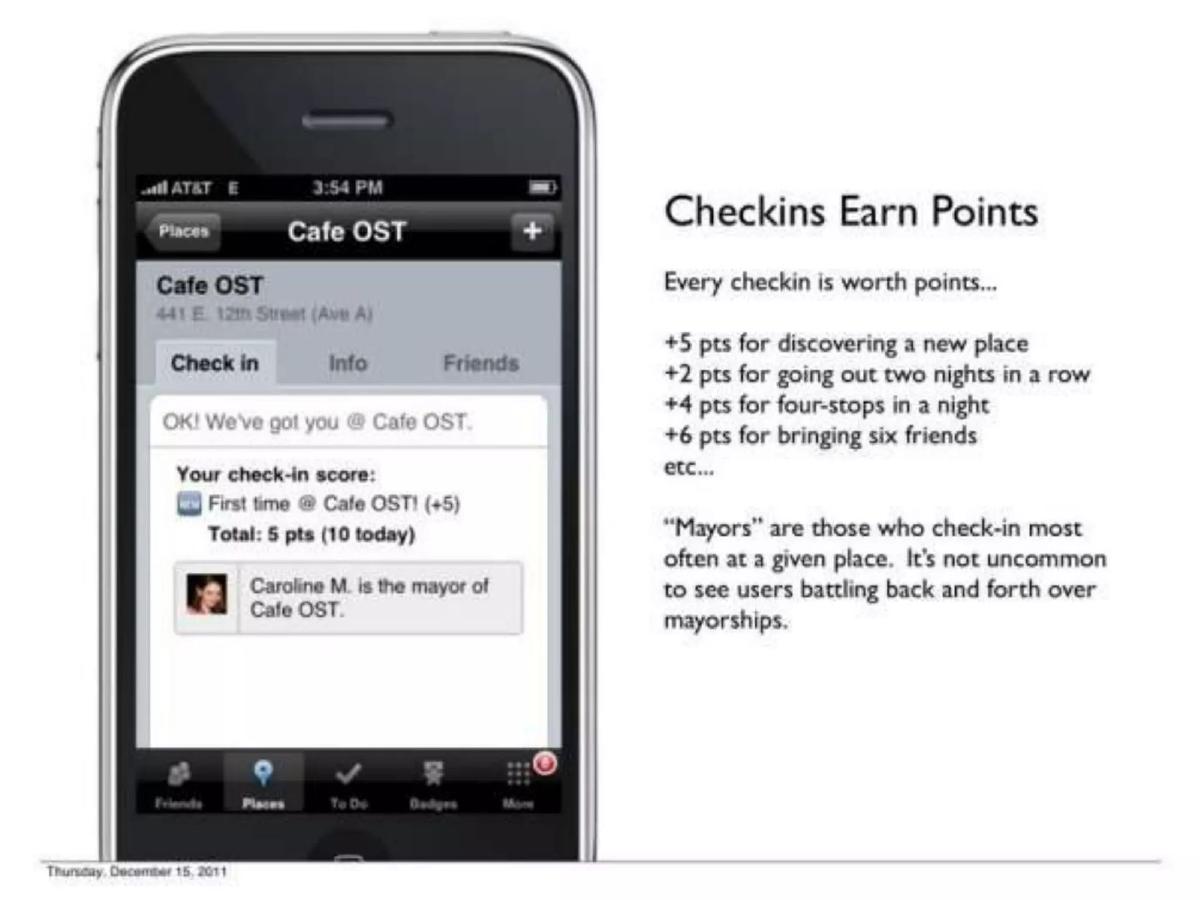
- Gamification was the core engagement engine, with specific point values for discovering new places (+5 pts) or multiple stops in one night (+4 pts) (Slide 5).
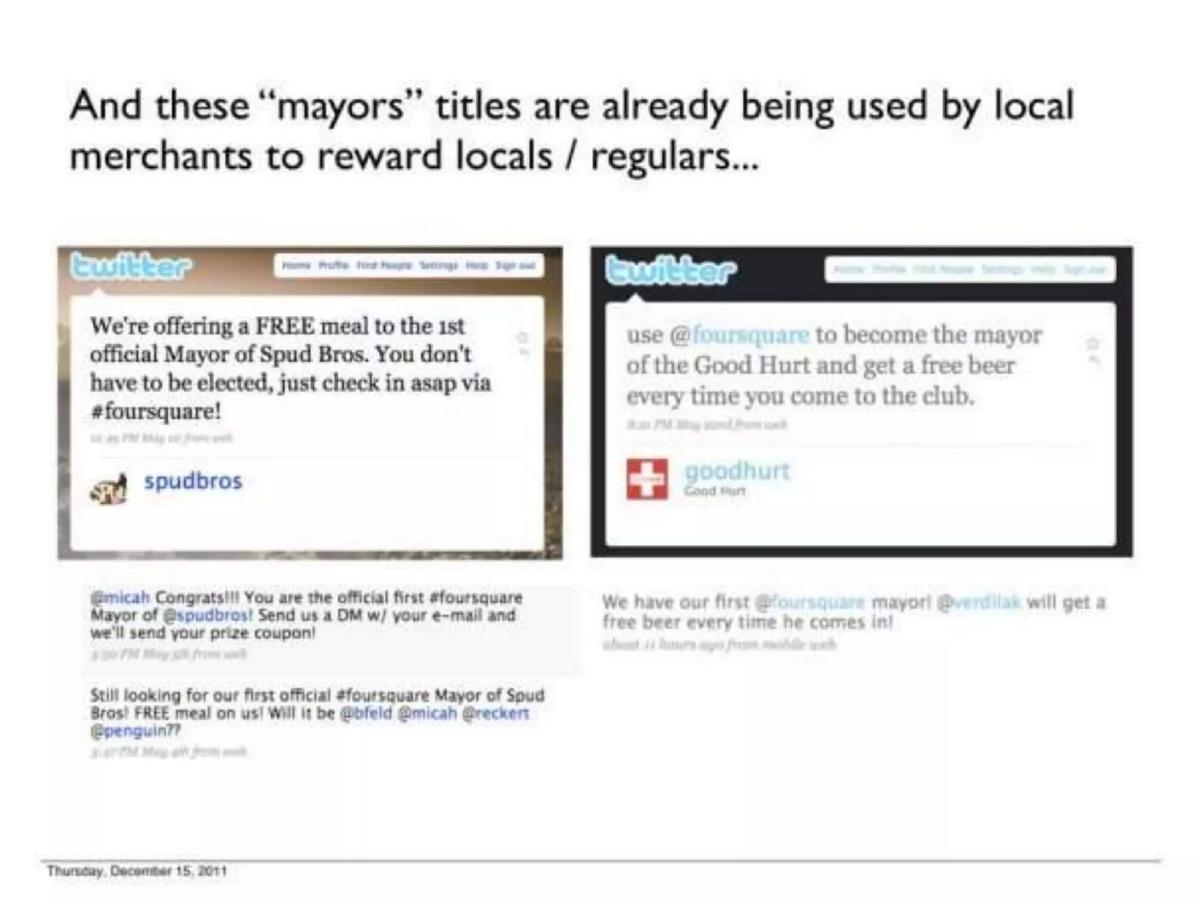
- The 'Mayor' mechanic was already being used by merchants like Spud Bros and Good Hurt to reward regulars with free meals and beer (Slide 6).
- The deck explicitly states that lead generation for local businesses would be the primary revenue model (Slide 11).
- Secondary revenue streams included sponsored badges, redeemable points, and the resale of aggregated behavioral data (Slide 12).
- At the time of the deck, the service was available in 20 US cities plus Amsterdam (Slide 15).
- The team consisted of only two people, Dennis Crowley and Naveen Selvadurai, both with relevant backgrounds at Google/Dodgeball and Sony Music/Socialight (Slide 15).
Introduction
The Foursquare 1st Pitch Deck, dated July 6, 2009, is a historic artifact from the early days of the mobile-first social era. At just 15 slides, it is a concise, product-focused presentation that prioritizes user experience and engagement mechanics over complex financial modeling. This teardown examines how Dennis Crowley and Naveen Selvadurai pitched a concept that would eventually define the 'check-in' culture of the early 2010s.
Slide 1: Title Slide
The deck opens with the original Foursquare logo—a stylized character playing the playground game of four square. It includes the date (July 6, 2009) and Dennis Crowley’s contact information. The simplicity of the title slide sets a casual, consumer-focused tone that persists throughout the deck.
Slide 2: What is Foursquare?
Foursquare uses a 'Think: X meets Y' approach to define its value proposition. It describes itself as part friend-finder, part social city-guide, and part social-game . Crucially, it mentions that the app uses game mechanics to 'encourage and reward users for experiencing new things.' It also notes the company's size: a 'two person startup based out of NYC.'
Slide 3: Friend Finder
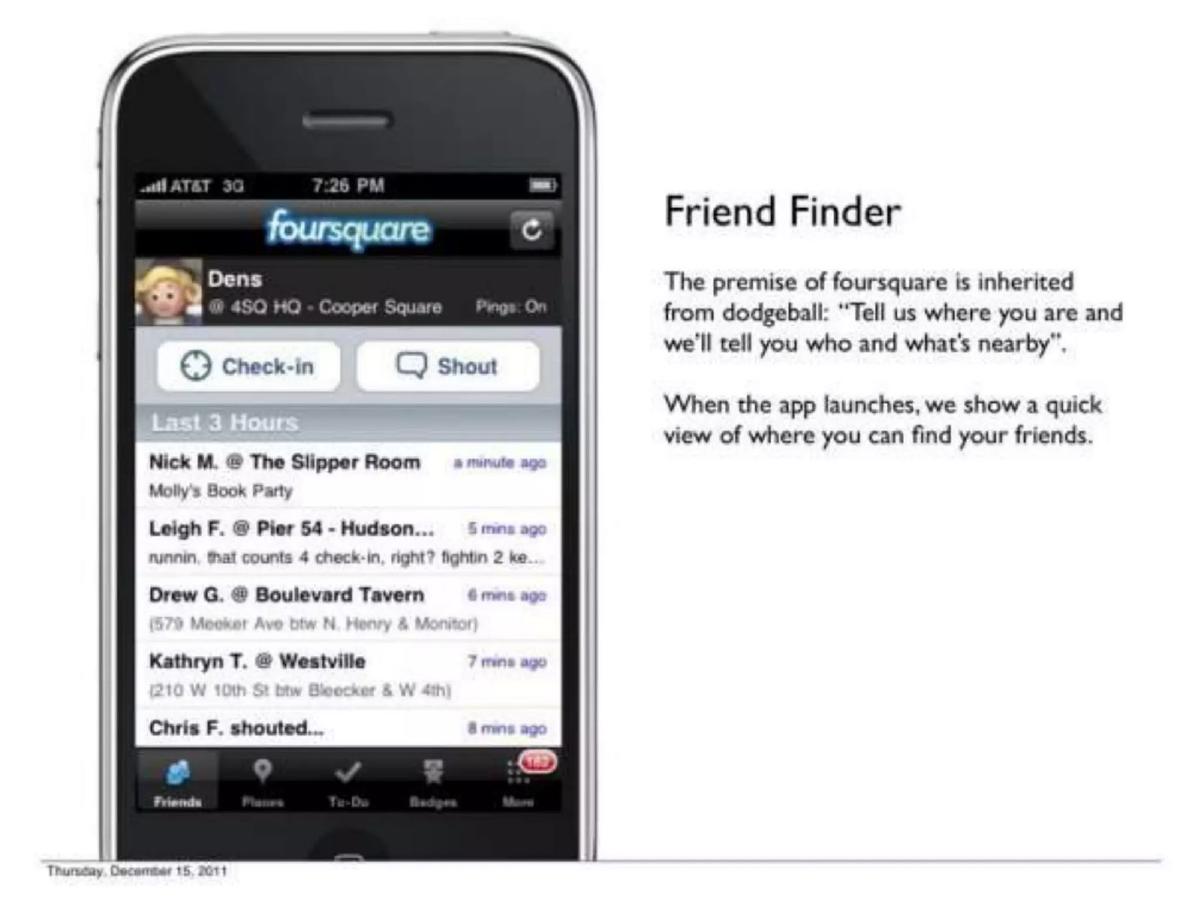
This slide establishes the product's lineage, explicitly mentioning Dodgeball , Crowley's previous venture. The core premise is simple: 'Tell us where you are and we'll tell you who and what's nearby.' The accompanying iPhone screenshot shows a feed of friends' locations, emphasizing the social utility of the app.
Slide 4: Social City Guide
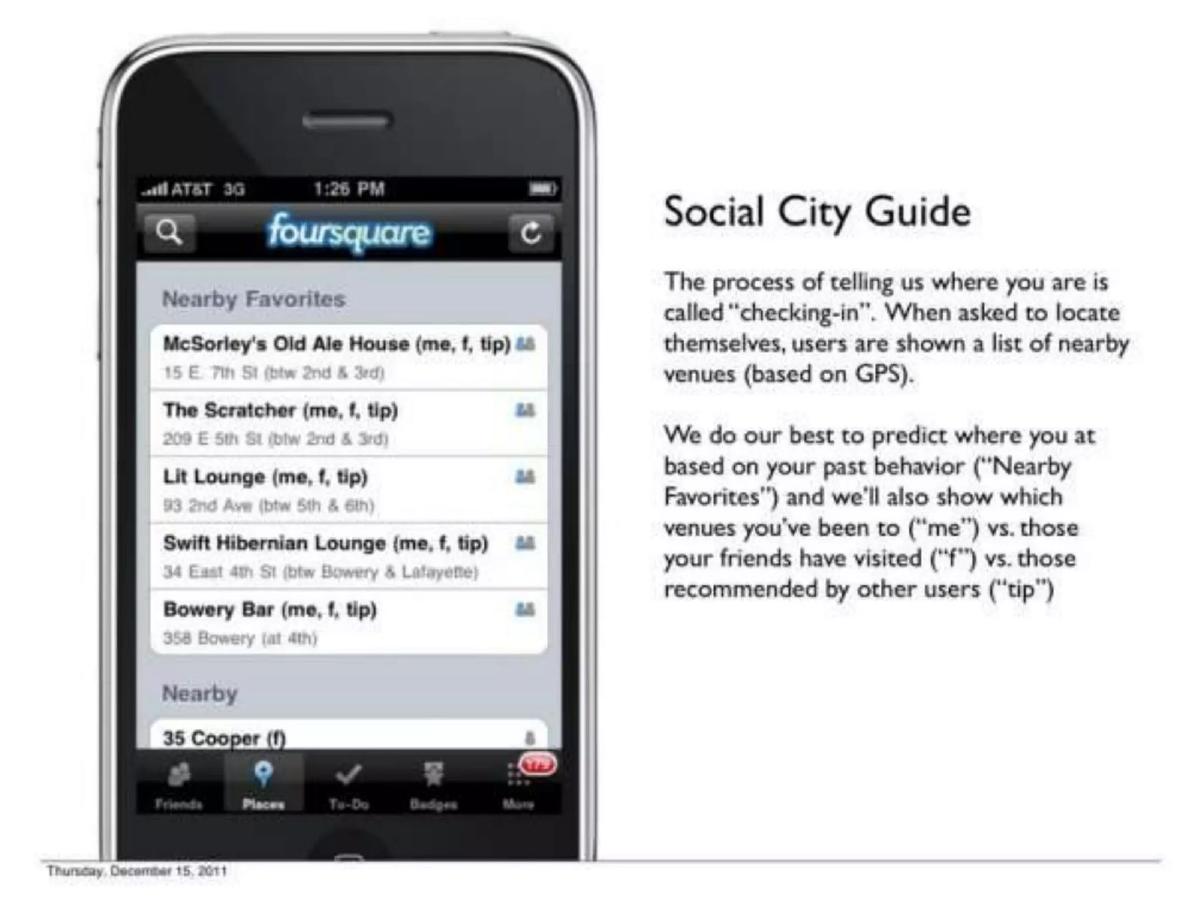
Here, the deck introduces the 'check-in' process. It explains that the app uses GPS to show nearby venues and predicts favorites based on past behavior. It introduces the shorthand icons used in the app: 'me' (user's history), 'f' (friends' history), and 'tip' (recommendations from others). This slide demonstrates the app's ability to organize local data social-first.
Slide 5: Checkins Earn Points
Slide 5 dives into the gamification aspect. It lists specific point rewards: +5 pts for discovering a new place , +2 pts for consecutive nights out, and +6 pts for bringing six friends. It also introduces the concept of 'Mayors'—users who check in most often at a specific location—and notes that users are already 'battling back and forth over mayorships.'
Slide 6: Merchant Rewards
This is a critical 'proof of concept' slide. It shows real-world examples of merchants (Spud Bros and Good Hurt) using Twitter to offer rewards to Foursquare Mayors, such as free meals or free beer . This proves that the digital game has tangible value for physical businesses, validating the future revenue model.
Slide 7: Leaderboard
The leaderboard slide reinforces the competitive social element. It describes the 'high score for Saturday night' and how top scorers unlock badges and '7-days of bragging rights.' The screenshots show both global (NYC) and friend-based rankings, highlighting the scalability of the social loop.
Slide 8: Tips
Foursquare differentiates itself from competitors like Yelp here. It describes 'Tips' as an experiment in social city guides that avoids long-form reviews in favor of 'Twitter-style recommendations' (e.g., 'Go here, try this'). This was a prescient move toward the short-form content that would later dominate mobile social media.
Slide 9: Tips (Part 2!)
This slide illustrates the 'push' nature of the app. As users check in, the app surfaces relevant tips from other users via pop-up notifications. The example shown is a tip about 'bacon flavored bourbon' at a nearby bar, demonstrating how the app provides value at the exact moment of intent.
Slide 10: Badges
Badges are presented as the long-term retention hook. They are tied to 'time, distance and location.' Examples include badges for staying out past 2am or frequently checking in in Brooklyn. This adds a layer of 'collection' to the user experience, encouraging diverse exploration of the city.
Slide 11: Primary Revenue Model
Foursquare identifies lead generation as its primary revenue stream. The slide argues that by combining location reporting with rewards, they can offer unique metrics for local advertising. The specific metric proposed is: 'an offer was shown and X% of users responded within 3 hours.' This is a sophisticated take on 'closing the loop' between digital ads and physical foot traffic.
Slide 12: Incremental Revenue Streams
Beyond lead generation, the deck suggests three additional revenue paths: Sponsored badges (e.g., a Starbucks badge), Redeemable points (similar to AmEx Rewards), and Banner placements targeted by user activity or geography. This shows the founders were thinking about a diversified business model from the start.
Slide 13 & 14: Website and Stats
These slides show the desktop version of Foursquare, which acted as a 'Facebook profile that is passively updated.' Slide 14 shows a detailed 'Stats' page with charts and graphs of a user's activity over 30 days. This indicates that Foursquare viewed itself not just as a game, but as a personal data dashboard for one's social life.
Slide 15: Trivia (The 'Team' and 'Status' Slide)
The final slide provides the current status: available in 20 US cities plus Amsterdam . It mentions the API is in private beta and lists the two-man team. Dennis Crowley’s background at Dodgeball/Google is the primary credibility marker here, providing investors with confidence in the founders' ability to execute in this specific niche.
What Works Well
Clarity of Product: The deck does an excellent job of explaining a new behavior (checking in) through the lens of familiar concepts (points, badges, and city guides). · Real-World Validation: Including screenshots of merchants already using the platform (Slide 6) is a powerful way to prove market demand without needing a massive sales team. · Founder-Market Fit: Mentioning Dodgeball (Slide 3 and 15) immediately signals to investors that the founders have deep domain expertise and have learned from previous iterations of the same idea. · Visual Storytelling: The use of iPhone mockups on almost every slide makes the product feel real and ready for use, which was vital in the early days of the App Store.
What is Missing
The Ask: There is no slide detailing how much money the company is looking to raise or what the milestones for that funding would be. · Competition: The deck mentions Yelp only to differentiate the 'Tips' feature but does not provide a comprehensive competitive landscape analysis. · Financial Projections: While revenue models are discussed, there are no projections regarding user growth, churn, or expected revenue figures. · Market Size: The deck assumes the investor understands the potential of the 'local' market but does not provide TAM/SAM/SOM data to quantify the opportunity.
What a Founder Should Copy
The 'Think: X meets Y' Slide: Slide 2 is a perfect example of how to quickly orient an investor in a new category. · Focusing on Mechanics: If you are building a consumer app, don't just show the UI; show the incentives . Foursquare's breakdown of point values (Slide 5) explains why users will keep coming back. · Closing the Loop: Slide 11’s focus on 'metrics for local advertising' is a masterclass in explaining how a social behavior translates into a business. Don't just say 'we will show ads'; explain why your ads are more valuable than the status quo. · Simplicity: The deck is not over-designed. It uses clear screenshots and bullet points to let the product vision speak for itself.
Frequently asked questions
- What was Foursquare's primary revenue strategy in 2009?
- According to Slide 11, Foursquare intended to use lead generation as its primary revenue model. The goal was to drive customers to local businesses and provide metrics for local advertising, such as tracking how many users responded to an offer within three hours of it being shown. They also planned to monetize through sponsored badges and data resale.
- How did Foursquare differentiate itself from Yelp?
- Slide 8 explains that Foursquare intentionally stayed away from 'Yelp-style reviews.' Instead, they encouraged 'Twitter-style recommendations' which were shorter, more immediate tips like 'Go here, try this.' The focus was on real-time discovery and social validation rather than long-form static critiques.
- What game mechanics were highlighted in the deck?
- The deck emphasizes three main mechanics: Points, Mayorships, and Badges. Slide 5 details the point system for check-ins, Slide 6 shows how 'Mayorships' (being the most frequent visitor) were used for merchant rewards, and Slide 10 illustrates 'Badges' as rewards for exploration, such as staying out late or frequenting specific neighborhoods like Brooklyn.
- Who were the founders and what was their background?
- Slide 15 identifies the founders as Dennis Crowley and Naveen Selvadurai. Crowley was previously at Dodgeball (which was acquired by Google), and Selvadurai came from Socialight and Sony Music. This established significant founder-market fit, as Crowley had already built a similar location-based service.
- What platforms did Foursquare support at launch?
- Slide 15 notes that Foursquare was available as a native iPhone app, a mobile website for Blackberry and Android users, and an SMS shortcode (50500) for older devices. This multi-channel approach ensured they could capture users regardless of their hardware, which was critical in the pre-smartphone-dominance era of 2009.