Flo Health's Series B deck is a masterclass in demonstrating market dominance through high-volume user acquisition and sustained engagement. By 2021, the company had already achieved over 160 million total installs and 38 million monthly active users, positioning itself as the top iOS health and fitness app globally by downloads. The deck successfully argues that Flo is not just a period tracker but a 'SuperApp' capable of supporting women through every life stage, from menstruation to menopause. With 66% organic installs and a clear path to $100M+ ARR, the presentation provided the quantitat…
Key takeaways
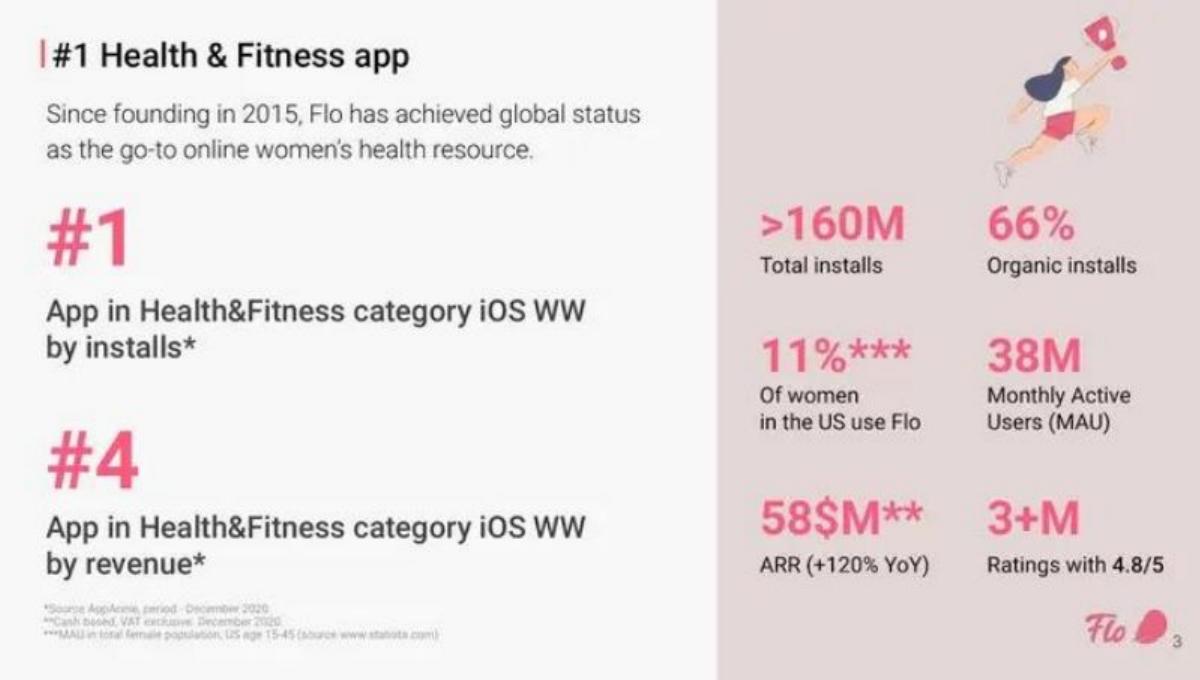
- Flo achieved the #1 rank in the iOS Health & Fitness category worldwide by installs as of December 2020 (Slide 3).
- The company reported $58M in ARR with a 120% year-over-year growth rate (Slide 3).
- User acquisition is highly efficient, with 66% of installs coming from organic sources (Slide 3).
- The platform has deep penetration in mature markets, reaching 11% of all women aged 15-45 in the United States (Slide 3).
- Flo positions itself as a 'SuperApp' by expanding beyond cycle tracking into content libraries, secret chats, and health assistants (Slide 11).
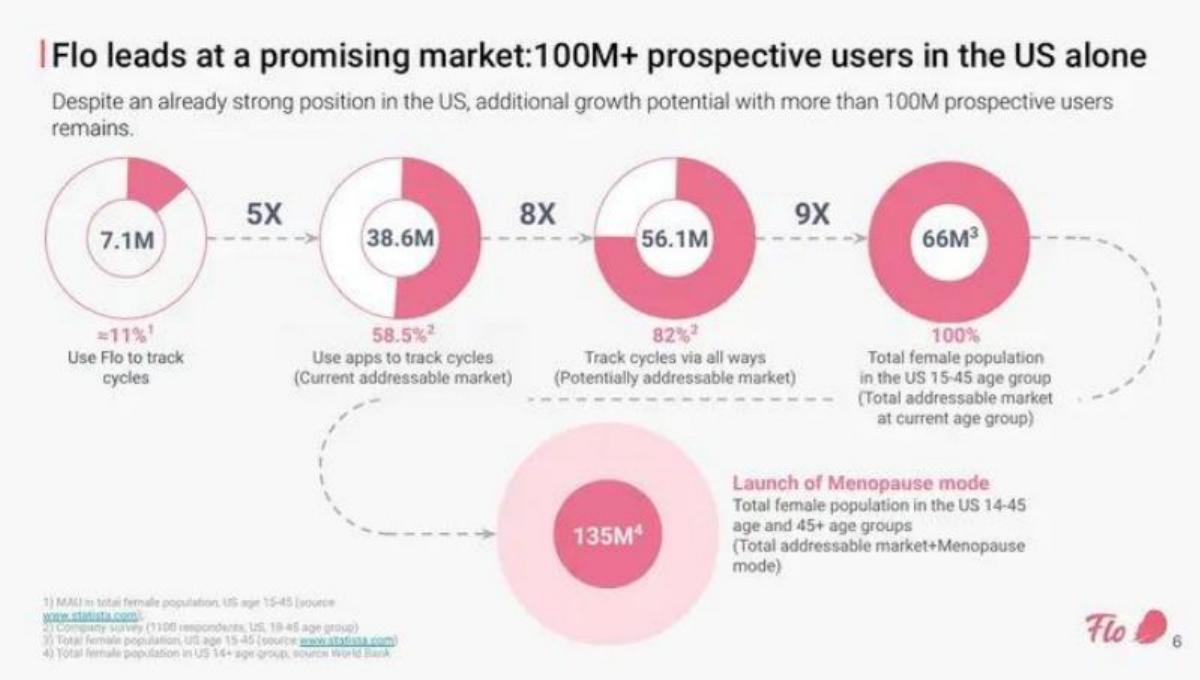
- The product roadmap includes a transition to 'Menopause Mode,' extending the user lifecycle to over 40 years (Slide 9).
- Technical strength is emphasized by the fact that over 50% of the workforce is in Product and Engineering (Slide 19).
- Subscription growth is aggressive, with the company forecasting a reach of 1 million subscribers shortly after the deck's release (Slide 23).
Executive Summary: The Scale of a Category Leader
Flo Health's Series B deck is a study in momentum. By the time this deck was circulated in 2021, Flo was no longer a startup trying to find product-market fit; it was a dominant market player seeking capital to cement its lead and expand its product surface area. The deck leans heavily into quantitative social proof, using rankings and massive user numbers to frame the company as an inevitable winner in the FemTech space.
Slide 1: The Vision of a SuperApp
The cover slide introduces Flo as 'The AI-Powered SuperApp for Women’s Lifelong Health & Well-being.' The use of the term 'SuperApp' is a strategic choice, signaling an ambition to move beyond a single-feature utility (cycle tracking) into a comprehensive platform. The visual is clean, featuring a high-quality mockup of the app interface, emphasizing the user-centric design.
Slide 3: Dominant Market Metrics
This is the 'traction' slide that likely did the heavy lifting for the round. Flo lists several staggering figures: over 160 million total installs, 38 million Monthly Active Users (MAU), and a #1 ranking in the iOS Health & Fitness category by installs. Crucially, they disclose that 66% of these installs are organic, proving a powerful brand pull. Financially, they cite $58M in ARR with 120% year-over-year growth, and a high user satisfaction rating of 4.8/5 from over 3 million ratings.
Slide 5: Competitive Positioning
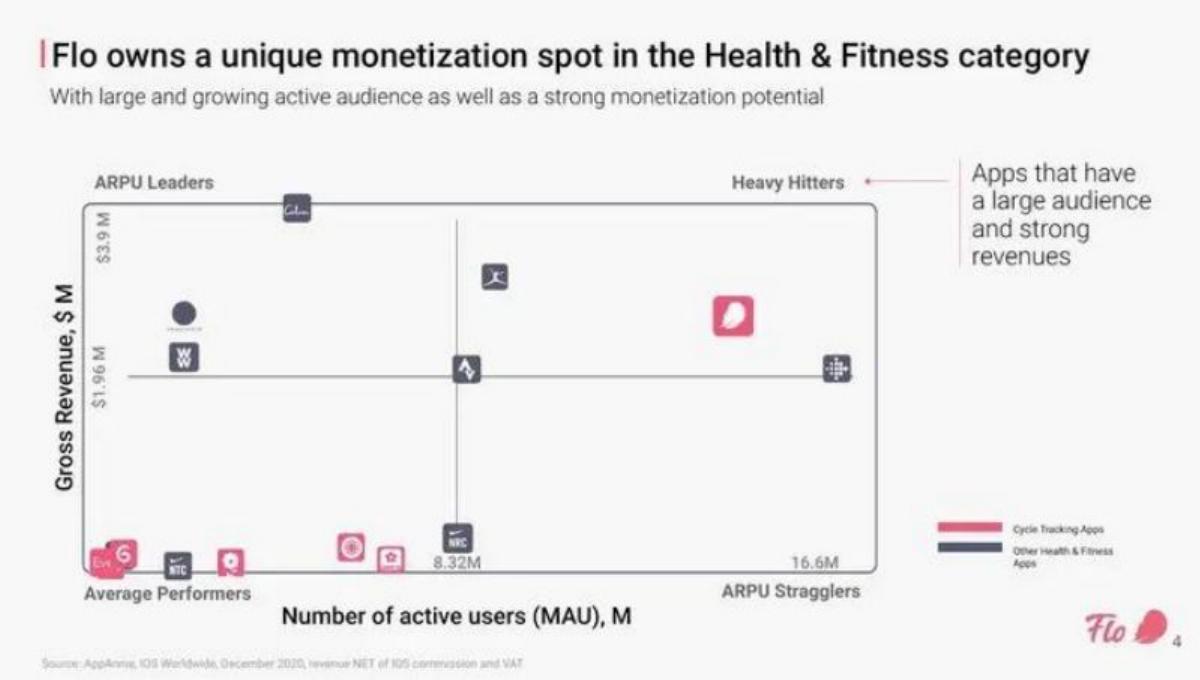
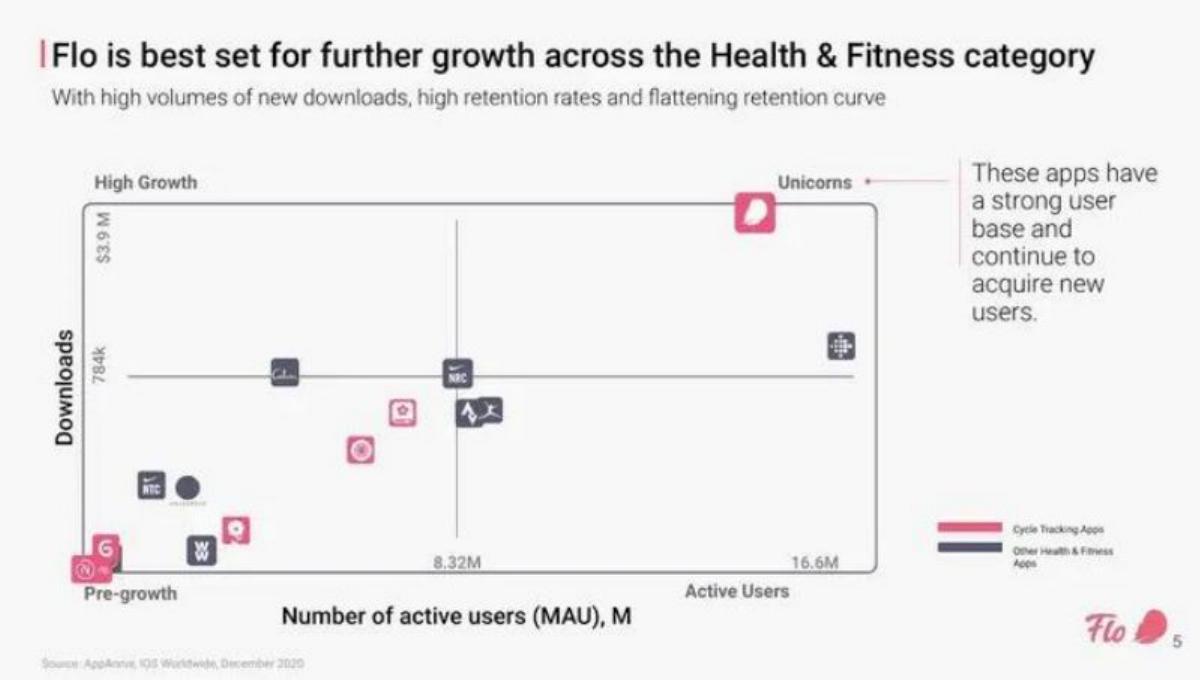
Slide 5 uses a standard 2x2 matrix but with a twist: the axes are 'Downloads' and 'Active Users.' Flo places itself in the top-right 'Unicorn' quadrant, significantly distanced from other cycle tracking apps (indicated in pink) and general health apps (indicated in grey). The slide notes that these apps have a 'strong user base and continue to acquire new users,' positioning Flo as the clear leader in both scale and engagement compared to competitors like Calm, Fitbit, or MyFitnessPal.
Slide 7: Global Footprint and Expansion
Flo demonstrates its global reach with a map showing penetration rates. They highlight that 11% of women in the US use Flo, with similar high penetration in Australia (11%) and Canada (10%). The slide outlines a plan to localize content into 20 languages by 2021 (up from 10 in 2020) to capture a share of the 1.7 billion prospective users worldwide. This addresses the 'Total Addressable Market' (TAM) by showing how much room is left to grow outside of their core Western markets.
Slide 9: The 40-Year Lifecycle
One of the most compelling arguments for Flo's long-term value is the lifecycle slide. It illustrates four distinct modes: Tracking, Pregnancy, Early Motherhood, and the planned Menopause mode. By supporting users through these transitions, Flo extends its utility from a few years to 'more than 40 years of her life.' This is a powerful narrative for increasing Lifetime Value (LTV) and reducing churn as users age.
Slide 11: Expanding the Product Ecosystem
To justify the 'SuperApp' label, Slide 11 details 'Satellite products.' These include a Content Library, Health & Wellbeing courses, 'Secret Chats' for community engagement, and a 'Health Assistant.' The slide explicitly states that these tools create 'value users are willing to pay for,' linking product expansion directly to monetization strategy.
Slide 13: User Sentiment and Social Proof
Slide 13 doubles down on social proof, showing a breakdown of over 4 million ratings across the App Store and Google Play. The visual representation of the rating bars—dominated by 5-star reviews—serves to reassure investors of the product's quality and the community's loyalty. It frames Flo as a 'global community' rather than just a piece of software.
Slides 15 & 17: Roadmap and Team Transitions
Slide 15 serves as a transition to the 2021 roadmap, though the specific details of the roadmap are not included in the provided images. Slide 17 introduces the 'FLO Team' with a lifestyle photo of employees, though it lacks the specific executive bios often found in earlier-stage decks. This suggests that at Series B, the company's metrics were considered more important than the individual resumes of the founding team.
Slide 19: Technical Infrastructure
This slide focuses on the 'Technical Department and Tech Stack.' It reveals that over 50% of the workforce is in Product and Engineering. The slide lists a sophisticated array of logos, including TensorFlow, PyTorch, Spark, and AWS SageMaker. This is intended to prove that Flo's 'AI-powered' claims are backed by a robust data science and engineering organization capable of handling massive scale.
Slide 21: MAU Growth Trajectory
A bar chart shows the steady, month-over-month growth of Worldwide MAU from September 2016 to late 2020. The chart shows a consistent upward trend, reaching the 38M MAU mark. The lack of significant dips or plateaus in this chart is a strong indicator of a healthy, growing ecosystem.
Slide 23: Subscription Growth
This slide breaks down subscription growth by platform (iOS vs. Android). While iOS (in pink) represents the majority of the 726K subscribers as of December 2020, the chart shows Android subscriptions growing steadily. The headline confidently predicts reaching the 1 million subscriber milestone within the current quarter.
Slide 25: Revenue Forecast
The final data slide provides a monthly gross revenue forecast. It shows actuals ('Fact') through 2020, peaking at $4.9M in December, and forecasts a climb to $8.5M by December 2021. This level of granularity gives investors a clear benchmark to measure the company's performance post-investment.
What Flo Health Does Well
Flo Health excels at using scale as a moat . By highlighting their #1 ranking and 160M+ installs, they make it clear that any competitor would need massive capital to catch up. They also do an excellent job of linking product features to financial outcomes ; for example, the lifecycle modes aren't just 'features,' they are LTV expansion strategies. The deck is also highly data-transparent , providing specific monthly breakdowns of MAU, subscribers, and revenue rather than just vague annual summaries.
What is Missing from the Deck
Despite the 27-slide length, the 14 slides provided omit a few key Series B requirements. There is no explicit 'Ask' slide in this selection, which would typically detail how the $50M would be allocated (e.g., % to R&D, % to marketing). There is also a lack of unit economics ; while they show total revenue, they don't explicitly state their Customer Acquisition Cost (CAC) or the LTV/CAC ratio, which is a standard metric for Series B investors. Finally, the Team Slide is purely visual and lacks the 'why us' narrative regarding the founders' specific expertise in healthcare or data science.
Founder Takeaways: What to Copy
Use 'Fact vs. Forecast' charts: Showing exactly where you are and where you are going on a monthly basis builds immense trust with investors (Slide 25). · Visualize the User Journey: If your product has long-term utility, map it out visually to show how you capture value over decades, not just months (Slide 9). · Leverage Category Rankings: If you are #1 in any niche or geography, lead with it. It is the strongest form of social proof (Slide 3). · Showcase your Tech Stack: For AI-driven companies, showing the actual tools you use (TensorFlow, PyTorch) proves that your 'AI' isn't just marketing fluff (Slide 19). · Highlight Organic Growth: Investors love efficient acquisition. If a large percentage of your users come to you for free, make sure that number is prominent (Slide 3).
Frequently asked questions
- What was the primary growth metric Flo used to prove market leadership?
- Flo focused heavily on its ranking as the #1 Health & Fitness app on iOS worldwide by installs. They supported this with a massive top-of-funnel figure of 160 million total installs and 38 million Monthly Active Users (MAU). This scale, combined with 66% organic acquisition, demonstrated that the brand had achieved 'global status' without relying solely on paid marketing.
- How does Flo define its 'SuperApp' strategy in the deck?
- The 'SuperApp' strategy involves moving beyond simple cycle tracking. Slide 11 illustrates 'Satellite products' including a Content Library, Courses on Health & Wellbeing, Secret Chats, and a Health Assistant. This diversification is intended to create multiple value touchpoints that users are willing to pay for, increasing the Average Revenue Per User (ARPU) and retention.
- What is the significance of the 40-year user lifecycle mentioned?
- By mapping out modes for Tracking, Pregnancy, Early Motherhood, and the planned Menopause mode, Flo argues it can retain a user for four decades. This significantly increases the Lifetime Value (LTV) of a customer. Slide 9 visually represents this journey, showing that Flo aims to be a lifelong health companion rather than a utility used only during specific windows of time.
- How did Flo demonstrate its technical advantage to Series B investors?
- Slide 19 highlights that over 50% of the company's workforce is dedicated to Product and Engineering, with an average of 10 years of experience. They also showcased a modern, complex tech stack including TensorFlow, PyTorch, and AWS SageMaker, signaling to investors that their AI-powered predictions are built on a sophisticated data infrastructure rather than simple heuristics.
- What financial projections were included in the Series B deck?
- The deck included a detailed monthly revenue forecast on Slide 25. It showed 'Fact' (actuals) up to December 2020, where they hit $4.9M in monthly gross revenue, and 'Forecast' through December 2021, targeting $8.5M per month. This transparency in monthly growth helped validate their 120% YoY ARR growth claim.