FLORA’s 11-slide deck, which supported a $42M Series A in 2024, is a masterclass in aesthetic-led storytelling for the creative industry. Rather than overwhelming investors with technical AI jargon, the deck focuses on the 'creative infrastructure' gap. It positions the platform as a unified environment for ideation, exploration, refinement, and distribution. Key highlights include a usage-based pricing model ('Pay for Output, Not Seats') and a roster of high-profile design partners like Pentagram and Red Antler. While the deck is light on traditional financial metrics and specific team bios,…
Key takeaways
- The deck positions FLORA as 'creative infrastructure' rather than just another generative AI tool (Slide 2).
- FLORA identifies a specific market gap: existing AI tools are built for 'outputs, not for process' (Slide 2).
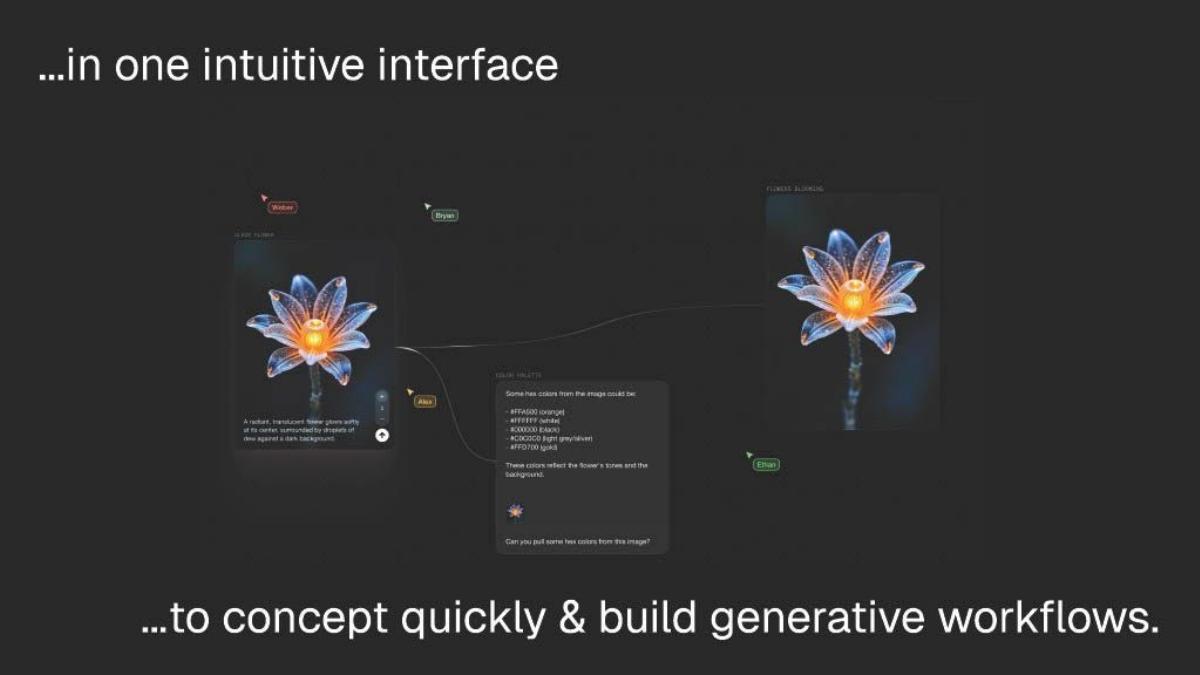
- The product interface emphasizes multi-user collaboration, featuring real-time cursors for users like 'Weber' and 'Bryan' (Slide 3).
- The workflow is defined by four distinct stages: ideate, explore, refine, and distribute (Slide 4).
- FLORA utilizes a 'Pay for Output, Not Seats' pricing model to encourage enterprise-wide collaboration without cost barriers (Slide 5).
- The company claims SOC 2 compliance and full commercial usage rights, addressing major enterprise legal concerns (Slide 5).
- Traction is demonstrated through logos of elite creative firms including Pentagram, Red Antler, and 2x4 (Slide 5).
- The platform includes 'Forward Deployed Creatives' to assist enterprise teams in scaling workflows (Slide 5).
The $42M Aesthetic: How FLORA Sells Creative Infrastructure
FLORA’s 11-slide deck is a study in minimalism and industry-specific positioning. In an era where AI startups are often criticized for being 'wrappers' around existing models, FLORA uses its Series A deck to argue that the interface and the workflow are the product. By raising $42M in 2024, the company proved that investors are willing to bet on the 'how' of creative work just as much as the 'what.'
Slide 1: The Visual Hook
The title slide features the FLORA logo in a stylized, serif font paired with a high-fidelity, iridescent 3D floral render. There is no subtitle, no 'Uber for X' tagline, and no mission statement. This is a deliberate choice for a company selling to the creative industry; the slide serves as a portfolio piece, demonstrating the aesthetic quality the platform aims to enable. It sets a tone of sophistication that aligns with the enterprise design firms listed later in the deck.
Slide 2: The Origin Story and Problem Statement
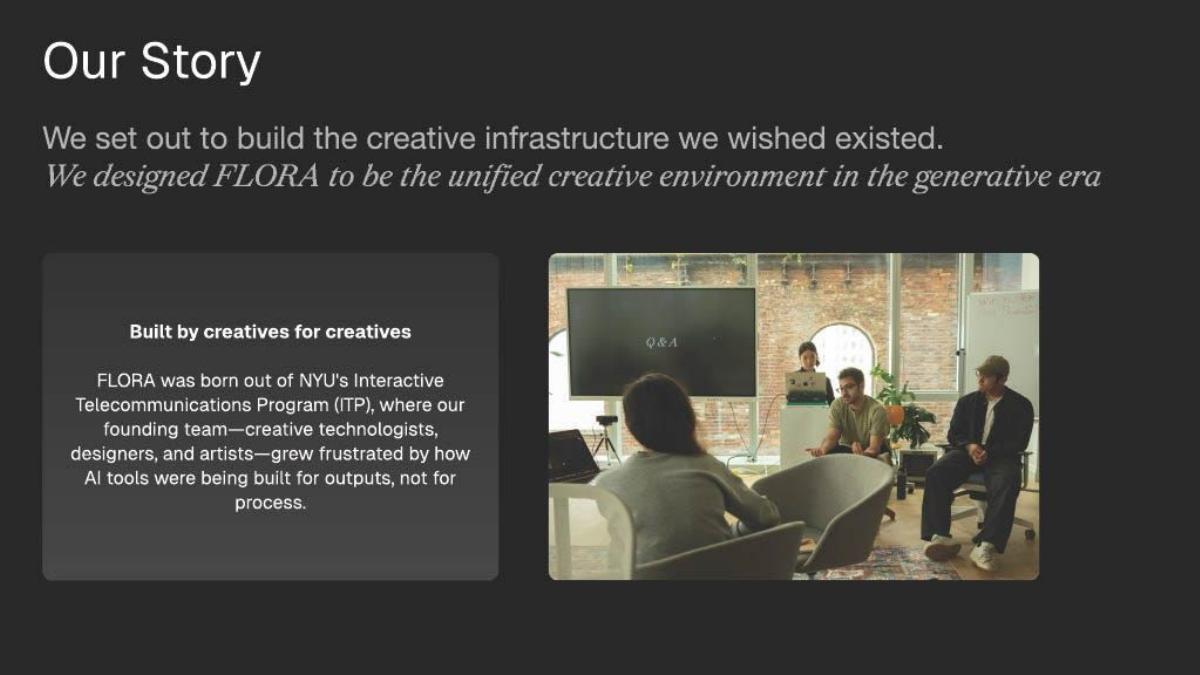
Slide 2 introduces the 'Our Story' narrative. It states, "We set out to build the creative infrastructure we wished existed." This is a powerful framing because 'infrastructure' implies something essential and foundational, rather than a discretionary tool. The slide identifies the founding team's pedigree: "FLORA was born out of NYU's Interactive Telecommunications Program (ITP)."
The core problem is articulated clearly: the team "grew frustrated by how AI tools were being built for outputs, not for process." This is the central thesis of the deck. By focusing on process, FLORA carves out a niche that isn't just about generating a better image, but about how a professional team works together to get there.
Slide 3: The Collaborative Interface
Slide 3 provides a look at the product, titled "...in one intuitive interface." The visual shows a node-based or canvas-style environment where multiple users (identified by cursors labeled 'Weber,' 'Bryan,' 'Alex,' and 'Ethan') are interacting with AI-generated assets. One asset shows a translucent flower, while another window displays a color palette with specific hex codes (e.g., #FFA500 orange, #FFFFFF white). The caption at the bottom reads, "...to concept quickly & build generative workflows." This slide visually confirms the 'process' focus mentioned earlier, showing that the tool handles color extraction and collaborative feedback in real-time.
Slide 4: The Workflow Linearization
Slide 4 is remarkably simple. It features a horizontal arrow moving through four stages: ideate, explore, refine, distribute . The header text says, "house their entire creative process in one environment..." This slide addresses the 'fragmentation' problem in creative work, where designers often jump between Midjourney for ideation, Photoshop for refinement, and Slack for distribution. FLORA promises to collapse these steps into a single timeline.
Slide 5: Enterprise Scale and Business Model
This is the 'meat' of the deck. Titled "Designed for Enterprise Scale," it addresses three critical pillars for a Series A company: traction, pricing, and security.
Traction: The slide lists logos from Base, Pentagram, Red Antler, Levi's, and Lionsgate . These are not just tech startups; they are legacy brands and top-tier design agencies, which provides massive social proof. · Pricing: FLORA introduces a "Pay for Output, Not Seats" model. The deck explains that "Usage-based pricing allows teams to add collaborators without increasing costs." This is a direct shot at the per-seat licensing models of Adobe or Figma, positioning FLORA as a more collaborative-friendly option for large organizations. · Security: It explicitly mentions being "SOC 2 compliant with full commercial usage rights over outputs." For enterprise clients, legal indemnity and data security are often the biggest barriers to AI adoption. · Support: The mention of "Forward Deployed Creatives" suggests a high-touch service model similar to Palantir’s 'Forward Deployed Engineers,' signaling that FLORA is willing to embed with clients to ensure success.
Slides 6-11: The Missing Pieces
The provided text indicates that slides 6 through 11 all carry the 'FLORA' branding or a 'Thank you!' message (Slide 11). In the context of a $42M raise, it is highly likely that the version of the deck released to the public or captured here is a 'teaser' or a condensed version. However, based on what is visible, there are significant omissions that a founder should be aware of:
No Team Slide: While Slide 2 mentions NYU ITP, there are no headshots or bios for the founders. Investors usually want to see the specific technical and commercial leadership. · No Financials: There is no mention of ARR, growth rates, or burn. While the publisher reports a $42M raise, the deck does not show the path to $100M in revenue. · No Competition Slide: The deck ignores the existence of Adobe Firefly, Canva, or Midjourney. It relies entirely on the 'infrastructure' and 'process' argument to differentiate itself without naming rivals.
What Works in the FLORA Deck
1. Industry-Specific Language: The use of terms like 'concepting,' 'generative workflows,' and 'forward deployed creatives' speaks directly to the target audience. It sounds like a tool built by people who have actually worked in an agency.
2. Solving the 'Seat' Friction: The usage-based pricing model is a brilliant strategic move. In large agencies, getting budget approval for 50 new software seats is a nightmare. A usage-based model allows for viral internal adoption without immediate budget triggers.
3. High-End Social Proof: Listing Pentagram and Red Antler is more valuable for this specific sector than listing a dozen random YC startups. It signals that the tool meets the highest standards of professional design.
What is Missing
1. The 'Why Now' (Technically): The deck doesn't explain what proprietary AI tech FLORA is using. Is it a fine-tuned model? An ensemble of models? While the 'process' story is strong, a $42M Series A usually requires a deeper technical moat than just a good UI.
2. Unit Economics: For a usage-based model, investors typically want to see the relationship between the cost of compute (GPU time) and the revenue generated per output. The deck is silent on the sustainability of the business model.
3. The Roadmap: The deck shows the 'what' and the 'how,' but not the 'where next.' There is no indication of whether FLORA plans to expand into video, 3D, or marketing automation.
Founder's Playbook: What to Copy
1. Lead with the 'Frustration': FLORA’s best slide is Slide 2. Identifying a specific, relatable frustration (tools built for outputs, not process) is much more effective than a generic 'market is big' slide.
2. Show, Don't Just Tell, Collaboration: Slide 3 uses simple cursor overlays to prove the platform is multi-user. If your product is collaborative, your screenshots must show multiple people working simultaneously.
3. Address Enterprise 'Must-Haves' Early: By putting SOC 2 and commercial rights on the same slide as the logos, FLORA preemptively answers the two biggest questions a corporate legal department will ask.
4. Use a 'Linearized' Workflow: If your product covers multiple stages of a user's day, use a simple arrow diagram like Slide 4. It helps investors visualize where your tool sits in the customer's existing stack.
Frequently asked questions
- How much did FLORA raise with this deck?
- According to publisher-reported facts from Business Insider, FLORA raised $42 million in a Series A round in 2024. The deck itself does not explicitly state the amount raised or the valuation, which is common for decks shared post-close or used in high-level introductory meetings.
- What is FLORA's unique selling proposition?
- FLORA differentiates itself by focusing on the 'creative process' rather than just the final AI output. Slide 2 notes that the founding team was frustrated by tools built only for outputs. Their solution is a unified environment that handles the entire workflow from ideation to distribution in one interface.
- Who is the target customer for FLORA?
- The deck specifically targets enterprise-scale creative teams and agencies. Slide 5 lists 'Trusted by creative professionals' and displays logos for Pentagram, Red Antler, Base, Levi's, and Lionsgate, indicating a focus on high-end design and media organizations.
- What is FLORA's pricing strategy?
- FLORA uses a usage-based pricing model described on Slide 5 as 'Pay for Output, Not Seats.' This is a strategic move to allow large teams to add as many collaborators as needed without increasing the subscription cost, removing a common friction point in enterprise software adoption.
- Does the deck include a detailed team slide?
- No. While Slide 2 mentions the team originated from NYU's Interactive Telecommunications Program (ITP) and consists of 'creative technologists, designers, and artists,' there is no dedicated slide listing individual founders, their specific backgrounds, or previous exits.