FlexyMovies, led by Alessandro Masi in 2012, aimed to solve the inefficiency of uniform pricing in the movie theater industry. The deck proposes a ticketing platform and mobile app that uses a real-time algorithm to adjust ticket prices based on seat availability and time. By targeting the Italian market—where they claimed no specialized cinema ticketing platform existed—the company sought to increase exhibitor profits and consumer engagement. The deck relies heavily on academic and industry expert quotes to validate the concept of variable pricing. While the team slide is missing from this 8…
Key takeaways
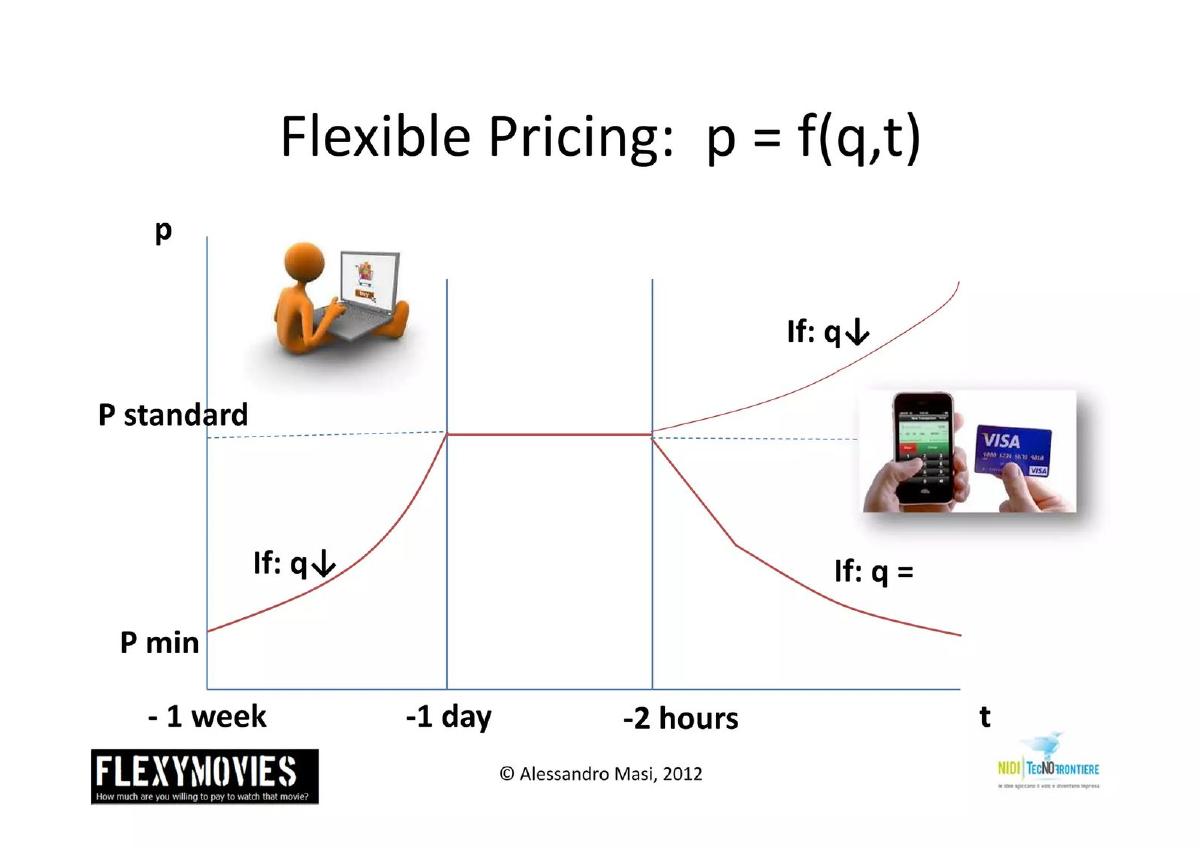
- The core product is a ticketing platform and mobile app using a real-time flexible pricing algorithm based on seat availability and time (Slide 2).
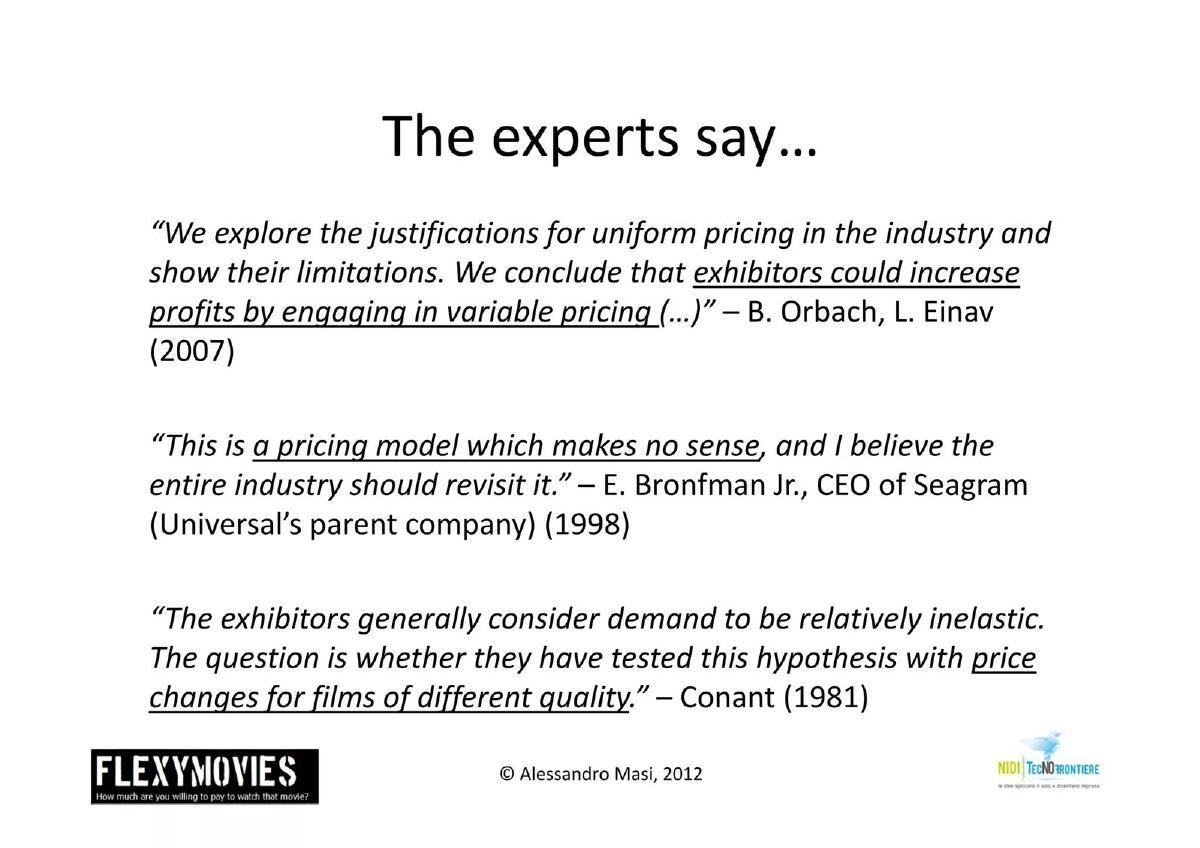
- The deck uses historical quotes from 1981, 1998, and 2007 to argue that uniform pricing in the film industry is outdated and limits profit (Slide 3).
- Advisors include industry veterans like Tearlach Hutcheson of Studio Movie Grill and Aldo Lemme, formerly of Sony Pictures Releasing Italy (Slide 4).
- Competitive analysis identifies a gap in the Italian market, claiming no specialized cinema ticketing platform existed there at the time (Slide 5).
- Partnerships are already established or targeted with software providers like ELAND and content providers like Preview Networks (Slide 6).
- The go-to-market strategy involves a three-stage process: testing in 10 theaters, building a free community platform, and finally moving to a subscription plus transaction fee model (Slide 7).
- The financial ask is €167k for an 18-month runway, with 61% of the allocation dedicated to Marketing & Sales (Slide 8).
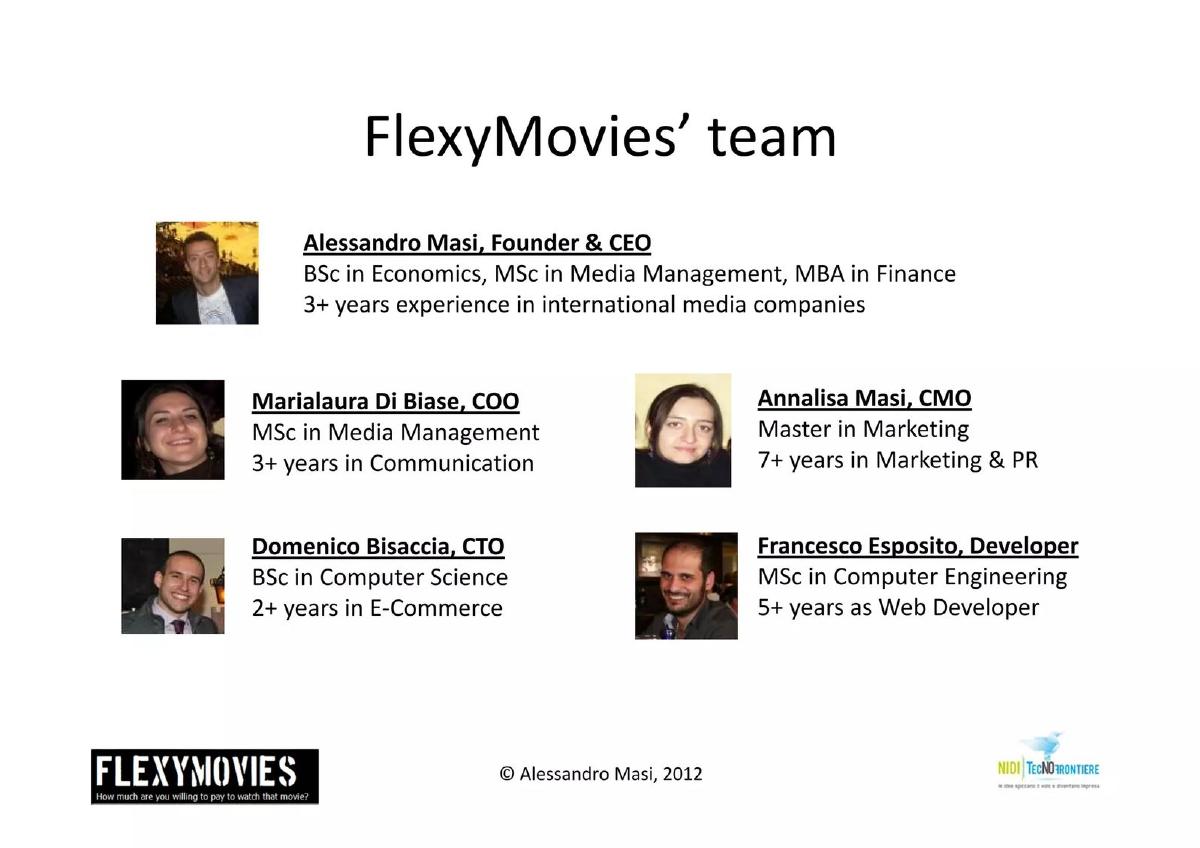
- The deck lacks a formal team slide, unit economics, and specific revenue projections beyond the mention of a transaction fee model (Slides 1-8).
FlexyMovies: The 2012 Vision for Dynamic Cinema Pricing
The FlexyMovies pitch deck, dated June 8, 2012, presents a solution for the movie theater industry's perceived inefficiency: static pricing. By introducing a dynamic, real-time algorithm to the Italian cinema market, the company aimed to fill empty seats and maximize exhibitor revenue. This teardown looks at the 8 slides provided from the 16-slide deck.
Slide 1: Title and Vision
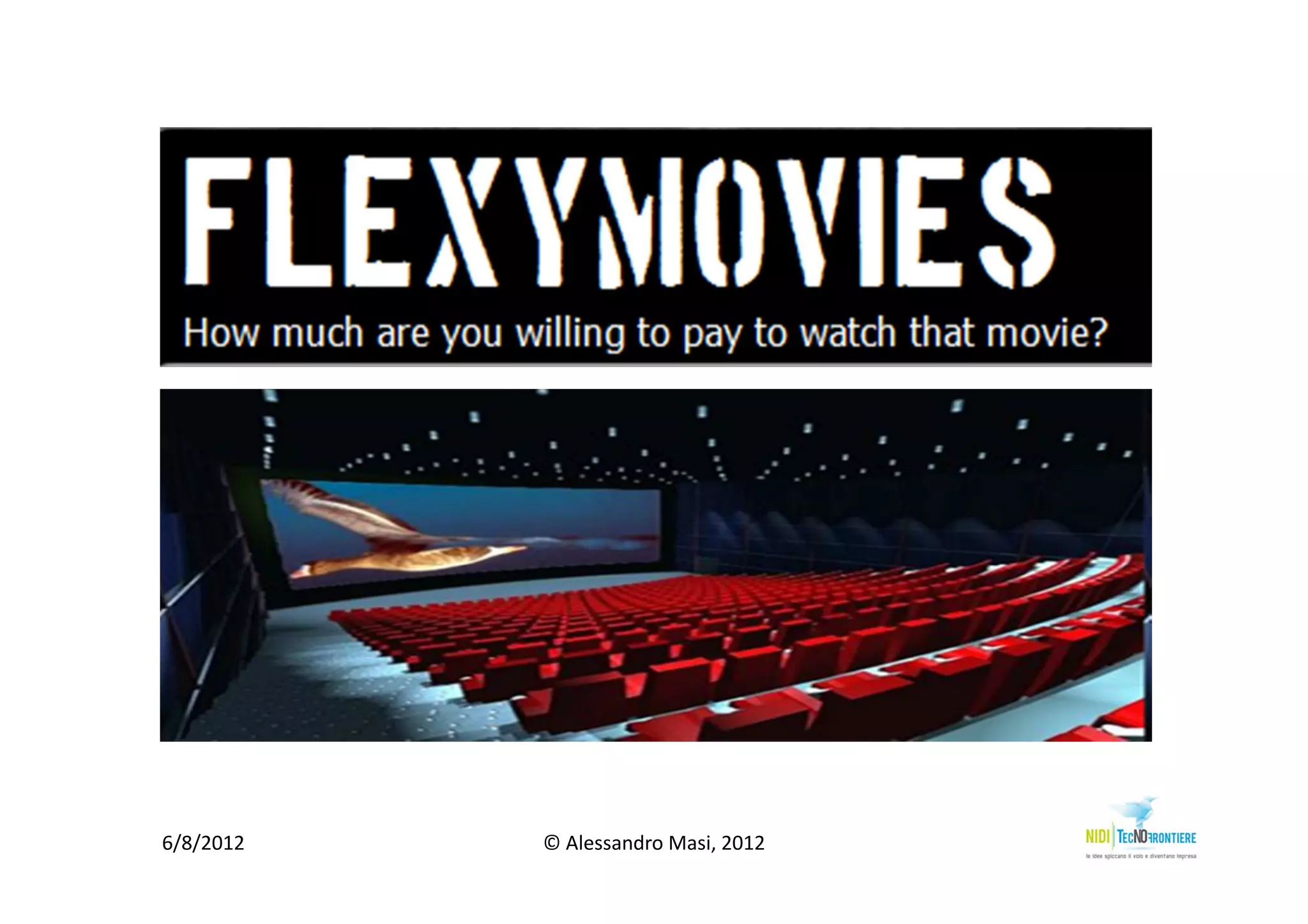
The cover slide introduces the brand name, FlexyMovies , with the provocative subtitle: "How much are you willing to pay to watch that movie?" The imagery features an empty red-seated movie theater, emphasizing the inventory problem the company intends to solve. The slide is watermarked with the NIDI TECNOFRONTIERE logo, suggesting involvement with an incubator or regional development fund in Italy.
Slide 2: The Value Proposition
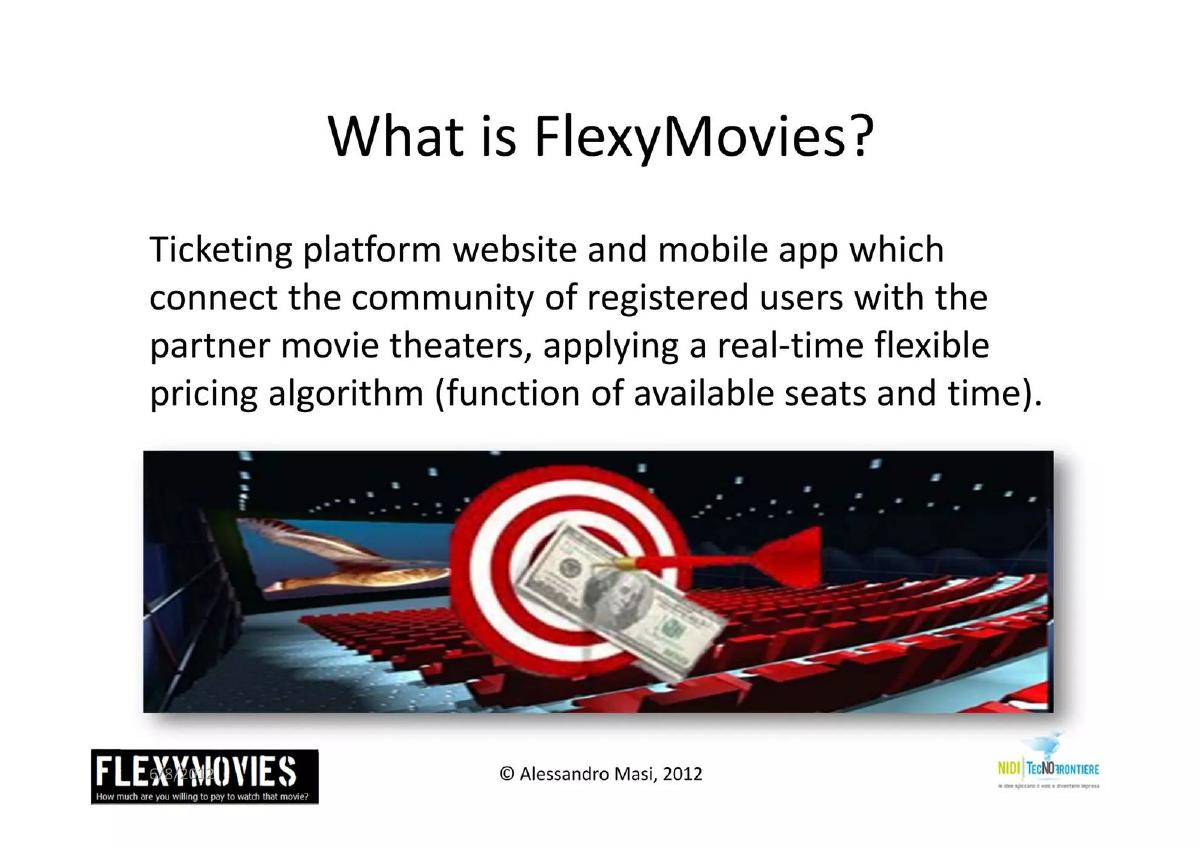
Slide 2 defines the product as a "Ticketing platform website and mobile app." The core functionality is to connect a community of registered users with partner movie theaters. The technical differentiator is a "real-time flexible pricing algorithm" that adjusts prices based on two specific variables: available seats and time . The visual aid shows a target over theater seats with a hundred-dollar bill, reinforcing the goal of hitting the right price point for maximum revenue.
Slide 3: Industry Validation
Titled "The experts say...", this slide attempts to validate the concept of variable pricing through academic and executive quotes. It cites B. Orbach and L. Einav (2007) regarding the limitations of uniform pricing, E. Bronfman Jr. (former CEO of Seagram/Universal) calling uniform pricing a model that "makes no sense," and a 1981 quote from Conant regarding price elasticity. While these quotes provide intellectual backing, they are somewhat dated, with the oldest being 31 years old at the time of the presentation.
Slide 4: The Advisory Board
This slide lists four high-profile advisors, which serves as a proxy for team credibility in the absence of a dedicated founder slide in this selection. The advisors include:
Tearlach Hutcheson: Director of Marketing at Studio Movie Grill (20 theaters in the US). · Aldo Lemme: Former Senior Marketing Director at Sony Pictures Releasing Italy. · Paola Dubini: Associate Professor at Bocconi University and Director of a research center for Arts and Culture. · Severino Salvemini: President of Mikado Film and board member of Cinecitta’ Holding S.p.A.
The inclusion of both US-based exhibition experience and Italian film industry heavyweights suggests a well-connected project.
Slide 5: Competitive Landscape
Slide 5 categorizes competitors into three groups: Ticketing (Ticketmaster, Viva Ticket, TicketOne), Couponing (Groupon, Groupalia), and Specialist players (MYmovies.it, Fandango). The company stakes its claim on three points:
No current competitor applies flexible pricing. · There is no ticketing platform specialized for cinema in Italy. · Couponing platforms are "unengaging and unfocused."
Slide 6: Strategic Partnerships
The Partnerships slide shows a mix of software, content, and exhibition partners. ELAND is listed under software. Content partners include Seen That , Searcheeze , and Preview Networks . Most importantly, under Movie Theaters, the slide lists ANEC (Associazione Nazionale Esercenti Cinema) and Studio Movie Grill . The presence of ANEC is critical for any Italian cinema startup, as it represents the national association of cinema exhibitors.
Slide 7: Go-to-Market Strategy
Testing: A pilot program in 10 theaters selected in collaboration with ANEC. · Free platform + community: A phase focused on user acquisition and providing free tools to theater partners to build the ecosystem. · Definitive biz model: The final stage where the company implements a subscription and transaction fee model.
Slide 8: The Ask and Allocation
The final slide in this set, titled "Money talks, rest walks...", specifies a funding requirement of €167k to cover the next 18 months of operations. A pie chart breaks down the allocation:
The heavy lean toward Marketing & Sales (61%) indicates that the technology was likely near completion, and the primary challenge was user and theater acquisition.
What FlexyMovies Does Well
The deck excels at identifying a specific, localized market gap. By pointing out that Italy lacked a specialized cinema ticketing platform in 2012, FlexyMovies created a clear "why now" and "why here" narrative. The use of an advisory board (Slide 4) is particularly strong; bringing in a Marketing Director from a US theater chain (Studio Movie Grill) and a former Sony Pictures executive provides the necessary industry gravitas to convince investors that the founders can navigate the complex world of film distribution and exhibition rights.
The focus on a pilot program with ANEC (Slide 7) is also a smart move. In the highly regulated and traditional Italian cinema market, having the blessing of the national association is often a prerequisite for entry. This shows a realistic understanding of the sales cycle and the gatekeepers involved.
What is Missing from the Deck
The most glaring omission in this 8-slide sequence is a Team Slide . While the advisors are impressive, investors fund founders, not just advisors. We do not see the backgrounds of the people who will be doing the day-to-day work. Additionally, there is a complete lack of Unit Economics . While a "transaction fee" is mentioned, there are no projections on what that fee would be, the average ticket price, or the expected volume needed to reach break-even.
The R&D allocation of only 3% (Slide 8) is also questionable for a company claiming to build a "real-time flexible pricing algorithm." This suggests either the algorithm was already fully built or the complexity of the technology was being underestimated. Finally, there is no mention of Exit Strategy or how the €167k investment would lead to a subsequent, larger round of funding.
Founder Takeaways: What to Copy
Use Advisors as a Shield: If you are entering a traditional industry (like film or real estate) as a tech outsider, follow FlexyMovies' lead by stacking your advisory board with industry veterans. It signals to investors that you won't be blocked by a lack of industry knowledge.
Identify Local Gaps: Even if a business model exists globally (like Fandango in the US), identifying a specific country or region where that model hasn't been localized is a valid pitch. FlexyMovies correctly identified that Italy was behind the curve in specialized cinema ticketing.
Phased Go-to-Market: Don't try to monetize on day one if your platform requires a two-sided marketplace. The three-step approach (Test -> Community -> Monetize) shown on Slide 7 is a standard, logical way to build a platform that requires both supply (theaters) and demand (viewers) to be present before the value proposition is fully realized.
Frequently asked questions
- What is the primary problem FlexyMovies aims to solve?
- FlexyMovies addresses the 'limitations' of uniform pricing in the movie theater industry. According to Slide 3, the company believes exhibitors could increase profits by engaging in variable pricing, moving away from the industry standard where every seat for every showtime often costs the same regardless of demand.
- How does the FlexyMovies pricing algorithm work?
- As stated on Slide 2, the platform applies a 'real-time flexible pricing algorithm.' The two primary variables mentioned for this function are the number of available seats and the time remaining before the screening, effectively creating a supply-and-demand marketplace for cinema tickets.
- What is the specific market opportunity identified in the deck?
- Slide 5 highlights that, as of 2012, no ticketing platform specialized for cinema existed in Italy. The company also argues that existing couponing platforms like Groupon or Groupalia were 'unengaging and unfocused' for the specific needs of moviegoers and exhibitors.
- What is the proposed business model?
- The business model evolves through the go-to-market phases shown on Slide 7. It begins with a free platform for partners to build a community, eventually transitioning into a 'Definitive biz model' consisting of a subscription fee and a transaction fee per ticket sold.
- Who are the key advisors supporting this project?
- The project is supported by a mix of industry and academic advisors (Slide 4). Key figures include Tearlach Hutcheson (Director of Marketing at Studio Movie Grill), Aldo Lemme (former Senior Marketing Director at Sony Pictures Releasing Italy), and professors from Bocconi University, Paola Dubini and Severino Salvemini.